To understand why the Kashi Vishwanath darshan matters so deeply to a Hindu, it helps to understand what a Jyotirlinga is. Of the countless Shiva lingas worshipped across India, twelve are held to be Jyotirlingas - places where Shiva is believed to have manifested as a pillar of light, self-born and without beginning or end. To make the darshan of these twelve is a lifelong aspiration for many devotees, and Kashi Vishwanath, the Lord of the Universe in the holiest of cities, is among the most cherished of them all.
The temple's history is a story of devotion surviving everything. Raised, razed and raised again across the centuries, rebuilt in its present form by Rani Ahilyabai Holkar of Indore in the eighteenth century and crowned with gold by Maharaja Ranjit Singh, Kashi Vishwanath has outlasted every force that rose against it - which is itself, to the devout, a sign of the Lord's eternal presence in the city that is never destroyed. To stand before the Jyotirlinga is to stand in that unbroken line of faith.
The Dham corridor, opened in recent years, has transformed the approach without touching the sanctity. Where pilgrims once pressed through narrow, crowded lanes to reach the shrine, there is now a broad, ordered complex opening from the temple down to the Ganga at Lalita Ghat - so that a devotee can take the darshan of Vishwanath and walk straight down to the holy river, the two devotions joined in a single sacred passage. It has made the darshan both more dignified and far easier for elders and families.
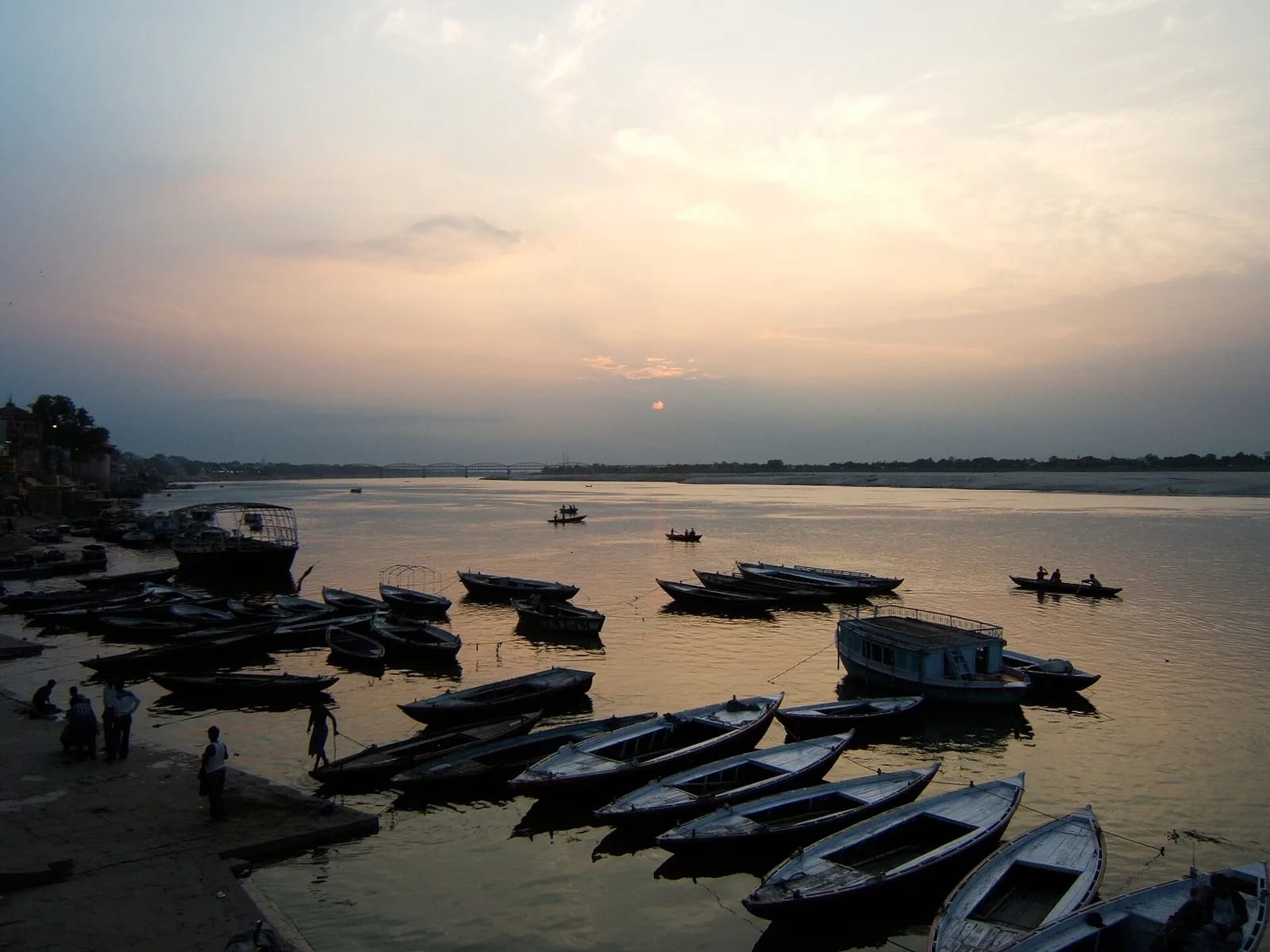
For all that grandeur, the darshan itself remains intimate: the moment before the Jyotirlinga, the offering of water and bilva leaves, the whispered prayer. We arrange that moment to fall, where we can, at a calmer hour, so it is not swallowed by the crowd - an early morning darshan after the sunrise boat ride, when the Dham is quieter and the heart is open.
The water offering is the heart of the rite. A devotee brings Ganga water and bilva leaves to pour over the Jyotirlinga, and in that simple act - the coolness of the river meeting the pillar of light - the whole meaning of Kashi is concentrated: Shiva and the Ganga, the Lord and the river, received together in a single gesture. We make sure you carry what the offering needs and know how it is made, so the moment is yours and not a fumble at the sanctum. Small as it sounds, that readiness is often what lets a pilgrim feel, at the Jyotirlinga, that they truly made the offering rather than merely passed through the queue.
And we surround it with the darshans that complete a Kashi pilgrimage: Kaal Bhairav first, as tradition asks, then Vishwanath and Annapurna together, the Lord and the goddess of nourishment side by side, and Sankat Mochan Hanuman, founded by the poet-saint Tulsidas who wrote the Ramcharitmanas in this very city. Experience My India plans the whole sequence as the tradition intends. WhatsApp +91-7302265809. Har Har Mahadev.