Essential info at a glance
| Detail | At a glance |
|---|---|
| What it is | The Royal Gateway Temple, standing where the grand entrance to the palace of Ram and the Suryavanshi kings once rose. |
| Morning darshan | 5:00 AM to 12:00 PM. |
| Evening darshan | 4:00 PM to 9:00 PM. |
| Aartis | Morning around 7:00 to 7:30 AM, and evening around 7:00 to 7:30 PM. |
| Entry fee | Free for all devotees. There is no VIP darshan. |
| The building | A towering Nagara-style temple on an elevated platform, with a shikhara once made of pure gold. |
| The deities | The Ram Parivar, the family of Ram, in the central shrine. |
| Location | Kanak Bhawan Road, Tulsi Nagar, near Kanak Bhavan and Hanuman Garhi. |
Raj Dwar Mandir timings and aarti
The temple keeps a split day, open in the morning and again in the evening, and entry is free, with aartis morning and evening. It is a quieter, less-thronged temple than the great sites, cherished by lovers of history and architecture, so darshan is usually calm and unhurried, and the early morning and evening, around the aartis, are the loveliest times.
| Ritual or session | Timing | Notes |
|---|---|---|
| Morning darshan | 5:00 AM to 12:00 PM | The morning aarti is around 7:00 to 7:30 AM. |
| Evening darshan | 4:00 PM to 9:00 PM | The evening aarti is around 7:00 to 7:30 PM. |
| Entry fee | Free | No VIP or paid darshan. |
| Best times | Around the aartis, morning and evening | The calmest, most beautiful darshan. |
Raj Dwar: the royal gateway to Ram's palace
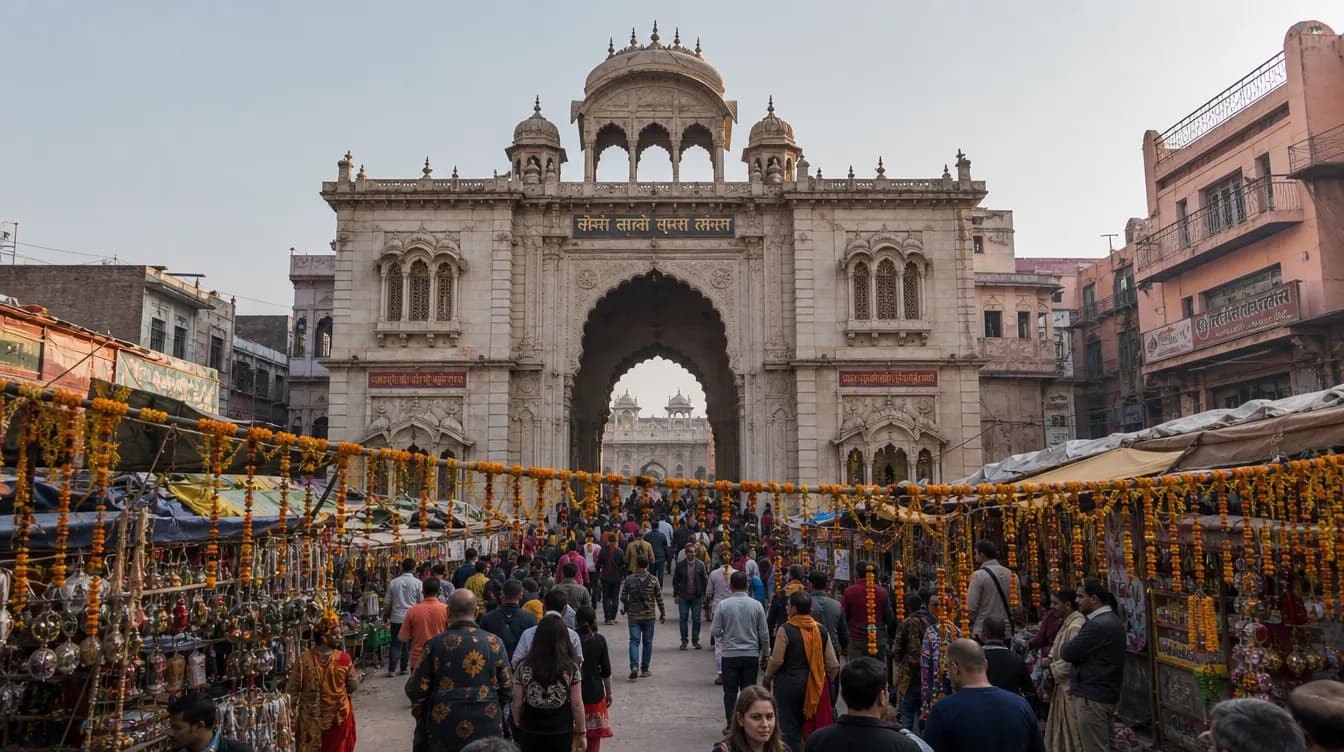
Its name tells its story: Raj Dwar means the royal gate, the doorway to the Raj, the kingdom; and this temple stands, tradition holds, at the very spot that was once the grand entrance to the great palace complex of the kings of Ayodhya, the Suryavanshi rulers of the Solar Dynasty into which Lord Ram was born. Picture it as it was: the elevated ground of Ramkot crowned with the palaces of the kings of Kosala, and here, at its threshold, the mighty Raj Dwar, the first landmark on the way in, the gate through which the subjects of the realm passed, queuing and waiting, to come at last before their king. And within, beyond this gate, lay the whole world of the royal house: the golden palace of Sita, Dashrath's palace, and, at the edge, the birthplace of Ram himself. This temple, then, marks the threshold of Ram's own home, the royal gate to the palace of the Lord.
There is a poignant tradition, too, that adds to its power: it is said that Lord Ram passed through this very gate as he left Ayodhya for his fourteen years of exile, with Lakshman and Sita at his side. To stand at the Raj Dwar is thus to stand where the whole great drama of the Ramayana passed in and out of the palace, the coming and the going of the Lord.
The towering temple and the golden shikhara
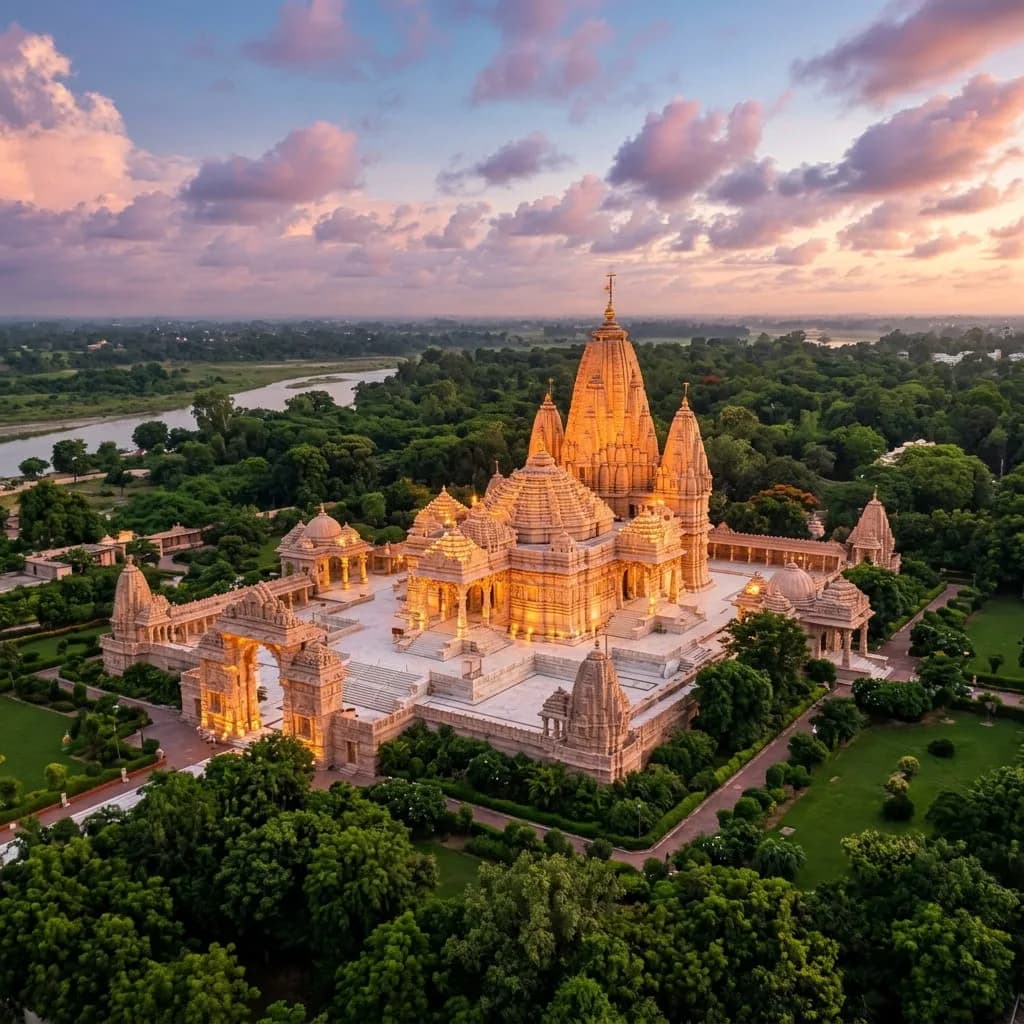
The temple that marks the royal gate is itself a wonder, and one of the most striking buildings in Ayodhya. Raised on a high, elevated platform, it soars upward in the classical Nagara style, storey upon storey, its central dome and tapering shikhara rising so high that the temple can be seen from far off across the city, like an ancient skyscraper of stone; and from its platform there opens a fine panoramic view over the rooftops of Ayodhya. Its splendid carved pillars and great doorways have stood the test of many centuries, testaments to the architectural genius of old, and its circular central shrine houses the beautiful idols of the Ram Parivar, the whole family of Ram. Most remarkable of all, the great shikhara was once crowned with a pinnacle of pure gold, which shone above the city; after independence, the gold was replaced, but the memory of that golden crown still glorifies the temple. For anyone who loves fine architecture, Raj Dwar Mandir is a genuine, if underrated, treasure.
Restored by Raja Man Singh
The present temple is old, its structure reckoned to be some nine hundred years in age, and it was rebuilt and restored, tradition tells, by Raja Man Singh, a king of Ayodhya, whose family has cared for and managed the temple ever since, down to a further restoration within living memory. So the royal gate of the ancient kings has been kept, through the long centuries, by later kings and their descendants, an unbroken thread of royal devotion at the threshold of Ram's palace.
The gate to the palace precinct: the core of Ayodhya
The loveliest way to understand Raj Dwar Mandir is as a threshold, a gateway, and to let it open the whole heart of Ayodhya to you. For beyond this royal gate lies the palace precinct of Ram, the core cluster of the holiest sites, all within a few minutes' walk. Passing through, as the subjects of Kosala once did, you come to Kanak Bhavan, the golden palace that was Sita's own home; to Dashrath Mahal, the palace of King Dashrath and Ram's childhood home; and, at the edge of Ramkot, to the Ram Janmabhoomi itself, the birthplace of the Lord, with Hanuman Garhi keeping watch above. To begin here, at the Raj Dwar, and to walk in through the royal gate to the palace world within, is a beautiful and meaningful way to enter the sacred core of Ayodhya.
The threshold of the Lord's home, in my own words
By Rajeev Sharma, guide with Experience My India
Raj Dwar Mandir is a place I love to use as a doorway, quite literally, for my guests. I bring them here first, to this towering temple most visitors have never heard of, and I tell them: this is the Raj Dwar, the royal gate, and here stood the grand entrance to the palace of Ram and his forefathers, the kings of the Sun. I ask them to imagine the old people of Kosala queuing here to meet their king; and I tell them the tender thing, that Ram himself is said to have gone out through this gate when he left for his exile. People look at the temple quite differently after that.
Then I say: now let us go in through the royal gate, as the subjects did, into the palace of Ram. And we walk on to Kanak Bhavan, Sita's golden palace, and Dashrath Mahal, and the Ram Janmabhoomi, the whole royal precinct, and it all makes sense as one place, the palace-world of Ram, entered through this gate. I always show them the great shikhara, and tell them it was once solid gold, shining over the city. It is a hidden gem, quiet and grand, and beginning the core of Ayodhya here, at its own royal gate, gives my guests a feeling for the city that they never forget.
In more than forty years of guiding, this is the gate through which I most love to lead pilgrims into the heart of Ayodhya.
Darshan and offerings
- Darshan is free and by a regular queue; there is no VIP or paid line.
- Take darshan of the Ram Parivar, the family of Ram, in the central shrine.
- Admire the towering Nagara architecture, the carved pillars and the once-golden shikhara.
- Enjoy the panoramic view of Ayodhya from the elevated platform.
- Remove footwear before the sanctum, and use the temple as your gateway into the core cluster.
How to reach Raj Dwar Mandir
The temple is on Kanak Bhawan Road, in Tulsi Nagar, at the heart of old Ayodhya, close to Kanak Bhavan and Hanuman Garhi, in the core Ramkot cluster. You reach it on foot or by e-rickshaw through the lanes.
| From | Distance | Notes |
|---|---|---|
| Kanak Bhavan | A few minutes' walk | The golden palace within the royal gate; do them together. |
| Hanuman Garhi | Close by | The guardian temple, in the core cluster. |
| Ram Janmabhoomi Mandir | A short walk | At the edge of the palace precinct of Ramkot. |
| Ayodhya Dham Junction (railway) | About 2 km | By e-rickshaw, auto or taxi. |
| Maharishi Valmiki Airport, Ayodhya | About 10 km | The new airport; taxis and autos to the old city. |
It is the natural gateway to the core cluster; begin here and walk in to the palace world of Ram.
Best time to visit and how to plan it
| When | Why |
|---|---|
| Around the aartis, morning or evening | The calmest and most beautiful darshan. |
| Ram Navami, Navratri, Diwali and Holi | The temple's festivals, and its lively annual fair. |
| As the gateway to the core cluster | Begin here and walk in to Kanak Bhavan, Dashrath Mahal and the Ram Mandir. |
| For the view and the architecture | The elevated platform and towering shikhara, a treat for lovers of history. |
- Begin your core-Ayodhya darshan here, then walk in to the palace precinct.
- Allow 20 to 30 minutes for the temple, the view and the architecture.
For Ayodhya, or a combined Kashi and Ayodhya pilgrimage, planned end to end, see our tour packages.
Accessibility for elderly and mobility limited visitors
- The temple stands on an elevated platform with steps up; take them slowly, or view the temple from below.
- It is at lane level to reach, in the core cluster, easier than a hilltop temple.
- It is usually quiet and uncrowded, which suits a gentle, restful darshan.
- We plan the order of the core temples so an elderly pilgrim is comfortable.
Our guided darshan and Ayodhya tours
We are a Varanasi and Ayodhya based operator, a unit of Experience My India, with more than forty years of guiding pilgrims across Kashi, Ayodhya, and Prayagraj, and we have our own local guide and pandit in Ayodhya. Entry and darshan are free, so what we arrange is the visit around it: a guide who tells the story of the royal gate and leads you, as the old subjects were led, in through the Raj Dwar to the palace precinct, Kanak Bhavan, Dashrath Mahal and the Ram Mandir, with a puja by a pandit if you wish.
| Service | Includes | Price |
|---|---|---|
| Guided core Ayodhya darshan | Raj Dwar Mandir as the gateway, then Kanak Bhavan, Dashrath Mahal and the Ram Mandir, with a guide. | Contact us for pricing |
| Puja at Raj Dwar Mandir | A puja before the Ram Parivar with a pandit, and the prasad. | Contact us for pricing |
| Full Ayodhya darshan day | Raj Dwar Mandir within a wider Ayodhya pilgrimage, with a guide. | Contact us for pricing |
| Kashi and Ayodhya pilgrimage | Varanasi and Ayodhya combined, with darshan, transfers and a guide. | Contact us for pricing |
Inclusions and exclusions are stated up front, with any taxes and conditions, and no charge appears later that was not named. Darshan is free; our charge is only for guiding and services. See all our tour packages for the full range.
Experience My India is a travel operator, not the temple administration. Darshan is free; our charge is only for our guiding and services. Temple timings and rules are set by the temple and can change.
Nearby sacred sites in Ayodhya
Raj Dwar Mandir is the gateway to the core cluster of Ayodhya's palace precinct.
| Site | What it is | Internal link |
|---|---|---|
| Kanak Bhavan | The Golden Palace of Ram and Sita, within the royal gate. | /temple/ayodhya/kanak-bhavan |
| Dashrath Mahal | The palace of King Dashrath, Ram's childhood home, in the precinct. | /temple/ayodhya/dashrath-mahal |
| Hanuman Garhi | The guardian temple of Hanuman, close by. | /temple/ayodhya/hanuman-garhi |
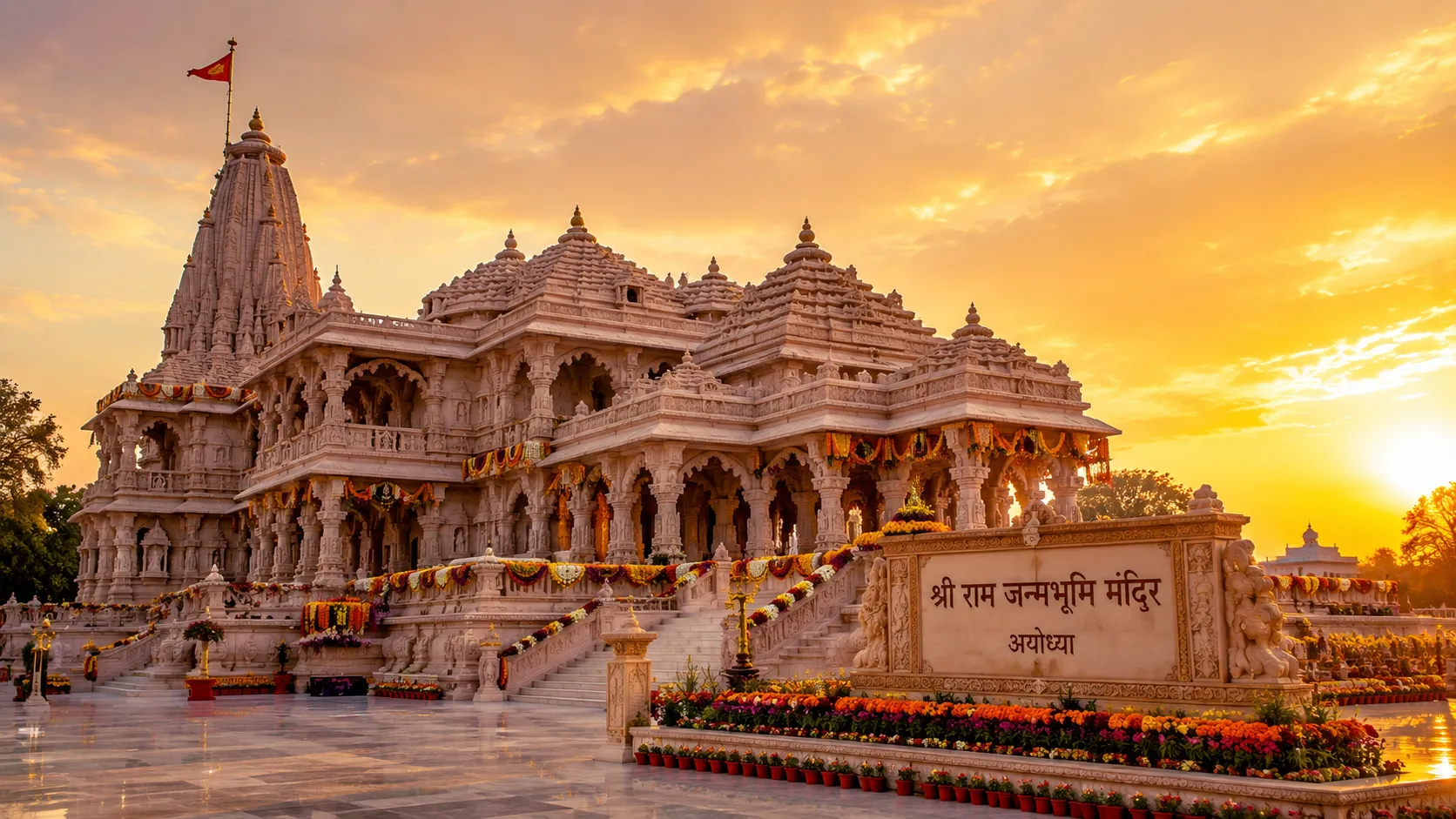
| Shri Ram Janmabhoomi Mandir | The birthplace of Ram, at the edge of the palace precinct. | /temple/ayodhya/ram-janmabhoomi-mandir |
| Surajkund | The Sun pond of Ram's Suryavanshi line, whose kings' palace this gated. | /temple/ayodhya/surajkund |
For the Ram Mandir darshan and its free Sugam booking, see our Ram Janmabhoomi Mandir guide.