Essential info at a glance
| Detail | At a glance |
|---|---|
| What it is | The Golden Palace, Sone ka Ghar, the temple-palace of Lord Ram and Goddess Sita, one of the most beautiful temples of Ayodhya. |
| Morning session | 8:00 AM to 12:00 PM, with the morning aarti around 8:00 to 8:30 AM. |
| Evening session | 4:30 PM to 9:30 PM, with the evening aarti around 6:00 to 7:00 PM. |
| Afternoon rest | Closed from 12:00 PM to 4:30 PM for the deity's rest. |
| Entry fee | Completely free for all devotees. There is no VIP or paid darshan. |
| The legend | Gifted to Sita by Queen Kaikeyi after her marriage to Ram, as the couple's own palace. |
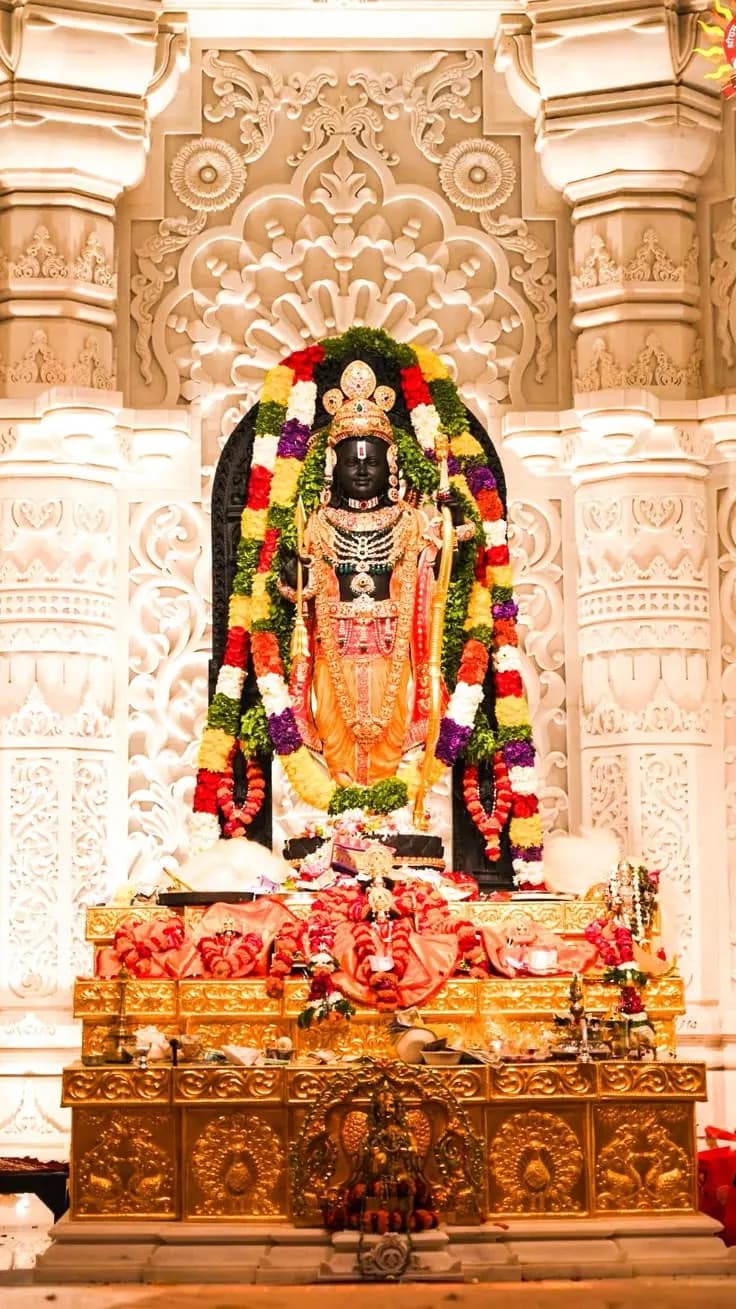
| The idols | Three pairs of Ram and Sita idols, crowned and adorned in gold, hence the golden palace. |
| Location | Tulsi Nagar, Ramkot, about 300 to 400 m from the Ram Janmabhoomi Mandir and Hanuman Garhi. |
Kanak Bhavan timings and aarti
The temple keeps a split day, open in the morning and again in the evening, closing through the afternoon for the deity's rest, and entry is free. It is a serene, beautiful place, and its aartis, when the golden idols shine, are its loveliest moments. The general queues move smoothly, and coming early or at a non-peak hour makes for the calmest darshan.
| Session or ritual | Timing | Notes |
|---|---|---|
| Morning session | 8:00 AM to 12:00 PM | May open at 8:00 or 9:00 AM by season; closes by noon. |
| Morning aarti | About 8:00 to 8:30 AM | The gold idols radiant in the morning worship. |
| Afternoon rest | 12:00 PM to 4:30 PM | The temple is closed for the deity's rest. |
| Evening session | 4:30 PM to 9:30 PM | The public evening window. |
| Evening aarti | About 6:00 to 7:00 PM | Around sunset; sometimes to 7:30 PM by season. |
*Entry is free and there is no VIP darshan.
Kanak Bhavan: the Golden Palace of Ram and Sita
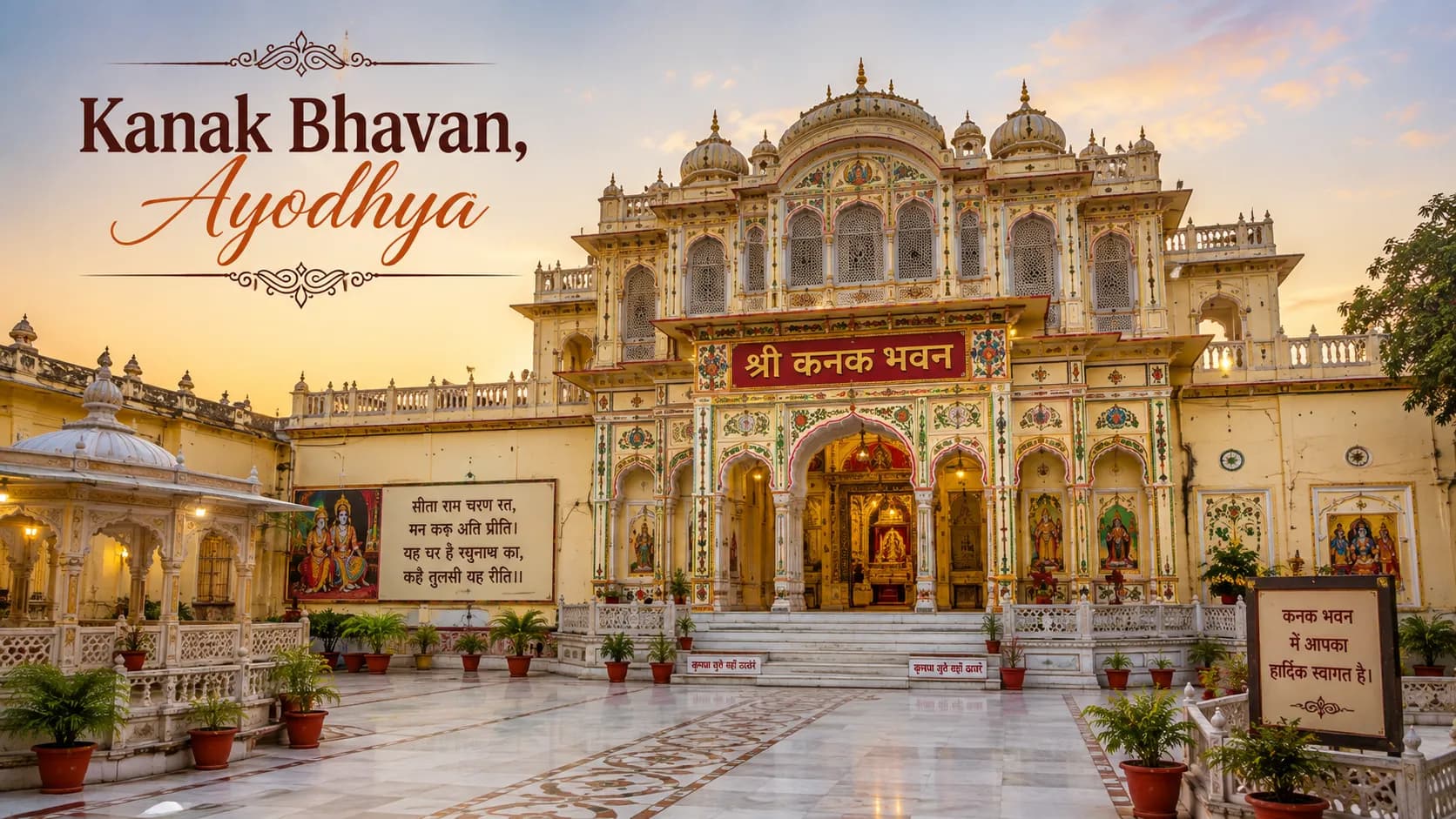
Of all the temples of Ayodhya, Kanak Bhavan holds a special tenderness, for it is the palace of the divine couple, of Lord Ram and his beloved Sita, together as husband and wife. Its name means the Golden House, and it is fondly called Sone ka Ghar, the House of Gold, because the idols of Ram and Sita within are crowned and adorned in gold, so that when the lamps of the aarti are lit, the deities shine and glow with a soft, radiant light that fills the whole hall. Where the Ram Mandir shows us Ram as the child, and other temples show him as the king or the warrior, Kanak Bhavan gives us something more intimate and human: Ram and Sita at home, in their own palace, in the happiness of their married life.
It is one of the most beautiful and beloved temples in the whole of Ayodhya, and one of the most peaceful. Devotees come not only for darshan but to sit awhile in its calm, ornate courtyard, amid the soft, continuous chanting of hymns, and simply to feel the presence of the loving couple. There is a sweetness here, a devotion of the heart, that many pilgrims say they find nowhere else in the city.
The legend: Kaikeyi's golden gift to Sita
The story of Kanak Bhavan is one of the loveliest in all the lore of Ayodhya, and it turns on a moment of pure love. When Lord Ram married Sita and brought her home to Ayodhya, his stepmother, Queen Kaikeyi, welcomed the new bride with a gift beyond price. As a Munh Dikhai, the traditional gift given on first beholding the face of a new daughter-in-law, Kaikeyi is said to have removed her own jewellery and given Sita this beautiful golden palace, adorned with love and joy, to be her own. And so Kanak Bhavan became the private palace of Ram and Sita, their home, the place of their life together as a married couple.
The temple is ancient, held to date in some form to the very age of Ram, and tradition tells that it was cherished and rebuilt across the ages, by Ram's own son Kush, and by later kings and sages, damaged and restored again and again through the long centuries. The present, beautiful structure is the fruit of that unbroken love, raised in 1891 by the royal house of Orchha and Tikamgarh in Bundelkhand, Maharaja Mahendra Pratap Singh and, above all, his queen Vrishabhanu Kunwari, who is remembered as its devoted patron. So this temple, gifted by one queen to Sita in the age of legend, was given its present glory by another queen many centuries later, a lovely continuity of women's devotion to the Mother Sita.
The architecture and the three golden idols
Kanak Bhavan is a palace as much as a temple, and it looks it. Built in the Bundela style of Bundelkhand, with the flavours of Rajput and Awadhi and Mughal architecture blended in, it is a graceful, ornate building set around a large open courtyard, its central hall reached through fine arched doorways, its walls and ceilings richly worked and carved, some with scenes from the Ramayana. It is a visual delight, and stepping into its courtyard, away from the bustle of the lanes, feels like entering another, gentler world.
At the heart of it, in the Garbhagriha, the sanctum, are enshrined the deities: three pairs of idols of Ram and Sita, of different eras and sizes, each crowned and adorned with intricate gold ornaments. In the tender tradition of this being Sita's own palace, she stands here to the left of Ram, as the lady of the house. To behold these golden idols, and to watch them light up as the aarti lamps are waved before them, is the heart of a Kanak Bhavan darshan, and it is a sight of great beauty and devotion.
A temple of divine love
What sets Kanak Bhavan apart, and what draws so many devotees back to it again and again, is the particular quality of its devotion. This is the temple of Ram and Sita as a couple, and so it is a place of divine love, of the sweetness and grace of their union, and the mood here is one of gentle, joyful, tender bhakti. It is a place to slow down, to sit in the courtyard, to sing or listen to the kirtan, and simply to be in the loving presence of the divine pair.
The temple is at its most glorious at Vivah Panchami, the anniversary of the marriage of Ram and Sita, which is celebrated here with special splendour, fittingly, for this is the couple's own palace; the whole temple is decked as for a wedding, and the joy is immense. The Jhula festivals, when the deities are placed on beautifully decorated swings, and the great days of Ram Navami, are also cherished here. If you can time your visit to one of these, you will see Kanak Bhavan at its most radiant.
The gentlest darshan in Ayodhya, in my own words
By Rajeev Sharma, guide with Experience My India
After the intensity of the Ram Mandir and the joyful crowds of Hanuman Garhi, I love to bring my guests to Kanak Bhavan, because it has a softness, a tenderness, that the others do not. I tell them the beautiful story first, how Kaikeyi took off her own jewels and gave Sita this golden palace as a welcome gift, so that this is not a temple of Ram the king or Ram the child, but of Ram and Sita at home together, husband and wife. People are so moved by that, especially couples and families. And then we go in, and there are the golden idols, and when the aarti begins and they light up, you hear people sigh.
I always tell my guests to not rush here, but to sit for a while in the lovely old courtyard and just be, because Kanak Bhavan is a place to feel, not to hurry through. It is only three or four minutes' walk from the Ram Mandir and Hanuman Garhi, so I fit all three into one beautiful morning, Hanuman first, then Ram, then this gentle golden palace to close. If they come at Vivah Panchami, when the whole temple is dressed as for a wedding, it is one of the loveliest things in all of Ayodhya. This is the temple people fall quietly in love with.
In more than forty years of guiding, this is the darshan that most often brings a soft smile rather than tears.
; photography may be restricted in the sanctum.]*
Darshan and offerings
- Darshan is free and by a smooth general queue; there is no VIP or paid line.
- Remove footwear before entry, dress modestly, and keep a gentle, reverent quiet in the sanctum.
- Traditional offerings include peda, tulsi leaves, sandalwood and perfume; a little cash is useful for offerings.
- Photography may be restricted in the sanctum; follow the temple staff's guidance.
- Come for an aarti if you can, when the golden idols are at their most radiant.
How to reach Kanak Bhavan
The temple is in Tulsi Nagar, Ramkot, in the heart of old Ayodhya, only about 300 to 400 metres from both the Ram Janmabhoomi Mandir and Hanuman Garhi, so all three are easily and beautifully done together. You reach it on foot or by e-rickshaw through the lanes.
| From | Distance | Notes |
|---|---|---|
| Ram Janmabhoomi Mandir and Hanuman Garhi | About 300 to 400 m | A few minutes' walk; do all three together. |
| Ayodhya Dham Junction (railway) | About 8 km | By e-rickshaw, auto or taxi. |
| Maharishi Valmiki Airport, Ayodhya | About 10 km | The new airport; taxis and autos to the old city. |
| Lucknow | About 150 km | The larger airport, with more flights. |
Because it sits with the Ram Mandir and Hanuman Garhi in one small area, a guided visit lets you do the whole core of Ayodhya in a single, well-ordered morning.
Best time to visit and how to plan it
| When | Why |
|---|---|
| Morning or evening, for the aarti | The golden idols radiant in the lamplight, the temple at its most beautiful. |
| Vivah Panchami (the Ram-Sita marriage anniversary) | The temple decked as for a wedding; fitting, and glorious, at the couple's own palace. |
| Ram Navami and the Jhula festivals | Great, joyful celebrations of Ram and of the divine couple. |
| Early or non-peak hours | The calmest, most contemplative darshan. |
- Pair it with the Ram Janmabhoomi Mandir and Hanuman Garhi in one morning, all within a few minutes' walk.
- Allow 30 to 45 minutes; longer to sit in the courtyard and enjoy the calm.
For Ayodhya, or a combined Kashi and Ayodhya pilgrimage, planned end to end, see our tour packages.
Accessibility for elderly and mobility limited visitors
- The temple is at lane level with a large courtyard, easier than a hilltop temple, though there are some steps.
- It is calm and unhurried, which suits a gentle, seated visit; the courtyard has room to rest.
- Come early or at a non-peak hour for the easiest darshan.
- We plan the visit and the order so an elderly pilgrim is comfortable across the core Ayodhya temples.
Nearby sacred sites in Ayodhya
Kanak Bhavan sits at the heart of the old city, with the great sites of Ayodhya all around.
| Site | What it is | Internal link |
|---|---|---|
| Shri Ram Janmabhoomi Mandir | The grand temple of Lord Ram, a few minutes' walk away. | /temple/ayodhya/ram-janmabhoomi-mandir |
| Hanuman Garhi | The guardian temple of Hanuman, visited first, close by. | /temple/ayodhya/hanuman-garhi |
| Saryu Ghats and the aarti | The sacred river of Ayodhya, with its evening aarti at Ram ki Paidi. | /temple/ayodhya/saryu-ghat-aarti |
| Dashrath Mahal | The palace of King Dashrath, Ram's father. | /temple/ayodhya/dashrath-mahal |
| Nageshwarnath Temple | The ancient Shiva temple said to be founded by Ram's son Kush. | /temple/ayodhya/nageshwarnath-temple |
For the Ram Mandir darshan and its free Sugam booking, see our Ram Janmabhoomi Mandir guide.
Our guided darshan and Ayodhya tours
We are a Varanasi and Ayodhya based operator, a unit of Experience My India, with more than forty years of guiding pilgrims across Kashi, Ayodhya, and Prayagraj, and we have our own local guide and pandit in Ayodhya. Entry and darshan at Kanak Bhavan are free, so what we arrange is the visit around it: a guide who tells the beautiful story of the golden palace, a well-ordered darshan of the core of Ayodhya, the Ram Mandir, Hanuman Garhi and Kanak Bhavan together, and a proper puja with a pandit if you wish.
| Service | Includes | Price |
|---|---|---|
| Guided core Ayodhya darshan | Hanuman Garhi, the Ram Mandir and Kanak Bhavan in one morning, with a guide. | Contact us for pricing |
| Puja at Kanak Bhavan | A puja before Ram and Sita with a pandit, and the prasad. | Contact us for pricing |
| Full Ayodhya darshan day | Kanak Bhavan with the Ram Mandir, Hanuman Garhi and the wider Ayodhya sites. | Contact us for pricing |
| Kashi and Ayodhya pilgrimage | Varanasi and Ayodhya combined, with darshan, transfers and a guide. | Contact us for pricing |
Inclusions and exclusions are stated up front, with any taxes and conditions, and no charge appears later that was not named. Darshan itself is free; our charge is only for guiding and services. See all our tour packages for the full range.
Experience My India is a travel operator, not the temple administration. Darshan is free; our charge is only for our guiding and services. Temple timings and rules are set by the temple and can change.