Essential info at a glance
| Detail | At a glance |
|---|---|
| What it is | The grand temple at the birthplace of Lord Ram in Ayodhya, consecrated on 22 January 2024, home of the deity Ram Lalla. |
| Managed by | The Shri Ram Janmabhoomi Teerth Kshetra Trust. |
| Entry fee | Completely free. All darshan, and all Sugam darshan and aarti passes, are free of charge. |
| General darshan | 7:00 AM to 11:30 AM and 2:00 PM to 7:00 PM, open to all; the temple closes 12:00 to 2:00 PM. |
| Aartis | Mangala (4:30 AM), Shringar (6:30 AM), Sandhya (7:30 PM) and Shayan (9:30 PM), by advance pass. |
| Sugam darshan | A free, time-slotted priority darshan, booked in advance on the official portal; there are no commercial agents. |
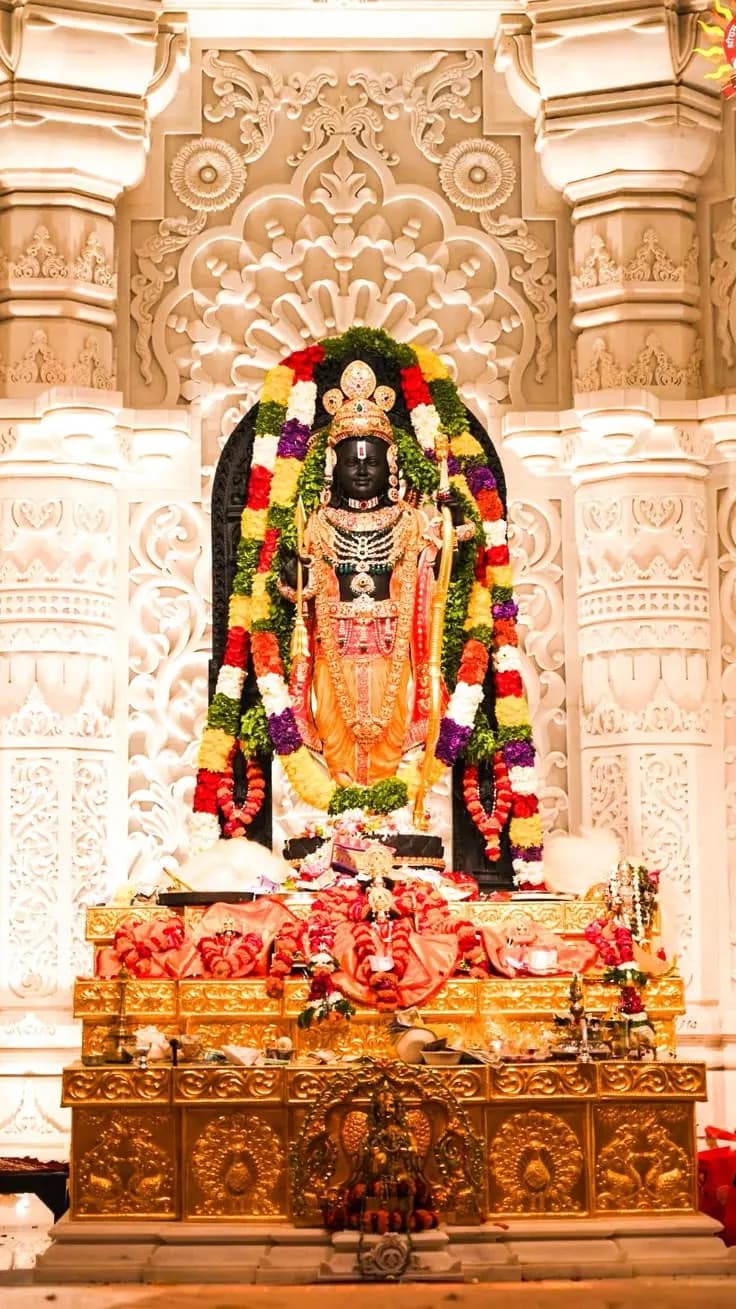
| The deity | The 51-inch idol of Ram Lalla, the child form of Lord Ram, in the sanctum; the Ram Darbar on the first floor. |
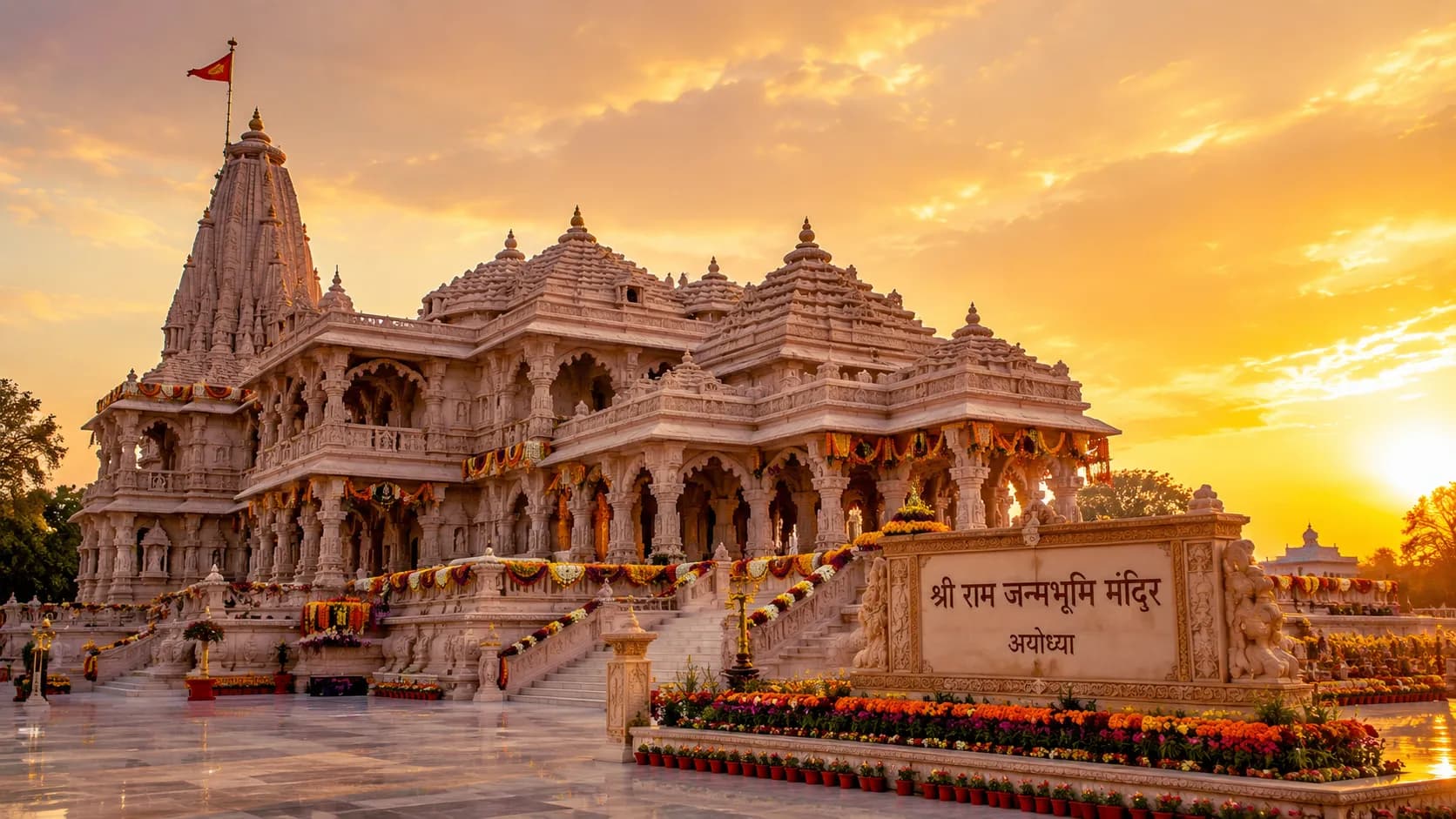
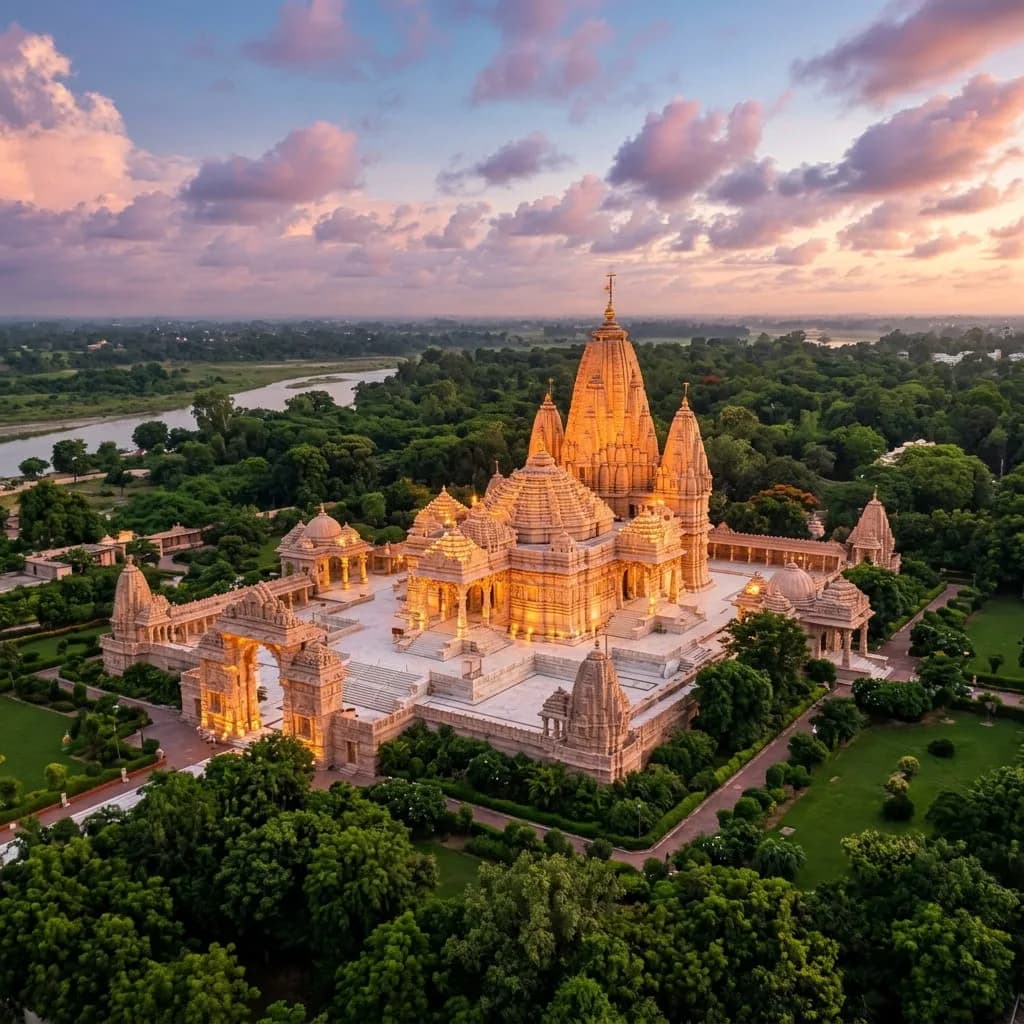
| Campus | A 70-acre complex in the Nagara style, built of pink sandstone without iron or steel, to last over a thousand years. |
Darshan and aarti timings
The temple keeps a full daily schedule of darshan and aartis. The general darshan, in the morning and the evening, is open to everyone and free; you simply join the queue. The aartis, and the priority Sugam darshan, require a free advance pass booked online. Below is the complete schedule.
| Event or session | Timing | Access |
|---|---|---|
| Mangala aarti | 4:30 AM | By free advance pass only. |
| Shringar aarti | 6:30 AM | By free advance pass only. |
| Morning general darshan | 7:00 AM to 11:30 AM | Open to all; entry via the Singh Dwar, up 32 steps. |
| Bhog aarti and midday closure | 12:00 PM to 2:00 PM | The temple is closed for the deity's rest. |
| Evening general darshan | 2:00 PM to 7:00 PM | Open to all devotees. |
| Sandhya aarti | 7:30 PM | By free advance pass only. |
| Shayan aarti | 9:30 PM | The night ritual before the temple closes; by free advance pass. |
The Shri Ram Janmabhoomi Mandir: the temple of Lord Ram's birthplace
Ayodhya is, for millions of Hindus across the world, the most cherished of cities, for it is revered as the birthplace of Lord Ram, the seventh avatar of Vishnu, the ideal king and the beloved hero of the Ramayana. And at the very heart of Ayodhya stands the Shri Ram Janmabhoomi Mandir, the grand temple raised at the spot devotees hold to be the Ram Janmabhoomi, the place of Ram's birth. On 22 January 2024, the temple's presiding deity, Ram Lalla, the infant Ram, was consecrated in the sacred rite of Pran Pratishtha, a moment of deep emotion and joy for devotees the world over, the fulfilment of an aspiration held in the hearts of the faithful for generations.
Today the temple is a living, thronged place of worship, drawing pilgrims in their millions from every corner of India and beyond, and it has transformed Ayodhya into one of the foremost pilgrimage destinations on earth. The temple is built, cared for and administered by the Shri Ram Janmabhoomi Teerth Kshetra Trust, which oversees the darshan, the rituals and the great campus. To stand in its courtyard and take darshan of Ram Lalla is, for a devotee, one of the most moving experiences a lifetime can hold, and even for the traveller who comes as a visitor, the scale, the beauty and the sheer devotion of the place are unforgettable.
A marvel built to last a thousand years
The Ram Janmabhoomi Mandir is not only a holy place but an extraordinary feat of traditional architecture. It is built in the classical Nagara style of North India, the same grand temple tradition of soaring, curvilinear towers, and it was designed by the renowned Sompura family of temple architects, who have shaped many of India's great modern temples. Most remarkably of all, the temples has been built entirely without iron or steel, using time-tested stone-on-stone techniques, so that it is engineered to stand for more than a thousand years; its stability was rigorously tested by India's finest institutes before a stone was laid.
It is built of the beautiful pink Bansi Paharpur sandstone of Rajasthan, prized for its beauty and its strength, on foundations and plinths of granite, and its scale is majestic.
| Feature | Detail |
|---|---|
| Architectural style | Nagara, the classical North Indian temple style, with its towering shikhara. |
| Material | Pink Bansi Paharpur sandstone from Rajasthan; granite plinths; no iron or steel. |
| Length | About 380 feet. |
| Width | About 250 feet. |
| Height | About 161 feet, rising far above the old city. |
| Storeys | Three, each about 20 feet high. |
| Pillars | 392 intricately carved pillars, each bearing many sculpted deities. |
| Doors | 44 doors. |
| Longevity | Engineered, and independently tested, to last more than 1,000 years. |
The five Mandaps and the carved pillars
To walk through the temple is to pass through a sequence of five great halls, the Mandaps, each with its own purpose in the worship and the life of the temple, before you reach the sanctum. Together they carry the devotee, step by step, deeper into the presence of the deity.
| Mandap (hall) | Its purpose |
|---|---|
| Nritya Mandap | The hall of sacred dance, where dance is offered to the Lord. |
| Rang Mandap | The hall of assembly and colour, a grand gathering space. |
| Sabha Mandap | The audience or congregation hall. |
| Prarthana Mandap | The hall of prayer. |
| Kirtan Mandap | The hall of devotional singing, of kirtan and bhajan. |
The temple is entered from the east, up thirty-two steps and through the great Singh Dwar, the Lion Gate. Within, the 392 pillars and the walls are covered with the most exquisite carving, each pillar bearing many sculpted images of gods, goddesses and divine beings, so that the whole temple is a gallery of sacred art, and simply to walk among the pillars, gazing up at the carvings, is itself an act of devotion that stills and lifts the heart.
The idols: Ram Lalla and the Ram Darbar
At the very heart of the temple, in the Garbhagriha, the sanctum sanctorum on the ground floor, is enshrined the presiding deity: the beautiful 51-inch idol of Ram Lalla, Lord Ram in his childhood form, dark and serene and adorned, the very idol consecrated at the Pran Pratishtha in January 2024. This is the deity the pilgrim comes to behold, and the moment of that darshan, the first sight of Ram Lalla's face, is the emotional peak of the whole visit, a moment many devotees say they never forget.
On the first floor of the temple is the Shri Ram Darbar, the royal court of Ram, where Lord Ram is enshrined enthroned with his consort Sita, his devoted brother Lakshman, and his greatest devotee Hanuman, the beloved family of the Ramayana together in majesty. Between the child Ram of the sanctum and the enthroned Ram of the Darbar, the temple holds the whole arc of the story that Hindus love above all others.
The Surya Tilak: sunlight on the divine forehead
Among the temple's many wonders, one is so beautiful that it has captured the imagination of the whole country: the Surya Tilak. On Ram Navami, the day that celebrates the birth of Lord Ram, at exactly twelve o'clock noon, a beam of sunlight falls upon the forehead of the Ram Lalla idol, a shining tilak of pure sunlight anointing the divine child, as if the sun itself, from whom Ram's solar dynasty descends, comes to honour him on his birthday.
This is no accident but a marvel of engineering and devotion combined. A specially designed system of lenses and mirrors, worked out with great precision by Indian scientists, captures the sunlight high on the temple and channels it down, through the storeys, to strike the forehead of the deity at the exact moment of noon on Ram Navami. Science and faith meet in a single, luminous instant, and it is one of the most moving and sought-after sights in all of Ayodhya. If you can visit at Ram Navami, this is a spectacle beyond compare, though the crowds are immense.
The 70-acre campus: the shrines, the wall and the green
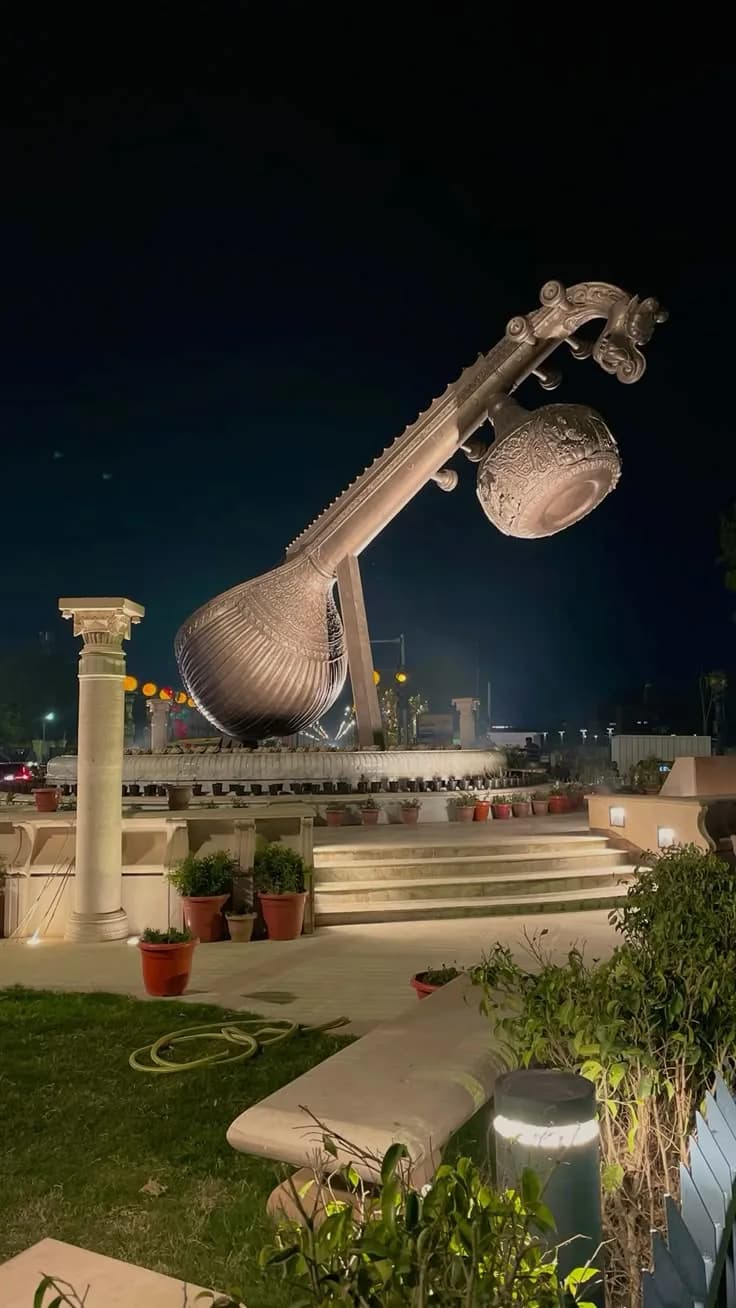
The main temple stands at the centre of a vast campus of some seventy acres, and there is far more to see than the great mandir alone. The whole complex is enclosed by the Parkota, a mighty rectangular rampart wall running for hundreds of metres around the temple, and within and around it are set many other shrines, so that the campus is a whole sacred landscape.
- At the four corners of the temple stand shrines to Surya (the Sun God), Devi Bhagwati, Ganesh and Shiva.
- In the northern arm is a temple of Maa Annapurna, and in the southern arm a temple of Hanuman.
- At Kuber Tila, in the south-west of the campus, stands an ancient Shiva temple, restored, with a statue of Jatayu, the noble vulture who died defending Sita.
- The ancient Sita Koop, a sacred well said to date from the age of the Ramayana, lies near the temple.
- Around the campus are shrines to the great sages and figures of Ram's story, among them Maharshi Valmiki, Vasishtha, Vishwamitra and Agastya, and the devotees Nishad Raj and Mata Shabri, honouring all who loved and helped the Lord.
And in keeping with a deep respect for nature, a great part of the seventy-acre campus, some seventy per cent of it, has been left green, planted with trees and gardens, so that the temple sits within a calm, living landscape rather than bare stone. Allow time, then, not just for the darshan but to walk the campus and its shrines, and to feel the whole sacred world that has been created here.
How the darshan works
For most pilgrims, the visit centres on the general darshan, and it is beautifully simple. During the morning window, from 7:00 to 11:30 AM, and the evening window, from 2:00 to 7:00 PM, anyone may come, join the queue, and take darshan of Ram Lalla, entirely free. You enter, after security, up the thirty-two steps and through the Singh Dwar, pass through the great halls, and come at last before the sanctum and the deity. The queues can be very long, especially in the mornings, on weekends and on festival days, so patience, and an early arrival, help a great deal.
The aartis, the ceremonial worship at set times through the day, from the pre-dawn Mangala aarti to the night Shayan aarti, are a more intimate and powerful experience, but attending them requires a free advance pass, as places are limited. The Sugam darshan, described below, offers a smoother, time-slotted darshan, again by free advance pass. Whichever you choose, the darshan of Ram Lalla is the heart of it all.
Sugam darshan and aarti passes: the free booking guide
This is the most important practical thing to understand before you visit, so please read it carefully.
What people often call VIP darshan is officially the Sugam Darshan, a time-slotted, prioritised darshan that lets you take darshan more smoothly and with less waiting. There are also Aarti Passes for the four ticketed aartis. And here is the single most important fact of all:
Every pass, every slot and every entry is one hundred per cent free. The Shri Ram Janmabhoomi Teerth Kshetra Trust charges nothing whatsoever for darshan, Sugam darshan or aarti, and it authorises no commercial agents to sell passes. If anyone asks you to pay for a Ram Mandir darshan or aarti pass, it is not official, and you should refuse. This warning matters, because the fame of the temple has drawn touts and fake websites; the only official booking is free, on the trust's own portal.
| Detail | What to know |
|---|---|
| Cost | Free. Always. There is no charge for any pass, slot or darshan. |
| Official portal | online.srjbtkshetra.org, the trust's own booking site, and nowhere else. |
| Commercial agents | None are authorised. Beware anyone selling passes for a fee. |
| Booking window | Slots open about 10 to 15 days in advance. |
| Fastest to fill | The morning slots, around 7:00 to 9:00 AM, go first; book early. |
| Passes per booking | Up to 8 devotees per booking. |
To book online yourself, the steps are:
-
Open the official portal, online.srjbtkshetra.org, and log in with your mobile number and the OTP you receive.
-
From the dashboard, choose either Sugam Darshan or an Aarti Pass.
-
Pick your date and your preferred time slot.
-
Fill in the identity details for each devotee, up to eight per booking.
-
Download the QR-code pass to your phone; you will show it at entry.
On the day, Indian citizens must carry the original physical ID used in the booking, and the Aadhaar card is strongly preferred; NRIs and foreign nationals must carry a valid passport. Without the matching original ID, entry on a pass may be refused, so do not forget it.
Essential visitor logistics: what you can and cannot carry
Security at the temple is strict, for the protection of the millions who visit, and it is important to know the rules before you arrive, or you will lose time at the gate.
Prohibited items
The following are strictly not allowed inside the main security cordons, and this list is enforced firmly:
- Mobile phones, cameras, smartwatches and earphones, and all electronic devices.
- Keys, lighters and similar items.
- All leather items, including belts and wallets.
It is best to leave as much as possible at your hotel, and to carry only what you truly need and are permitted, so that you pass through security quickly and calmly.
Lockers and the Pilgrimage Facility Centre
For everything you cannot carry in, there is help: a large Pilgrimage Facility Centre, the PFC, provides free, secure lockers where you can safely deposit your phone, your electronics and your other belongings before you join the queue, and collect them afterwards. Use it, and enter the temple unburdened and at ease.
Accessibility
The temple has been thoughtfully built for everyone. There are ramps and lifts throughout, and free wheelchair assistance is available for elderly and differently-abled pilgrims, so that no one who longs to see Ram Lalla is turned away by steps or distance. If you or a family member needs assistance, it is provided with care; do ask, or let us arrange it in advance for you.
A darshan of a lifetime, in my own words
By Rajeev Sharma, guide with Experience My India
I have guided pilgrims across Kashi and Ayodhya for more than forty years, and I can tell you that nothing I have seen compares to the emotion on a devotee's face at the first darshan of Ram Lalla in this temple. People weep. Old men and women who thought they would never live to see this day stand before the child Ram and cannot speak. I always tell my guests to slow down, to not rush the moment, to simply look at that beautiful face and let it fill them. That, more than the great architecture, is what Ayodhya gives you.
But I also help them with the practical side, because the temple is vast and busy, and it can overwhelm the first-time visitor. I explain, above all, that everything here is free, the darshan, the Sugam pass, the aarti pass, all of it, and that they must never pay a tout, because the trust allows no agents. I book their free Sugam or aarti pass for them, so they do not struggle with the portal or miss the fast-filling slots, and I make sure they carry the right ID and leave their phones and belts and wallets in the free lockers, so they are not turned back at security. And I get them there early, before the great queues build. Handled well, it is the darshan of a lifetime; handled badly, it can be a long, hot, confusing day. My job is to make sure it is the former.
In more than forty years of guiding, this is the darshan I am now most often asked for, and the one that most moves the people I bring.
[Photos are official or exterior, as photography is not permitted within the temple's security cordons.]
How to reach Ayodhya and the temple
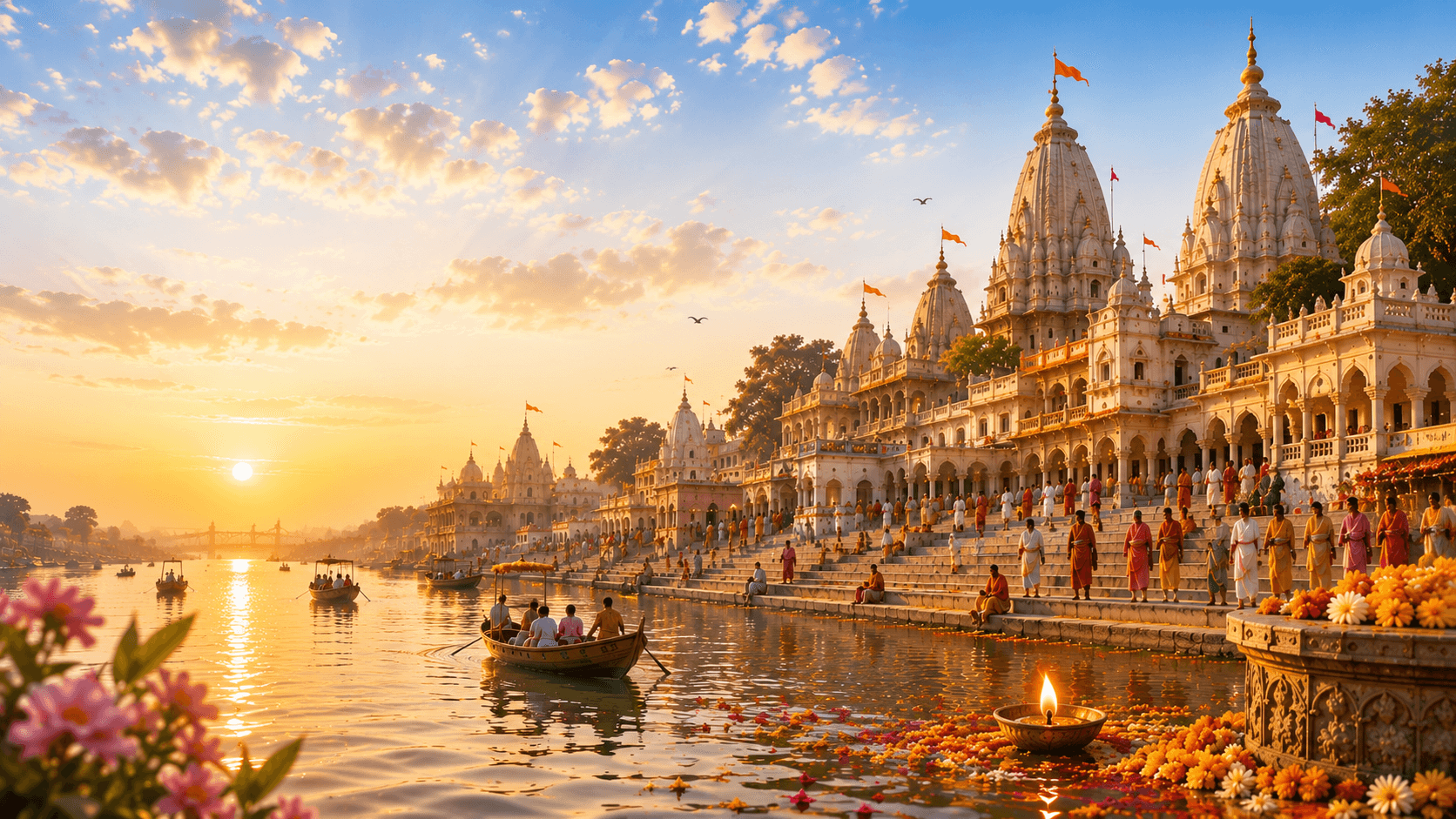
Ayodhya has been transformed for the pilgrim, with a fine new airport, a grand redeveloped railway station and good roads, so it is now easy to reach from across India. From Varanasi, the other great city of our tours, it is a journey of a few hours, which makes a combined Kashi and Ayodhya pilgrimage very natural.
| From | How | Notes |
|---|---|---|
| By air | Maharishi Valmiki International Airport, Ayodhya | The new airport, close to the city; flights from major Indian cities. |
| By train | Ayodhya Dham Junction | The grandly redeveloped station, well connected across India. |
| From Varanasi (Kashi) | About 200 km, roughly 4 to 5 hours by road | A natural combined pilgrimage; we arrange the transfer. |
| From Lucknow | About 135 km by road | The nearest large city, with its own airport. |
| From Prayagraj | About 165 km by road | For the wider Kashi, Ayodhya and Prayagraj circuit. |
Within Ayodhya, the temple is at the heart of the Ram Janmabhoomi complex, reached from the town by e-rickshaw, auto or car to the pilgrim drop points, and then on foot through the security and facility centre. We arrange the transport, the timing and a guide to make it smooth.
Best time to visit and how to plan it
| When | Why |
|---|---|
| Ram Navami (March or April) | The birth of Lord Ram and the Surya Tilak; the most sacred and spectacular time, but the most crowded of all. |
| Deepotsav and Diwali (October or November) | Ayodhya's festival of a million lamps on the Saryu; breathtaking, and very crowded. |
| Winter (October to March) | The most pleasant weather for a comfortable darshan. |
| Early morning, on a weekday | The calmest darshan, with shorter queues; book a Sugam pass for the smoothest visit. |
| Avoid the summer peak and festival crowds | If comfort matters, come off-peak; the heat and the crowds can be intense. |
- Allow at least half a day for the temple and the campus; a full day to include Hanuman Garhi, Kanak Bhavan and the Saryu ghats.
- Book your free Sugam darshan or aarti pass well ahead, especially for festivals and weekends.
For Ayodhya, or a combined Kashi and Ayodhya pilgrimage, planned end to end, see our tour packages.
Nearby sacred sites in Ayodhya
The Ram Janmabhoomi Mandir is the heart of Ayodhya, but the holy city holds many more treasured places, and a proper pilgrimage takes them in.
| Site | What it is | Internal link |
|---|---|---|
| Hanuman Garhi | The great hilltop temple of Hanuman, traditionally visited before Ram darshan. | /temple/ayodhya/hanuman-garhi |
| Kanak Bhavan | The golden palace temple of Ram and Sita, gifted by Kaikeyi. | /temple/ayodhya/kanak-bhavan |
| Saryu Ghats and the aarti | The sacred river of Ayodhya, with its evening aarti at Ram ki Paidi. | /temple/ayodhya/saryu-ghat-aarti |
| Dashrath Mahal | The palace of King Dashrath, Ram's father. | /temple/ayodhya/dashrath-mahal |
| Nageshwarnath Temple | The ancient Shiva temple said to be founded by Ram's son Kush. | /temple/ayodhya/nageshwarnath-temple |
Book your free Sugam darshan and plan your Ayodhya visit with us
We are a Varanasi and Ayodhya based operator, a unit of Experience My India, with more than forty years of guiding pilgrims across Kashi, Ayodhya, and Prayagraj. Here is exactly, and honestly, what we do and do not do.
We do NOT sell you a darshan or an aarti pass, because the passes are free, and no operator is authorised to sell them. What we do is take the hassle out of your visit: with your Aadhaar or passport details, we make your free Sugam darshan or aarti pass booking for you on the official portal, so you do not struggle with the website or lose out when the good slots fill, and we plan the whole visit, transport, timing, a knowledgeable guide, the right ID and the lockers, and, if you wish, an assisted or wheelchair-friendly darshan. You pay only for our guiding and travel service; you never pay us, or anyone, for the pass itself.
| Service | Includes | Price |
|---|---|---|
| Free Sugam darshan or aarti pass booking | We make your free official booking with your ID; the pass itself is free. | No charge for the pass; |
| Guided Ayodhya darshan day | A guide, transport, timing and the temple with the key Ayodhya sites. | Contact us for pricing |
| Kashi and Ayodhya pilgrimage | Varanasi and Ayodhya combined, with darshan, transfers and a guide. | Contact us for pricing |
| Assisted or wheelchair darshan | A comfortable, assisted visit for elderly or differently-abled pilgrims. | Contact us for pricing |
Inclusions and exclusions are stated up front, with any taxes and conditions, and no charge appears later that was not named. See all our tour packages for the full range.
Experience My India is a travel operator, not the temple administration. Darshan and all passes are free and are issued by the Shri Ram Janmabhoomi Teerth Kshetra Trust on its official portal; our charge, if any, is only for our guiding and travel service, never for a pass. Temple timings and rules are set by the trust and can change.