Essential info at a glance
| Detail | At a glance |
|---|---|
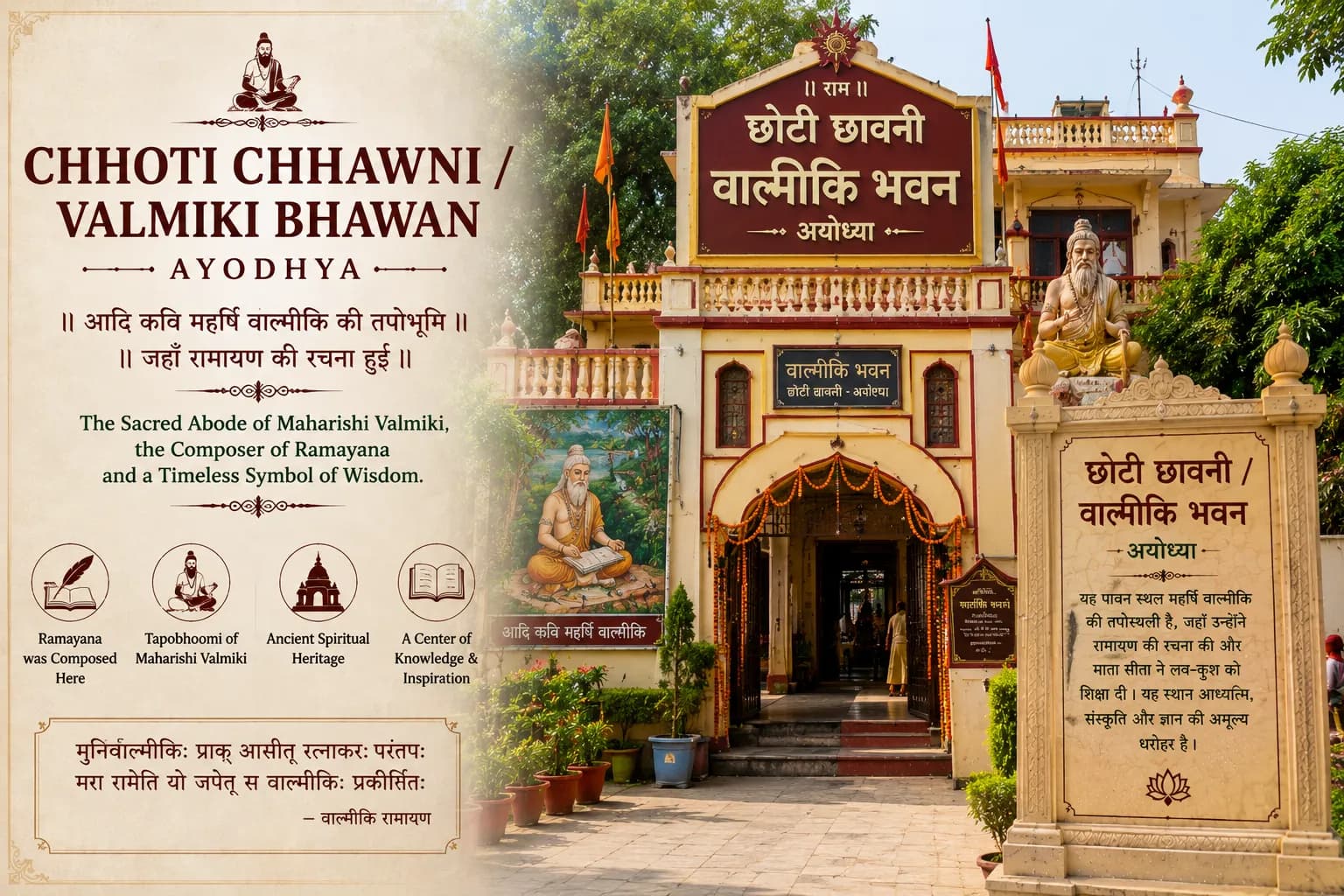
| What it is | A magnificent white marble complex and ashram, the Valmiki Bhawan, where the entire Valmiki Ramayana is engraved on the walls. |
| Opening hours | Generally 5:00 AM to 11:00 AM and 2:00 PM to 11:00 PM; darshan is widely accessible between 7:00 AM and 10:00 PM. |
| Entry fee | Completely free for all devotees and visitors. |
| The marvel | The 24,000 shlokas of the Ramayana, inscribed on white marble panels across the two floors of a grand, 30-foot-high hall. |
| The idols | Statues of Maharishi Valmiki with Luv and Kush, the sons of Ram, at one end of the hall. |
| Also here | A living ashram of saints, with a Ram Darbar temple, free meals, and the devotional Ram Naam Bank. |
| Atmosphere | Serene, beautiful and less crowded; a place for reflection. |
| Location | Chhoti Chhawni Road (Maniram Das Chhawni Road), Ayodhya. |
Chhoti Chhawni timings and entry
The complex is open through the day, and entry is free. It follows the daily prayer schedule of the ashram, with morning and evening worship, and darshan is generally accessible from the morning through to the evening. It is one of the more peaceful and uncrowded of Ayodhya's great sites, so any hour is calm; the soft morning and evening light on the white marble is especially lovely.
| Detail | When | Notes |
|---|---|---|
| Opening hours | About 5:00 to 11:00 AM and 2:00 to 11:00 PM | Darshan widely accessible between 7:00 AM and 10:00 PM. |
| Aarti and prayers | Morning and evening | Following the ashram's daily prayer schedule; exact public times vary. |
| Entry fee | Free | For all devotees and visitors; no VIP or pass needed. |
| Free meals | Daily | The ashram serves free meals to sadhus and guests. |
The whole Ramayana in marble
There are few sights in all of Ayodhya as quietly astonishing as the great hall of the Valmiki Bhawan. It is a magnificent chamber of white marble, some thirty feet high, and across the marble panels of its walls, over two floors, is inscribed the entire Valmiki Ramayana, all twenty-four thousand Sanskrit verses of the great epic, letter by letter, carved into stone. To stand in that gleaming hall and realise that the whole of the Ramayana, the timeless story of Ram, from his birth to his return, surrounds you on every side, written out in full in the eternal marble, is a genuinely moving experience, a feat of devotion and patience almost beyond imagining, the sacred word made solid and everlasting. At one end of the hall stand the idols of Luv and Kush, the twin sons of Lord Ram, together with their guru, Maharishi Valmiki, the very poet whose words fill the walls around them, so that the author and his epic and the princes who first sang it are all gathered in one radiant space.
The white marble Bhawan
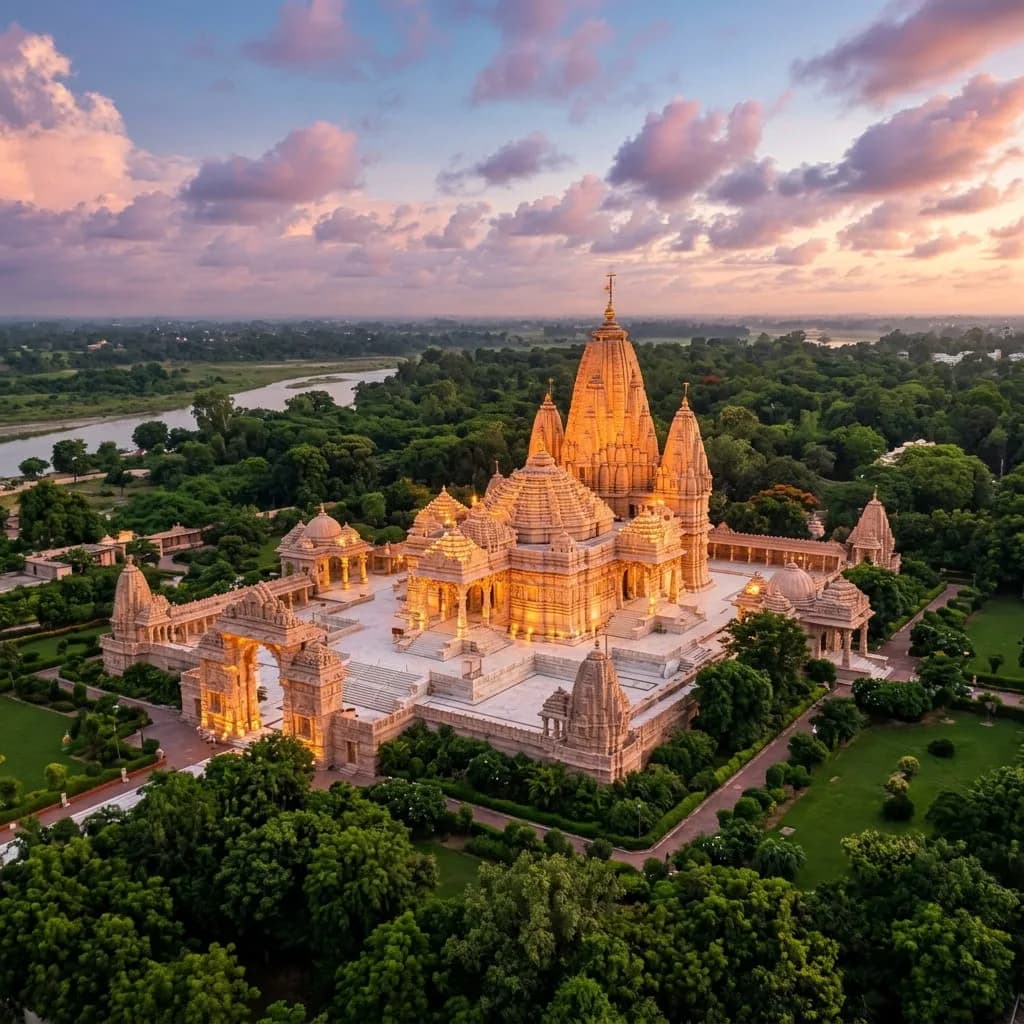
The Valmiki Bhawan itself is a work of great beauty. Crafted wholly of white marble, gleaming and serene, it is one of the loveliest modern structures in Ayodhya, a grand and graceful building that visitors describe simply as a sigh of sheer beauty. It stands within the Maniram Das Chhawni complex, which has two facing mansions, an older, traditional ashram building and, before it, this new marble marvel, so that the ancient and the modern face one another across the courtyard. After the crowds and intensity of the great temples, to step into the calm, cool, white brightness of the Valmiki Bhawan is a balm, and it is one of the most peaceful and contemplative places a pilgrim can find in the holy city.
Maharishi Valmiki, the first poet
The Bhawan is a temple to a poet, and that poet is Maharishi Valmiki, honoured as the Adi Kavi, the first poet, the author of the Ramayana itself, the epic that has shaped the heart and imagination of India for thousands of years. And Valmiki's bond with Ayodhya's story is deep and tender, for it was in his forest ashram that the goddess Sita took refuge in her sorrow, and there that she gave birth to and raised her twin sons, Luv and Kush; and it was Valmiki who composed the Ramayana and taught it to the two boys, who then sang it, the first ever telling of the tale, in the court of their own father, Lord Ram. To honour Valmiki here, in Ayodhya, and to surround his statue with his own imperishable words, is to honour the very source of the story that makes this city holy.
The Maniram Das Chhawni: an ashram of saints
The Valmiki Bhawan is part of the Sri Maniram Das Chhawni, one of the oldest and most important ashrams of Ayodhya. The word Chhawni means a camp or cantonment, a name that goes back to the encampments of the Ramanandi Vaishnav ascetics, and this Chhoti Chhawni, the smaller camp, is a great living seat of saints, thronged with sadhus at all hours, a place of deep devotion and service. Within it are temples of Ram and Sita and a beautiful Ram Darbar, and, remarkably, a Rangnath deity carved from a single block of black stone. The ashram is renowned for its generosity, serving free meals daily to its many sadhus and to guests, in the true spirit of a house of God.
A particularly lovely and unusual feature here is the Ram Naam Bank, a bank not of money but of the name of Ram. Devotees may take from it, and repay their devotion by writing the name of Ram, Ram, Ram, many times over in the books that are kept and treasured here, so that the written name of the Lord accumulates as a sacred wealth. It is a beautiful practice, and a window into the deep, gentle devotion of this place.
The Maniram Das Chhawni is also of great standing in Ayodhya's religious life today: the mahant of this ashram is the president of the Shri Ram Janmabhoomi Teerth Kshetra Trust, the body that built and now cares for the grand Ram Mandir.
A house of the poet, in my own words
By Rajeev Sharma, guide with Experience My India
Chhoti Chhawni is a place many hurried visitors miss, and it is one of my quiet favourites, so I always make time for it. I walk my guests into the great white marble hall, and I let them look up and around, and then I tell them: every wall you see, on both floors, has the entire Ramayana carved into the marble, all twenty-four thousand verses. People are astonished; they go quiet, and they run their eyes over the stone. I show them the statues of Luv and Kush with their guru Valmiki, and I tell them how the two boys learned the Ramayana here in the sage's ashram and sang it before their own father. For anyone who loves the story of Ram, this is a deeply moving place.
I also love to show them the Ram Naam Bank, and explain that here you can 'deposit' the name of Ram by writing it, which always makes people smile and think. It is a real ashram, full of saints, very peaceful, and they feed everyone freely, which tells you the spirit of the place. And for those who have seen the Tulsi Manas Mandir in my own Kashi, where Tulsidas's Ramcharitmanas is written on the walls, I point out the beautiful pairing: the Sanskrit Ramayana of Valmiki in marble here in Ayodhya, and the Hindi Ramcharitmanas of Tulsidas on the walls in Varanasi. The two cities, the two great tellings of the one story. It moves people every time.
In more than forty years of guiding, this is the hidden gem I am most glad to have never let a thoughtful pilgrim miss.
What to see and do
- Stand in the great 30-foot marble hall and behold the entire Ramayana engraved on its walls.
- See the statues of Luv and Kush with their guru, Maharishi Valmiki, the author of the epic.
- Take darshan at the Ram Darbar and the temples of the older ashram, and the black-stone Rangnath.
- Learn about, and try, the Ram Naam Bank, the writing of the name of Ram.
- Feel the calm of a great living ashram of saints, and, if offered, share in its free meal.
How to reach Chhoti Chhawni
The complex is on Chhoti Chhawni Road, also called Maniram Das Chhawni Road, a name that guides you straight to it, in Ayodhya. It is easily reached by road from the core temples and the ghats.
| From | Distance | Notes |
|---|---|---|
| The core temples (Ram Mandir, Hanuman Garhi) | A short drive | By e-rickshaw or auto through the town. |
| The Saryu ghats | A short drive | Combine with the riverfront. |
| Ayodhya Dham Junction (railway) | A few km | By e-rickshaw, auto or taxi. |
| Maharishi Valmiki Airport, Ayodhya | About 10 to 12 km | The new airport; taxis and autos to the town. |
Because it is a little apart from the busiest core, it is worth building into your day with a guide, so it is not missed.
Best time to visit and how to plan it
| When | Why |
|---|---|
| Morning or evening | The soft light on the white marble, and the ashram's prayers. |
| Any day, for the calm | It is peaceful and uncrowded, a lovely contemplative pause. |
| Ram Navami and the festivals | The whole of Ayodhya at its most devotional. |
| With a Ramayana lover | For anyone who cherishes the epic, this is a highlight, not to be missed. |
- Pair it with the core temples and the Saryu ghats over a full day of Ayodhya.
- Allow 30 to 45 minutes to take in the hall and the ashram at a gentle pace.
For Ayodhya, or a combined Kashi and Ayodhya pilgrimage, planned end to end, see our tour packages.
Accessibility for elderly and mobility limited visitors
- The marble complex is spacious and largely at ground level, easier than a hilltop temple, though the hall has two floors and some steps.
- It is calm and uncrowded, which suits a slow, restful, contemplative visit.
- Reach it comfortably by road; there is parking nearby.
- We arrange transport and plan a gentle visit within your Ayodhya day.
Nearby sacred sites in Ayodhya
Chhoti Chhawni sits a little apart from the busiest core, among the great sites of the holy city.
| Site | What it is | Internal link |
|---|---|---|
| Shri Ram Janmabhoomi Mandir | The grand temple of Lord Ram, cared for by the trust this ashram's mahant leads. | /temple/ayodhya/ram-janmabhoomi-mandir |
| Hanuman Garhi | The guardian temple of Hanuman, visited first. | /temple/ayodhya/hanuman-garhi |
| Kanak Bhavan | The Golden Palace of Ram and Sita. | /temple/ayodhya/kanak-bhavan |
| Saryu Ghats and the aarti | The sacred river of Ayodhya and its evening aarti. | /temple/ayodhya/saryu-ghat-aarti |
| Tulsi Manas Mandir (Varanasi) | The temple in Kashi with Tulsidas's Ramcharitmanas on its walls, the beautiful counterpart. | /temple/varanasi/tulsi-manas-mandir |
For the Ram Mandir darshan and its free Sugam booking, see our Ram Janmabhoomi Mandir guide.
Our guided visit and Ayodhya tours
We are a Varanasi and Ayodhya based operator, a unit of Experience My India, with more than forty years of guiding pilgrims across Kashi, Ayodhya, and Prayagraj, and we have our own local guide and pandit in Ayodhya. Entry is free, so what we arrange is the visit around it: a guide who tells the story of Valmiki and the Ramayana, points out the wonders of the engraved hall and the Ram Naam Bank, and weaves this beautiful, often-missed place into a full and well-planned day of Ayodhya.
| Service | Includes | Price |
|---|---|---|
| Guided Chhoti Chhawni visit | A guide, the story of Valmiki and the engraved Ramayana, and the ashram. | Contact us for pricing |
| Ramayana heritage day | Chhoti Chhawni with the core Ram temples and the Ramayana sites of Ayodhya. | Contact us for pricing |
| Full Ayodhya darshan day | Chhoti Chhawni within a wider Ayodhya pilgrimage, with a guide. | Contact us for pricing |
| Kashi and Ayodhya pilgrimage | Varanasi and Ayodhya combined, with the two great tellings of the Ramayana. | Contact us for pricing |
Inclusions and exclusions are stated up front, with any taxes and conditions, and no charge appears later that was not named. Entry is free; our charge is only for guiding and services. See all our tour packages for the full range.
Experience My India is a travel operator, not the ashram administration. Entry is free; our charge is only for our guiding and services. Timings and rules are set by the ashram and can change.