.webp&w=2048&q=75)
Essential info at a glance
| Detail | At a glance |
|---|---|
| What it is | An ancient Shakti Peeth of Prayag, where three fingers of Goddess Sati fell; the shrine of the auspicious Mother Kalyani. |
| Morning session | 5:00 AM to 12:00 PM (calmest 5:00 to 8:00 AM). |
| Afternoon break | 12:00 PM to 4:00 PM (temple closed). |
| Evening session | 4:00 PM to 9:00 PM. |
| Aartis | Morning Shringar aarti around 5:30 AM; evening aarti around 7:30 to 8:30 PM. |
| Entry fee | Free for all devotees. There is no VIP darshan. |
| The goddess | Kalyani, a form of Durga, the auspicious and welfare-bringing Mother. |
| Location | Attarsuiya (the Kalyani Devi Mohalla), old Prayagraj; a short way from the Sangam. |
Kalyani Devi Temple timings and aarti
The temple keeps a split day, open from 5:00 AM to noon and again from 4:00 PM to 9:00 PM, with a closure through the middle of the day; the calmest time is the early morning, from about 5:00 to 8:00 AM. Entry is free. Its aartis are its most devotional moments, the morning Shringar aarti around 5:30 AM, when the Mother is adorned, and the evening aarti around 7:30 to 8:30 PM. Mondays and Fridays see special rituals and decorations; and during the two Navratris, the Chaitra Navratri of spring and the Ashwin Navratri of autumn, the whole quarter turns into a hub of celebration and the crowds are very large.
| Detail | When | Notes |
|---|---|---|
| Morning session | 5:00 AM to 12:00 PM | Calmest 5:00 to 8:00 AM; Shringar aarti around 5:30 AM. |
| Afternoon break | 12:00 PM to 4:00 PM | The temple is closed. |
| Evening session | 4:00 PM to 9:00 PM | With the evening aarti around 7:30 to 8:30 PM. |
| Busiest | Chaitra and Ashwin Navratri; Mondays, Fridays | Great crowds; special rituals. |
Maa Kalyani Devi Mandir: the third Devi of Prayag
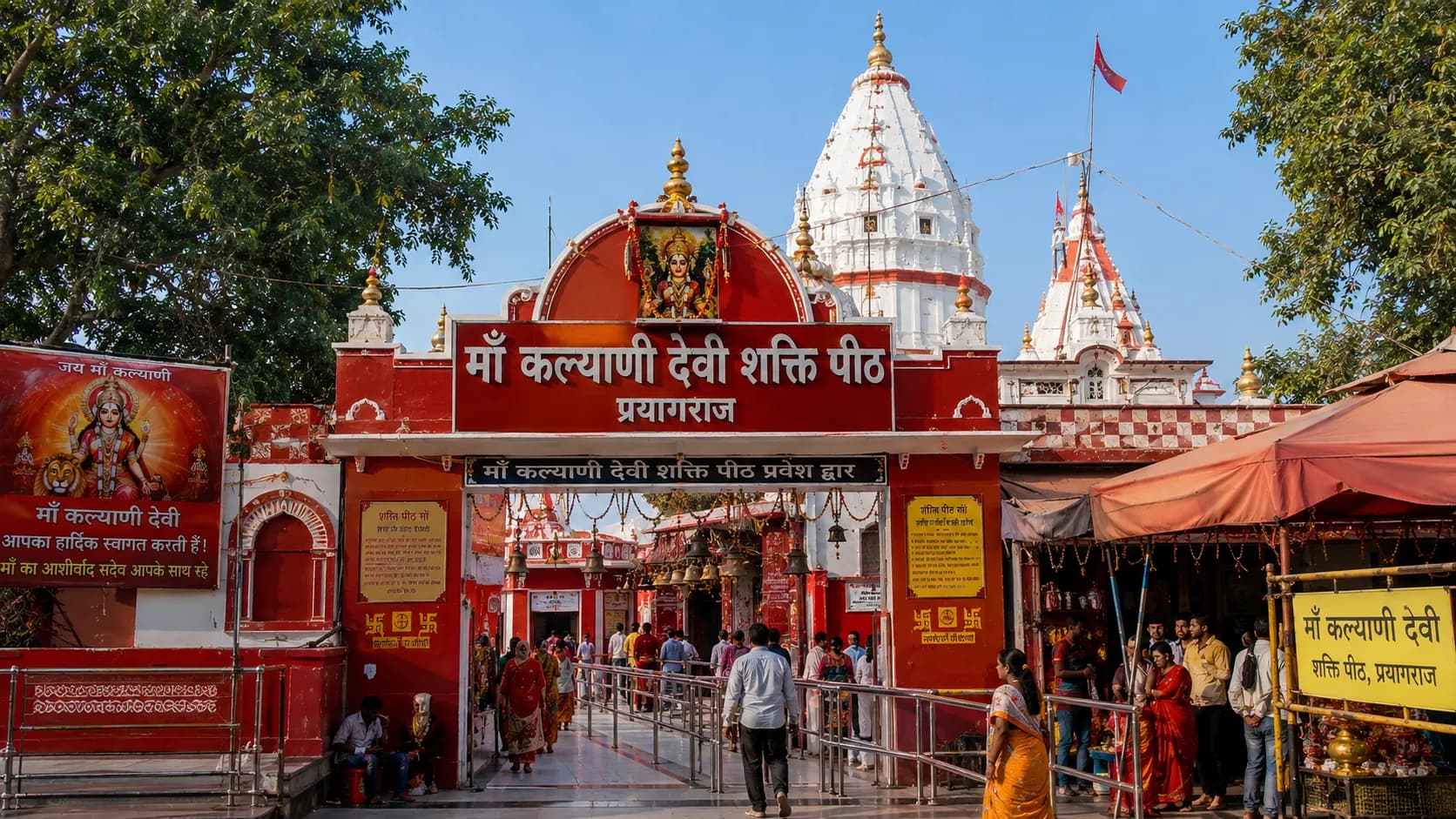
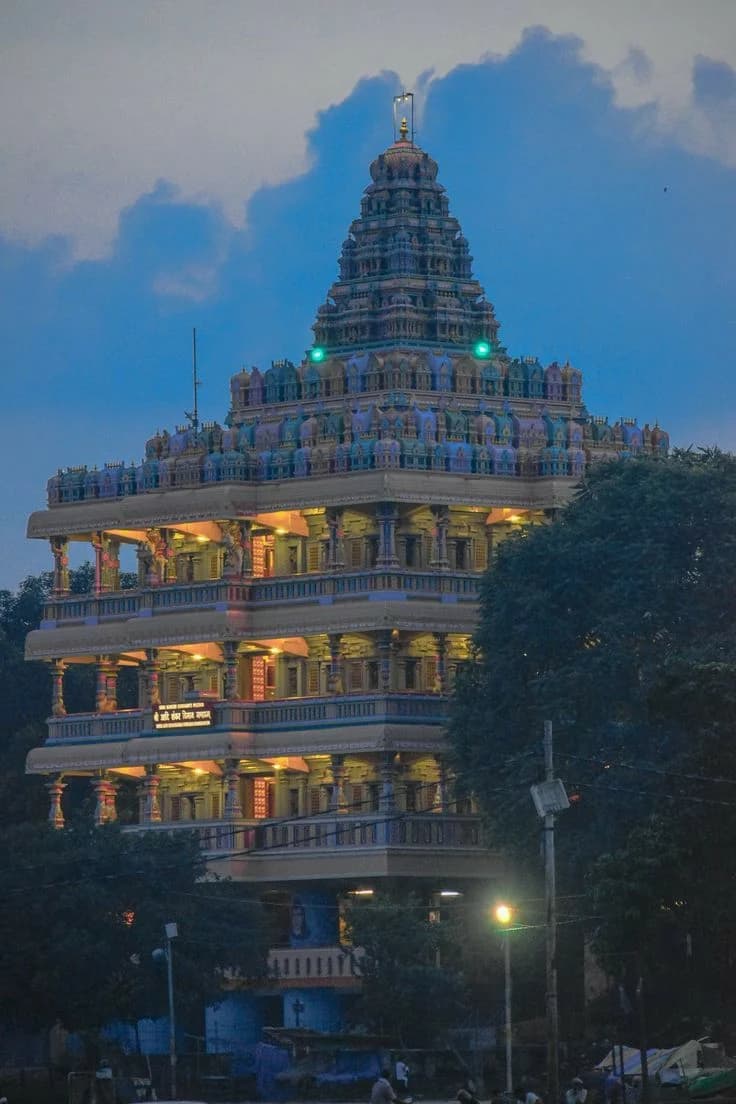
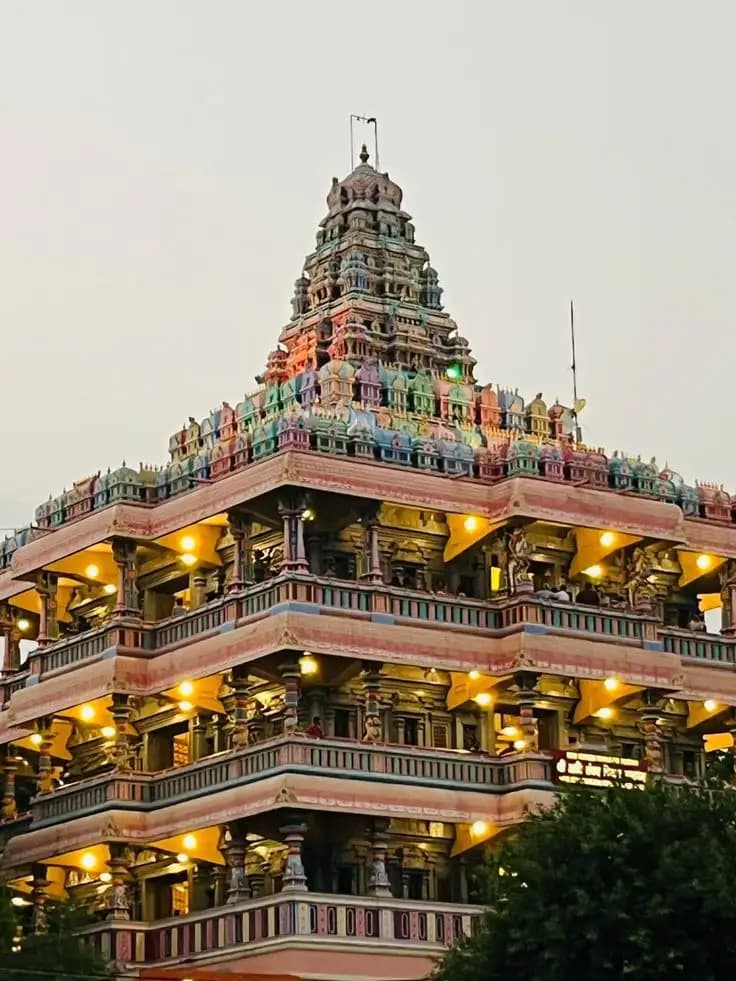
In the old heart of Prayagraj, in the Attarsuiya quarter a little south of the Lalita Devi temple, stands the ancient and greatly revered Maa Kalyani Devi Mandir, honoured as a Mahashakti Siddhpeeth, a Shakti Peeth of the Mother. It is among the oldest of all the Shakti Peethas: the sacred idols within are believed to be some fifteen hundred years old, though the present temple was raised in 1883, and the tradition holds that the idol of the goddess was first consecrated here by the great sage Maharishi Yagyavalkya himself, in ages long past. So great is the goddess's presence that the whole quarter around her has been named for her, the Kalyani Devi Mohalla; and she is honoured in the Padma, the Brahma Vaivarta and the Matsya Puranas, in the last of which, in its list of the hundred and eight Peeths, Kalyani Devi is named the very first. She is the third of the three great shrines of the Mother in Prayag, and with them completes the Devi of the holy city.
The Shakti Peeth: where three fingers of Sati fell
Kalyani Devi is a Shakti Peeth, and its sanctity, like that of all the Peeths, is born of the great legend of Sati. When the goddess Sati gave up her life in the fire of her father Daksha's sacrifice, unable to bear the insult to her Lord Shiva, the grief-maddened Shiva took up her body and roamed the worlds in his sorrow, until Lord Vishnu, to end his grief and save the cosmos, sent his Sudarshan Chakra and cut the body of Sati, so that its parts fell at fifty-one places, each becoming a holy Shakti Peeth. And here, the tradition holds, fell three fingers of the goddess, sanctifying this as a Peeth of the Mother. It is a beautiful and telling thing that both this shrine and the Lalita shrine nearby are held to mark the falling of the fingers of Sati; for indeed the ancient Prayag Mahatmya holds that Lalita and Kalyani are but two names of the one Mahashakti, the one Mother worshipped in two shrines of the holy city.
Kalyani, the auspicious Mother, and the sanctum trinity
The goddess here is Kalyani, and her name is one of the loveliest of all the names of the Mother, for Kalyani means the auspicious one, the bringer of welfare, of well-being and blessing and good fortune; from kalyan, which is welfare and all that is good. She is worshipped as a form of Maa Durga, the warrior goddess, the mighty power of the Divine Feminine, who bestows upon her devotees both the good things of this life, welfare and prosperity and protection, and the ultimate grace of the next, the mercy of moksha and reunion with the Supreme. And her sanctum holds a beautiful company, for three deities are enshrined here together: in the centre reigns Maa Kalyani herself, the form of Durga; to her left is the Mahavidya Chinnamastika, one of the ten great goddesses of wisdom; and to her right are Bhagwan Shankar with Maa Parvati, Shiva and his consort. So the pilgrim who comes to Kalyani Devi bows before the Mother in her power, her wisdom and her grace, all in one holy shrine.
The completed trinity: the three Devi of Prayag
With Kalyani Devi, the pilgrim may complete the beautiful round of the three great Devi of Prayag. For the Mother is worshipped in this holy city at three ancient shrines: at Lalita Devi, the Shakti Peeth where the fingers of her right hand fell; at Kalyani Devi here, where three fingers fell, and where Lalita and Kalyani are held to be one; and at Alopi Devi, the wondrous shrine of the goddess who vanished and became formless. To bow at all three is the cherished Devi pilgrimage of Prayag; and the devotees of the Mother may trace the Shakti Peethas onward to Vishalakshi at Kashi and beyond, or behold all fifty-one gathered at the great Viman Mandapam by the Sangam. And, as at all the Devi shrines of the holy city, the darshan of the Mother crowns the pilgrimage of the Sangam, so that the pilgrim, having bathed at the confluence, comes to her for her blessing.
The auspicious Mother, in my own words
By Rajeev Sharma, guide with Experience My India
I love to complete the round of the three Devi of Prayag with my guests at Kalyani Devi. I tell them her beautiful name means the auspicious one, the bringer of welfare and all good things, and that she is a form of our Mother Durga; and that this is one of the oldest of all the Shakti Peethas, where three fingers of Mother Sati fell, and where the great sage Yagyavalkya himself, they say, first set up the goddess ages ago. People feel the great age and power of it. And I show them the beautiful thing, that three deities sit together in her sanctum, Maa Kalyani in the middle, Chinnamastika to one side, Shiva and Parvati to the other.
I tell them the lovely truth that our old books say Lalita and Kalyani are two names of the one Mother, so these two great shrines are, in a way, one goddess; and I fit Kalyani into the round of the three, Lalita, Alopi and Kalyani, so my guests bow to the whole Mother of Prayag. After the Sangam bath, I bring the devotees of the Mother to all three, for her blessing. Kalyani is a most powerful and benevolent Mother, above all at Navratri, and completing her trinity is one of the loveliest Devi pilgrimages I share at Prayag.
In more than forty years of guiding, completing the round of the three Devi of Prayag is among the most beloved pilgrimages I share with the devotees of the Mother.
What to see and do
- Take the darshan of Maa Kalyani, the auspicious Mother, a form of Durga, in the ancient sanctum.
- See the three deities enshrined together: Kalyani in the centre, Chinnamastika and Shankar-Parvati beside her.
- Attend the morning Shringar aarti or the evening aarti of the Mother.
- Complete the round of the three Devi of Prayag, Lalita, Alopi and Kalyani, after the Sangam bath.
- Visit during Chaitra or Ashwin Navratri for the grand fairs and celebrations.
How to reach Kalyani Devi Temple
The temple is at Attarsuiya, in the Kalyani Devi Mohalla near the Kotwali, in the old city a little south of the Lalita Devi temple, a short way from the Sangam, easily reached by auto or e-rickshaw.
| From | Distance | Notes |
|---|---|---|
| Lalita Devi Temple | A little to the north | The two are held to be one Mother; visit them together. |
| Alopi Devi Mandir | In the old city | The vanished-goddess shrine; the Devi of Prayag together. |
| The Triveni Sangam | A few km | Bathe at the Sangam, then come for the Mother's darshan. |
| Prayagraj Junction (railway) | About 3 km | By auto or e-rickshaw. |
| Prayagraj (Bamrauli) Airport | About 15 to 18 km | The city airport; taxis to the old city. |
It completes the round of the three Devi of Prayag.
Best time to visit and how to plan it
| When | Why |
|---|---|
| Chaitra and Ashwin Navratri | The two great festivals of the goddess, when the temple is at its most glorious. |
| Mondays and Fridays | The days of special rituals and decorations of the Mother. |
| Early morning, around the Shringar aarti | The calmest and most beautiful time for darshan. |
| After the Sangam bath, with the three Devi | To complete the Devi pilgrimage of Prayag. |
- Pair it with Lalita and Alopi Devi and the Sangam for the full Devi of Prayag.
- Allow 30 to 45 minutes; longer in Navratri and the Mela season.
For Prayagraj, or a combined Kashi, Ayodhya and Prayagraj pilgrimage, planned end to end, see our tour packages.
Accessibility for elderly and mobility limited visitors
- The temple is in the old city, reachable by auto or e-rickshaw; a helper is useful for the frail on the last stretch.
- Come early, in the calm 5 to 8 AM window, for a comfortable darshan.
- The quick-moving queues suit elderly visitors, except in Navratri.
- We arrange transport and plan a gentle darshan within your Prayagraj day.
Etiquette for visiting
- Remove footwear and dress modestly; be reverent before the Mother.
- Offer red cloth, sindoor, flowers and your prayers in the local custom.
- Keep to the queue and follow the priests, especially in Navratri.
- Keep your phone away in the sanctum, and mind the old-city lanes and the crowd.
Our guided darshan and Prayagraj tours
We are a Varanasi, Ayodhya and Prayagraj based operator, a unit of Experience My India, with more than forty years of guiding pilgrims across all three holy cities, and our own local guide in Prayagraj. Darshan is free, so what we offer is the experience made smooth and meaningful: a guide who tells the story of the Shakti Peeth and the auspicious Mother, the darshan woven with the Sangam and the round of the three Devi of Prayag, and, for the devotees of the Mother, the Shakti Peethas of the holy cities, from Prayag to Vishalakshi at Kashi.
| Service | Includes | Price |
|---|---|---|
| The three Devi of Prayag | Lalita, Kalyani and Alopi Devi, the Devi shrines of the holy city, with a guide. | Contact us for pricing |
| Guided Kalyani Devi and Sangam darshan | The temple and the Sangam, with the Shakti Peeth story, with a guide. | Contact us for pricing |
| Full Prayagraj darshan day | Kalyani Devi within a wider Prayagraj visit, with a guide. | Contact us for pricing |
| Shakti Peeth and three-city pilgrimage | The Devi of Prayag with Vishalakshi at Kashi and the Devi sites, with a guide. | Contact us for pricing |
Inclusions and exclusions are stated up front, with any taxes and conditions, and no charge appears later that was not named. Darshan is free; our charge is only for guiding, transport and services. See all our tour packages for the full range.
Experience My India is a travel operator, not the temple administration. Darshan is free; our charge is only for our guiding and services. Timings and rules are set by the temple and can change.
Nearby sacred sites in Prayagraj
Kalyani Devi completes the three great Devi shrines of Prayag.
| Site | What it is | Internal link |
|---|---|---|
| Lalita Devi Temple | The Shakti Peeth of Prayag; held to be one Mother with Kalyani. | /temple/prayagraj/lalita-devi-temple |
| Alopi Devi Mandir | The shrine of the vanished goddess; the third of the Devi of Prayag. | /temple/prayagraj/alopi-devi-mandir |
| Triveni Sangam | The sacred confluence; the Mother's darshan crowns the pilgrimage after the bath. | /temple/prayagraj/triveni-sangam |
| Shankar Viman Mandapam | The temple gathering all 51 Shakti Peethas, near the Sangam. | /temple/prayagraj/shankar-viman-mandapam |
| Vishalakshi Temple (Varanasi) | The great Shakti Peeth of Kashi; the sister Peeth of the Mother. | /temple/varanasi/vishalakshi-temple |
For the Sangam snan and the confluence, see our Triveni Sangam guide.