.webp&w=2048&q=75)
.webp&w=2048&q=75)
Essential info at a glance
| Detail | At a glance |
|---|---|
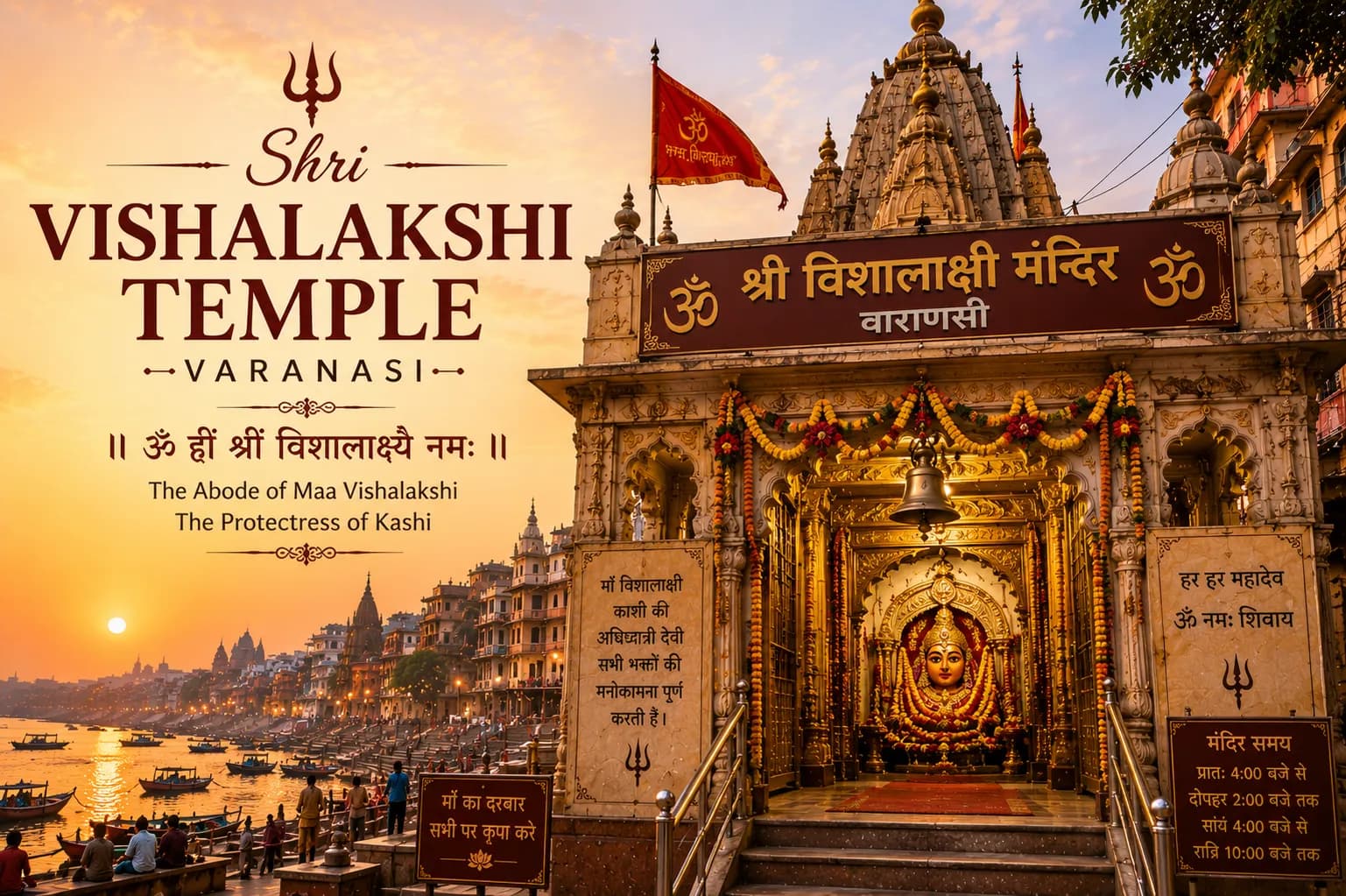
| What it is | The Vishalakshi Gauri Temple, one of the Shakti Peethas of Kashi, where the earrings of the goddess Sati are said to have fallen. |
| The goddess | Vishalakshi, the wide eyed goddess, an aspect of Parvati; the guardian Bhairava of this Peetha is Kaal Bhairav. |
| Darshan hours | Morning 4:30 AM to 11:00 AM and evening 5:00 PM to 10:00 PM, split into two windows. |
| Aartis | Morning aarti at 4:30 AM and evening aarti around 9:00 PM. |
| Entry fee | Free for all devotees. There is no paid Sugam or VIP darshan here. |
| Heritage | Built and cared for by the Tamil Nagarathar community, with a South Indian gopuram; part of the triad with Kanchi Kamakshi and Madurai Meenakshi. |
| Big festival | Kajali Teej in Bhadrapada, August, along with the two Navratris. |
| Location | Mir Ghat, about 200 to 300 metres from the Kashi Vishwanath Dham corridor. |
Vishalakshi temple timings and darshan
The temple opens before dawn for the morning aarti and again in the evening, with a closed period through the middle of the day. Because it sits a few minutes from Kashi Vishwanath, most pilgrims take darshan here as part of the same visit to the old city.
| Session | Timing | Notes |
|---|---|---|
| Morning window | 4:30 AM to 11:00 AM | The morning aarti is at 4:30 AM; early is calmest. |
| Evening window | 5:00 PM to 10:00 PM | The evening aarti is around 9:00 PM. |
| Festivals | Adjusted | Timings shift during Navratri and Kajali Teej, when crowds are large. |
The Shakti Peetha: Sati's earrings and the wide eyed goddess
Vishalakshi is one of the Shakti Peethas, the most sacred shrines of the Divine Mother, which mark the places where parts of the goddess Sati fell to earth. When Sati gave up her life at her father Daksha's yagna and the grieving Shiva carried her body across the world, Vishnu's discus severed it, and where each part came down a Peetha arose. At Mir Ghat in Kashi, it is said, the earrings of Sati fell, and here the goddess is worshipped as Vishalakshi.
The name means the wide eyed, or vast eyed, goddess, for as the divine eye takes in the whole universe, so the Mother here watches over all. At every Shakti Peetha the goddess is guarded by a form of Shiva as Bhairava, and the Bhairava of this Peetha is none other than Kaal Bhairav, the Kotwal of Kashi, which is why the two are so often worshipped together. See our guide to the Kaal Bhairav Temple for the guardian of this Peetha.
The triad and the South Indian heritage
One of the most remarkable things about Vishalakshi is that it is not only a Banarasi temple but a great South Indian one too. In the tradition, Kashi Vishalakshi stands with Kanchi Kamakshi in Tamil Nadu and Madurai Meenakshi as a famous triad of the goddess, the three great eyed forms of the Mother. Fittingly, the temple here has been built and cared for since the 19th century by the Nattukottai Nagarathars, a Tamil merchant community, who raised the present shrine with a South Indian gopuram over the entrance and Tamil inscriptions within.
| At a glance | Detail |
|---|---|
| The goddess | Vishalakshi, the wide eyed goddess, an aspect of Parvati, also called Vishalakshi Gauri and Vishalakshi Amman. |
| Shakti Peetha | One of the Shakti Peethas, where the earrings of Sati are said to have fallen; the guardian Bhairava is Kaal Bhairav. |
| The triad | Worshipped with Kanchi Kamakshi and Madurai Meenakshi as the three great eyed forms of the goddess. |
| Built by | The Tamil Nagarathar community, who raised the present temple, with a South Indian gopuram and Tamil inscriptions; the newer idol dates from 1949. |
| Two idols | A small older black stone idol, Adi Vishalakshi, at the back, and a taller black stone idol installed later. |
| Also here | The Vishalakshieshwar Mahadev shivalinga within the temple. |
So you stand in the middle of the Kashi lanes before a goddess of the deep south, in a temple that quietly joins two great streams of Indian devotion. It is one of those layered, surprising places that reward a traveller who slows down to understand them.
Why devotees come to Vishalakshi
Vishalakshi is a goddess of grace and good fortune, and devotees come to her with the tender hopes of ordinary life. She is believed to bless her worshippers with beauty and wealth and to lift away disease and sorrow.
- Unmarried women pray to her for a good husband, and childless couples for a child.
- Many make a vow to offer kumkum prasad on forty one Tuesdays, believing the goddess then fulfils their wishes.
- She is worshipped for beauty, wealth, health and the turning of fortune.
These are the quiet, human reasons a small temple stays so beloved across the centuries.
A darshan in the old lanes, in my own words
By Rajeev Sharma, Varanasi local
Most of my guests have never heard of Vishalakshi, and I love the moment they understand what it is. A few minutes from Kashi Vishwanath, down the narrow lanes near Mir Ghat, we come to a temple with a small South Indian tower over the door, and I tell them that the earrings of the goddess Sati are said to have fallen right here, and that this is one of the Shakti Peethas. Then I tell them the part they never expect: that the same goddess is worshipped in the deep south as Kanchi Kamakshi and Madurai Meenakshi, and that Tamil families have looked after this temple for generations.
Inside there are two idols, an old small one and a taller one, both in black stone, and there is a stillness here that the bigger temples do not have. I always pair it with Kaal Bhairav, because he is the guardian of this Peetha, and often with Annapurna and Kashi Vishwanath, since they are all within a short walk. Banarasi women come to Vishalakshi with the hopes of their whole lives, and you feel that.
In more than forty years of guiding, this is one of the temples that makes people realise how deep Kashi goes beneath its famous surface.
Entry, rules, and what to carry
- Entry is free. There is no paid Sugam or VIP darshan, though a guide can help you through the queue during festival rushes.
- Dress modestly, covering shoulders and knees, and keep your voice low near the sanctum.
- Footwear comes off before entry; leave it at the counter or in the car.
- Because the temple is near the Kashi Vishwanath security zone, keep your phone away and photography discreet; check for signs near the sanctum.
- Carry a little cash for prasad, and kumkum if you wish to offer it.
How to reach the Vishalakshi Temple
The temple is at Mir Ghat, deep in the old city, about 200 to 300 metres from the Kashi Vishwanath Dham corridor. As with the other old city temples, you reach it on foot through the lanes.
| From | Distance | Notes |
|---|---|---|
| Kashi Vishwanath and Annapurna | About 200 to 300 metres | A short walk through the galis; do the three together. |
| Dashashwamedh Ghat | A short walk | Reach it on foot from the ghat or from Godowlia. |
| Kaal Bhairav | About 1.5 to 2 km | The guardian Bhairava of this Peetha, in the old city. |
| Varanasi Junction (Cantt) | About 5 km | Autos and cabs to the edge of the old city, then on foot. |
| Airport | About 25 km | Lal Bahadur Shastri International Airport, roughly an hour by road. |
The lanes near Mir Ghat are a maze, so a guide who knows them saves time and confusion, and lets you flow smoothly between the old city temples.
Best time to visit and how to plan it
| When | Why |
|---|---|
| Early morning | The calmest darshan, around the 4:30 AM aarti, taken with Kashi Vishwanath. |
| Tuesdays | Especially auspicious for the goddess; many keep the forty one Tuesday vow. |
| Navratri | The great goddess festival, when Vishalakshi is part of the Gauri circuit of Kashi. |
| Kajali Teej (August) | The temple's own annual festival, at its most alive. |
| Avoid the midday gap | The temple closes between the morning and evening windows. |
- Pair it with Kashi Vishwanath and Annapurna next door, and with Kaal Bhairav, its guardian.
- Allow 20 to 30 minutes on a normal day, more during Navratri and Kajali Teej.
For the old city temples planned as one route, see our Varanasi tour packages.
Festivals: Kajali Teej and Navratri
The temple's own great day is Kajali Teej, in the Hindu month of Bhadrapada, around August, when the goddess is celebrated with a fair and special worship, and married and unmarried women come to seek her blessings. Beyond that, Vishalakshi is one of the goddess temples on the Navratri circuit of Kashi, visited as part of the sequence of the nine Gauris and Durgas over the nine nights, in both the autumn Ashwin Navratri and the spring Chaitra Navratri. On these days the small temple fills and the atmosphere is wonderful, if crowded.
Accessibility for elderly and mobility limited visitors
- The temple is in the tight old city lanes reached on foot, which can be hard for those with limited mobility.
- Come early morning to avoid the crowds, and avoid Navratri and Kajali Teej peak days if a queue is difficult.
- We arrange a car to the nearest drop point and a guide to help through the lanes and the old city temples together.
Nearby sacred sites to combine with your darshan
Vishalakshi sits in the heart of the old city cluster, so it pairs naturally with the great temples and the river.
| Site | What it is | Internal link |
|---|---|---|
| Kashi Vishwanath Temple | The Jyotirlinga at the heart of Kashi, a few minutes' walk away. | /temple/varanasi/kashi-vishwanath-temple |
| Annapurna Devi Temple | The goddess of nourishment, beside Kashi Vishwanath. | /temple/varanasi/annapurna-temple |
| Kaal Bhairav Temple | The Kotwal of Kashi and the guardian Bhairava of this Shakti Peetha. | /temple/varanasi/kaal-bhairav-temple |
| Dashashwamedh Ghat | Home of the grand evening Ganga aarti, a short walk toward the river. | /temple/varanasi/dashashwamedh-ghat |
| Manikarnika Ghat | The great cremation ground, itself a Shakti Peetha, along the riverfront. | /temple/varanasi/manikarnika-ghat |
To add the river to your day, see our evening Ganga aarti experience.
Safety and practical tips
| Watch out for | How to handle it |
|---|---|
| Self appointed pandas offering a quick puja for a large donation. | Agree any amount before you accept a service, and do not feel pressured. |
| Getting lost in the Mir Ghat lanes. | The galis are a maze; a guide or a clear drop point saves confusion. |
| Phone and photography near the Kashi Vishwanath security zone. | Keep your phone away and photography discreet; check for signs. |
| The crush during Navratri and Kajali Teej. | Come early, or let us plan the timing and the route for you. |
A guided visit removes the guesswork so you can focus on the darshan.
Our guided old city visits including Vishalakshi
We are a Varanasi based operator, a unit of Experience My India, with more than forty years of guiding pilgrims across Kashi, Ayodhya, and Prayagraj. Entry to Vishalakshi is free, so what we arrange is the visit around it: transport to the nearest drop point, a local guide who knows the lanes and the goddess tradition, and a smooth route through the old city temples and the Shakti Peetha with its guardian Bhairava.
| Package | Includes | Price |
|---|---|---|
| Kashi Vishwanath, Annapurna and Vishalakshi | Car, a Varanasi local guide, and the three old city temples together. | Contact us for pricing |
| Shakti Peetha and Bhairav darshan | Vishalakshi with Kaal Bhairav, its guardian, and a guide. | Contact us for pricing |
| Old city temple walk | The cluster of old city temples with a guide, timed around the aartis. | Contact us for pricing |
| Full Kashi darshan day | The old city temples, the corridor, and the evening Ganga aarti. | Contact us for pricing |
Inclusions and exclusions are stated up front, with any taxes and conditions, and no charge appears later that was not named. See all our Varanasi tour packages for the full range.
Experience My India is a travel operator, not the temple administration. Prices are ours. Temple timings and rules are set by the temple and can change.