.webp&w=2048&q=75)
Essential info at a glance
| Detail | At a glance |
|---|---|
| What it is | The sacred confluence of the Ganga, the Yamuna and the invisible Saraswati; the Tirtharaj, the holiest of confluences. |
| Access | Open 24 hours; best managed between 5:00 AM and 7:00 PM. General entry is free. |
| The holy dip (snan) | The central act; best at sunrise for calm water and fewer crowds. |
| Boat rides | From about 6:00 AM to 6:00 PM; roughly Rs 500 to 1,500 by shared or private boat. |
| Morning aarti | Around sunrise, roughly 5:45 to 6:30 AM. |
| Evening aarti | Around sunset, roughly 6:00 to 7:00 PM. |
| The Kumbh Mela | The greatest gathering on earth, held here; the annual Magh Mela draws pilgrims each winter. |
| Location | Near the Allahabad Fort, Daraganj, Prayagraj. |
Triveni Sangam timings and activities
The Sangam is an open riverfront, accessible around the clock, and general entry is free; the best hours are from sunrise to sunset, roughly 5:00 AM to 7:00 PM. The great act here is the holy dip, the snan, and the finest time for it is early morning at sunrise, when the water is calm and the crowds are fewer. Boats carry pilgrims out to the confluence point from about 6:00 AM to 6:00 PM, and the aartis to the sacred rivers are performed at the ghats around sunrise and again at sunset. In the Mela season, from Makar Sankranti in January through Magh, the Sangam becomes a vast tented city and the whole rhythm of the place changes.
| Activity | When | Notes |
|---|---|---|
| General access | 24 hours; best 5:00 AM to 7:00 PM | Open riverfront; general entry free. |
| Holy dip (snan) | Best at sunrise | Calm water and fewer crowds; the central act. |
| Boat rides | About 6:00 AM to 6:00 PM | Roughly Rs 500 to 1,500; agree the fare before boarding. |
| Morning aarti | Around 5:45 to 6:30 AM | At the ghats, at sunrise. |
| Evening aarti | Around 6:00 to 7:00 PM | At the ghats, at sunset; varies by season. |
The Triveni Sangam: where three sacred rivers meet
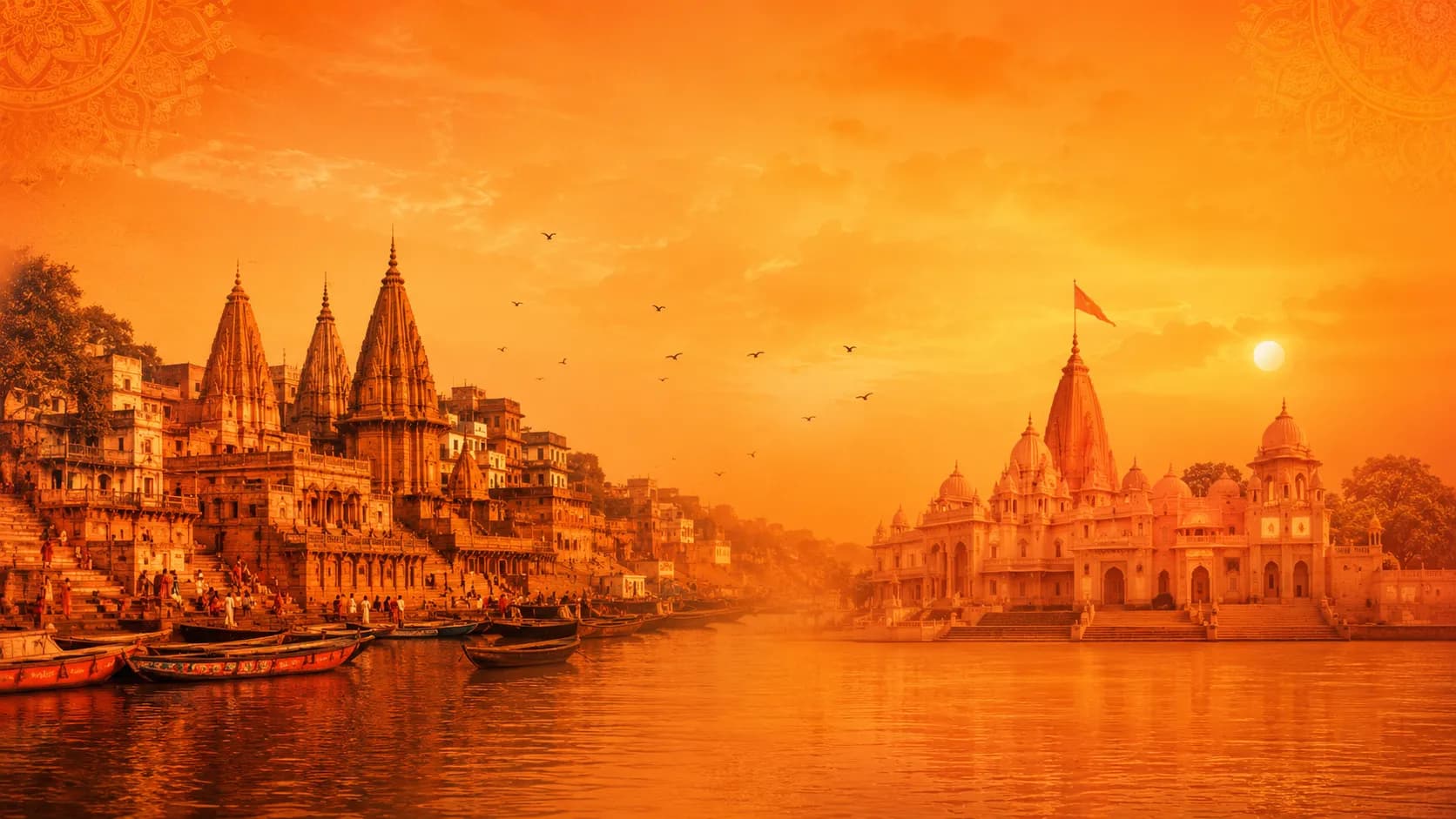
Welcome to Prayagraj, the Tirtharaj, the King of all the holy places of India, and to the Triveni Sangam, the most sacred confluence in all of Hinduism. Here, at this one blessed spot, three of the holiest rivers of Bharat come together and become one: the Ganga, her waters pale and clear from the Himalayas; the Yamuna, her waters a deep and lovely green-blue; and the Saraswati, the mystical third river, unseen, believed to flow underground and to join the other two here from below. Where Kashi is defined by its Lord Vishwanath and Ayodhya by its Lord Ram, Prayagraj is defined by this, its confluence; for the Sangam is not merely a meeting of waters but a meeting of the three streams of the divine, the very heart and reason of the holy city.
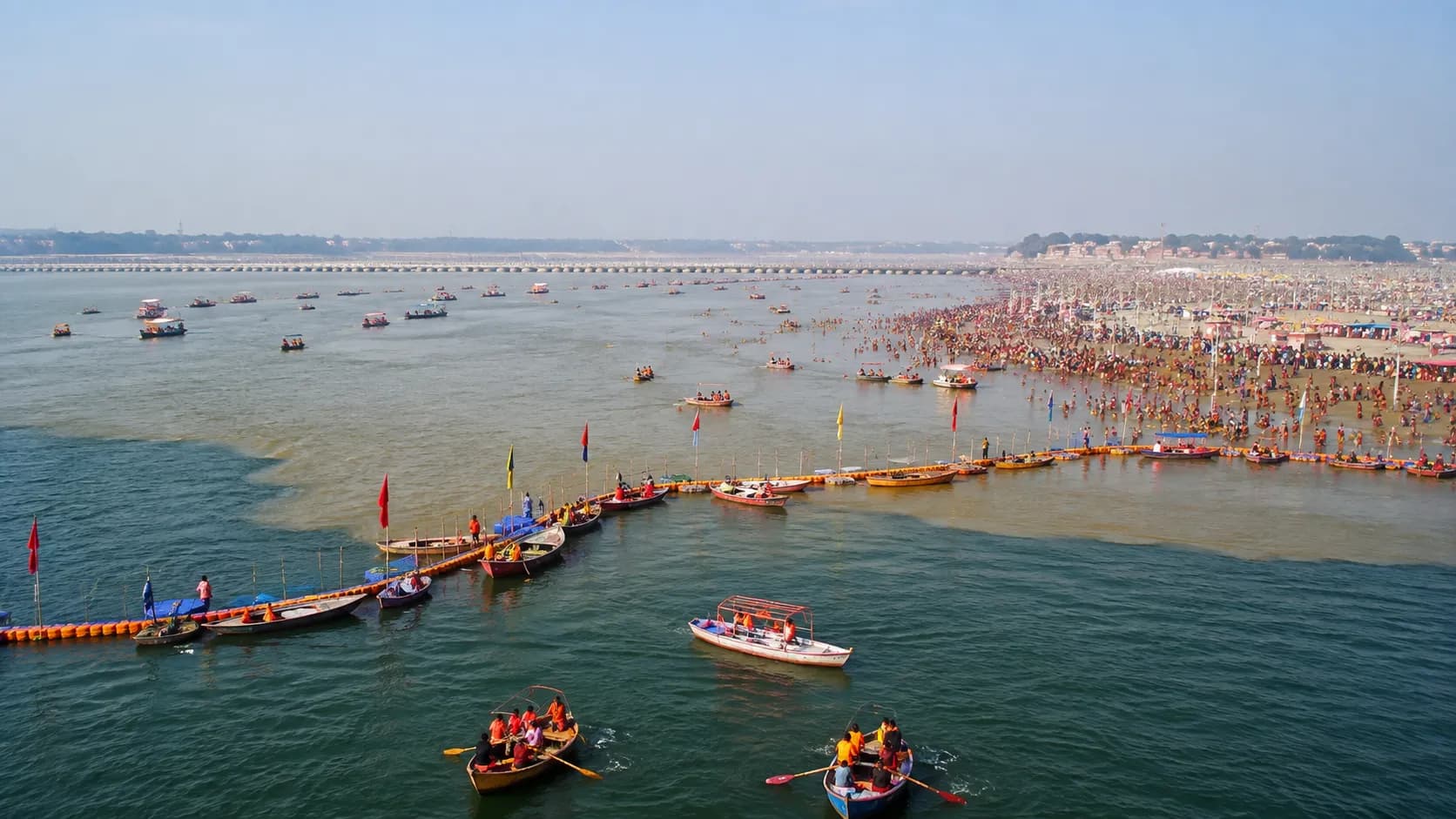
And it is a wonder to behold with one's own eyes, for the two visible rivers do not mingle at once, but flow on side by side for a distance, so that one may see, sharp and clear upon the water, the pale stream of the Ganga running beside the green stream of the Yamuna, the two colours meeting in a shining line. The great poet Kalidasa likened the sight to a garland of white and blue lotuses intertwined. To sit in a boat at the very point of the meeting, with the pale water on one hand and the green on the other, and the unseen Saraswati beneath, is to sit at the still centre of India's sacred geography.
The Tirtharaj: the holiest of confluences
The Sangam is honoured as the Tirtharaj, the King of Tirthas, the greatest of all the pilgrimage places, and its sanctity reaches back to the very beginning of things. Here, the tradition holds, Lord Brahma himself, having created the universe, performed the first great yajna, the first fire-sacrifice, so that this is Prayag, the place of sacrifice, the place of the first offering; and here, in his exile, Lord Ram is said to have come to pray. The Vedas and the Puranas and the great epics sing the praises of this confluence; the gods themselves, it is said, descend to the Sangam to cleanse themselves in its holy waters. It is a place charged with a spiritual power beyond any other, where the earthly and the divine meet as surely as the three rivers, and where the soul may find, in the words of the pilgrims, redemption, release, and rebirth.
The holy dip: the Sangam snan
The supreme act of pilgrimage at the Triveni Sangam is the snan, the holy dip in the confluence of the three rivers; and it is held to be among the most powerful acts of purification in all the tradition. To bathe at the Sangam, with faith and a devout heart, is believed to wash away the sins not of this life alone but of countless lifetimes, to cleanse the very karma of the soul, and to open the way to moksha, to liberation and to heaven. For this the pilgrim comes; and the way of it is beautiful. From the ghats near the Fort, the boats carry the pilgrims out across the water to the very point of the confluence, where wooden platforms and jetties are set in the shallows at the meeting of the rivers; and there, at the exact Sangam, holding to the platform, the pilgrim takes the sacred dip, three times or more, with the name of God on the lips and a solemn sankalp, a prayer and a resolve, in the heart.
Many pilgrims come also to perform the rites of the ancestors here, the pind daan, the tarpan and the shraddha, for the Sangam is among the greatest of all places to offer peace to the departed and to discharge the debt to one's forefathers; and the priests of the ghat assist the devout with these rituals and offerings. Any day of the year, a dip at the Sangam is holy; but on the great bathing days, when the sun and moon and planets stand in the appointed places, the merit is held to be multiplied beyond measure. Chief among these are Makar Sankranti in January, Mauni Amavasya, Basant Panchami, Maghi Purnima and Maha Shivratri, the great bathing days of the Magh season, and Kartik Purnima; and on these days the pilgrims come in their hundreds of thousands and their millions.
The Kumbh Mela: the greatest gathering on earth
Above all, the Triveni Sangam is the home of the Kumbh Mela, the largest and most extraordinary gathering of human beings anywhere on the face of the earth. Its origin lies in one of the greatest of all the legends, the Samudra Manthan, the churning of the cosmic ocean, when the gods and demons churned the sea for the amrit, the nectar of immortality; and in the struggle that followed over the sacred pot, the Kumbh, four drops of the nectar fell to the earth, at four places, at Prayag, at Haridwar, at Nashik and at Ujjain. And so at these four places, in turn, as the planets come round to the appointed positions, the Kumbh Mela is held, that pilgrims may bathe in the waters made sacred by the nectar of immortality itself.
The Purna Kumbh comes to Prayagraj once in twelve years, and the Ardh Kumbh, the half-Kumbh, at the midpoint of six; and the annual Magh Mela is held here every winter through the sacred month of Magh, a great gathering in its own right. And, rarest and greatest of all, once in every hundred and forty-four years, after twelve full Purna Kumbhs, there comes the Maha Kumbh, which is held only here, at Prayagraj; and it was this, the once-in-a-hundred-and-forty-four-years Maha Kumbh, that was held at the Sangam in the year 2025, when, it is reckoned, more than four hundred million souls came to bathe, forming for those weeks the largest temporary city and the greatest single gathering in the history of the world. To be at the Sangam in Mela time is an experience beyond describing: a vast tented city spreads across the sands, the air rings with chants and bells, and on the great bathing days the akharas, the ancient orders of sadhus and the ash-smeared naga ascetics, process to the water in their thousands, on foot and on elephants and horses, to take the Shahi Snan, the royal bath, the Amrit Snan, at the most auspicious hour. And through the season the Kalpvasis, the devout who take a vow to live for the whole month on the riverbank, bathe each dawn, eat simply, and pass their days in prayer. There is no sight of faith like it anywhere on earth.
The invisible Saraswati and the eternal sites
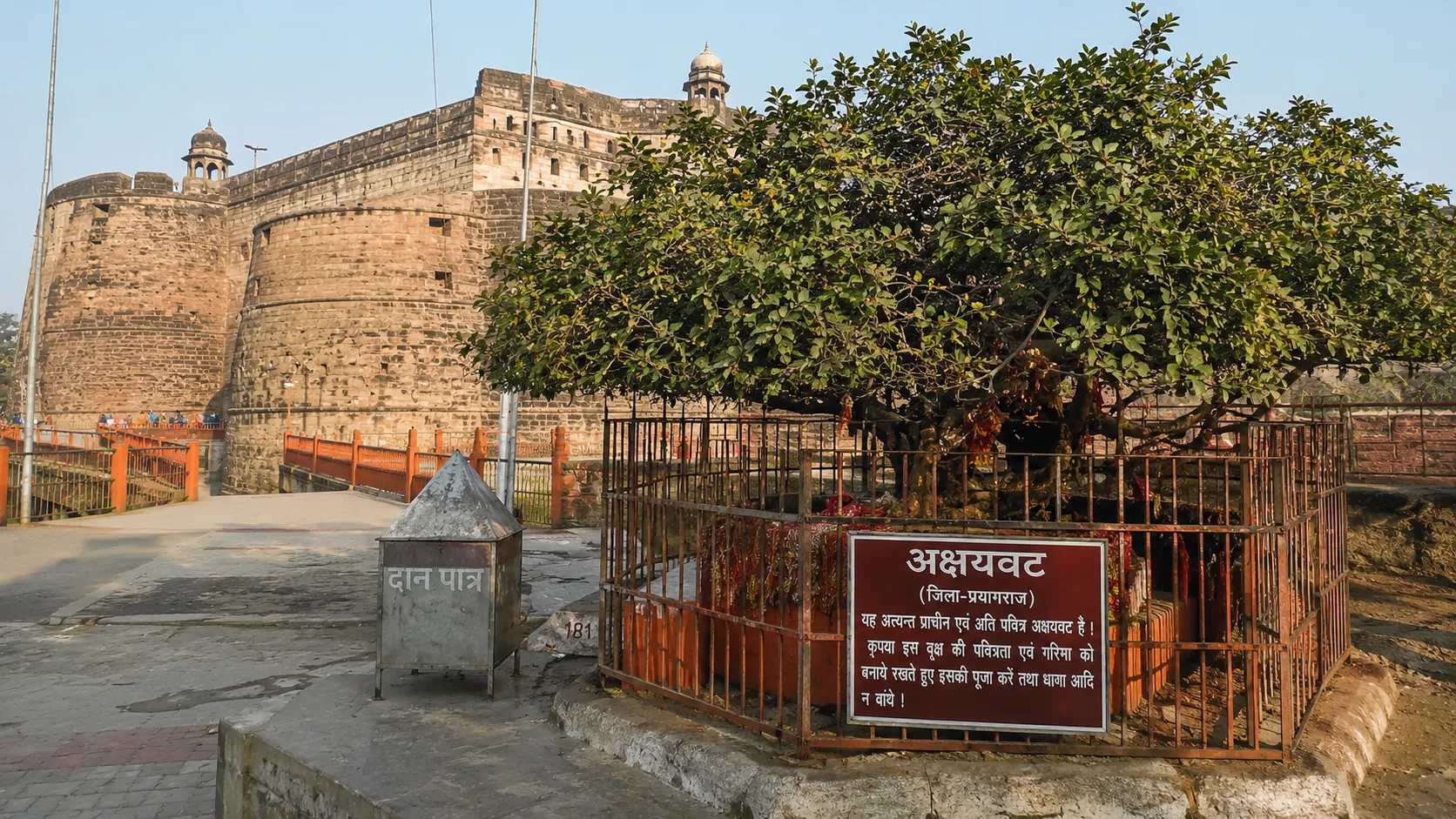
Part of the deep magic of the Sangam is the mystery of the Saraswati, the third and unseen river. The Ganga you may see, and the Yamuna; but the Saraswati, the river of wisdom, joins them, the tradition holds, from beneath, invisible, the antah-salini, the hidden stream. Scholars may debate whether she was a great river of the ancient world that dried and vanished; but for the pilgrim she is not a matter of debate but of faith, the unseen made present, and it is she who makes the meeting a Triveni, a threefold braid, and the confluence complete. Nearby, in and by the old Fort, stand the other eternal sites of the Sangam: the Akshayavat, the immortal, undying banyan tree, from beneath which, the tradition tells, the soul may attain liberation, and the Saraswati Koop, the well of the hidden river. Together they make the Sangam a whole and perfect idea of the sacred.
The guardian Hanuman: completing the pilgrimage
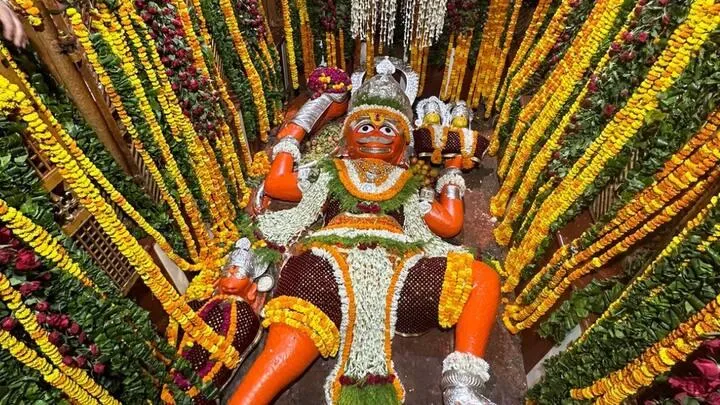
And the pilgrimage to the Sangam has its guardian and its completion, close by, in the great reclining Hanuman of Prayagraj. For it is the firm belief of the holy city that the darshan of Bade Hanuman, the Lete Hanuman, completes the pilgrimage of the Sangam; that the full merit of the sacred bath is granted only to the pilgrim who, having bathed, also comes to take the darshan of Hanuman, the guardian of the confluence. And so the way of the Prayagraj pilgrim is this: to bathe at the Triveni Sangam, and then to go to Bade Hanuman, that the pilgrimage may be whole and its fruit complete. We always guide our pilgrims in this proper and blessed order.
A lifetime on the sacred rivers, in my own words
By Rajeev Sharma, guide with Experience My India
I have spent my life on the sacred rivers of our three holy cities, the Ganga at Kashi, the Saryu at Ayodhya, and here, the greatest of all, the Triveni Sangam at Prayag, where the Ganga and the Yamuna and the hidden Saraswati become one. I bring my pilgrims out on a boat at sunrise, when the water is calm and the light is golden, to the very point of the meeting; and I show them the two colours of the water, the pale Ganga and the green Yamuna, running side by side, and I tell them the Saraswati flows below, unseen, and they are always awed. And there, at the exact Sangam, I help them take the holy dip that our tradition says washe away the sins of many lifetimes and opens the way to moksha. There is no bath in all of India like the Sangam snan.
I was here for the great Maha Kumbh, the once-in-a-hundred-and-forty-four-years Mela, and I have no words for it, a whole city on the sand, hundreds of millions of people, the naga sadhus going to the Amrit Snan, one heart of faith. If my guests come in the Mela, I plan it with the greatest care, for it is the experience of a lifetime, but a mighty crowd. And I always keep the proper order: the Sangam snan first, and then straight to Bade Hanuman, for our belief is that the bath is not complete without his darshan. I tell my guests, too, always to agree the boat fare before they step in, so no one troubles them, for I look after the people I bring. To share the Tirtharaj, the King of all tirthas, with a pilgrim is the greatest privilege of my work.
In more than forty years on the sacred rivers, the Sangam snan at sunrise, and the Maha Kumbh, are the most powerful things I have ever known.
How to experience the Sangam
- Come at sunrise for the calmest water, the fewest crowds, and the loveliest light on the confluence.
- From the ghat near the Fort, take a boat out to the Sangam point; agree the fare clearly before boarding.
- At the platforms at the exact confluence, take the holy dip, three times or more, with a sankalp and the name of God.
- See the two-coloured waters of the Ganga and Yamuna meeting, and remember the unseen Saraswati below.
- Perform any ancestral rites with a pandit if you wish, then go to Bade Hanuman to complete the pilgrimage.
How to reach the Triveni Sangam
The Sangam is reached from the ghats near the Allahabad Fort, at Daraganj, from where the boats set out; it is easily reached by road, and by boat to the confluence itself.
| From | Distance | Notes |
|---|---|---|
| Bade Hanuman Mandir | About 1 km | The guardian Hanuman; complete the pilgrimage there. |
| The Allahabad Fort and Akshayavat | Adjacent | The old fort and the immortal banyan. |
| Prayagraj Junction (railway) | About 7 to 10 km | By auto, e-rickshaw or taxi to the ghats. |
| Prayagraj (Bamrauli) Airport | About 15 to 18 km | The city airport; taxis to the ghats. |
| To the confluence itself | By boat from the ghat | The boats carry pilgrims to the Sangam point. |
The boats from the ghat carry you to the heart of the confluence.
Best time to visit and how to plan it
| When | Why |
|---|---|
| Sunrise, for the snan | The calmest water, fewest crowds, and the loveliest light for the holy dip. |
| The great bathing days (Magh season, Jan to Mar) | Makar Sankranti, Mauni Amavasya, Basant Panchami, Maghi Purnima and Maha Shivratri, when the merit is greatest. |
| The Magh Mela (every winter) and the Kumbh | For the great gathering, the Kalpvasis and the akharas, though hugely crowded. |
| Winter (Nov to Feb) | Cool, pleasant, and the season of the migratory birds on the water. |
| Around the aartis | For the beautiful river worship at the ghats, at sunrise and sunset. |
- Complete the pilgrimage with Bade Hanuman, and see the Fort and Akshayavat nearby.
- Book far ahead for the Kumbh and the great bathing days, when Prayagraj is overwhelmingly crowded.
For Prayagraj, or a combined Kashi, Ayodhya and Prayagraj pilgrimage, planned end to end, see our tour packages.
Accessibility for elderly and mobility limited visitors
- The boat is the way to the confluence; boarding needs care, and a helper is wise for the frail, but the boat itself is restful.
- Come at sunrise on a non-Mela day for the calmest, most comfortable experience.
- For the dip, the platforms have handholds, but a helping hand is advisable; we assist elderly pilgrims.
- We arrange a comfortable boat, a pandit and a gentle, well-timed visit, and avoid the worst crowds.
Etiquette and an honest word
- The snan is a sacred act; take it with faith, and treat the rivers and the rites with reverence.
- Dress modestly, especially for the dip; use the changing areas provided, and do not pollute the water.
- Always agree the boat fare clearly before boarding, and beware anyone promising special or paid access to the free river; the Sangam itself is free.
- In the Mela, keep to the marked routes and the attendants' guidance, mind your belongings, and keep family close in the crowd.
Our guided Sangam experiences and Prayagraj tours
We are a Varanasi, Ayodhya and Prayagraj based operator, a unit of Experience My India, with more than forty years on the sacred rivers of all three holy cities, and our own local guide and pandit in Prayagraj. The Sangam and the holy dip are free, so what we offer is the experience made safe, smooth and meaningful: a good boat out to the confluence, with the fare fixed and fair; a pandit to help you take the snan with the proper sankalp, and to perform any ancestral rites; a guide who tells the wonders of the confluence; the darshan of Bade Hanuman to complete the pilgrimage; and, in the Mela season, careful arrangements for the great crowds. And, above all, the great pilgrimage of the three holy cities, Kashi, Ayodhya and Prayagraj, planned end to end.
| Service | Includes | Price |
|---|---|---|
| Sangam snan and boat | A boat to the confluence and the guided holy dip with a pandit and sankalp. | Contact us for pricing |
| Sangam and Bade Hanuman darshan | The snan and then the darshan of the guardian Hanuman, in order, with a guide. | Contact us for pricing |
| Kumbh / Magh Mela pilgrimage | The Sangam snan in the Mela season, with a boat, a pandit and careful arrangements. | Contact us for pricing |
| Kashi, Ayodhya and Prayagraj pilgrimage | The three holy cities, with the Ganga aarti, the Saryu aarti and the Sangam snan, and a guide. | Contact us for pricing |
Inclusions and exclusions are stated up front, with any taxes and conditions, and no charge appears later that was not named. The snan and the Sangam are free; our charge is only for the boat, guiding, the pandit and services. See all our tour packages for the full range.
Experience My India is a travel operator, not a temple or government body. The Sangam, the holy dip and the aarti are free; our charge is only for the boat, our guiding and services. Timings, boat fares, the Mela arrangements and the great bathing days are set by the authorities and can change.
Nearby sacred sites in Prayagraj
The Sangam is the heart of Prayagraj, ringed by its sacred sites.
| Site | What it is | Internal link |
|---|---|---|
| Bade Hanuman Mandir | The reclining Hanuman, guardian of the Sangam; darshan completes the pilgrimage. | /temple/prayagraj/bade-hanuman-mandir |
| Allahabad Fort and Akshayavat | Akbar's fort and the immortal banyan of liberation, by the Sangam. | /temple/prayagraj/allahabad-fort-akshayavat |
| Ganga Aarti, Dashashwamedh (Varanasi) | The great river aarti of Kashi, on the Ganga. | /temple/varanasi/dashashwamedh-ghat-ganga-aarti |
| Saryu Aarti and Ram ki Paidi (Ayodhya) | The great river aarti of Ayodhya, on the Saryu. | /temple/ayodhya/saryu-ghat-aarti |
| Manikarnika Ghat (Varanasi) | The great liberation ghat of Kashi, on the Ganga. | /temple/varanasi/manikarnika-ghat |
For the guardian Hanuman whose darshan completes the Sangam pilgrimage, see our Bade Hanuman guide.