Essential info at a glance
| Detail | At a glance |
|---|---|
| What it is | The sacred Saryu riverfront of Ayodhya, at Ram ki Paidi, home of the grand Saryu aarti and the holy dip. |
| Ghat access | Open 24 hours, and completely free; no VIP pass or ticket for the aarti or the dip. |
| Morning aarti | 5:30 AM to 6:00 AM. |
| Evening aarti (summer, Apr to Oct) | 7:00 PM to 7:45 PM. |
| Evening aarti (winter, Nov to Mar) | 6:00 PM to 6:45 PM. |
| Arrive | 30 to 45 minutes early for a good place on the steps. |
| Deepotsav | The record-breaking festival of lamps on the eve of Diwali, the world's largest display of diyas. |
| Laser and light show | Evening shows at Ram ki Paidi; tickets around Rs 100 to 200. |
| Location | Ram ki Paidi, Naya Ghat, on the Saryu, Ayodhya. |
Saryu aarti timings
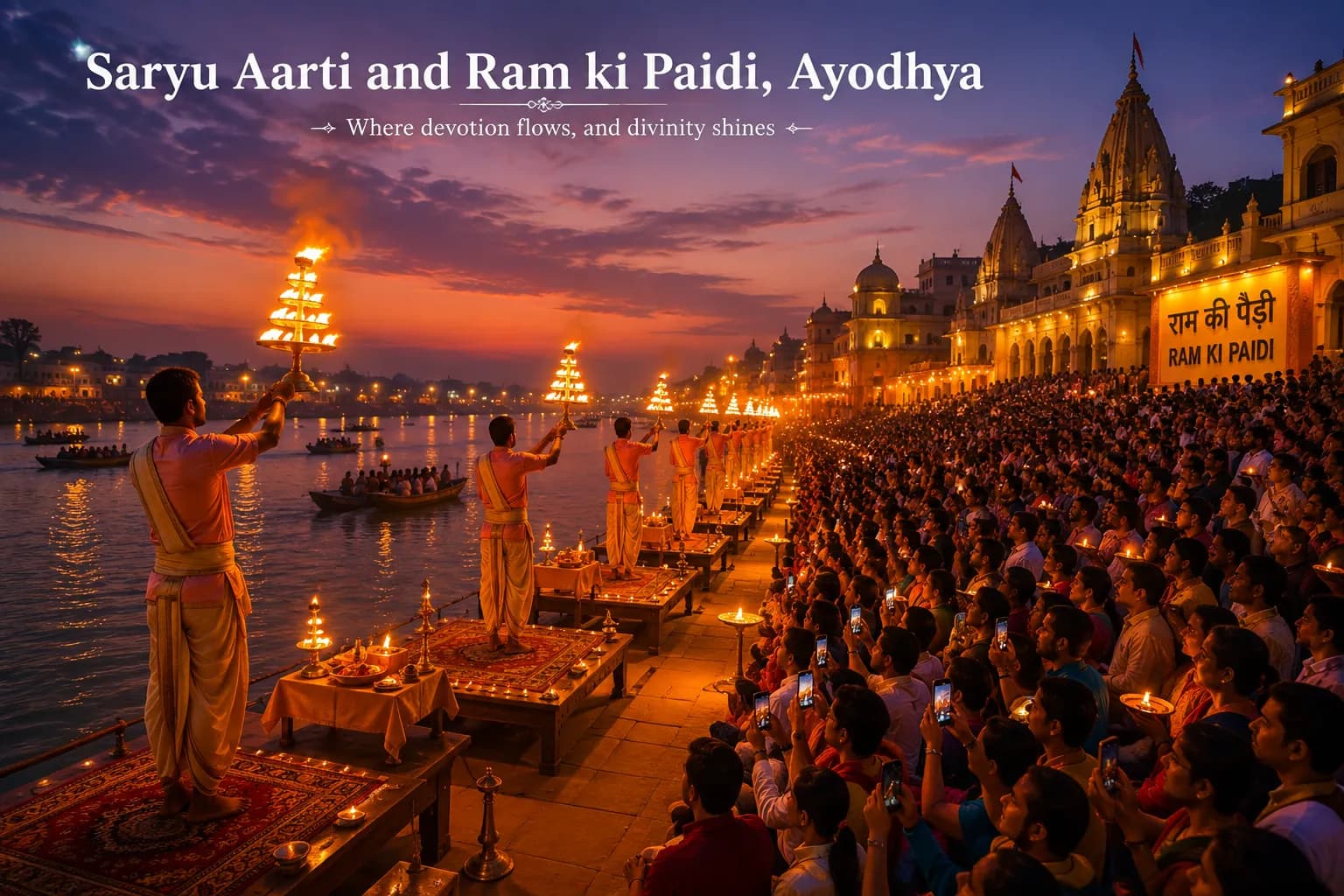
The grand Saryu aarti is held twice a day at Ram ki Paidi, in the soft light of dawn and again at sunset, and the evening aarti is the one most visitors come for. The timings shift with the season, following the sun: in the summer months, from about April to October, the evening aarti is around 7:00 to 7:45 PM; in the winter, from about November to March, it is earlier, around 6:00 to 6:45 PM; and the morning aarti is around 5:30 to 6:00 AM. The aarti lasts some thirty to forty-five minutes, and the ghat itself is open around the clock, and free. It is wise to arrive thirty to forty-five minutes early, for the steps fill up, and a good place near the front is worth the wait.
| Aarti or event | Timing | Notes |
|---|---|---|
| Morning Saryu aarti | 5:30 AM to 6:00 AM | A quieter, beautiful dawn aarti. |
| Evening aarti (summer, Apr-Oct) | 7:00 PM to 7:45 PM | The main aarti; at sunset. |
| Evening aarti (winter, Nov-Mar) | 6:00 PM to 6:45 PM | Earlier, with the earlier sunset. |
| Duration | About 30 to 45 minutes | Arrive 30 to 45 minutes early for a good spot. |
| Ghat access and the dip | 24 hours, free | No VIP pass or ticket needed. |
The Saryu aarti at Ram ki Paidi
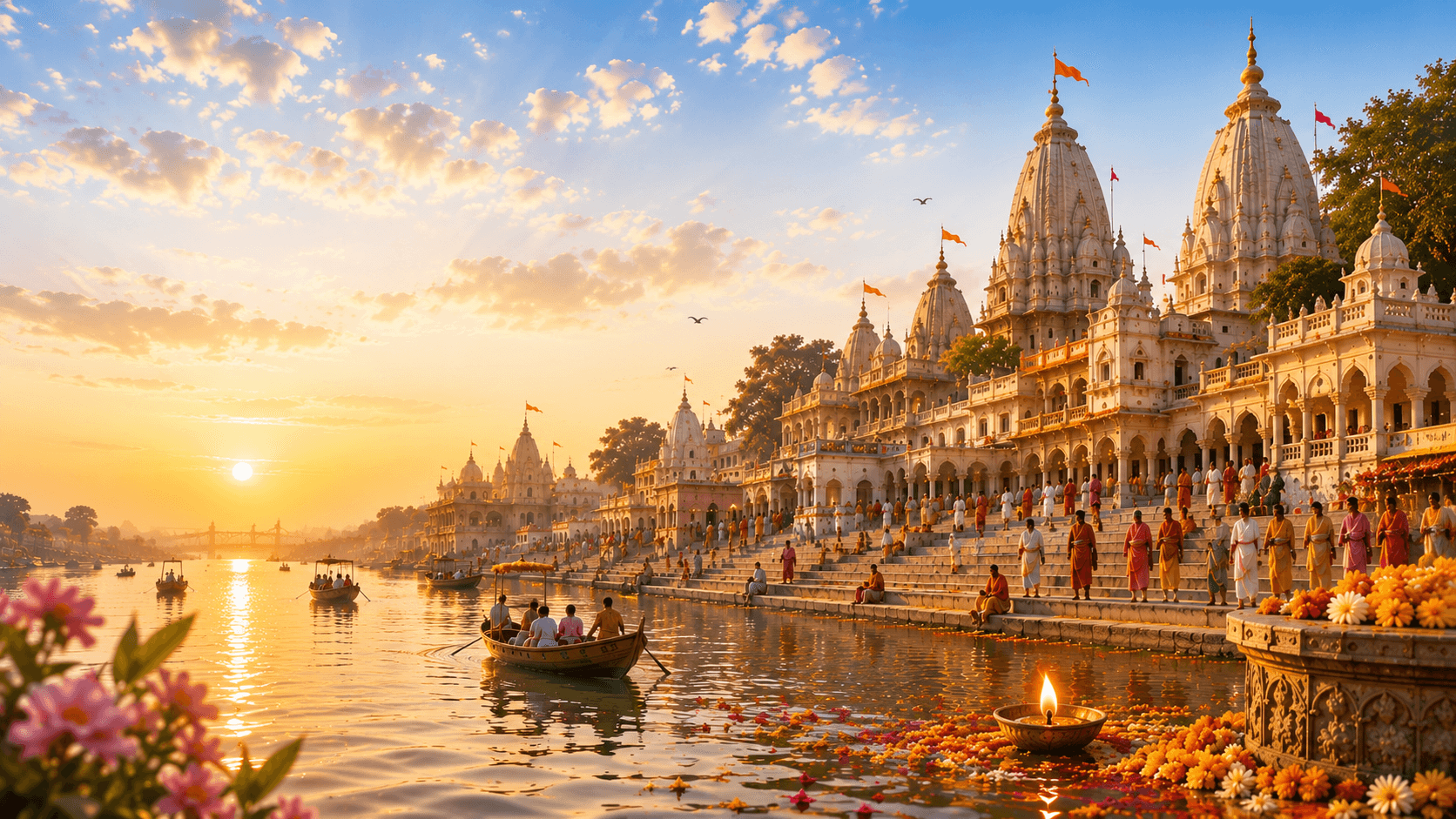
As the sun sinks over the Saryu and the day cools, the crowds gather on the great steps of Ram ki Paidi, and the grand Saryu aarti begins, one of the most beautiful and moving sights in all of Ayodhya. Young priests in saffron take their places at the water's edge, and to the deep sound of the conch and the ringing of bells, the beat of the drum and the chanting of the ancient shlokas, they raise the great tiered brass lamps, heavy with flame, and swing them in slow, sweeping circles toward the sacred river, offering fire and light and devotion to Maa Saryu, the river goddess. The many flames glow against the darkening water, the smoke of incense drifts across the steps, and thousands of voices take up the chant of Jai Shri Ram; and for those minutes, the whole riverfront becomes one great act of worship. It is a spectacle of light and sound and devotion that stays with every soul who witnesses it, the beating heart of the sacred river of Ram's city.
Those who know the great Ganga aarti of Kashi, at the Dashashwamedh Ghat, will feel a deep kinship here, for the Saryu aarti of Ayodhya is its sister, the same offering of fire to the sacred river, in the two holiest of the river cities; and to witness both, the aarti of Ganga at Kashi and the aarti of Saryu at Ayodhya, is one of the most beautiful things a pilgrim to this land can do.
Ram ki Paidi and the sacred Saryu
Ram ki Paidi is the great sweep of stone steps and ghats along the Saryu at Naya Ghat, the built and beautified heart of Ayodhya's riverfront, where the fifty-six ghats of the holy city gather the pilgrims to the water. Here they come to take the sacred dip, the Saryu snan; for the Saryu is one of the holiest of India's rivers, and to bathe in her waters, especially on the great days like Kartik Purnima and Ram Navami, is believed to wash away the sins of many lifetimes and to bring the deepest blessings. Along the ghats the pilgrims bathe and pray and offer lamps to the flowing water, and boats carry visitors out upon the river; and above it all rises the skyline of Ram's Ayodhya.
And the Saryu is no ordinary river but the very river of the Ramayana, woven through the whole story of Lord Ram. She was born, tradition tells, of the prayer of the sage Vashishtha, made to spring forth to purify the ancestors of the solar kings; she flowed past the palaces of Ram's Ayodhya and was the river of his childhood and his reign; and it was into her waters, at last, at Guptar Ghat downstream, that Lord Ram walked to lay down his earthly form and return to his heavenly abode. To sit on the steps of Ram ki Paidi, then, is to sit beside the river that holds the whole of Ram's life, from before his birth to his final departure.
Deepotsav: the original Diwali of Ayodhya
If there is one time when the Saryu ghats blaze into a glory seen nowhere else on earth, it is at Deepotsav, the great festival of lamps that Ayodhya keeps on the eve of Diwali. For Diwali itself began here, in this very city, in the age of legend: when Lord Ram returned home to Ayodhya after his fourteen years of exile and his victory over Ravana, the joyful people lit rows upon rows of lamps to welcome him, and that first festival of lights is the Diwali the whole world keeps to this day. And so Ayodhya, where it all began, celebrates the original and grandest Diwali of all.
At Deepotsav, the ghats of the Saryu, Ram ki Paidi chief among them, are lit with an ocean of earthen lamps, diyas, lined in their millions along every step and terrace by tens of thousands of volunteers, the little clay lamps made by the traditional potter communities of the region. In recent years the display has broken the world record again and again, growing from a few lakh lamps to well over twenty-five lakh, more than two and a half million diyas lit at once, the largest display of oil lamps ever recorded, verified from the sky and certified by the Guinness World Records; and in the same festival, more than two thousand priests have performed the Saryu aarti together in a single, breathtaking chorus, itself a world record. The whole riverfront becomes a sea of golden light reflected in the dark water, and the celebration blazes on with a grand procession of Ramayana tableaux, the arrival of artists as Ram, Sita and Lakshman in a Pushpak Vimaan, cultural performances, a dazzling laser and drone show telling the story of Ram, and fireworks over the river. It is, quite simply, one of the most spectacular sights in all of India, and to be at Ram ki Paidi for Deepotsav is a once-in-a-lifetime experience.
The laser and light show at Ram ki Paidi
On many evenings through the year, and not only at Deepotsav, Ram ki Paidi hosts a laser and light and sound show, in which the great story of the Ramayana is told in coloured light and lasers played across the water and the fountains, with music and narration, the flight of Hanuman, the war with Ravana, the return of Ram, all conjured in light upon the river. It is a wonderful, family-friendly way to spend an evening after the aarti, especially for children, who love it. The show usually runs in the evening, commonly around 7:30 PM on weekdays and with two shows, around 7:00 and 8:30 PM, on weekends, and tickets are modest, around Rs 100 to 200, available at the Ram ki Paidi counters.
The river of the whole Ramayana
The beauty of the Saryu is that her story is Ram's story, and her ghats and shrines trace his whole life along the water. Upstream stands the Vashishtha Kund, revered as the very source of the river, sprung from the sage's prayer. Along her banks rise the ancient guardian temple of Nageshwarnath, said to be founded by Ram's own son, and the riverside quarter with its old temples. Here at Ram ki Paidi is the beating heart of her worship, the grand aarti and the holy dip. And downstream lies Guptar Ghat, the place of Ram's final departure into her waters. To follow the Saryu from her source to Guptar Ghat is to follow Lord Ram from before his birth to his return to heaven; and this is a pilgrimage we love to guide along the sacred river.
A lifetime on the river, in my own words
By Rajeev Sharma, guide with Experience My India
I have spent my whole life on the river ghats, first on the Ganga at Kashi and then on the Saryu at Ayodhya, and I never tire of the aarti. I always tell my guests: you have seen, or you will see, the Ganga aarti at Kashi, and now you will see her sister, the Saryu aarti here at Ram ki Paidi, and you will carry both in your heart forever. I bring them to the steps well before time, find them a good place, and tell them the story of the river as we wait for the priests, how the Saryu was born of Vashishtha's prayer, how she was Ram's own river, how he departed into her at Guptar Ghat. And then the conch sounds and the lamps rise, and I watch my guests fall silent, and often weep.
If they have the time and wish, I take them out on a boat, for to see the aarti from the water, the whole lit riverfront glowing before you, is the most beautiful of all; and afterwards, if there are children, we go to the light show, which they adore. But the greatest thing of all is Deepotsav, the Diwali of Ayodhya, when the ghats are lit with millions of lamps and the whole city becomes a sea of gold. I tell my guests that this is where Diwali itself began, when Ayodhya lit the first lamps to welcome Ram home, and that to be here for it is a blessing of a lifetime. In more than forty years, the Saryu aarti at dusk, and the ghats of Deepotsav, are among the most beautiful things these old eyes have ever seen, and it is my joy to share them.
How to experience the Saryu aarti
- Arrive at Ram ki Paidi 30 to 45 minutes before the aarti time (summer around 7 PM, winter around 6 PM) to find a good place on the steps.
- Sit on the steps facing the priests and the river; the central platform is where the main aarti is performed.
- For the finest view, take a boat on the Saryu and watch the aarti from the water, the whole lit ghat before you.
- During the aarti, join the chanting, and receive the flame and blessing as the lamps are passed; offer a lamp to the river if you wish.
- Afterwards, stay for the laser and light show, or take the holy dip at the ghat, and walk the beautiful riverfront.
How to reach Ram ki Paidi
Ram ki Paidi is at Naya Ghat, on the Saryu, at the heart of Ayodhya's riverfront, close to the core temples, and easily reached on foot, by e-rickshaw, or by boat.
| From | Distance | Notes |
|---|---|---|
| The core temples (Ram Mandir, Hanuman Garhi) | A short ride or walk | By foot, auto or e-rickshaw. |
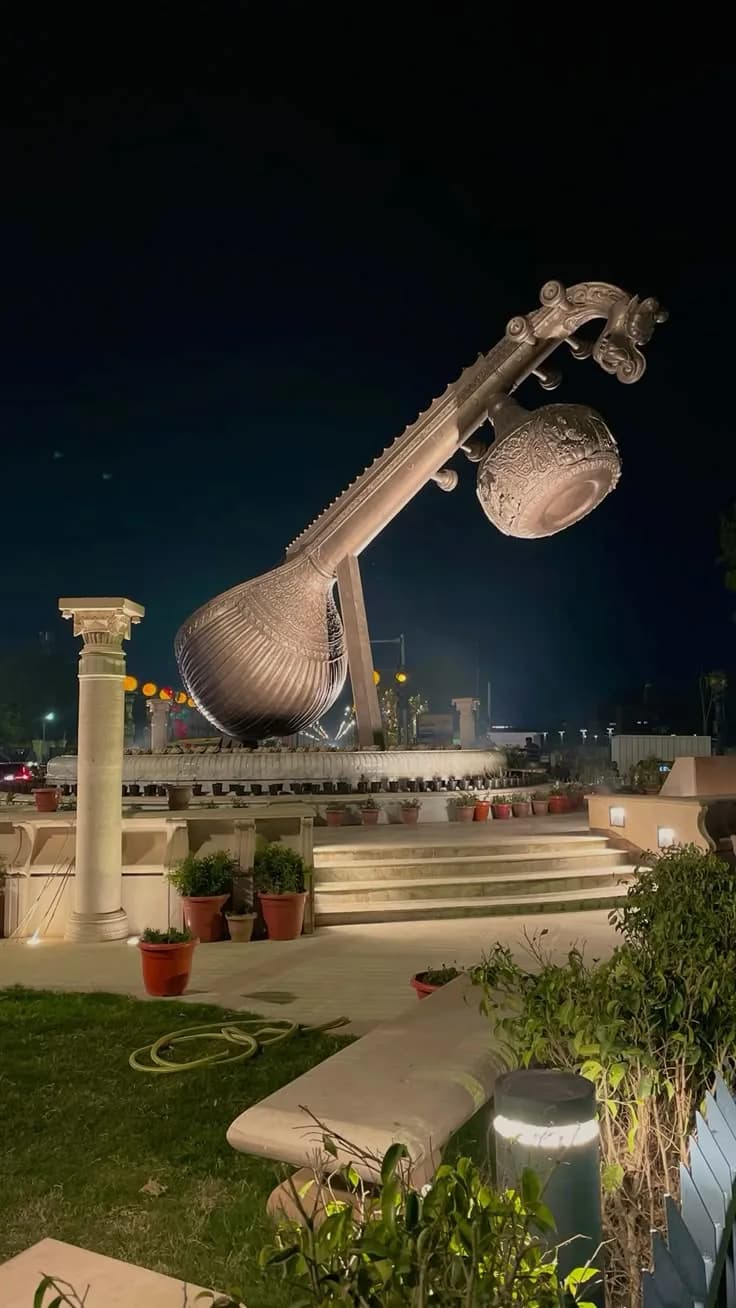
| Ram Katha Park and the Queen Heo Memorial | Adjacent | The cultural park and Deepotsav area, right by the ghats. |
| Ayodhya Dham Junction (railway) | A few km | By e-rickshaw, auto or taxi. |
| Maharishi Valmiki Airport, Ayodhya | About 12 km | The new airport; taxis and autos to the ghats. |
| By boat on the Saryu | From the ghats | For the aarti from the water and river sightseeing. |
It is the natural evening highlight of any Ayodhya visit.
Best time to visit and how to plan it
| When | Why |
|---|---|
| Sunset, for the evening aarti | The grand Saryu aarti, the highlight of any Ayodhya evening. |
| Deepotsav (eve of Diwali, Oct or Nov) | The record-breaking festival of millions of lamps, the most spectacular sight of all. |
| Kartik Purnima (Nov) | The greatest day for the holy dip in the Saryu. |
| Ram Navami (Mar or Apr) | Ram's birthday, when the ghats and the city are at their most festive. |
| Dawn, for the morning aarti | A quieter, beautiful aarti and the soft light on the river. |
- Pair the aarti with the core temples by day and the light show or a boat by evening.
- Book well ahead for Deepotsav, Kartik Purnima and Ram Navami, when Ayodhya is very crowded.
For Ayodhya, or a combined Kashi and Ayodhya pilgrimage with both great river aartis, planned end to end, see our tour packages.
Accessibility for elderly and mobility limited visitors
- Ram ki Paidi is a broad, stepped riverfront; the upper terraces are easier, and there are level spots to view the aarti.
- A boat is a wonderful, comfortable option for the elderly to see the aarti without managing the crowded steps.
- Come early, when it is calmer, and we can arrange a comfortable, well-placed spot and a helper.
- For the holy dip, the ghats have gentle steps, but a helping hand is wise; we assist elderly pilgrims.
Etiquette at the ghats
- The aarti is an act of worship; watch quietly and respectfully, and follow the crowd's lead.
- Dress modestly, especially if you take the holy dip; changing spots are available at the ghats.
- Do not litter or put plastic in the river; offer only the leaf-boat lamps sold for the purpose.
- Mind your belongings in the crowd, and keep children close on the steps and near the water.
Our guided Saryu aarti experiences and Ayodhya tours
We are a Varanasi and Ayodhya based operator, a unit of Experience My India, with more than forty years on the river ghats of Kashi and Ayodhya, and our own local guide and pandit in Ayodhya. The ghat and the aarti are free, so what we offer is the experience made perfect: a well-placed reserved spot on the steps or, best of all, a boat on the Saryu to watch the aarti from the water; a guide who tells you the story of the river and the aarti as it unfolds; a pandit to help you offer your own lamp or perform a ritual if you wish; and the whole evening, the aarti, the light show, the dip, planned and cared for.
| Service | Includes | Price |
|---|---|---|
| Saryu aarti boat experience | A boat on the Saryu for the aarti from the water, with a guide. | Contact us for pricing |
| Guided Saryu aarti evening | A reserved spot, a guide and a pandit, and the story of the river. | Contact us for pricing |
| Deepotsav Ayodhya package | The Deepotsav festival with viewing, stay and a guide (books far ahead). | Contact us for pricing |
| Full Ayodhya darshan with aarti | The core temples by day and the Saryu aarti by evening, with a guide. | Contact us for pricing |
| Kashi and Ayodhya two-aarti pilgrimage | The Ganga aarti of Kashi and the Saryu aarti of Ayodhya, with darshan and transfers. | Contact us for pricing |
Inclusions and exclusions are stated up front, with any taxes and conditions, and no charge appears later that was not named. The aarti and ghat are free; our charge is only for the boat, guiding and services. See all our tour packages for the full range.
Experience My India is a travel operator, not a temple or government body. The aarti, the ghat and the holy dip are free; our charge is only for the boat, our guiding and services. Timings, the Deepotsav dates and the show schedule are set by the authorities and can change.
Nearby sacred sites in Ayodhya
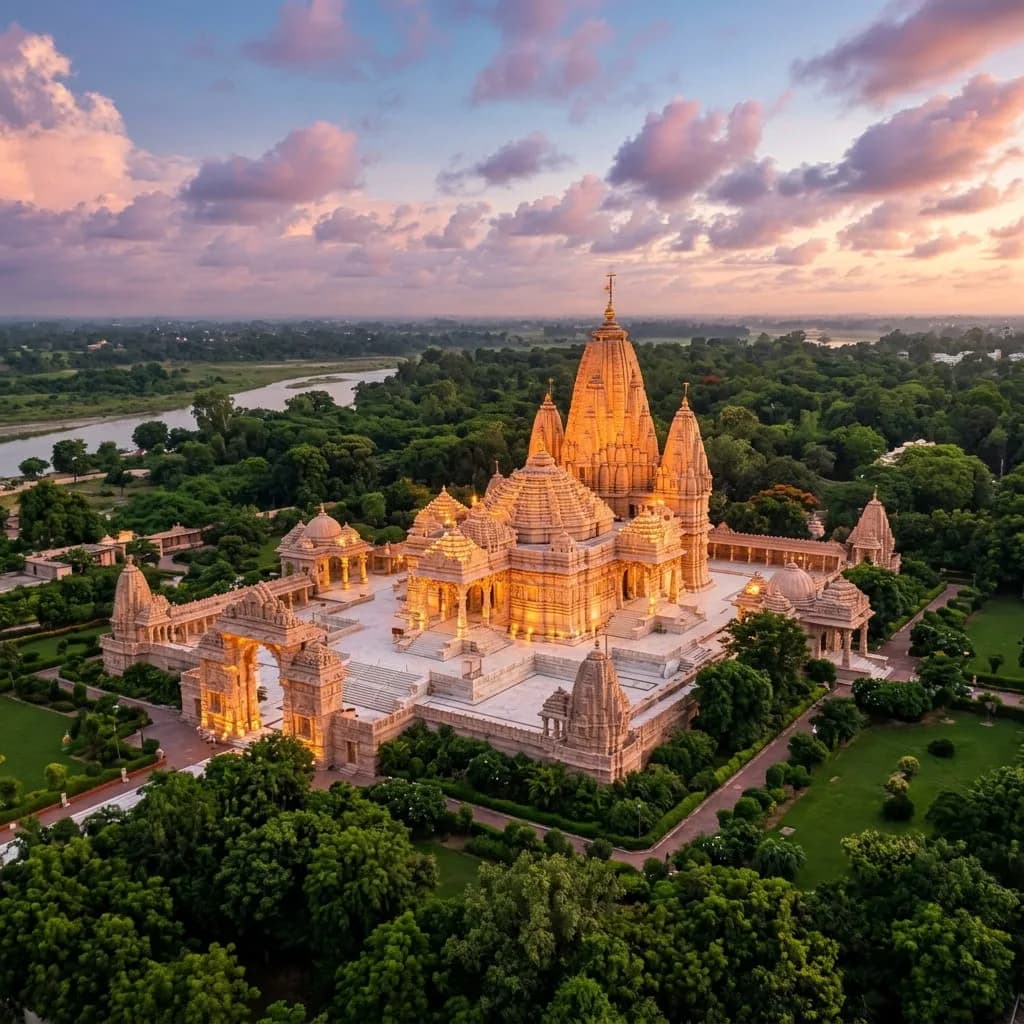
The Saryu ghats are the riverside heart of Ayodhya, ringed by its sacred sites.
| Site | What it is | Internal link |
|---|---|---|
| Nageshwarnath Temple | The ancient guardian Shiva temple of Ayodhya, by the river. | /temple/ayodhya/nageshwarnath-temple |
| Vashishtha Kund | The revered source of the Saryu, from the sage's prayer. | /temple/ayodhya/vashishtha-kund |
| Guptar Ghat | The place of Ram's final departure into the Saryu, downstream. | /temple/ayodhya/guptar-ghat |
| Ram Katha Park and Queen Heo Memorial | The riverside cultural park and the India-Korea memorial, adjacent. | /temple/ayodhya/ram-katha-park |
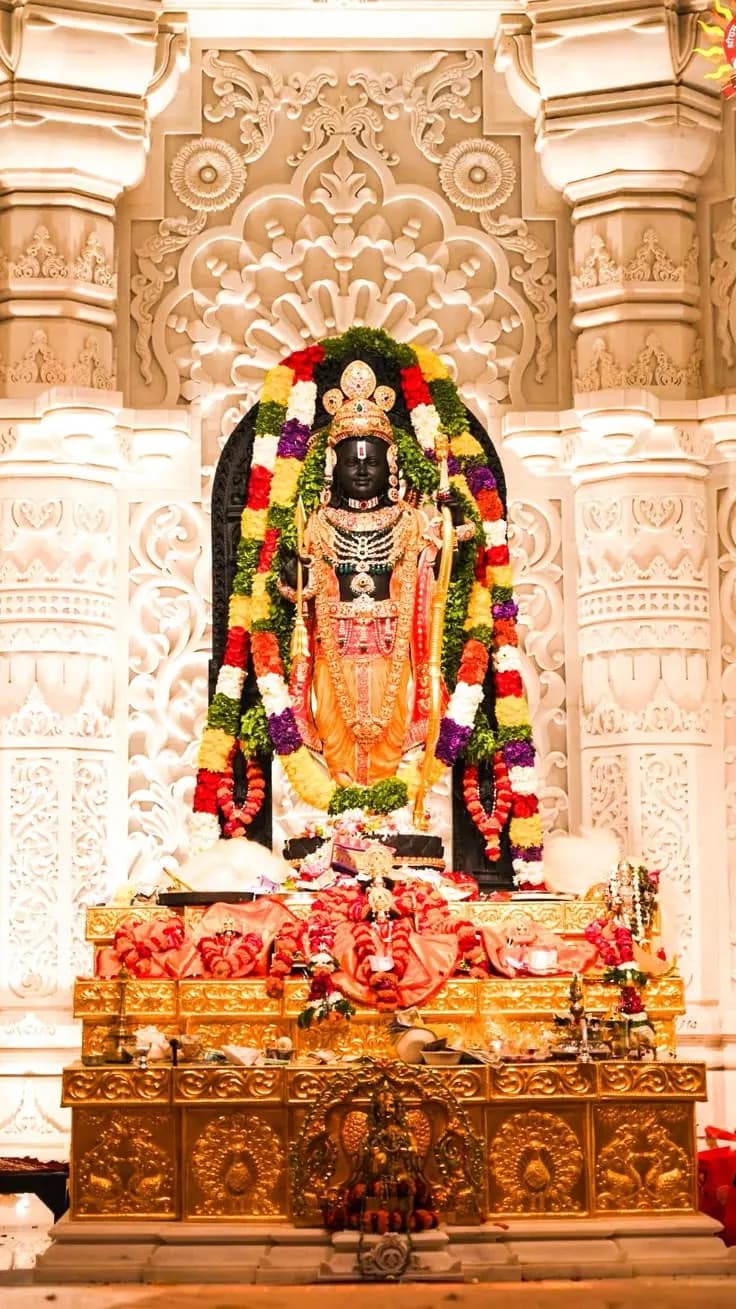
| Shri Ram Janmabhoomi Mandir | The grand temple of Lord Ram, in the core. | /temple/ayodhya/ram-janmabhoomi-mandir |
| Ganga Aarti, Dashashwamedh Ghat (Varanasi) | The great sister aarti of Kashi, on the Ganga. | /temple/varanasi/dashashwamedh-ghat-ganga-aarti |
For the Ram Mandir darshan and its free Sugam booking, see our Ram Janmabhoomi Mandir guide.