.webp&w=2048&q=75)
.webp&w=2048&q=75)
Essential info at a glance
| Detail | At a glance |
|---|---|
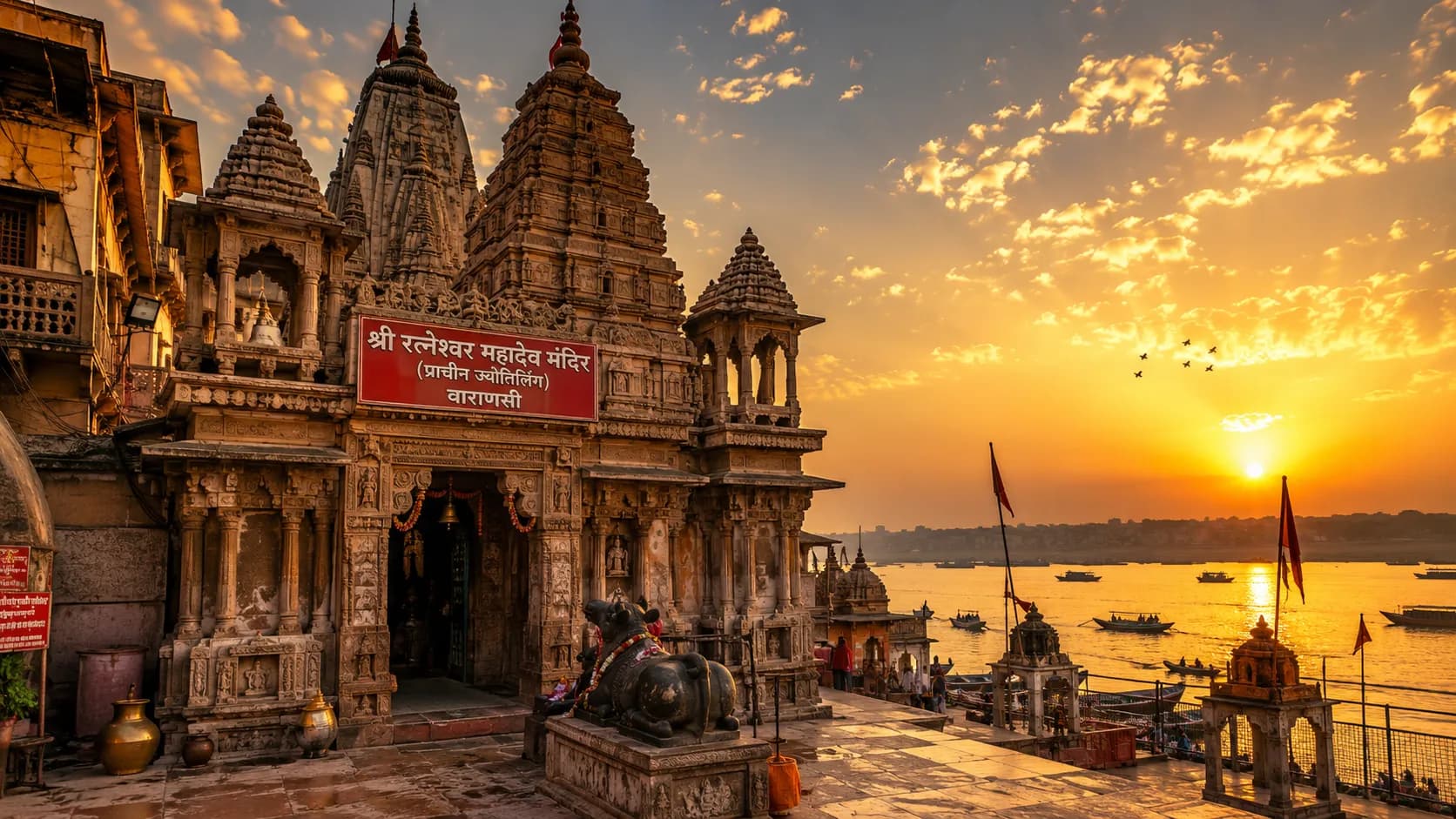
| What it is | The Ratneshwar Mahadev Temple, a Shiva shrine on the riverbank famous as the leaning temple of Varanasi, tilted about 9 degrees and submerged for much of the year. |
| Darshan hours | Generally accessible for darshan from 6:00 AM to 7:00 PM daily, when water levels permit; exterior views from the ghat are possible around the clock. |
| Aartis | Morning aarti at 6:00 AM and evening aarti at 7:00 PM. |
| Entry fee | Free. There is no ticket to view or visit the temple. |
| VIP passes | None. It is an open structure on the river ghat, with no VIP darshan system. |
| The tilt | About 9 degrees, more than the Leaning Tower of Pisa; the lower sanctum stays underwater for most of the year. |
| Best time | October to March for pleasant weather; April to June for low water, when more of the temple is reachable. |
| Location | On the riverbank at Manikarnika Ghat, in front of the Tarkeshwar Mahadev Temple, beside Scindia Ghat. |
Timings, darshan and aarti
This is not a temple you can rely on entering at any time of year, because the river decides. When the water is low, in the summer months, the sanctum is reachable and darshan runs on a daily schedule with morning and evening aartis. For much of the rest of the year the lower sanctum is underwater, and you admire the temple from the ghat or a boat rather than stepping inside.
| Ritual | Timing | Notes |
|---|---|---|
| Darshan (when accessible) | 6:00 AM to 7:00 PM daily | Depends on the water level; the sanctum is reachable mainly in the low-water summer months. |
| Morning aarti | 6:00 AM | As the temple opens for the day. |
| Evening aarti | 7:00 PM | The closing worship. |
| Exterior view | Around the clock | The leaning temple can be seen from the ghat or a boat at any hour, as water permits. |
The leaning temple: the tilt and the water
Two things make the Ratneshwar Mahadev Temple one of the most extraordinary sights in Varanasi. First, the lean: it tilts about 9 degrees, more than twice the famous lean of the Tower of Pisa. Second, the water: unlike every other temple on the ghats, which sit high on stone platforms, this one was built right at the river's edge, and its lower sanctum stays submerged in the Ganga for most of the year. In the past, when the doorway was underwater, the priest was said to dive down to perform the worship.
| The mystery | Detail |
|---|---|
| The tilt | About 9 degrees, more than the Leaning Tower of Pisa; the temple earns its nickname, the leaning temple of Varanasi. |
| It was once upright | Photographs from the 1860s show the temple standing straight, so the lean developed later, most likely from a waterlogged foundation. |
| Submerged | The lower sanctum is under the Ganga for much of the year; only the summer low water fully reveals it. |
| A later scar | A lightning strike in 2015 caused slight damage to parts of the shikhara, the tower. |
| The nickname | Also called Kashi Karvat, and remembered in legend as the temple that leans as if turning away. |
Because old images show it standing straight, the temple is a genuine puzzle: not built to lean, but tilted over time by the river it was so boldly built beside. That slow, unfinished quality, a shrine the Ganga seems to be gently claiming, is exactly what makes it so haunting to see.
The legends and the enigma of who built it
Almost nothing about this temple is settled, and that is part of its spell. Even its builder is disputed. Some say it was raised by a servant of Raja Man Singh, some by a servant of the great Ahilyabai Holkar, and others by the Scindia queen of Gwalior, Baiza Bai, in the 19th century; revenue records point to the 1820s, while other accounts credit the Amethi royal family. No single answer has ever been proven.
The best loved legend explains the lean as a curse. In the story, a devoted son built the temple in the name of his mother, Ratna Bai, and then proudly declared that he had at last repaid the debt he owed her. But in the tradition a mother's debt can never be repaid, and for that pride the temple was cursed to lean and to sink, never to stand upright or fully rise again. Whether you take it as history or as parable, it gives the tilted shrine a strange, human poignancy.
Architecture and what to look for
For all its mystery, the temple itself is an elegant, classical Shiva shrine. Look for the lion on its pinnacle, and the fine carvings on the stonework depicting scenes of the Krishna Leela and the Dashavatar, the ten incarnations of Vishnu. Within the sanctum, when the water allows, are consecrated Shiva lingas. It stands on the riverbank in front of the Tarkeshwar Mahadev Temple, at the northern end of the ghats where Manikarnika meets Scindia Ghat, which is the wider riverfront you will pass on the way. See our guide to Scindia Ghat for the setting around it.
When and how to see the leaning temple
Timing matters more here than at almost any other temple in the city, because the river changes what you can see.
| When | What you get |
|---|---|
| October to March | Pleasant weather and clear light; the temple stands partly in the water, dramatic from a boat. |
| April to June (low water) | The water drops, revealing more of the temple, so the lower parts become easier to reach and darshan is more likely. |
| Monsoon and after | The temple is most deeply submerged, often only the leaning tower showing above the river. |
| Sunrise | The best light and the calmest water for the classic photograph from a boat. |
-
Go at sunrise, when the light is soft and the river is calm.
-
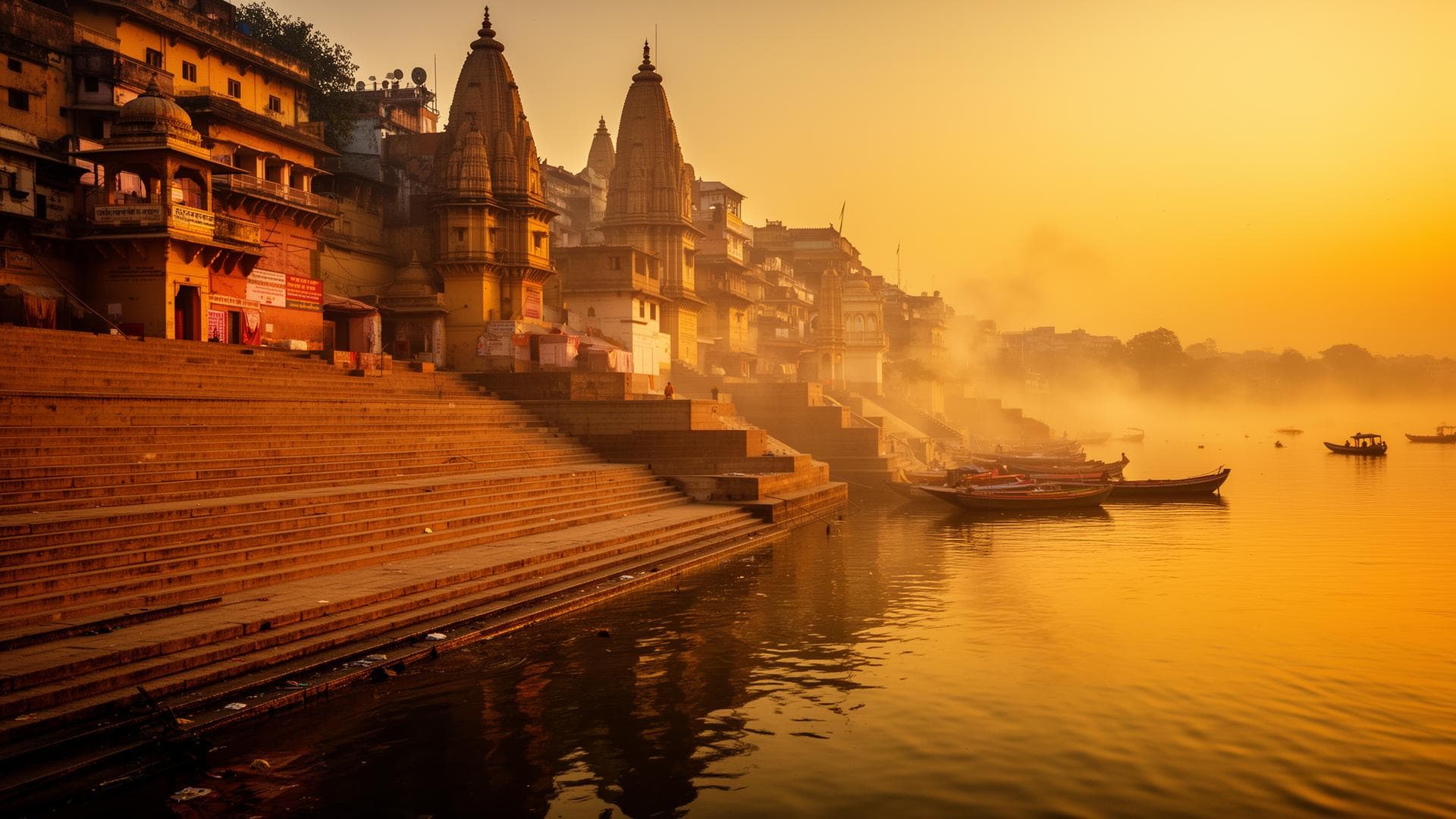
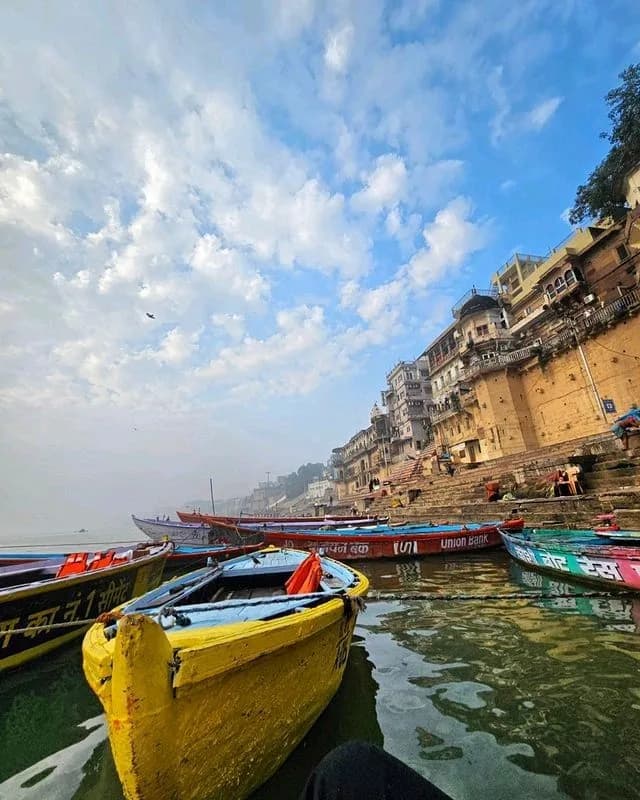
View from a boat on the Ganga, which is how the temple is best seen and photographed, and the only way to see it at all when the water is high.
-
If you visit in the low-water summer months, ask whether the sanctum is reachable that week for darshan.
-
Be respectful, as the temple sits right beside the Manikarnika cremation ghat; photograph the temple, never the cremations.
We arrange the sunrise boat, the timing and a guide who knows exactly where to hold the boat for the leaning temple.
Seeing the leaning temple at dawn, in my own words
By Rajeev Sharma, Varanasi local
Of all the sights I show my guests on the river, this is the one that stops them mid sentence. We take a boat out before dawn, and as the light rises the leaning temple comes up out of the Ganga, tilted, half drowned, and still standing. I let them look for a while before I say anything. Then I tell them the truth of it: that in old photographs it stood perfectly straight, that nobody can agree who built it, and that the loveliest story says a son cursed it by boasting he had repaid his mother's debt.
In the summer, when the river is low, we sometimes see the lower steps of the temple emerge and a little worship happening; the rest of the year, only the tower shows and we simply admire it from the water. It sits right next to the burning ghat at Manikarnika, so I keep the boat quiet and respectful. There is something about a temple the river is slowly taking back that stays with people long after the grand aarti has faded from memory.
In more than forty years of guiding, no photograph my guests take surprises their friends more than this one.
How to reach the Ratneshwar Mahadev Temple
The temple stands on the riverbank at Manikarnika Ghat, at the northern end of the main ghats beside Scindia Ghat. There is no road to it; you see it from the ghat steps or, far better, from a boat.
| From | Distance | Notes |
|---|---|---|
| Manikarnika Ghat | At the ghat | The temple stands on the riverbank here; visit the cremation ghat with respect. |
| Scindia Ghat | Adjacent | The neighbouring ghat to the north, from where the temple is often admired. |
| Dashashwamedh Ghat | About 1.2 km | A short walk or boat ride south to the grand evening aarti. |
| Varanasi Junction (Cantt) | About 5 km | Autos and cabs to the edge of the old city, then on foot or by boat. |
| Airport | About 25 km | Lal Bahadur Shastri International Airport, roughly an hour by road. |
By boat is the best and often the only way to see the leaning temple, and it links naturally with the ghats north and south in one sunrise journey.
Accessibility for elderly and mobility limited visitors
- There is no step free access to the temple itself; for most of the year it can only be viewed, not entered.
- A boat is by far the easiest and best way to see it, since the temple is meant to be admired from the water.
- The sunrise is calm and uncrowded, which suits a gentle visit.
- We arrange the boat and the drop points so a senior visitor is comfortable throughout.
Nearby ghats and temples to combine
The leaning temple is part of the quiet northern riverfront, easy to combine on a single sunrise boat journey.
| Site | What it is | Internal link |
|---|---|---|
| Scindia Ghat | The quiet, photogenic ghat beside the temple; the setting around it. | /varanasi/scindia-ghat |
| Manikarnika Ghat | The great cremation ground on whose riverbank the temple stands; visit with respect. | /varanasi/manikarnika-ghat |
| Dashashwamedh Ghat | Home of the grand evening Ganga aarti, a short way south; our Ganga aarti experience. | /varanasi/dashashwamedh-ghat |
| Kashi Vishwanath Temple | The Jyotirlinga in the old city, a short walk through the lanes. | /varanasi/kashi-vishwanath-temple |
For a sunrise boat that takes in the leaning temple with the wider riverfront and the old city temples, see our Varanasi tour packages.
Safety and practical tips
| Watch out for | How to handle it |
|---|---|
| Boatmen quoting inflated prices for a sunrise ride. | Agree the boat and price in advance, or book through us for a fair fixed rate. |
| Expecting to walk into the temple year round. | It is submerged for much of the year; entry is mainly possible in the low-water summer months. |
| Respect near the adjacent Manikarnika cremation ghat. | Photograph the leaning temple, never the cremations. |
| Boarding without a life jacket, risky after the monsoon. | Always insist on a life jacket; we provide them as standard. |
A guided sunrise boat removes the haggling and the guesswork so you can simply take in the view.
Our sunrise boat experiences
We are a Varanasi based operator, a unit of Experience My India, with more than forty years of guiding pilgrims across Kashi, Ayodhya, and Prayagraj. The temple is free, so what we arrange is the experience around it: a sunrise boat that holds the right position for the leaning temple, a fair fixed price, a life jacket, and a local guide who tells you its story.
| Experience | Includes | Price |
|---|---|---|
| Sunrise ghats and leaning temple boat | A dawn boat to the leaning temple and the northern ghats, with a guide. | Contact us for pricing |
| Sunrise and evening aarti day | The leaning temple at sunrise and the grand Dashashwamedh evening aarti in one day. | Contact us for pricing |
| Old city temples and ghats | Kashi Vishwanath, the leaning temple and the riverfront in one planned outing. | Contact us for pricing |
Inclusions and exclusions are stated up front, with any taxes and conditions, and no charge appears later that was not named. See all our Varanasi tour packages for the full range.
Experience My India is a travel operator. Boat prices vary with season, demand and boat type; we give you a fair fixed rate before you board.