.webp&w=2048&q=75)
.webp&w=2048&q=75)
Essential info at a glance
| Detail | At a glance |
|---|---|
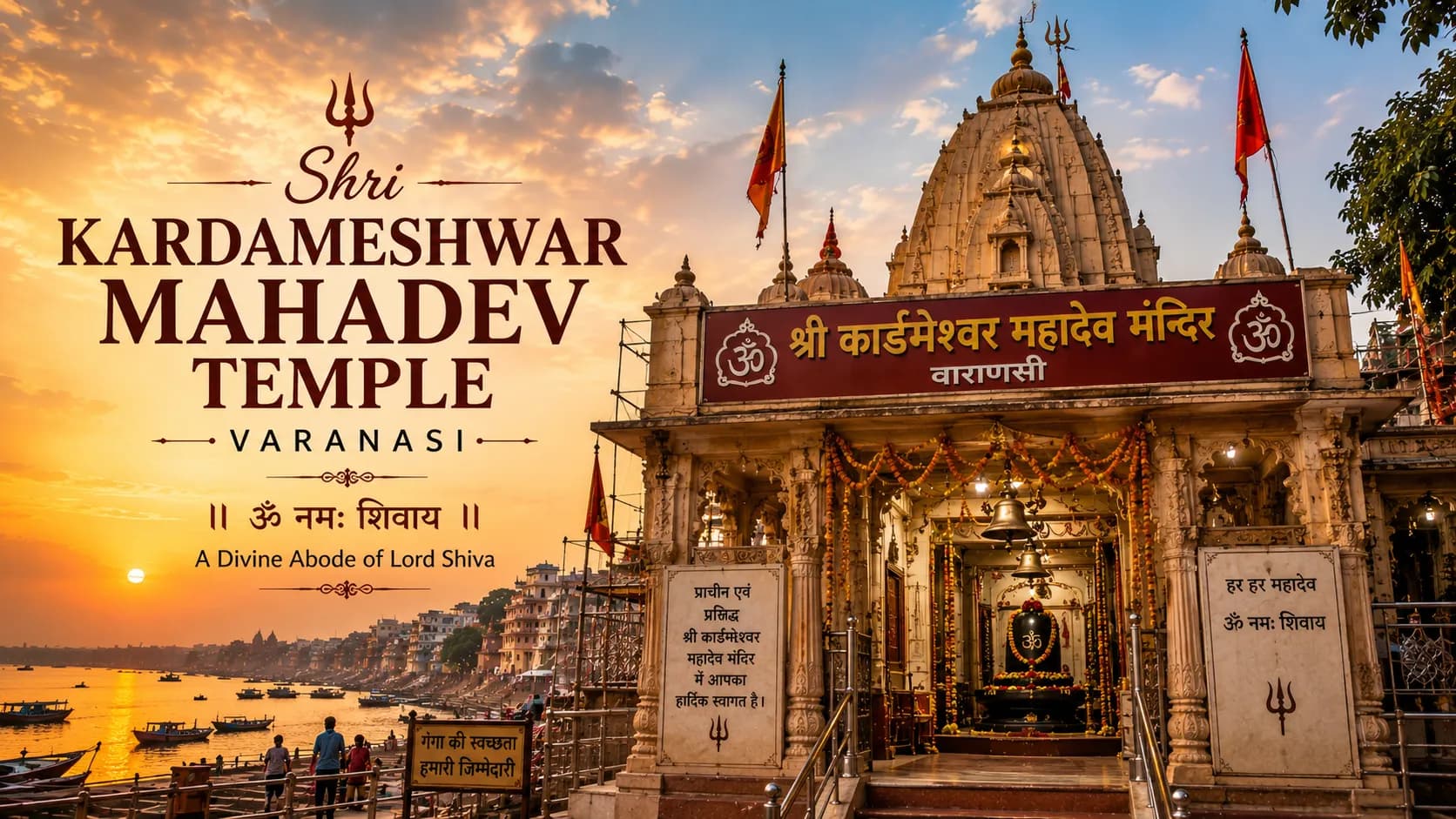
| What it is | Widely regarded as the oldest surviving temple in Varanasi, a medieval Nagara stone temple to Shiva, beside the Kardama Kund at Kandwa. |
| Why it is special | It rarely escaped the destruction that levelled Kashi's old temples, so it survives as a window into the city's ancient architecture. |
| Morning hours | 5:30 AM to 12:00 PM, with the morning aarti around sunrise. |
| Evening hours | 4:00 PM to 9:00 PM, with the evening aarti around sunset. |
| Entry fee | Completely free. There is no VIP darshan or ticket. |
| Panchakroshi Yatra | The first night halt of the sacred Panchakroshi Yatra, the circumambulation of Kashi. |
| Location | Kandwa village, about 7 km southwest of Assi Ghat, on the southern edge of the city. |
| Good for | Heritage, architecture, a peaceful darshan away from the crowds. |
Kardameshwar Mahadev temple timings and aarti
The temple keeps morning and evening hours with a closed period through the middle of the day, and it is a peaceful, uncrowded village shrine on most days. The exceptions are Mondays in the holy month of Shrawan and Mahashivratri, when pilgrims come in numbers, and the Panchakroshi season.
| Session | Timing | Notes |
|---|---|---|
| Morning | 5:30 AM to 12:00 PM | The morning aarti is around sunrise, roughly 5:30 to 6:00 AM. |
| Evening | 4:00 PM to 9:00 PM | The evening aarti is around sunset, roughly 7:00 to 7:30 PM. |
| Busy days | Shrawan Mondays and Mahashivratri | Otherwise calm; come early or in the late evening for a quiet darshan. |
*Entry is free and there is no VIP darshan.
The oldest surviving temple in Kashi
Varanasi is one of the oldest living cities on earth, yet almost none of its ancient temples survive, because over the centuries the great shrines of Kashi were destroyed and rebuilt again and again. That is what makes Kardameshwar so precious. It is widely regarded as the oldest surviving temple in the city, the rare shrine that came through the destruction of the medieval period intact, and it has been worshipped without a break ever since. To stand before it is to see, more or less, what the temples of old Kashi actually looked like, something no other temple in the city can quite offer.
It is also, quietly, a living temple, not a ruin or a museum piece. The lamps are still lit, the aartis still sung, the villagers still come. That combination, of great antiquity and unbroken worship, is exactly what gives the place its rare, peaceful power. It sits well off the tourist trail, so most visitors to Varanasi never see it, which is part of why those who do never forget it.
The medieval architecture and the Kardama Kund
The temple is built in the Nagara style, its stone tower, the shikhara, rising to the east above a large tank of water, the Kardama Kund. Most sources date the present structure to around the 11th to 12th century, the work of the Gahadavala kings, with earlier elements and later additions, and its finest carving recalls the great temples of Khajuraho. Over its stonework are worked images of many deities, giving it the richness of a true medieval shrine.
| Feature | Detail |
|---|---|
| Style | Nagara, with a stone shikhara rising above the sacred tank; most often dated to about the 11th to 12th century. |
| The carvings | Images of many deities, including Ardhanareshwar, Brahma, Vishnu and Uma Maheshwar, with detailing reminiscent of Khajuraho. |
| The Kardama Kund | The large tank in front of the temple, in which it is beautifully reflected; the adjacent tank was rebuilt by Rani Bhavani in the 18th century. |
| The sacred well | The Kardama Kupa, a deep round well whose water is used in worship; pilgrims look for their reflection in it as a sign of long life. |
| Its survival | Almost uniquely among Kashi's old temples, it survived the medieval destruction largely intact. |
Sage Kardama, Lord Rama, and the legend
The temple takes its name from Rishi Kardama, a Prajapati and, in the tradition, a son of Brahma and one of the progenitors of life, the father of the sage Kapila who founded the Samkhya philosophy. It is said that Kardama performed severe penance here for thousands of years and himself consecrated the Shiva lingam, which is therefore called Kardameshwar.
The temple is described in the Kashi Khand of the Skanda Purana, and it holds a beautiful connection to Lord Rama. The scriptures tell that after killing Ravana, himself a great devotee of Shiva, Rama was burdened with the sin of Brahmahatya, and on the counsel of his guru Vashishtha he came here with his family, bathed in the Kandwa tank, and circumambulated Shiva and Parvati, and so was freed of the sin. From that, it is said, the tradition of the parikrama, the sacred circling, was born. For a company that also guides pilgrims in Ayodhya, the city of Rama, that link makes this quiet temple especially dear.
The Panchakroshi Yatra: the circle of Kashi
Kardameshwar is not only the oldest temple in the city; it is the gateway to one of its greatest pilgrimages. The Panchakroshi Yatra is the sacred circumambulation of the whole territory of Kashi, a walk of around 80 km that traditionally takes five days, with five night halts and more than a hundred shrines along the way, undertaken by pilgrims to earn liberation. Kardameshwar, at Kandwa, is the first night halt, the place where the great circle begins.
For pilgrims, then, this temple is a beginning, the first step of a journey around the sacred city, most often walked around Mahashivratri and in the Panchakroshi season. Even if you do not undertake the full yatra, to stand at its starting point, before the oldest surviving temple in Kashi, is to feel the deep, patient devotion that has circled this city for a thousand years.
A quiet heritage darshan, in my own words
By Rajeev Sharma, Varanasi local
Kardameshwar is the temple I take the traveller who has already seen the famous Kashi and wants something deeper. It is out at Kandwa, past BHU, in a quiet village, and when you come upon the old stone temple reflected in its tank, with almost no one around, it feels like you have found a secret. I tell them the thing that always surprises them, that this is the oldest temple left in the whole city, the one that survived when the rest were destroyed, so this is what old Kashi looked like.
I show them the carvings, the deities worked into the stone, and the old well where pilgrims look for their reflection to know their life is safe. I tell them that Rama himself is said to have come here to be freed of a great sin, and that this is where the Panchakroshi Yatra, the great circle of Kashi, begins. After the intensity of the ghats, this peaceful, ancient place is a kind of balm, and it gives people a sense of the sheer depth of time under this city.
In more than forty years of guiding, this is the temple that most rewards the curious traveller willing to go a little off the map.
Entry, rules, and what to carry
- Entry is free, and there is no VIP darshan. It is a calm village temple; simply arrive during opening hours.
- Dress modestly, covering shoulders and knees, and keep your voice low near the sanctum.
- Footwear comes off before entry; leave it at the counter or with your guide.
- It is remote, so carry water, and a little cash for offerings, as there are few shops nearby.
- Photography of the temple and the kund is usually welcome; be respectful during worship.
How to reach Kardameshwar Mahadev Temple
The temple is at Kandwa, on the southern edge of the city, about 7 km southwest of Assi Ghat and beyond the BHU area. Unlike the old city temples, you can drive close to it, so a car or auto is the easy way to come.
| From | Distance | Notes |
|---|---|---|
| Assi Ghat | About 7 km southwest | The nearest ghat; combine with a southern cluster visit. |
| Lanka and BHU | A short drive | The temple is beyond the university, toward Kandwa and Chitaipur. |
| Varanasi Junction (Cantt) | About 14 km | By taxi or auto; allow for city traffic. |
| Airport | About 30 km | Lal Bahadur Shastri International Airport, roughly an hour or more by road. |
Because it is out of the centre and off the usual route, a car with a driver who knows the way makes it easy, and lets you pair it with the southern temples and Assi.
Best time to visit and how to plan it
| When | Why |
|---|---|
| Early morning, 6 to 8 AM | A peaceful darshan with beautiful light on the temple and its reflection in the tank. |
| Late evening, 7:30 to 9 PM | Quiet after the evening aarti. |
| Mahashivratri and the Panchakroshi season | The temple comes alive as the yatra begins; atmospheric but crowded. |
| Shrawan Mondays | Busy with Shiva devotees; expect crowds. |
- Pair it with Assi Ghat, Durga Kund and Sankat Mochan for a full southern day.
- Allow 30 to 45 minutes at the temple, more if you linger by the kund.
For a heritage day or a Panchakroshi Yatra planned end to end, see our Varanasi tour packages.
Accessibility for elderly and mobility limited visitors
- Kandwa is reachable by road, and the site is largely flat, far easier than the old city lanes and ghat steps.
- There are some steps around the temple and the tank; a relaxed pace helps.
- It is calm and uncrowded on normal days, which suits a gentle visit.
- We arrange a car to the temple and plan the day so a senior visitor is comfortable.
Combine it with the southern temples and ghats
Kardameshwar sits near the southern cluster, so it pairs naturally with Assi and the temples around BHU.
| Site | What it is | Internal link |
|---|---|---|
| Assi Ghat | The southern ghat, famous for the sunrise Subah-e-Banaras aarti. | /temple/varanasi/assi-ghat |
| Durga Kund (Durga Mandir) | The red Nagara temple to Durga, whose tank shares the Rani Bhavani patronage. | /temple/varanasi/durga-kund |
| Sankat Mochan Hanuman Temple | The beloved Hanuman temple founded by Tulsidas. | /temple/varanasi/sankat-mochan-hanuman-temple |
| New Vishwanath Temple (BHU) | The marble Birla temple on the university campus. | /temple/varanasi/new-vishwanath-temple-bhu |
For the grand evening aarti back in the city, see our evening Ganga aarti experience.
Practical tips
| Good to know | Detail |
|---|---|
| It is out of the centre. | Plan your transport; a car and driver is the easy way, as autos back can be scarce. |
| It is a peaceful heritage site. | Come for the architecture and the calm, not for a big temple spectacle. |
| The well and the tank. | Look for your reflection in the old well, as pilgrims do; enjoy the temple mirrored in the tank. |
| Few facilities nearby. | Carry water and small cash; there are few shops in the village. |
Our guided heritage and Panchakroshi visits
We are a Varanasi based operator, a unit of Experience My India, with more than forty years of guiding pilgrims across Kashi, Ayodhya, and Prayagraj. Entry is free, so what we arrange is the day around it: a car and a knowledgeable guide who brings the history alive, a route that pairs this heritage gem with the southern temples, and, for the devout, help with the Panchakroshi Yatra that begins here.
| Package | Includes | Price |
|---|---|---|
| Kardameshwar heritage visit | A car, a guide, and the oldest temple with its kund and legends. | Contact us for pricing |
| Southern temples and Kardameshwar | Assi, Durga Kund, Sankat Mochan, BHU and Kardameshwar in one day. | Contact us for pricing |
| Panchakroshi Yatra assistance | Guidance and support for the sacred circumambulation that starts here. | Contact us for pricing |
Inclusions and exclusions are stated up front, with any taxes and conditions, and no charge appears later that was not named. See all our Varanasi tour packages for the full range.
Experience My India is a travel operator, not the temple administration. Prices are ours. Temple timings and rules are set by the temple and can change.