.webp&w=2048&q=75)
.webp&w=2048&q=75)
Essential info at a glance
| Detail | At a glance |
|---|---|
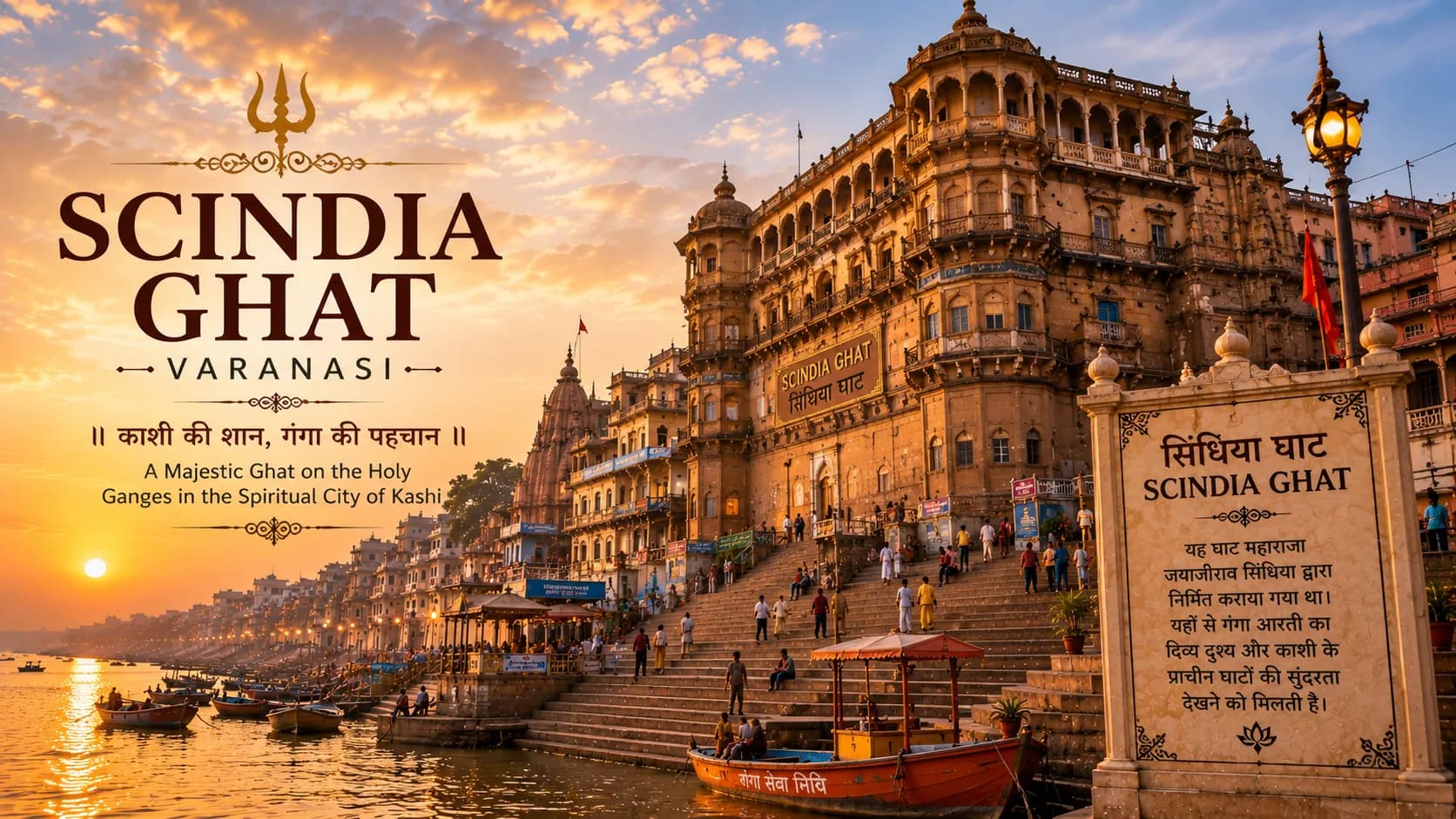
| What it is | A quiet, highly photogenic ghat on the northern riverfront, beside the Manikarnika cremation ghat, known for meditation, sunrise and old shrines. |
| Ganga Aarti | There is no grand evening aarti here; the famous one is at Dashashwamedh Ghat, around 7:00 PM in summer and 6:00 PM in winter. |
| Entry fee | None. It is an open public riverbank, with no tickets or VIP passes. |
| Built | As a pucca ghat in the 1830s by Maharani Baiza Bai of Gwalior, of the Scindia dynasty. |
| Famous neighbour | The leaning Ratneshwar Mahadev Temple stands on the riverbank beside it, covered in full on its own page. |
| In the lanes above | The Siddha Kshetra, a maze of old shrines; by tradition, Agni, the god of fire, was born here. |
| Best time | Early morning, 5:30 to 7:00 AM, for meditation, photography and a sunrise view from a boat. |
| Location | Near Dattatreya Math, on the riverfront, north of Dashashwamedh and beside Manikarnika. |
Is there a Ganga Aarti at Scindia Ghat?
No large, synchronised public Ganga Aarti is staged at Scindia Ghat. What happens here are small, local prayers and lamp offerings near the shrines and the Dattatreya Paduka, quiet and unstaged. That is precisely its charm: while the crowds gather elsewhere, Scindia stays calm, which is why locals and photographers love it and why it is one of the best places on the river simply to sit.
For the grand daily spectacle, head a little south to Dashashwamedh Ghat, where the famous multi priest aarti takes place every evening. Read our full guide to the Dashashwamedh Ghat Ganga Aarti and let us arrange a boat that takes in Scindia on the way.
The leaning temple beside Scindia Ghat
Scindia's most famous neighbour is the Ratneshwar Mahadev Temple, the leaning, half submerged Shiva shrine that stands on the riverbank where Scindia meets Manikarnika. It tilts more than the Leaning Tower of Pisa and sits under the Ganga for much of the year, and it is one of the most photographed sights on the whole river. Most visitors admire it from a boat as part of a Scindia sunrise.
Because the leaning temple is a story in its own right, its full detail, the darshan and aarti timings, the mystery of the tilt, and the legends behind it, lives on its own page. See our complete guide to the Ratneshwar Mahadev Temple, the deep-dive on the leaning temple.
The quiet ghat: meditation, sunrise and photography
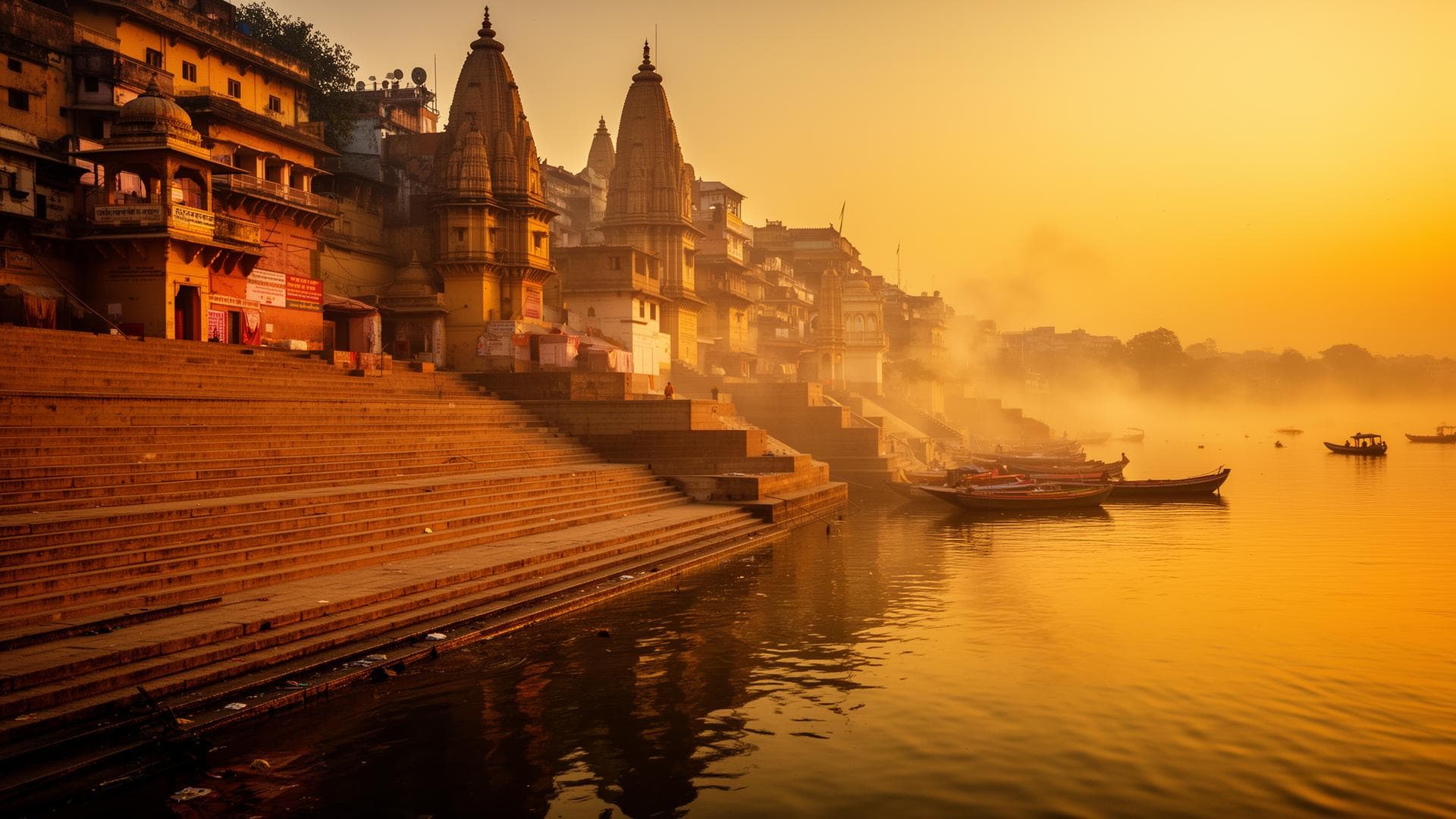
Scindia is one of the calmest stretches of the Varanasi riverfront, and that calm is the reason to come. It sits away from the bustle of Dashashwamedh, and while the great cremation ghat of Manikarnika is right next door, Scindia itself is a place to slow down, meditate on the steps, and watch the city and the river wake up. Early in the morning the light is soft, the water is still, and the whole northern riverfront glows, which is why photographers count it among the best sunrise spots in Kashi.
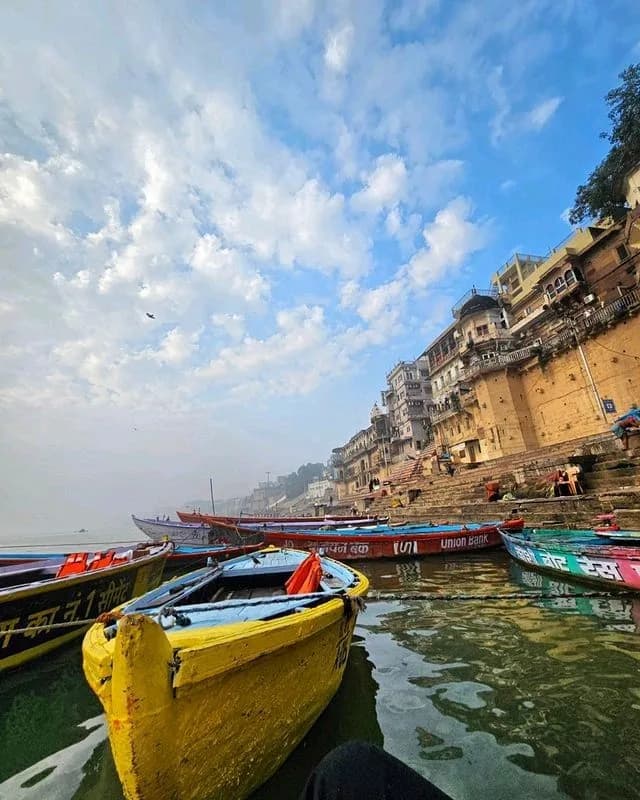
The most rewarding way to take it in is from a boat at first light, drifting quietly past the steps and the shrines and the leaning temple on the water. Because Manikarnika adjoins it, this is a stretch of river to move through gently and respectfully; keep your voice low and your camera away from the cremation ghat. Done right, a Scindia sunrise is one of the most peaceful hours you can have in a city that is rarely quiet.
- Come at sunrise, roughly 5:30 to 7:00 AM, for the softest light and the calmest water.
- Bring a wrap in winter; the mornings on the river can be cold before the sun climbs.
- Sit for a while on the steps or in the boat; Scindia rewards stillness more than sightseeing.
Agni's birthplace and the hidden shrines above the ghat
Scindia rewards the curious, because its real depth is not on the waterline but in the lanes behind it. Above the ghat lies a warren of alleys known as the Siddha Kshetra, the field of fulfilment, which hides some of Kashi's older and more influential shrines, far from the tourist trail. By tradition, this is the very spot where Agni, the god of fire, was born, which gives the quiet ghat a surprising cosmic weight.
Among the shrines here is the Vireshwar temple, in some tellings the Atmavireshwar, an ancient Shiva shrine after which the ghat itself was once named Vireshwar. Devotees have long come to Vireshwar to pray for a son, for heroes, since the name means the Lord of all Heroes. Nearby stand the Dattatreshwar shrine, sacred to both Shiva and Dattatreya, and the Dattatreya Paduka, the revered footprints of Dattatreya, close to the Dattatreya Math that gives this part of the ghat its address. These are living, local places of worship rather than sights, and exploring them quietly with a guide is what turns a quick photo stop into a real understanding of the place.
The Scindia dynasty and the ghat's story
The ghat takes its name from the Scindia, or Shinde, dynasty of Gwalior, one of the great Maratha houses that rose to power in the 18th and 19th centuries. It was built as a solid, pucca ghat in the 1830s by Maharani Baiza Bai of Gwalior, a formidable ruler and one of the many royal patrons whose works shaped the Varanasi waterfront. It was later rebuilt by the Gwalior royal family in the 20th century, and before it carried the Scindia name it was known as Vireshwar, after the old Shiva temple in the lanes above.
| At a glance | Detail |
|---|---|
| The name | Scindia, or Shinde, Ghat, after the Scindia dynasty of Gwalior; once known as Vireshwar. |
| Built | As a pucca ghat in the 1830s by Maharani Baiza Bai of Gwalior; rebuilt by the Gwalior royal family in the 20th century. |
| Agni's birthplace | By tradition, Agni, the Hindu god of fire, was born here. |
| The lanes above | The Siddha Kshetra, a maze of old, influential shrines including Vireshwar and Dattatreshwar. |
| The setting | Beside the Manikarnika cremation ghat, on the quieter northern riverfront. |
| Famous neighbour | The leaning Ratneshwar Mahadev Temple, covered in full on its own page. |
Standing on these steps, you are on ground shaped by Maratha queens, older than the ghat's stone, and heavy with legend. It is the kind of layered history that Varanasi hides in its quietest corners.
Best time to visit and how to plan it
| When | Why |
|---|---|
| 5:30 to 7:00 AM | The best window: soft light, quiet steps, meditation, and calm water for a sunrise boat. |
| October to March | Pleasant weather and clear light; the ideal season for the ghats. |
| Summer, before the monsoon | The river is lowest, revealing more of the leaning temple beside the ghat. |
| Evening | Quiet here; for the grand aarti, move south to Dashashwamedh. |
- Allow an unhurried hour, ideally by boat, to take in the ghat, the shrines and the leaning temple next door.
- Pair a Scindia sunrise with the evening aarti at Dashashwamedh for the full contrast of the riverfront.
For a sunrise on the northern ghats planned as one outing, see our Varanasi tour packages.
A sunrise at Scindia, in my own words
By Rajeev Sharma, Varanasi local
When my guests have had enough of crowds, I bring them to Scindia at dawn. We go out by boat while it is still dark, and we let the morning arrive slowly: the steps emptying of the last of the night, the light turning the river silver, and the old buildings and shrines catching the first sun. It is the calm, secret side of the riverfront, and after the intensity of the burning ghat next door, people are grateful for the stillness.
I like to point out what most visitors miss, that the quiet lanes above us hide temples older than half the city, that this is said to be where the god of fire himself was born, and that the ghat carries the name of a Maratha queen of Gwalior. And of course, right there on the water beside us, tilted and half drowned, is the leaning temple, which I always let the river reveal in its own time. Scindia does not shout. It waits for you to slow down, and then it gives you a great deal.
In more than forty years of guiding, this is the sunrise stop that people did not know to ask for, and remember most fondly.
How to reach Scindia Ghat
Scindia sits on the northern riverfront, just beside Manikarnika and a little north of Dashashwamedh. As with the other old city ghats, you arrive on foot through the lanes or, far better for this ghat, by boat.
| From | Distance | Notes |
|---|---|---|
| Manikarnika Ghat | Adjacent | Scindia borders the cremation ghat to its north; visit with respect. |
| Dashashwamedh Ghat | About 1.2 km | A short walk or boat ride south to the grand aarti. |
| Kashi Vishwanath | A short walk | Through the old city lanes above the ghat. |
| Varanasi Junction (Cantt) | About 5 km | Autos and cabs to the edge of the old city, then on foot or by boat. |
| Airport | About 25 km | Lal Bahadur Shastri International Airport, roughly an hour by road. |
By boat is the best way to reach and see Scindia, and it links naturally with the ghats to the north and south in one sunrise journey.
Accessibility for elderly and mobility limited visitors
- Scindia is reached through the old city lanes and steps, which can be hard for those with limited mobility.
- A boat is by far the easier and better option here, since the ghat and its leaning temple are best seen from the water.
- The morning is calm and uncrowded, which suits a gentle visit.
- We arrange the boat and the drop points so a senior visitor is comfortable throughout.
Nearby ghats and temples to combine
Scindia is part of the quiet northern riverfront, easy to combine with the great ghats and temples on a single sunrise journey.
| Site | What it is | Internal link |
|---|---|---|
| Ratneshwar Mahadev Temple | The leaning, half submerged temple beside the ghat; the full guide. | /varanasi/ratneshwar-mahadev-temple |
| Manikarnika Ghat | The great cremation ground next door; visit with respect and no photography. | /varanasi/manikarnika-ghat |
| Dashashwamedh Ghat | Home of the grand evening Ganga aarti, a short way south; our Ganga aarti experience. | /varanasi/dashashwamedh-ghat |
| Kashi Vishwanath Temple | The Jyotirlinga in the old city, a short walk through the lanes. | /varanasi/kashi-vishwanath-temple |
If you are combining Scindia with the main temple, you can book Sugam VIP darshan officially to skip the Kashi Vishwanath queues; our Kashi Vishwanath guide explains how, and our Varanasi tour packages tie the whole morning together.
Safety and practical tips
| Watch out for | How to handle it |
|---|---|
| Boatmen quoting inflated prices for a sunrise ride. | Agree the boat and price in advance, or book through us for a fair fixed rate. |
| Respect near the adjacent Manikarnika cremation ghat. | Do not photograph the cremations; the ghat and the leaning temple are fine to shoot. |
| Boarding without a life jacket, risky after the monsoon. | Always insist on a life jacket; we provide them as standard. |
| Quiet, uneven steps and lanes in the early dark. | Wear steady footwear and, ideally, go with a guide who knows the way. |
A guided sunrise boat removes the haggling and the guesswork so you can simply enjoy the calm.
Our sunrise boat and photography experiences
We are a Varanasi based operator, a unit of Experience My India, with more than forty years of guiding pilgrims across Kashi, Ayodhya, and Prayagraj. Scindia is free, so what we arrange is the experience around it: a sunrise boat that holds the right position for the ghat and the leaning temple, a fair fixed price, a life jacket, and a local guide who tells you the story and shows you the hidden shrines above the ghat.
| Experience | Includes | Price |
|---|---|---|
| Sunrise ghats boat | A dawn boat taking in Scindia, the leaning temple and the northern ghats, with a guide. | Contact us for pricing |
| Sunrise and evening aarti day | The Scindia sunrise and the grand Dashashwamedh evening aarti in one day. | Contact us for pricing |
| Old city temples and ghats | Kashi Vishwanath, the leaning temple and the riverfront in one planned outing. | Contact us for pricing |
Inclusions and exclusions are stated up front, with any taxes and conditions, and no charge appears later that was not named. See all our Varanasi tour packages for the full range.
Experience My India is a travel operator. Boat prices vary with season, demand and boat type; we give you a fair fixed rate before you board.