.webp&w=2048&q=75)
.webp&w=2048&q=75)
Essential info at a glance
| Detail | At a glance |
|---|---|
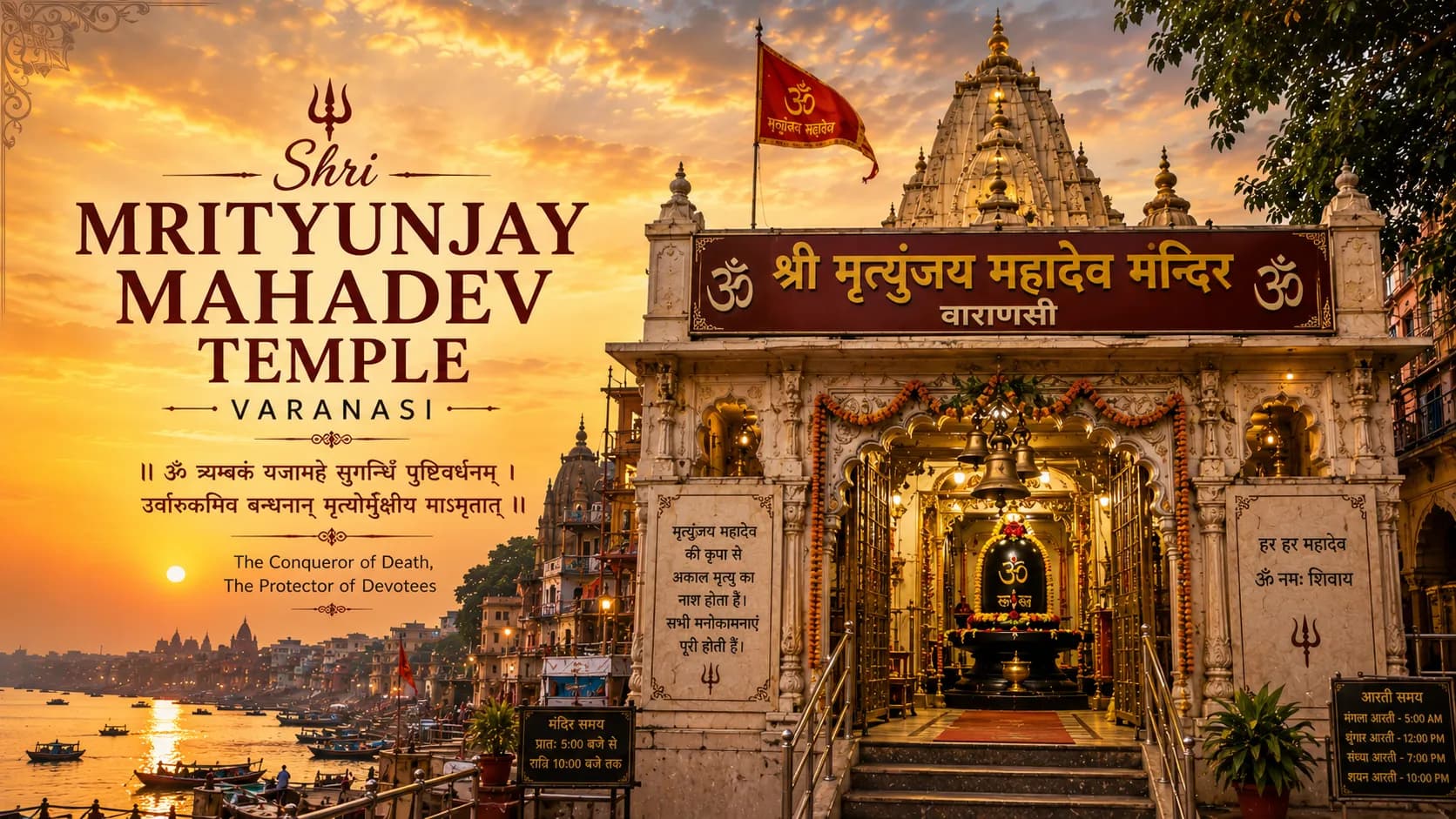
| What it is | The temple of Shiva as Mrityunjaya, the conqueror of death, one of the oldest and most revered shrines in Kashi, in Daranagar. |
| Opening hours | Open every day from 4:00 AM to 12:00 midnight, an unusually long day. |
| Aartis | Morning aarti at 5:30 AM, evening aarti at 6:30 PM, and the night Shayan aarti at 11:30 PM. |
| Entry fee | Free for all devotees. There is no VIP darshan or ticket. |
| The well | The Dhanvantari Koop, an ancient well whose water is believed to have healing power. |
| Why devotees come | For protection from untimely death, relief from illness, long life, and peace of mind. |
| The rituals | The temple is the great place for the Maha Mrityunjaya Jaap, Rudrabhishek and Havan, which we arrange for you. |
| Location | Daranagar, north of Kashi Vishwanath, on the route to the Kaal Bhairav Temple. |
Mrityunjay Mahadev temple timings and aarti
Unusually for an old city temple, this one keeps a very long day, opening before dawn and staying open to midnight, which makes it easy to fit into any part of your visit. It is smaller and calmer than Kashi Vishwanath, so darshan is usually quick, except on Mondays and through the holy month of Shrawan, when it is busy.
| Ritual | Timing | Notes |
|---|---|---|
| Opening hours | 4:00 AM to 12:00 midnight | Open every day of the week. |
| Morning aarti | 5:30 AM | The calmest time for darshan. |
| Evening aarti | 6:30 PM | Well attended and atmospheric. |
| Shayan (night) aarti | 11:30 PM | The closing worship of the day. |
*Entry is free and there is no paid line skipping.
Mrityunjay: the conqueror of death
The name Mrityunjay means the one who triumphs over death, and this is Shiva in his most protective form. Devotees come here above all to seek protection from untimely or unnatural death, relief from illness, and long life, and the ancient Kashi Khand of the Skanda Purana names this Lord as Apa Mrityu Hareshwar, the one who wards off premature death. The shivling here, worshippers believe, keeps them safe from an untimely end and eases suffering of body and mind.
At the heart of it all is the Maha Mrityunjaya mantra, which tradition, in the Shiv Purana, says Shiva himself revealed, and which is chanted here for health, courage and the turning away of misfortune. For pilgrims across India this is the temple you come to when someone is unwell, when a family faces a hard passage, or simply to ask for a long and healthy life. It is a place of hope, and it is often quieter and more meditative than the great temples, with a corner to sit and pray.
The Dhanvantari Koop: the healing well
The temple's most famous feature, after the shivling, is the Dhanvantari Koop, an ancient well within the complex. It is named for Dhanvantari, the physician of the gods and the deity of Ayurveda, who, tradition holds, poured his medicines and healing herbs into this well, giving its water a curative power. For centuries devotees have taken a little of this water as a blessing, believing it brings relief from illness, and the well remains one of the reasons the temple is regarded as a place of healing.
Do ask for the holy water of the Dhanvantari Koop when you visit; taking a small sip as prasad is part of the experience here. These are matters of faith and devotion, held sacred for generations, and they are best received in that spirit; they are not a substitute for medical care, and the temple is a place to seek blessings alongside, not instead of, a doctor's help.
Rituals here: Maha Mrityunjaya Jaap, Rudrabhishek and Havan
This is, above all, a temple of ritual. Because it is the great shrine of the conqueror of death, the powerful pujas of protection and healing are performed here with special meaning, and pilgrims travel far to have them done in their name or a loved one's. There is no line skipping pass, but formal private rituals can be arranged with the temple's priests, and this is exactly what we help with.
| Ritual | What it is and why it is done |
|---|---|
| Maha Mrityunjaya Jaap | The repeated chanting of the Maha Mrityunjaya mantra, often many thousands of times, for health, protection from untimely death, and long life. |
| Rudrabhishek | The sacred bathing and worship of the shivling with milk, honey, water and offerings, amid Vedic chanting, for wellbeing and the removal of obstacles. |
| Havan / Yagya | A fire offering accompanying the jaap or abhishek, to consecrate the prayer and its intention. |
We arrange these rituals with verified temple priests, on the day and in the name you choose, with the sankalpa (the statement of intention) made properly and the prasad sent to you. Everything is quoted up front, and you can join in person or have it performed on your behalf.
You can also arrange a Rudrabhishek at the main Jyotirlinga; see our Kashi Vishwanath Temple guide.
A quiet, powerful darshan, in my own words
By Rajeev Sharma, Varanasi local
I bring people to Mrityunjay Mahadev for a particular reason, and it is usually a tender one. Someone in the family is ill, or facing an operation, or a couple simply wants to pray for a long life together, and this is the temple in all of Kashi for that. It is in the old lanes of Daranagar, on the way to Kaal Bhairav, and it is quieter than the great temples, with a place to sit. I have watched worried people grow calm here in a way I find hard to explain.
I always take my guests to the Dhanvantari well and tell them the story, that the god of Ayurveda himself is said to have poured his medicines into it, and we take a little of the water as a blessing. And when a family wants it, I arrange a Maha Mrityunjaya Jaap with the priests, the mantra of Shiva as the conqueror of death, chanted in their name. I tell them plainly that this is a prayer, not a medicine, and to keep seeing their doctor, but that in Kashi, hope and faith are their own kind of medicine, and people leave lighter than they came.
In more than forty years of guiding, this is the temple where I have seen faith do its quiet work most often.
Entry, rules, and what to carry
- Entry is free. There is no VIP darshan; private rituals can be booked with the priests, which we arrange.
- Dress modestly, covering shoulders and knees, and keep your voice low near the sanctum.
- Footwear comes off before entry; leave it at the counter or with your guide.
- Ask respectfully for the Dhanvantari Koop water; take only a small sip as a blessing.
- Carry a little cash for offerings, and for the ritual if you book one on the day.
How to reach the Mrityunjay Mahadev Temple
The temple is in Daranagar, in the old city north of Kashi Vishwanath, tucked into narrow, vehicle free lanes. You come by auto or e rickshaw to the edge and walk the last short stretch.
| From | Distance | Notes |
|---|---|---|
| Bisheshwarganj or Maidagin | A short walk | Take an auto or e rickshaw to here, then walk in; vehicles cannot reach the gate. |
| Kaal Bhairav Temple | Walking distance | The temple is on the route from Daranagar to Kaal Bhairav; do the two together. |
| Kashi Vishwanath | About 1.5 to 2 km | To the south in the old city. |
| Varanasi Junction (Cantt) | About 5 km | Autos and cabs to the old city edge, then on foot. |
| Airport | About 25 km | Lal Bahadur Shastri International Airport, roughly an hour by road. |
The lanes here are a maze, so a guide who knows the way saves time and lets you pair the temple with Kaal Bhairav nearby.
Best time to visit and how to plan it
| When | Why |
|---|---|
| Early morning | The calmest darshan, around the 5:30 AM aarti. |
| Mondays | The day of Shiva, especially auspicious here, and busier. |
| Shrawan (the monsoon month of Shiva) | The most powerful and most crowded time; book any ritual well ahead. |
| Mahashivratri | The great night of Shiva, at its most intense. |
- Pair it with Kaal Bhairav, which is within walking distance, and the other old city temples.
- Allow 30 to 45 minutes for darshan and the well; longer if you are having a ritual performed.
For the old city temples planned as one route, see our Varanasi tour packages.
Accessibility for elderly and mobility limited visitors
- The temple is in tight, vehicle free old city lanes reached on foot, which can be hard for those with limited mobility.
- Come early morning for the calmest, least crowded visit, and avoid Mondays and Shrawan if a queue is difficult.
- If travel to the temple is not possible, we can arrange for a ritual to be performed in your name and the prasad sent to you.
- We arrange a car to the nearest drop point and a guide to help through the lanes.
Nearby sacred sites to combine with your darshan
Mrityunjay Mahadev sits in the old city, so it pairs naturally with the great temples nearby.
| Site | What it is | Internal link |
|---|---|---|
| Kaal Bhairav Temple | The fierce Kotwal of Kashi, within walking distance on the same route. | /temple/varanasi/kaal-bhairav-temple |
| Kashi Vishwanath Temple | The Jyotirlinga at the heart of Kashi, where you can also book a Rudrabhishek. | /temple/varanasi/kashi-vishwanath-temple |
| Annapurna Devi Temple | The goddess of nourishment, beside Kashi Vishwanath. | /temple/varanasi/annapurna-temple |
| Vishalakshi Temple | The Shakti Peetha of Kashi, in the old city. | /temple/varanasi/vishalakshi-temple |
| Dashashwamedh Ghat | Home of the grand evening Ganga aarti, toward the river. | /temple/varanasi/dashashwamedh-ghat |
To add the river to your day, see our evening Ganga aarti experience.
Safety and practical tips
| Watch out for | How to handle it |
|---|---|
| Self appointed pandas offering a quick ritual for a large donation. | Agree the ritual and the amount before you begin, or book through us for a fair fixed rate. |
| Anyone claiming to sell a paid line-skip. | There is no VIP ticket here; entry is free. Ignore the offer. |
| Getting lost in the Daranagar lanes. | The galis are a maze; a guide or a clear drop point saves confusion. |
| The Dhanvantari well water. | Take only a small sip as a blessing, and treat the healing beliefs as devotion, not as a medical cure. |
A guided visit removes the guesswork and lets you focus on the prayer.
Book a jaap, puja or guided visit with us
We are a Varanasi based operator, a unit of Experience My India, with more than forty years of guiding pilgrims across Kashi, Ayodhya, and Prayagraj. Entry to the temple is free, so what we arrange is the ritual and the visit around it: a Maha Mrityunjaya Jaap, Rudrabhishek or Havan performed by verified temple priests, in your name, with the prasad sent to you, and a guide to bring you through the lanes.
| Service | Includes | Price |
|---|---|---|
| Maha Mrityunjaya Jaap | The mantra chanted in your name by temple priests, with sankalpa and prasad. | Contact us for pricing |
| Rudrabhishek at Mrityunjay Mahadev | The abhishek of the shivling with a priest, and a guide. | Contact us for pricing |
| Havan and full puja | A fire offering with the jaap or abhishek, arranged end to end. | Contact us for pricing |
| Guided old city darshan | Mrityunjay Mahadev with Kaal Bhairav and the old city temples, with a guide. | Contact us for pricing |
Inclusions and exclusions are stated up front, with any taxes and conditions, and no charge appears later that was not named. See all our Varanasi tour packages for the full range.
Experience My India is a travel operator, not the temple administration. Ritual and tour prices are ours; the puja is performed by the temple's own priests. Temple timings and rules are set by the temple and can change.