

Essential info at a glance
| Detail | At a glance |
|---|---|
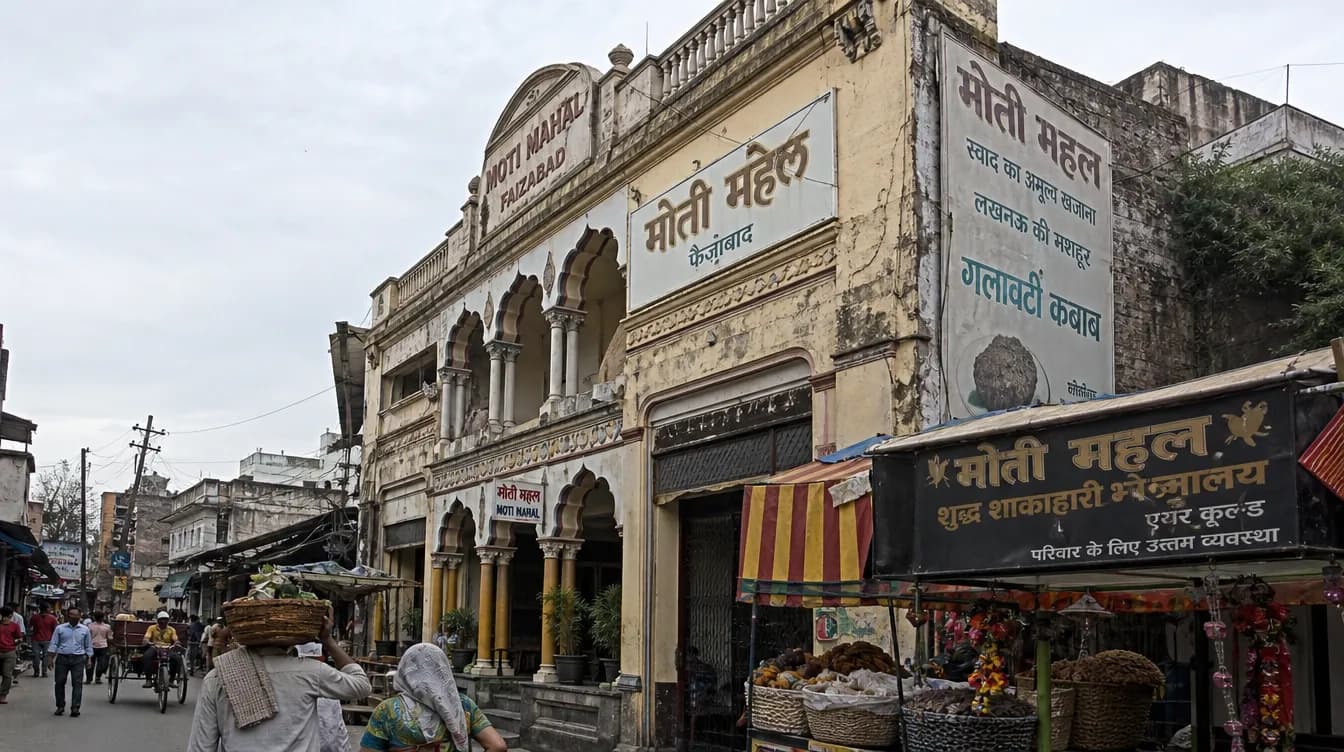
| What it is | The historic Pearl Palace, a Nawabi monument that was the residence of Bahu Begum, the great queen of Faizabad. |
| Built | In 1743, in the era of Nawab Shuja-ud-Daula, when Faizabad was the capital of Awadh. |
| Who lived here | Begum Unmatuzzohra Bano, known as Bahu Begum, wife of Shuja-ud-Daula. |
| Style | Nawabi and Mughal architecture, with fine carvings and expansive courtyards. |
| Part of | The Faizabad Nawabi trio, with Gulab Bari and the Bahu Begum ka Maqbara. |
| Access and hours | . |
| Entry fee | Free (confirm). |
| Location | Faizabad, the twin city of Ayodhya. |
Visiting Moti Mahal
Moti Mahal is a historic Nawabi palace and heritage monument, not a temple or a ticketed attraction with fixed aarti hours, and its access can vary with its state of preservation. It is best seen as part of a Faizabad heritage visit, together with the nearby Gulab Bari and the Bahu Begum ka Maqbara, in the cool of the morning or the late afternoon. Because the details of its current access matter, we confirm the hours and arrangements for your dates before your visit.
Moti Mahal: the Pearl Palace of Bahu Begum
Its very name is a jewel: Moti Mahal, the Pearl Palace. And it was built for a queen. Raised in 1743, in the golden age of the Nawabs of Awadh, when Faizabad, the twin city of Ayodhya, was their capital, the Moti Mahal was the residence, the beloved home, of Begum Unmatuzzohra Bano, the great queen known to history and to the people of Faizabad simply as Bahu Begum, the wife of Nawab Shuja-ud-Daula. Here, in this palace of opulence and grace, the queen lived out her long and remarkable life, and it stands today as a brilliant example of the Mughal and Nawabi architecture of that era, with its intricate carvings and its wide, elegant courtyards, an echo in stone of the splendour of the Awadh court at its height.
Bahu Begum, the queen who lived here
To walk at Moti Mahal is to remember a truly remarkable woman. Bahu Begum, born in 1727 into a distinguished noble family, married Nawab Shuja-ud-Daula and made her home in Faizabad, in this very palace. She was a figure of the greatest dignity, rank and wealth, immensely influential in the affairs of Awadh, and famed above all as the great builder of Faizabad, for most of the fine buildings of the city are attributed to her patronage. She was known, too, for her care for the welfare of the people. From the Moti Mahal she watched Faizabad rise to its golden age; and when she died, in 1816, she was laid to rest in the magnificent tomb that bears her name, the Bahu Begum ka Maqbara, not far away. So this palace and that tomb together hold the whole of her story: here she lived, there she rests. To see the Moti Mahal is to complete the tale of the queen begun at her Maqbara.
The Faizabad Nawabi trio
Moti Mahal is the third jewel of a set. For the golden age of Faizabad, under Shuja-ud-Daula and his queen, left three great Nawabi monuments that together tell the whole of that age: the Gulab Bari, the rose-garden tomb of the Nawab himself; the Bahu Begum ka Maqbara, the grand mausoleum of the queen; and this, the Moti Mahal, the palace where the queen lived in life. The two tombs and the palace, taken together, are the crowning legacy of Faizabad's brief, brilliant flowering as the capital of Awadh, before the glory passed to Lucknow; and to see all three is to feel the full sweep of that Nawabi story, and the rich, composite, Indo-Islamic heritage of this region, where the culture of Awadh has long stood beside the sanctity of Ayodhya.
The queen's own home, in my own words
By Rajeev Sharma, guide with Experience My India
When I take my guests to see the Nawabi heritage of Faizabad, I like to complete the story of Bahu Begum for them. We see her tomb, the great Maqbara, the Taj Mahal of the East, and I tell them she was a powerful, dignified queen. And then I bring them to the Moti Mahal, the Pearl Palace, and I say: and this is where she actually lived. It brings her to life for people, to see her tomb and then her home, to imagine the great queen here in her palace in the golden days of Faizabad. Her home in life and her rest in death, the two together.
I tell them the trio: Gulab Bari, where the Nawab is buried in his rose garden; the Maqbara, where the queen lies; and the Moti Mahal, where the queen lived. Three monuments, one golden age. It is a beautiful, dignified, gentle change from the temples, and it shows my guests the full, rich history of this land, that Faizabad was the great capital of the Nawabs before Lucknow, right beside holy Ayodhya. I always tell them, with respect, that this is a precious heritage that deserves care. For anyone who loves history, completing the trio with the Moti Mahal is a real pleasure.
In more than forty years of guiding, this is where I most love to bring the story of the great queen full circle.
What to see and do
- See the historic Pearl Palace, the Nawabi residence of Bahu Begum, and its Mughal architecture.
- Admire the intricate carvings and the expansive courtyards of the Awadh court's era.
- Hear the story of Bahu Begum, the great queen who lived here.
- Complete the Faizabad Nawabi trio with Gulab Bari and the Bahu Begum ka Maqbara.
- Reflect on the golden age of Faizabad, the old capital of Awadh beside holy Ayodhya.
How to reach Moti Mahal
Moti Mahal is in Faizabad, the twin city of Ayodhya, on the southern bank of the Saryu about 6 to 7 km from Ayodhya city. It is easily reached by road, and best seen with the other Nawabi monuments of Faizabad.
| From | Distance | Notes |
|---|---|---|
| Ayodhya city and the temples | About 6 to 8 km | By auto, e-rickshaw or taxi to Faizabad. |
| Bahu Begum ka Maqbara and Gulab Bari | Nearby | The other Nawabi monuments; see the trio together. |
| Ayodhya Dham Junction (railway) | A few km | By e-rickshaw, auto or taxi. |
| Maharishi Valmiki Airport, Ayodhya | About 12 to 15 km | The new airport; taxis and autos to the city. |
It pairs with Gulab Bari and the Bahu Begum ka Maqbara for a lovely Faizabad Nawabi heritage half-day.
Best time to visit and how to plan it
| When | Why |
|---|---|
| Morning or late afternoon | The most pleasant light and weather for the heritage monuments. |
| Winter (October to March) | The most comfortable season for a Faizabad heritage day. |
| As a heritage change of pace | A dignified, historical counterpoint to a day of temples. |
| With the Nawabi trio | To complete Gulab Bari, the Bahu Begum ka Maqbara and the Moti Mahal together. |
- Pair it with Gulab Bari and the Bahu Begum ka Maqbara for the full Faizabad Nawabi heritage.
- Allow 30 to 45 minutes for the palace, once its access is confirmed.
For Ayodhya and Faizabad, or a combined Kashi and Ayodhya pilgrimage, planned end to end, see our tour packages.
Etiquette for visiting
- This is a heritage monument; be respectful, keep your voice low, and follow any guidance.
- Dress modestly and treat the old building and its carvings with care.
- Do not touch, scratch or climb the structure except where allowed.
- As at any old monument, mind your footing on old steps and floors.
Accessibility for elderly and mobility limited visitors
- The palace is reachable by road; access within an old heritage building may involve steps and uneven floors.
- Come in the cooler morning or afternoon for the easiest visit.
- It is usually quiet, which suits a slow, restful visit.
- We arrange transport, confirm access and plan a gentle heritage visit within your Ayodhya day.
Our guided heritage visits and Ayodhya tours
We are a Varanasi and Ayodhya based operator, a unit of Experience My India, with more than forty years of guiding travellers across Kashi, Ayodhya, and Prayagraj. What we arrange is a rich Faizabad heritage visit: a guide who tells the story of Bahu Begum and the golden age of Faizabad, and completes the Nawabi trio, the Moti Mahal, Gulab Bari and the Bahu Begum ka Maqbara, for a lovely change of pace within a fuller day of Ayodhya. We confirm the monument's access for your dates in advance.
| Service | Includes | Price |
|---|---|---|
| Faizabad Nawabi heritage half-day | Moti Mahal, Gulab Bari and the Bahu Begum ka Maqbara, with a guide. | Contact us for pricing |
| Guided Moti Mahal visit | The Pearl Palace, its story and architecture, with a guide. | Contact us for pricing |
| Ayodhya and Faizabad day | The temples of Ayodhya and the Nawabi heritage of Faizabad. | Contact us for pricing |
| Full Ayodhya heritage tour | Moti Mahal within a wider Ayodhya and Faizabad visit, with a guide. | Contact us for pricing |
Inclusions and exclusions are stated up front, with any taxes and conditions, and no charge appears later that was not named. Our charge is only for guiding and services. See all our tour packages for the full range.
Experience My India is a travel operator, not the monument authority. Our charge is only for our guiding and services. Access and any timings are set by the authorities and can change.
Nearby sites in Ayodhya and Faizabad
Moti Mahal sits among the Nawabi heritage of Faizabad, the twin city of Ayodhya.
| Site | What it is | Internal link |
|---|---|---|
| Bahu Begum ka Maqbara | The grand tomb of Bahu Begum, the queen who lived at Moti Mahal. | /temple/ayodhya/bahu-begum-ka-maqbara |
| Gulab Bari | The Garden of Roses and the tomb of Nawab Shuja-ud-Daula. | /temple/ayodhya/gulab-bari |
| Shri Ram Janmabhoomi Mandir | The grand temple of Lord Ram, in the twin city. | /temple/ayodhya/ram-janmabhoomi-mandir |
| Saryu Ghats and the aarti | The sacred river of Ayodhya and its evening aarti. | /temple/ayodhya/saryu-ghat-aarti |
| Ramnagar Fort (Varanasi) | The Maharaja's palace-fort of Kashi, for more regional heritage. | /temple/varanasi/ramnagar-fort |
For the Ram Mandir darshan and its free Sugam booking, see our Ram Janmabhoomi Mandir guide.