

Essential info at a glance
| Detail | At a glance |
|---|---|
| What it is | The Garden of Roses, a Mughal-style rose garden and the mausoleum of Nawab Shuja-ud-Daula, the third Nawab of Awadh. |
| Opening hours | 4:00 AM to 7:00 PM daily. |
| Entry fee | Free for all visitors. |
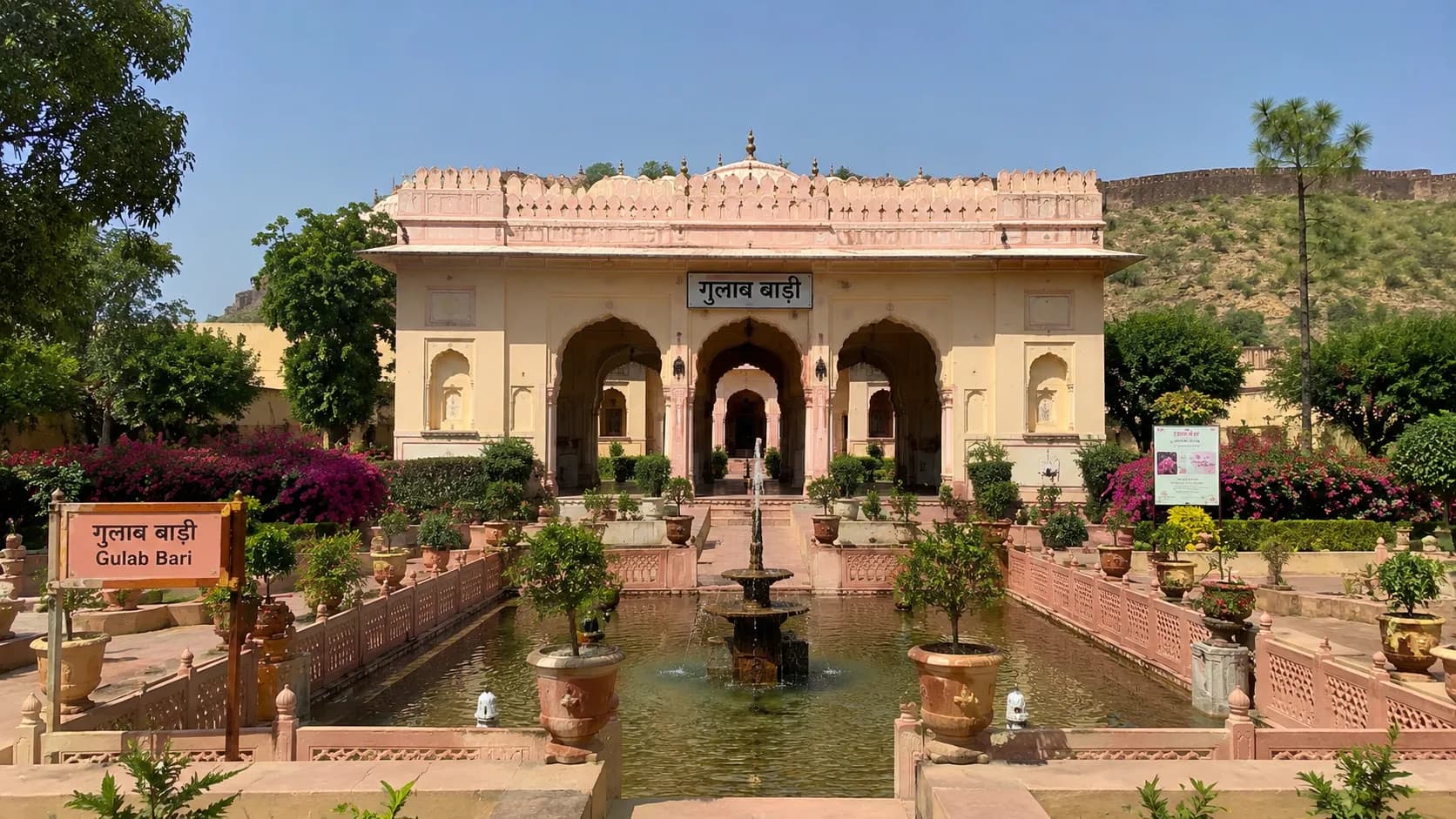
| The garden | A classic charbagh garden with roses of many varieties, fountains and water channels. |
| The tomb | The white, double-storeyed mausoleum of Shuja-ud-Daula, in fine Nawabi architecture. |
| Also in the complex | A grand gateway, a mosque, an Imambara, a Shahi Hammam and a Baradari pavilion. |
| Heritage | A monument of National Importance, of the era when Faizabad was the capital of Awadh. |
| Location | State Highway 9, Vaidehi Nagar, Faizabad, about 5 km from the Ayodhya railway station. |
Gulab Bari timings and entry
The garden is open every day from 4:00 AM to 7:00 PM, and entry is free. It is a large, green, tranquil space, and a wonderful change of pace from the crowded temples of Ayodhya. The roses and the gardens are at their loveliest in the cool of the early morning and the evening, and in the winter months when the roses are in bloom.
| Detail | When | Notes |
|---|---|---|
| Opening hours | 4:00 AM to 7:00 PM | Open every day; free. |
| Best times | Early morning and evening | Cooler, and the gardens at their most beautiful. |
| Best season | Winter (October to March) | The roses bloom, and the weather is pleasant. |
| Entry fee | Free | For all visitors. |
Gulab Bari: the Garden of Roses
Amid the temples and the devotion of Ayodhya lies a place of a very different, gentler beauty: Gulab Bari, whose name means simply the Garden of Roses. It is a serene, green oasis in the old city of Faizabad, the twin city of Ayodhya, and it is exactly what its name promises, a beautiful garden laid out in the classic Mughal charbagh style, the four-part garden divided by walkways and channels of water, and famous for its roses, once planted here in a great array of varieties by the sides of the fountains and shallow water channels. With its running fountains and its ornamental ponds, its lawns and its trees, it is a place of calm and refreshment, and simply to stroll here of a cool morning, among the roses and the play of water, is a lovely thing, a quiet pause from the intensity of the pilgrimage.
The tomb of Nawab Shuja-ud-Daula
At the heart of the garden, rising white and graceful from the greenery, stands the reason the garden was made: the mausoleum, the maqbara, of Nawab Shuja-ud-Daula, the third Nawab of Awadh, who built it himself during his lifetime in the eighteenth century as his own final resting place. It is a dazzling white, square, double-storeyed structure, with an arched verandah on each side and a three-arched facade above, graced with slender minarets at the corners and crowned with a wide, low dome topped by an inverted lotus and a metal finial; its terrace is edged with fine lattice-work, and its walls are carved with delicate designs. The style is that lovely, ornate late-Mughal, or Nawabi, manner, sometimes called Indian Rococo, and it makes the tomb one of the most elegant buildings in the region. Within the central chamber lie the cenotaphs of the Nawab and of his mother.
The gateway, the Imambara, the mosque and the Hammam
Gulab Bari is not only a tomb but a whole heritage complex, enclosed by a fine old wall of lakhauri brick, lime-plastered and moulded, and entered through a grand, triple-arched, double-storeyed gateway that is a handsome monument in its own right. Within the enclosure, besides the tomb, stand several other buildings of the Nawabi age: a mosque; an Imambara, the hall used by the Shia Muslim community for the observances of Muharram, which remains a living and revered place of worship, treated as holy by the local people; a Shahi Hammam, a royal bath; and a Baradari, a twelve-arched open pavilion, along with an old well. Together they make Gulab Bari a rounded and evocative example of the architecture and the life of the Awadh court, and a place to be walked slowly and admired.
Faizabad: the old capital of Awadh
To understand Gulab Bari is to remember a chapter of history that the fame of Ayodhya sometimes overshadows. For before Lucknow rose to its glory, it was Faizabad, here beside Ayodhya, that was the first capital of the Nawabs of Awadh, and its greatest age came under Nawab Shuja-ud-Daula, who made it his seat and adorned it with fine buildings. Gulab Bari is one of the jewels of that age, and close by stands another, the great Bahu Begum ka Maqbara, the tomb of Shuja-ud-Daula's wife, and the remains of the Moti Mahal, her palace. Together these Nawabi monuments are the legacy of Faizabad's golden century, and a beautiful, dignified reminder of the layered, composite heritage of this region, where the culture of Awadh and the sanctity of Ayodhya have long stood side by side.
A garden of calm, in my own words
By Rajeev Sharma, guide with Experience My India
I love to bring my guests to Gulab Bari, especially in the cool of the morning, because after the crowds and the queues of the temples, it is such a beautiful, peaceful change. I tell them: this is the Garden of Roses, a different Ayodhya, the world of the Nawabs of Awadh, whose first capital was here at Faizabad, long before Lucknow. We walk among the roses and the fountains, and I show them the lovely white tomb of Nawab Shuja-ud-Daula, who built it himself, with its low dome and its graceful arches, one of the finest old buildings in the whole region.
I always explain, with respect, that this is a living heritage, that the Imambara here is still used by the Muslim community at Muharram, and that the local people, of all faiths, treasure this place. And I tell my guests about Faizabad's golden age, and point them toward the Bahu Begum's great tomb nearby. I think it is important, on a pilgrimage to Ayodhya, to also see this gentler, greener, composite heritage of the region, the roses and the fountains and the elegant tombs, because it shows the full, rich story of this land. My guests always leave Gulab Bari calmer and gladder than they came.
In more than forty years of guiding, this is the green retreat I most often use to rest and refresh a weary pilgrim.
What to see and do
- Stroll the charbagh garden among the roses, the fountains and the water channels.
- Admire the white double-storeyed tomb of Nawab Shuja-ud-Daula and its fine Nawabi architecture.
- See the grand double-storeyed gateway, the mosque, the Imambara, the Shahi Hammam and the Baradari.
- Enjoy the calm and the greenery, a peaceful change from the temples.
- Learn of Faizabad's golden age as the old capital of Awadh, and see the Bahu Begum's tomb nearby.
How to reach Gulab Bari
Gulab Bari is in Vaidehi Nagar, on State Highway 9 in Faizabad, the twin city of Ayodhya, about 5 km from the Ayodhya railway station. It is easily reached by road.
| From | Distance | Notes |
|---|---|---|
| Ayodhya Dham Junction (railway) | About 5 km | By auto, e-rickshaw or taxi. |
| The Ayodhya temples | A short drive | In the twin city of Faizabad; combine with the heritage sites. |
| Bahu Begum ka Maqbara | Nearby | The companion Nawabi monument; see the two together. |
| Maharishi Valmiki Airport, Ayodhya | About 12 to 15 km | The new airport; taxis and autos to the city. |
It pairs naturally with the Bahu Begum ka Maqbara for a lovely Faizabad heritage half-day.
Best time to visit and how to plan it
| When | Why |
|---|---|
| Winter (October to March) | The roses bloom and the weather is most pleasant for the garden. |
| Early morning or evening | Cool and beautiful, the gardens and fountains at their best. |
| As a heritage change of pace | A green, calm counterpoint to a day of temples. |
| Around Muharram | The Imambara is active with the observances; visit respectfully. |
- Pair it with the Bahu Begum ka Maqbara and the Faizabad Nawabi heritage.
- Allow 45 minutes to an hour to enjoy the garden and the monuments.
For Ayodhya and Faizabad, or a combined Kashi and Ayodhya pilgrimage, planned end to end, see our tour packages.
Etiquette for visiting
- This is a heritage monument and a living place of worship; be respectful, keep your voice low, and follow any guidance.
- Dress modestly, especially near the mosque and the Imambara, and remove footwear where required.
- Do not disturb any prayers or observances, above all during Muharram.
- Treat the tombs and the buildings with care; do not touch or climb the monuments.
Accessibility for elderly and mobility limited visitors
- The garden is open and largely level, easy to stroll, and reachable by road, gentler than the old-city temples.
- There are steps up into the tomb; the gardens and grounds can be enjoyed without climbing.
- It is calm and uncrowded, which suits a slow, restful visit, with benches and shade to rest.
- We arrange transport and plan a gentle heritage visit within your Ayodhya day.
Nearby sites in Ayodhya and Faizabad
Gulab Bari sits among the Nawabi heritage of Faizabad, the twin city of Ayodhya.
| Site | What it is | Internal link |
|---|---|---|
| Bahu Begum ka Maqbara | The grand tomb of Shuja-ud-Daula's wife, the companion Nawabi monument. | /temple/ayodhya/bahu-begum-ka-maqbara |
| Shri Ram Janmabhoomi Mandir | The grand temple of Lord Ram, in the twin city. | /temple/ayodhya/ram-janmabhoomi-mandir |
| Hanuman Garhi | The guardian temple of Hanuman. | /temple/ayodhya/hanuman-garhi |
| Saryu Ghats and the aarti | The sacred river of Ayodhya and its evening aarti. | /temple/ayodhya/saryu-ghat-aarti |
| Ramnagar Fort (Varanasi) | The Maharaja's palace-fort of Kashi, for more regional heritage. | /temple/varanasi/ramnagar-fort |
For the Ram Mandir darshan and its free Sugam booking, see our Ram Janmabhoomi Mandir guide.
Our guided heritage visits and Ayodhya tours
We are a Varanasi and Ayodhya based operator, a unit of Experience My India, with more than forty years of guiding travellers across Kashi, Ayodhya, and Prayagraj. Entry is free, so what we arrange is a rich heritage visit: a guide who tells the story of the Nawabs of Awadh and the golden age of Faizabad, and pairs Gulab Bari with the Bahu Begum ka Maqbara and the Nawabi monuments for a lovely change of pace within a fuller day of Ayodhya.
| Service | Includes | Price |
|---|---|---|
| Faizabad Nawabi heritage half-day | Gulab Bari and the Bahu Begum ka Maqbara, with a guide. | Contact us for pricing |
| Guided Gulab Bari visit | The garden, the tomb and the complex, with a guide. | Contact us for pricing |
| Ayodhya and Faizabad day | The temples of Ayodhya and the Nawabi heritage of Faizabad. | Contact us for pricing |
| Full Ayodhya darshan tour | Gulab Bari within a wider Ayodhya pilgrimage, with a guide. | Contact us for pricing |
Inclusions and exclusions are stated up front, with any taxes and conditions, and no charge appears later that was not named. Entry is free; our charge is only for guiding and services. See all our tour packages for the full range.
Experience My India is a travel operator, not the monument authority. Entry is free; our charge is only for our guiding and services. Timings are set by the authorities and can change; the Imambara is a place of worship.