.webp&w=2048&q=75)
.webp&w=2048&q=75)
Essential info at a glance
| Detail | At a glance |
|---|---|
| What it is | The 18th-century sandstone fort and palace of the Maharaja of Banaras, the Kashi Naresh, across the Ganga at Ramnagar. |
| Opening hours | Open daily from 10:00 AM to 5:00 PM. |
| Entry fee | About ₹20 to ₹50 for Indian citizens and around ₹150 for foreign nationals, including the museum. |
| Time needed | About 2 to 3 hours to explore the museum and courtyards. |
| The museum | The Saraswati Bhawan museum of royal treasures, with a rare astronomical clock. |
| World-famous for | The month-long Ramnagar Ramlila each autumn, a UNESCO-listed living tradition. |
| Temples | A Vyasa Temple and a south-facing Hanuman temple; there is no daily Ganga aarti inside the fort. |
| Location | Qila Road, Ramnagar, on the eastern bank opposite Tulsi Ghat, about 14 km from the city. |
Ramnagar Fort timings and entry
Unlike the free, round-the-clock ghats, Ramnagar Fort is a ticketed museum and palace with set daytime hours. It takes a couple of hours to see properly, so plan a relaxed half-day, ideally in the cooler morning.
| Detail | Value | Notes |
|---|---|---|
| Opening hours | 10:00 AM to 5:00 PM, daily | Open all week. |
| Entry fee | About ₹20 to ₹50 Indian; about ₹150 foreign | Includes the Saraswati Bhawan museum; buy tickets at the gate. |
| Time needed | About 2 to 3 hours | For the museum, the Durbar Hall and the courtyards. |
| Aarti | None inside the fort | The grand Ganga aartis are across the river at Dashashwamedh and Assi. |
Ramnagar Fort: the last palace of the Kashi Naresh
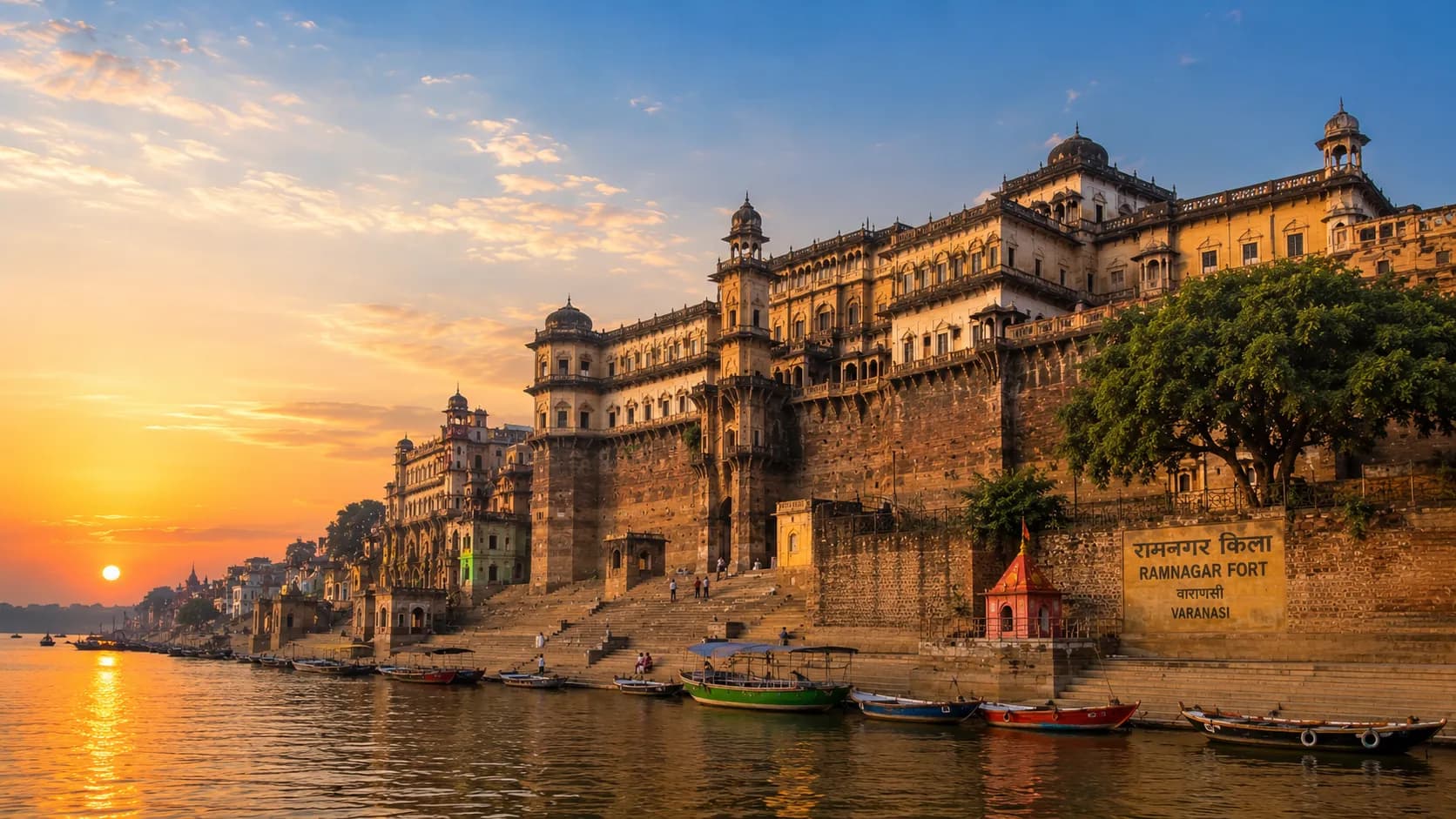
Across the Ganga from the ghats, on the eastern bank, rises the grand cream-and-red sandstone fort of Ramnagar, one of the great sights of Varanasi. It was built in 1750 by Maharaja Balwant Singh, the first of the line of Kashi Naresh, the hereditary Maharajas of Banaras, and it has been the seat of that royal family ever since. Indeed it is a living palace still: the current ceremonial Maharaja resides here to this day, which gives the fort a rare, inhabited grandeur, faded and romantic, rather than the emptiness of a ruin.
Built of Chunar sandstone in a beautiful blend of Mughal and Rajput styles, it was designed as much for art, ceremony and residence as for defence, with carved pillars and balconies, spacious courtyards, and jharokha windows and riverfront terraces that look out over the Ganga and catch the monsoon breeze. Within it lies the Durbar Hall, the public audience chamber where the Maharaja held court, still hung with chandeliers, antique furniture and royal portraits. To wander here is to step into the world of the kings of Kashi.
The Saraswati Bhawan museum
The heart of a visit is the Saraswati Bhawan museum, housed in the old Durbar Hall with its fading Persianate frescoes, one of the most eclectic and fascinating royal collections in India. It is a treasure-house of the life of the Banaras royals, and every object tells a story.
- Vintage American cars, royal chariots and bejewelled sedan chairs, from the golden age of the Maharajas.
- Gold and silver palanquins and silver elephant howdahs used in ceremonial processions.
- An armoury of medieval weapons, swords, daggers, matchlocks and guns, gathered from as far as Burma, Africa and Japan.
- Exquisite ivory work, jewellery, antique furniture and royal costumes of kimkhwa silk.
- Illustrated Mughal-style manuscripts, rare books and old documents, and royal portraits.
The single most famous exhibit is the astronomical clock, a remarkable nineteenth-century marvel that shows not only the time, day, week, month and year, but also the positions of the sun, the moon, the planets and the constellations, a working wonder built by the court's own astronomer.
The world-famous Ramnagar Ramlila
Above all else, Ramnagar Fort is renowned across the world for its Ramlila, and it is one of the most extraordinary living traditions in all of India. Begun around 1830 under the patronage of the Maharaja, the Ramnagar Ramlila is a re-enactment of the Ramayana that runs for thirty-one nights each autumn, around Dussehra, the longest continuous Ramlila anywhere. What makes it unique is that the whole town of Ramnagar becomes the stage: different quarters and grounds stand for Ayodhya, Janakpur, Lanka and the forest, and the audience, tens of thousands strong, walks with the story from place to place across the weeks, night after night, in a vast, immersive, moving theatre.
The Maharaja of Banaras himself presides, still riding out on his elephant to open the great episodes, a scene unchanged for generations. Drawn from Tulsidas's beloved Ramcharitmanas, written just across the river, the Ramnagar Ramlila was placed by UNESCO on its Representative List of the Intangible Cultural Heritage of Humanity. For a company that also guides pilgrims in Ayodhya, the city of Rama, to help travellers witness this is a special joy. If you visit Varanasi in September or October, we can help you experience it. See our guides to Tulsi Manas Mandir and Tulsi Ghat for Tulsidas and the Ramcharitmanas.
The temples of the fort
The fort complex holds two temples of its own. There is a temple to Ved Vyas, the sage who composed the Mahabharata, for legend tells that Vyas, unable to remain within the sacred bounds of Kashi across the river, settled here at Ramnagar, which was therefore known as Vyas Kashi. And there is a Dakshin-mukhi Hanuman temple, a south-facing Hanuman, traditionally set to face south to repel evil and guard the palace. Neither hosts a grand daily aarti; the great river aartis are across the water in the city.
The palace across the river, in my own words
By Rajeev Sharma, Varanasi local
I love taking guests across the river to Ramnagar, because it is a completely different side of Kashi, the world of the kings. I like to go by boat when we can, so people see the great sandstone fort rise from the far bank as we approach. Inside, I take them through the Maharaja's museum, and they are always delighted by the strange, wonderful collection, the old cars, the silver elephant saddles, the weapons from far-off lands, and above all that astonishing clock that tells the movements of the very stars. I tell them the Maharaja of Banaras still lives here, which they can hardly believe.
But what I most love to speak about is the Ramlila. I explain that for a whole month each autumn, the entire town becomes the stage for the story of Lord Rama, and that the audience walks from Ayodhya to Lanka over the weeks, and that the Maharaja himself comes out on his elephant. I tell them it comes from Tulsidas's Ramcharitmanas, written just over the river, and that UNESCO honours it as a heritage of all humanity. When I can bring guests here in the Ramlila season, it is one of the greatest gifts I can give them.
In more than forty years of guiding, this is the place where I most love to show travellers the royal, theatrical soul of Kashi.
What to see and do
- Explore the Saraswati Bhawan museum and its royal treasures, and find the famous astronomical clock.
- See the Durbar Hall, the audience chamber of the Maharaja, with its chandeliers and portraits.
- Walk the courtyards, carved balconies and riverfront terraces with their views of the Ganga.
- Visit the Vyasa Temple and the south-facing Hanuman temple in the complex.
- If you come in September or October, witness the world-famous Ramnagar Ramlila.
How to reach Ramnagar Fort
The fort is at Ramnagar, on the eastern bank of the Ganga opposite Tulsi Ghat, about 14 km from the heart of the city. There are two lovely ways to come: by road across the Ramnagar bridge, or, best of all, by a scenic boat across the river.
| Route | How | Notes |
|---|---|---|
| By road | Across the Ramnagar bridge | By taxi, auto or private car; easiest from the Assi side. |
| By boat | About a 30-minute boat from Dashashwamedh or Tulsi Ghat | A beautiful scenic crossing; the loveliest approach. |
| From Assi Ghat | A short drive to the bridge | The nearest ghat to the road route. |
| Varanasi Junction (Cantt) | About 14 to 16 km | By taxi or auto. |
| Airport | About 35 km | Lal Bahadur Shastri International Airport, over an hour by road. |
Coming by boat and returning by road, or the reverse, makes a wonderful half-day. We arrange the boat, the car, the tickets and a guide.
Best time to visit and how to plan it
| When | Why |
|---|---|
| Morning, soon after opening | Cooler and calmer for the museum and the courtyards. |
| September to October | The Ramnagar Ramlila season, a once-in-a-lifetime cultural experience. |
| Any open day, 10 AM to 5 PM | Allow 2 to 3 hours for the fort and museum. |
| By boat across the river | The most scenic and memorable way to arrive. |
- Pair it with Tulsi Ghat and Assi Ghat across the river, or with a city and temple day.
- Allow a half-day; longer if you attend the Ramlila in season.
For the fort, the ghats and the city planned together, see our Varanasi tour packages.
Accessibility for elderly and mobility limited visitors
- The fort is an old palace with steps, uneven floors and courtyards, which can be challenging for those with limited mobility.
- Coming by road avoids the boat and the ghat steps, and is the gentler option for seniors.
- Allow a relaxed pace and plenty of time; there is a garden at the entrance to rest.
- We arrange comfortable transport, tickets and a guide, and can advise on what will suit a senior visitor.
Nearby sites to combine with your visit
Ramnagar sits across the river from the southern ghats and the Tulsidas and Rama sites.
| Site | What it is | Internal link |
|---|---|---|
| Tulsi Ghat | The home of Tulsidas, whose Ramcharitmanas the Ramlila enacts, just across the river. | /temple/varanasi/tulsi-ghat |
| Tulsi Manas Mandir | The marble temple of the Ramcharitmanas, honouring Tulsidas. | /temple/varanasi/tulsi-manas-mandir |
| Sankat Mochan Hanuman Temple | The Hanuman temple founded by Tulsidas, for the Rama devotion. | /temple/varanasi/sankat-mochan-hanuman-temple |
| Chet Singh Ghat | The riverfront fort of the same Banaras royal family, in the city. | /temple/varanasi/chet-singh-ghat |
| Assi Ghat | The southern ghat, nearest the road route to Ramnagar. | /temple/varanasi/assi-ghat |
For the grand evening aarti and a boat ride, see our Varanasi tour packages.
Practical tips
| Good to know | Detail |
|---|---|
| It is a ticketed museum. | Buy tickets at the gate; allow 2 to 3 hours, and come in the cooler morning. |
| Come by boat if you can. | The scenic crossing from the ghats is the loveliest way to arrive. |
| Expect faded grandeur. | It is a living, old palace, romantic and weathered, not a polished modern museum. |
| The Ramlila is seasonal. | The great Ramlila is only in September to October; plan ahead and expect crowds. |
Our guided heritage and Ramlila experiences
We are a Varanasi based operator, a unit of Experience My India, with more than forty years of guiding travellers across Kashi, Ayodhya, and Prayagraj. What we arrange is the whole experience: a scenic boat across the river or a comfortable car, the tickets, and a guide who brings the fort, the royal collection and the story of the Kashi Naresh to life, and, in season, help to witness the world-famous Ramnagar Ramlila.
| Experience | Includes | Price |
|---|---|---|
| Ramnagar Fort heritage visit | A boat or car, the tickets, and a guide through the fort and museum. | Contact us for pricing |
| Fort and boat half-day | A scenic boat across, the fort and museum, and the return, with a guide. | Contact us for pricing |
| Ramlila experience | In season, help to witness the Ramnagar Ramlila, with guidance. | Contact us for pricing |
| City, ghats and fort day | Ramnagar Fort with the ghats and the Tulsidas sites, with a guide. | Contact us for pricing |
Inclusions and exclusions are stated up front, with any taxes and conditions, and no charge appears later that was not named. See all our Varanasi tour packages for the full range.
Experience My India is a travel operator, not the fort or museum authority. Our guiding, boats and services are ours; the fort entry ticket is charged separately at the gate. Timings, fees and the Ramlila schedule are set by others and can change.