Essential info at a glance
| Detail | At a glance |
|---|---|
| What it is | A Korean-style memorial park honouring Queen Heo Hwang-ok, born Princess Suriratna of Ayodhya, a symbol of India-Korea friendship. |
| Opening hours | 6:00 AM to 8:00 PM daily. |
| Entry fee | Free entry for all. |
| Time needed | About 1 to 2 hours. |
| The story | An Ayodhya princess who, legend tells, sailed to Korea in 48 CE and became its queen. |
| What to see | Queen and King pavilions with busts, a memorial pond, a granite egg, murals, and walking paths. |
| Descendants | Some six million Koreans of the Karak clan revere her, and Ayodhya, as their ancestral home. |
| Location | Near Ram Katha Park, Naya Ghat, on the Saryu riverfront. |
Queen Heo Memorial Park timings and entry
The park is open every day from 6:00 AM to 8:00 PM, and entry is free. It is a peaceful, beautiful place to walk and reflect, and an hour or two is enough to enjoy the pavilions, the pond, the murals and the gardens. The soft light of morning and evening is the loveliest time, and it pairs naturally with the neighbouring Ram Katha Park and the Saryu riverfront.
| Detail | When | Notes |
|---|---|---|
| Opening hours | 6:00 AM to 8:00 PM | Open every day; free. |
| Time needed | About 1 to 2 hours | For the pavilions, pond, murals and gardens. |
| Best times | Morning and evening | The loveliest light for a peaceful walk. |
| Entry fee | Free | For all visitors; no tickets. |
The Queen Heo Memorial Park
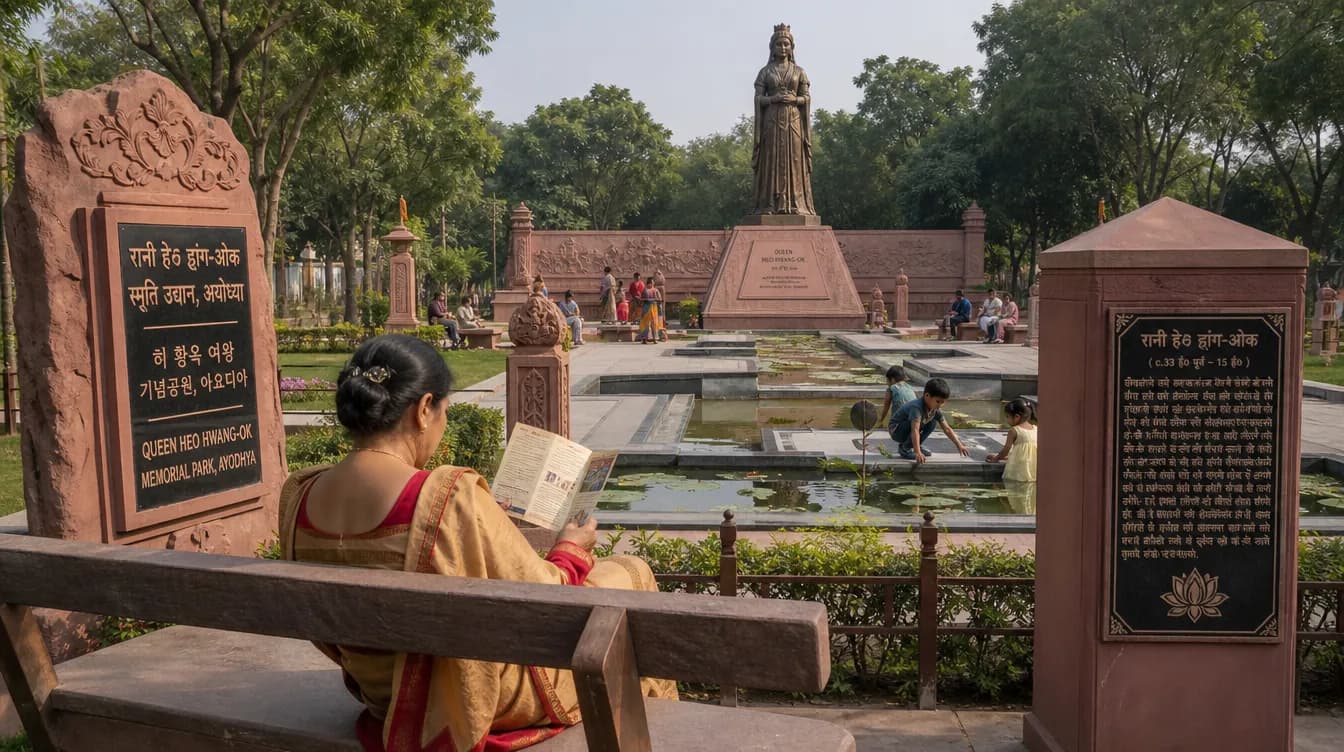
On the banks of the Saryu, beside the Ram Katha Park, lies one of the most unusual and delightful places in all of Ayodhya: a beautiful memorial park built in a graceful blend of Indian and Korean styles, dedicated to a queen who joins the two lands across the seas and the centuries. It is a serene, landscaped garden, and as you walk its winding paths you come upon elegant pavilions with the gently sloping tiled roofs of Korea, dedicated to the queen and her king and holding their busts; a peaceful memorial pond, whose still water recalls the great sea voyage at the heart of the story; a granite egg, from the Korean legend of the king's own birth; and vivid murals and plaques that tell the ancient tale, with a soft fountain playing beneath the trees. It is a place quite unlike any temple, a quiet, green, contemplative garden of friendship and remembrance, and a lovely, restful change of pace on an Ayodhya pilgrimage.
The legend of Suriratna: the Ayodhya princess who became a queen of Korea
The story the park tells is one of the most extraordinary and beautiful in all the shared history of Asia. It is preserved in an ancient Korean chronicle, the Samguk Yusa, and it is this: that long ago, in the first century, there lived in Ayodhya a princess named Suriratna, the daughter, tradition says, of King Padmasen and Queen Indumati of the old kingdom of Kosala. And it came to pass, the legend tells, that her parents were visited in a dream by a divine command, that their daughter should go far across the seas to wed a king in a distant eastern land. So the young princess set out from the banks of this very Saryu, on an epic voyage of thousands of miles across the ocean, all the way to Korea; and there, in the year 48, she married King Kim Suro, the founder and first king of the realm of Geumgwan Gaya, and became his queen, known ever after in her new land as Heo Hwang-ok. It is a tale of a dream, a fearless voyage, and a union of two distant worlds, a true legend of love and destiny spanning continents; and its heart, its beginning, is here, in Ayodhya, where the princess was born and from where she sailed.
Six million descendants: Ayodhya as Korea's grandmother's home
What makes this legend a living thing, and this park so moving, is that Queen Heo is no mere figure of an old story: she is revered as the great ancestress, the progenitor mother, of a vast family of living Koreans. Some six million people of Korea today, of the Karak clan, the Gimhae Kim and the Heo families, trace their very ancestry back to this queen from Ayodhya; and so, in a most touching way, these millions of Koreans look upon Ayodhya as their maternal home, their grandmother's home, the ancient land of their foremother. Every year members of the Karak clan travel from Korea to Ayodhya to pay their respects at this memorial to the mother of their line, a pilgrimage of the heart across half the world.
Out of this deep bond, the two nations have honoured the queen together. The memorial was first raised in 2001, in a partnership between the government of Uttar Pradesh and the city of Gimhae in Korea, where Queen Heo's own tomb lies; and it has since been greatly expanded and beautified, under an agreement between the leaders of India and Korea, with the ground-breaking of the new park attended by the First Lady of South Korea herself, and commemorative stamps issued in the queen's honour. So this quiet garden by the Saryu is far more than a memorial; it is a living symbol of the ancient, enduring friendship between India and Korea, a bridge of shared heritage two thousand years old.
A bridge of friendship by the Saryu, in my own words
By Rajeev Sharma, guide with Experience My India
The Queen Heo park is one of my favourite surprises to share, because so few Indian visitors know this astonishing story, and it always amazes them. I tell them: do you know that millions of Koreans call Ayodhya their grandmother's home? And then I tell them the legend of Princess Suriratna, who sailed from this very Saryu two thousand years ago to become a queen of Korea, and how six million Koreans today trace their family back to her. I have had the joy of guiding Korean visitors here, and it is deeply moving to see them come to pay respects to their ancestress, so far from home and yet, to them, at home. I love watching Indian and Korean visitors meet in this garden, two peoples joined by one princess.
It is a beautiful, peaceful place, the Korean pavilions, the pond, the gardens, right by Ram Katha Park and the Saryu, and after the busy temples it is a lovely, restful, thoughtful stop. I tell my guests that this little garden holds a friendship two thousand years old, between India and a land across the seas, and that such a bond, born of a princess of Ram's own city, is a wonderful thing. For any traveller who loves a great story, or the ties that join the peoples of the world, I never let them miss the Ayodhya princess who became a queen of Korea.
In more than forty years of guiding, this is the garden whose story of two lands joined most surprises and delights the travellers I bring.
What to see and do
- Walk the peaceful Korean-and-Indian-style gardens and winding paths.
- See the pavilions dedicated to Queen Heo and King Kim Suro, with their busts.
- Reflect at the memorial pond, which recalls the queen's great sea voyage, and see the granite egg.
- Read the story in the vivid murals and plaques, and any audio-visual displays.
- Combine it with the neighbouring Ram Katha Park and the Saryu riverfront.
How to reach the Queen Heo Memorial Park
The park is at Naya Ghat, near the Ram Katha Park, on the Saryu riverfront in Ayodhya, close to the core of the city. It is easily reached on foot or by e-rickshaw.
| From | Distance | Notes |
|---|---|---|
| Ram Katha Park | Adjacent | Right beside it; see the two together. |
| The Saryu ghats and Ram ki Paidi | Nearby | By the riverfront; combine with the ghats and the aarti. |
| The core temples (Ram Mandir, Hanuman Garhi) | A short ride | By auto or e-rickshaw. |
| Ayodhya Dham Junction (railway) | A few km | By e-rickshaw, auto or taxi. |
| Maharishi Valmiki Airport, Ayodhya | About 12 km | The new airport; taxis and autos to the city. |
Its riverside setting by Ram Katha Park makes it an easy, restful stop.
Best time to visit and how to plan it
| When | Why |
|---|---|
| Morning or evening | The loveliest light for a peaceful walk in the gardens. |
| Around Deepotsav and Diwali | When the neighbouring Ram Katha Park hosts Ayodhya's grand festivities. |
| For Korean visitors | A homeland pilgrimage to the ancestress of the Karak clan. |
| With Ram Katha Park and the Saryu | For a restful riverside cultural stop in a day of Ayodhya. |
- Pair it with Ram Katha Park, the Saryu ghats and the evening aarti.
- Allow 1 to 2 hours for the gardens, pavilions and the story.
For Ayodhya, or a combined Kashi and Ayodhya pilgrimage, planned end to end, see our tour packages.
Accessibility for elderly and mobility limited visitors
- The park is a landscaped, largely level garden, easier than the old-city temples, and reachable by road.
- There are benches and shaded spots to rest; it is calm and unhurried.
- It is one of the gentlest, most restful stops in Ayodhya for elderly visitors.
- We arrange transport and plan a gentle visit within your Ayodhya day.
Our guided visits and Ayodhya tours
We are a Varanasi and Ayodhya based operator, a unit of Experience My India, with more than forty years of guiding travellers across Kashi, Ayodhya, and Prayagraj. Entry is free, so what we offer is the story and the planning: a guide who tells the remarkable tale of Princess Suriratna and the two-thousand-year friendship of India and Korea, and, for our Korean visitors, a warm welcome to the homeland of their ancestress, woven into a fuller day of Ayodhya.
| Service | Includes | Price |
|---|---|---|
| Guided Queen Heo Memorial visit | The park, the pavilions and the India-Korea story, with a guide. | Contact us for pricing |
| Korean heritage visit | The Queen Heo Memorial with a warm welcome for Karak-clan and Korean visitors, with a guide. | Contact us for pricing |
| Ayodhya riverfront and culture day | The memorial with Ram Katha Park, the Saryu ghats and the aarti. | Contact us for pricing |
| Full Ayodhya darshan day | The memorial within a wider Ayodhya visit, with a guide. | Contact us for pricing |
Inclusions and exclusions are stated up front, with any taxes and conditions, and no charge appears later that was not named. Entry is free; our charge is only for guiding and services. See all our tour packages for the full range.
Experience My India is a travel operator, not the memorial authority. Entry is free; our charge is only for our guiding and services. Timings and access are set by the authorities and can change.
Nearby sites in Ayodhya
The Queen Heo Memorial is on the Saryu riverfront, by Ram Katha Park.
| Site | What it is | Internal link |
|---|---|---|
| Ram Katha Park | The great riverside cultural park and Deepotsav venue, right beside the memorial. | /temple/ayodhya/ram-katha-park |
| Saryu Ghats and the aarti | The sacred river of Ayodhya and its evening aarti, nearby. | /temple/ayodhya/saryu-ghat-aarti |
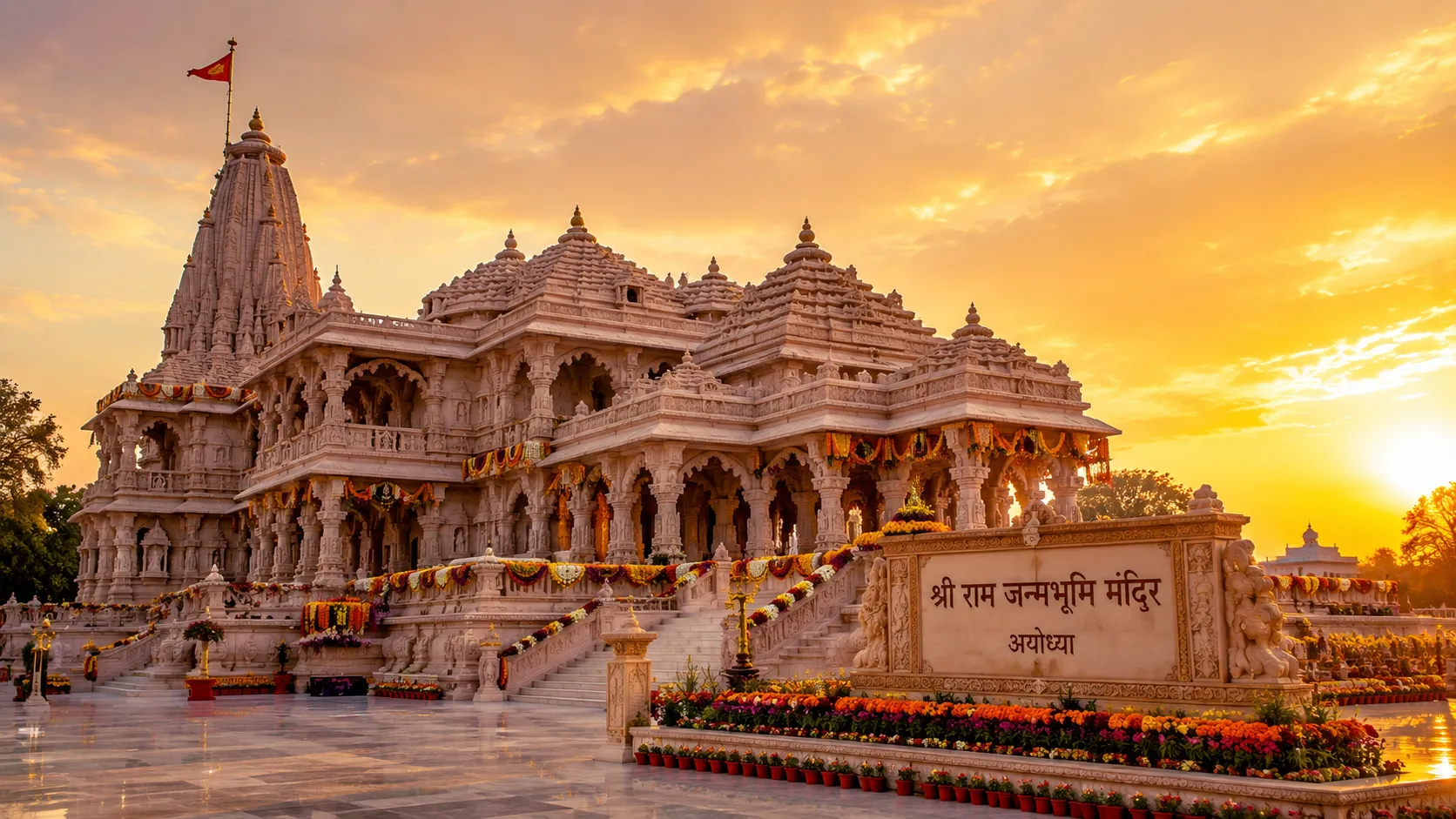
| Shri Ram Janmabhoomi Mandir | The grand temple of Lord Ram, in the core. | /temple/ayodhya/ram-janmabhoomi-mandir |
| Nageshwarnath Temple | The ancient guardian Shiva temple, by the river. | /temple/ayodhya/nageshwarnath-temple |
| Sarnath (Varanasi) | The great site with its international temples, for more of the region's global bonds. | /temple/varanasi/sarnath |
For the Ram Mandir darshan and its free Sugam booking, see our Ram Janmabhoomi Mandir guide.