.webp&w=2048&q=75)
.webp&w=2048&q=75)
Essential info at a glance
| Detail | At a glance |
|---|---|
| What it is | One of the four holiest sites of Buddhism, where the Buddha delivered his first sermon and set the Wheel of Dharma in motion. |
| Site hours | The Dhamek Stupa and archaeological area are open daily from 6:00 AM to 6:00 PM. |
| Museum | The Sarnath Archaeological Museum is open 9:00 AM to 5:00 PM, closed on Fridays. |
| Light and sound show | Around 6:30 PM daily, about 30 minutes, projected on the Dhamek Stupa and narrated by Amitabh Bachchan. |
| Entry | Nominal; Indian visitors about 25 rupees, children under 15 usually free. Reconfirm current ASI rates, especially for foreign visitors. |
| Distance | About 10 km northeast of central Varanasi, a 25 to 45 minute drive. |
| How long | Allow 3 to 4 hours for the stupa, the museum, the temple and the ruins. |
| Best paired with | A morning at Sarnath and the evening ghats and Ganga aarti back in the city. |
Timings and entry fees
Sarnath is spread across a walkable area, but the site, the museum and the evening show keep different hours and different tickets, so it pays to plan. In particular, the museum closes on Fridays, which catches many visitors out.
| Part of Sarnath | Timing | Ticket |
|---|---|---|
| Dhamek Stupa and archaeological area | 6:00 AM to 6:00 PM daily | Indian about 25 rupees; children under 15 usually free; foreign visitors reconfirm current ASI rate. |
| Sarnath Archaeological Museum | 9:00 AM to 5:00 PM, closed Fridays | A separate, nominal ticket. |
| Light and sound show | Around 6:30 PM daily, about 30 minutes | About 200 rupees Indian, 250 rupees foreign, separate from the daytime ticket. |
Why Sarnath matters: the Buddha's first sermon
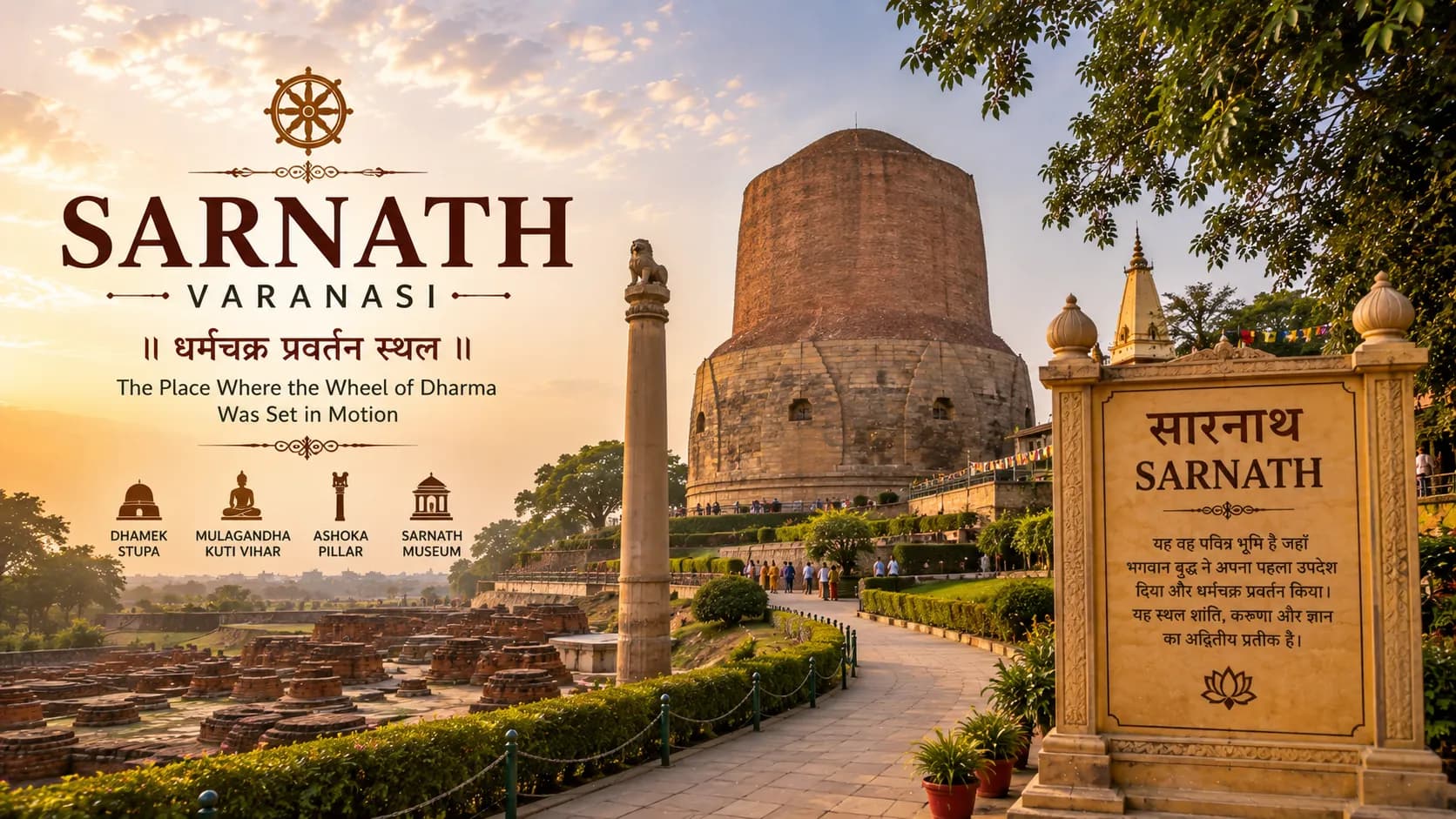
After attaining enlightenment at Bodh Gaya, the Buddha came here, to the Deer Park at Sarnath, and gave his first sermon to his five former companions. That teaching, known as the setting in motion of the Wheel of Dharma, the Dhammachakra Pravartana, is where the Buddhist community began. It is why Sarnath stands with Lumbini, Bodh Gaya and Kushinagar as one of the four holiest places in the Buddhist world, and why pilgrims come here from across Asia and beyond.
Most visitors to Varanasi treat Sarnath as an afterthought, a quick stop if there is spare time. That is a mistake. This is not a minor side temple; it is the birthplace of a world religion's teaching, and standing quietly in the Deer Park where that sermon was given is a genuinely moving experience, and a complete contrast to the intensity of the ghats.
What to see at Sarnath
Sarnath is best understood not as a set of separate photo stops but as the remains of a great religious settlement that grew up around the site of the first sermon. Walk it slowly. These are the highlights.
| Monument | What it is |
|---|---|
| Dhamek Stupa | The great cylindrical stupa, about 43 metres tall, that dominates the site and marks the area of the first sermon. Its carved lower stonework is beautiful; note that it reflects several periods of building rather than a single untouched monument. |
| Ashoka Pillar | The remains of the pillar raised by Emperor Ashoka in the 3rd century BCE. Its famous four lion capital now stands in the museum. |
| Mulagandha Kuti Vihar | The modern temple built in 1931 by the Mahabodhi Society, with celebrated frescoes of the Buddha's life by the Japanese artist Kosetsu Nosu, and a Bodhi tree grown from a Bodh Gaya sapling. |
| Dharmarajika Stupa and ruins | The foundations of stupas, monasteries and shrines spread across the area, the bones of the ancient settlement. |
| Chaukhandi Stupa | A short way off, the mound marking where the Buddha is said to have met his first five disciples, topped by a later octagonal Mughal era tower. |
| Deer Park | The green setting of the first sermon, with deer still kept on the grounds today. |
The international monasteries and temples around Sarnath, built by the Thai, Tibetan, Sri Lankan, Japanese, Chinese and other Buddhist communities, are also worth time, and show how alive this ancient place still is.
The Sarnath Archaeological Museum
Do not skip the museum, which is one of the finest small museums in India and holds the site's greatest treasures. Two are unmissable. The first is the original Lion Capital of Ashoka, the four back to back lions that India adopted as its national emblem, with the Dharmachakra beneath them that sits at the centre of the national flag. The second is the celebrated Gupta period statue of the seated Buddha, shown in the gesture of teaching, the Dhammachakra mudra, widely regarded as one of the masterpieces of Indian sculpture. Remember that the museum is closed on Fridays.
The evening light and sound show
After dark, the Dhamek Stupa itself becomes the screen for a light and sound show that tells the life of the Buddha, from his birth as Prince Siddhartha through his enlightenment to his arrival at Sarnath, narrated by Amitabh Bachchan. It begins around 6:30 PM and lasts about 30 minutes, on a separate ticket from the daytime entry. If you plan to see it, the easiest approach is to spend the day at Sarnath, have lunch nearby, and stay on for the show rather than making a separate evening trip.
A morning in the Deer Park, in my own words
By Rajeev Sharma, Varanasi local
I love bringing people to Sarnath in the morning, because it is the exact opposite of the old city. After the crush and the noise of the ghats, you walk into this calm green park, with the huge Dhamek Stupa rising over the ruins, and everything slows down. I tell my guests that this is where the Buddha gave his very first teaching, to five companions, in a deer park, and that everything that followed in the Buddhist world began right here. People go quiet when they understand that.
I always make sure we do the museum before we leave, and I take them straight to two things: the four lions that became the emblem of India, and the seated teaching Buddha, which to my eye is the single most beautiful sculpture in the country. And I always warn them, never come on a Friday expecting the museum, because it is shut. We usually do Sarnath in the morning and keep the evening for the aarti back on the river; the two together give you the whole span of Kashi in one day.
In more than forty years of guiding, Sarnath is the place travellers thank me for insisting on. Almost no one expects it to move them as much as it does.
A suggested half day at Sarnath
-
Arrive by mid morning and start at the Dhamek Stupa and the ruins in the Deer Park, walking the site slowly.
-
See the Ashoka Pillar remains, then the Mulagandha Kuti Vihar for the frescoes and the Bodhi tree.
-
Visit the Sarnath Archaeological Museum for the Lion Capital and the teaching Buddha, avoiding Friday when it is closed.
-
Add the Chaukhandi Stupa and one or two of the international monasteries if you have time.
-
Return to Varanasi for the evening ghats and the Ganga aarti, or stay on for the light and sound show.
We plan and drive this whole flow for you, so you do not lose the day to logistics.
Best time to visit
| When | Why |
|---|---|
| Morning | Cool, calm light in the Deer Park, and time for the museum before it gets busy. |
| October to March | Pleasant weather for walking the open site. |
| Buddha Purnima (usually May) | The great festival of the Buddha's birth, enlightenment and death, when Sarnath is at its most alive, and most crowded. |
| Avoid Fridays for the museum | The Sarnath Archaeological Museum is closed on Fridays. |
How to reach Sarnath
Sarnath lies about 10 km northeast of central Varanasi, an easy drive out of the city, and unlike the old city ghats you can drive right up to it.
| From | Distance | Notes |
|---|---|---|
| Central Varanasi and the ghats | About 10 km | A 25 to 45 minute drive depending on traffic. |
| Varanasi Junction (Cantt) | About 8 km | A short drive by taxi or auto. |
| Airport | About 20 km | Lal Bahadur Shastri International Airport is on the Sarnath side of the city. |
| Banaras (Manduadih) station | About 12 km | Also convenient by road. |
A car with a driver who knows the route makes Sarnath effortless, and lets you combine it with the city in one day. We arrange the transport and a guide who brings the history to life.
Accessibility for elderly and mobility limited visitors
- Sarnath is largely flat and open, far easier to walk than the old city lanes and ghat steps.
- There is a fair amount of walking across the site; a car to the gate and a relaxed pace help.
- The museum is at ground level and manageable for most visitors.
- We arrange transport to the gate and plan the route so a senior visitor is comfortable.
Combine Sarnath with Varanasi
The perfect Varanasi itinerary pairs the calm of Sarnath with the intensity of the old city and the river, usually Sarnath by day and the ghats by evening.
| Site | What it is | Internal link |
|---|---|---|
| Kashi Vishwanath Temple | The Jyotirlinga at the heart of Kashi, the city's greatest temple. | /varanasi/kashi-vishwanath-temple |
| Dashashwamedh Ghat | Home of the grand evening Ganga aarti, the natural evening to a Sarnath morning. | /varanasi/dashashwamedh-ghat |
| Assi Ghat | The southern ghat, famous for the sunrise Subah-e-Banaras aarti. | /varanasi/assi-ghat |
For Sarnath and the city planned as one seamless trip, see our Varanasi tour packages.
Our Sarnath day tours
We are a Varanasi based operator, a unit of Experience My India, with more than forty years of guiding pilgrims across Kashi, Ayodhya, and Prayagraj. Entry to Sarnath is nominal, so what we arrange is the day around it: a private car, a knowledgeable guide, museum entry, and a smooth flow that pairs Sarnath with the temples and the evening aarti.
| Package | Includes | Price |
|---|---|---|
| Sarnath half day | A private car, a guide, and the stupa, ruins and museum. | Contact us for pricing |
| Sarnath and the evening aarti | Sarnath by day and the grand Dashashwamedh Ganga aarti by evening. | Contact us for pricing |
| Same day Varanasi and Sarnath | Kashi Vishwanath, the old city, the ghats and Sarnath in one full day. | Contact us for pricing |
| Sarnath with the light and sound show | The daytime site and the evening show on the Dhamek Stupa. | Contact us for pricing |
Inclusions and exclusions are stated up front, with any taxes and conditions, and no charge appears later that was not named. See all our Varanasi tour packages for the full range.
Experience My India is a travel operator, not the site administration. Entry fees are set by the Archaeological Survey of India and can change; our tour prices are separate and stated up front.