Essential info at a glance
| Detail | At a glance |
|---|---|
| What it is | The ancient Shiva temple of Ayodhya, Nageshwar Nath, the Lord of Serpents, the guardian Shiva of the city, founded by Ram's son Kush. |
| Morning darshan | 5:00 AM to 12:00 PM, with the Mangala aarti around 5:00 to 6:00 AM. |
| Evening darshan | 4:00 PM to 9:00 PM (to 9:30 PM on special days), with the evening aarti around 8:00 to 8:30 PM. |
| Bhog break | 12:00 PM to 2:00 PM. |
| Entry fee | Completely free. There is no VIP or paid darshan. |
| The deity | An ancient, revered Shiva lingam in the sanctum. |
| Ritual | An Abhishek, the sacred bathing of the lingam, can be arranged with the temple priests for a small nominal offering. |
| Location | Kunj Marg, Theri Bazar, by Ram ki Paidi on the Saryu, about 1.5 to 2 km from the Ram Janmabhoomi. |
Nageshwarnath Temple timings and aarti
The temple keeps a split day, open in the morning and again in the evening, closing over the midday bhog break, and entry is free. Its aartis are its most powerful moments, and its greatest days are Maha Shivratri and the Mondays of Shravan. The general queues move smoothly on most days, so darshan is usually calm, except at the great festivals.
| Ritual or session | Timing | Notes |
|---|---|---|
| Morning darshan | 5:00 AM to 12:00 PM | The morning aarti is around 5:00 to 6:00 AM. |
| Bhog break | 12:00 PM to 2:00 PM | The temple closes for the deity's offering and rest. |
| Evening darshan | 4:00 PM to 9:00 PM | To about 9:30 PM on special days. |
| Evening aarti | About 8:00 to 8:30 PM | The evening worship. |
*Entry is free and there is no VIP darshan.
Nageshwarnath: the guardian Shiva of Ayodhya
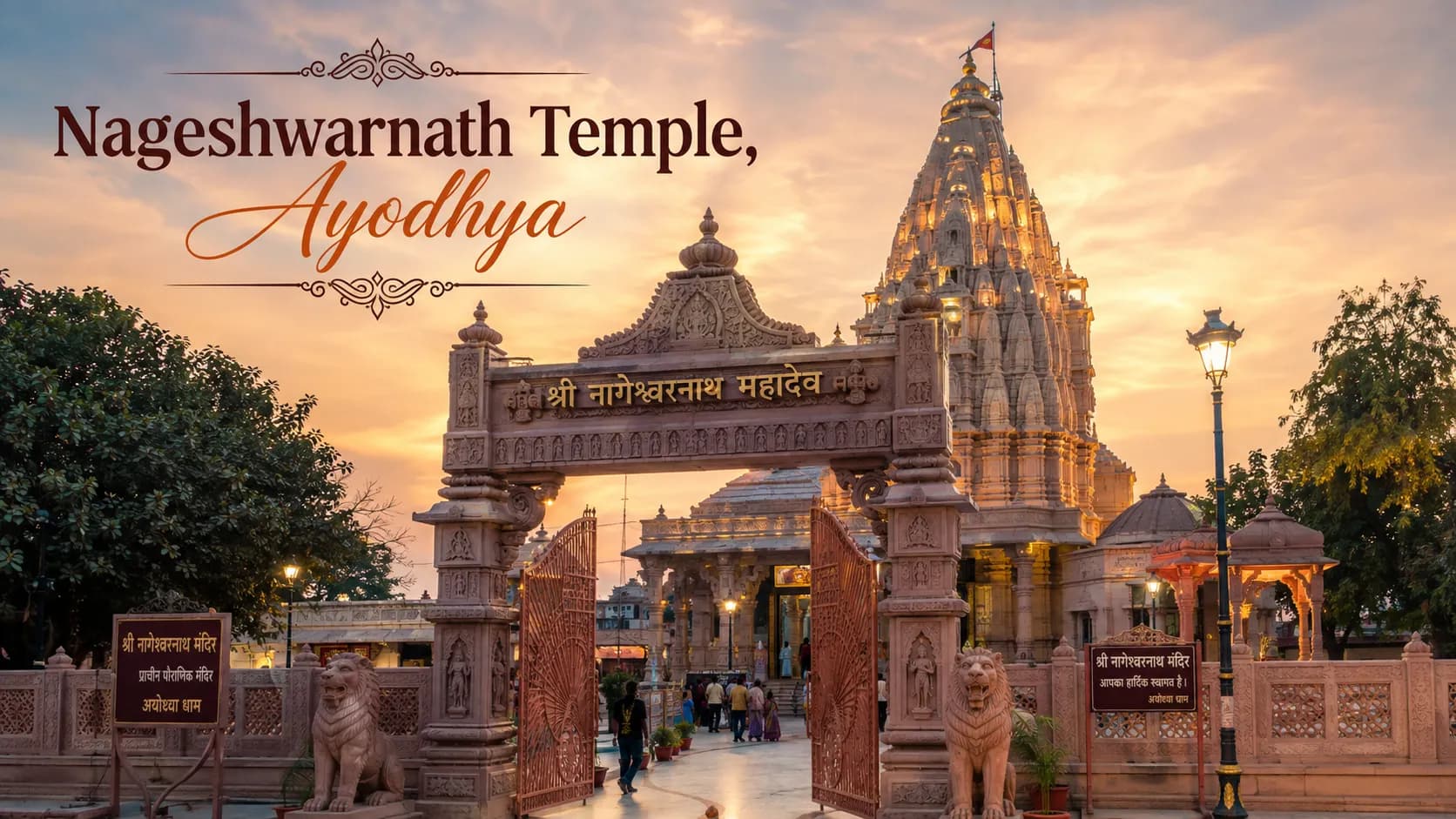
Ayodhya is, above all, the city of Lord Ram, an avatar of Vishnu, and yet at its heart, by the sacred Saryu, stands one of its oldest and most beloved shrines, dedicated to Lord Shiva. This is the Nageshwarnath Temple, and here Shiva is worshipped as Nageshwar Nath, the Lord of the Nagas, the Lord of Serpents. It is among the most ancient temples of Ayodhya, revered as a guardian of the city, and its ancient Shiva lingam has been worshipped here, without break, for longer than anyone can say. That a great Shiva temple should stand so lovingly cared for in the very city of Ram is beautiful, a reminder that in the Sanatan tradition Shiva and Vishnu, and their devotees, are woven together in one faith.
The legend of Kush and the serpent maiden
The story of how this temple came to be is one of the loveliest in Ayodhya, a tale of a lost armlet, a serpent maiden, and love. After Lord Ram departed the world, his son Kush ruled Ayodhya, and he is remembered for restoring and building much in the city. One day, tradition tells, Kush was bathing in the sacred Saryu when his armlet, his bajuband, slipped from his arm and was carried away by the current. It was found, deep in the river, by a Naga Kanya, a celestial serpent maiden who dwelt in the waters, and she returned it to the prince; and in that meeting a bond formed between them, for the maiden was taken with Kush, and she was, above all, a devoted worshipper of Lord Shiva.
The Naga Kanya wished for a temple of Shiva to be raised at that very spot, and Kush, out of respect for her devotion and affection, had it built and dedicated to Shiva. And so, from a lost armlet and a serpent maiden's love of Shiva, was born the Nageshwarnath temple, the Lord of the Serpents enshrined by the son of Ram, in memory of her faith. It is a tale of divine love and devotion, and it gives this ancient temple a tenderness beneath its great antiquity.
The temple that survived the ages
There is another reason Nageshwarnath is held in such special reverence, and it touches the very memory of Ayodhya itself. Tradition tells that as the long centuries passed and the ancient city fell into ruin and was swallowed by forest, so that its holy places were lost and forgotten, this one temple, Nageshwarnath, endured, standing on when all around had crumbled. And it is believed that it was by finding and recognising this surviving temple that the great King Vikramaditya, in a later age, was able to rediscover Ayodhya and to locate the sites of its sacred shrines, and so to restore them. In this telling, Nageshwarnath is the faithful landmark that kept the memory of holy Ayodhya alive through its darkest, most forgotten years, a testament, devotees say, to the enduring power of faith.
The present structure of the temple was rebuilt in 1750 by Naval Rai, a minister of the Nawab of Awadh, and it is worshipped and cherished to this day.
The Shiva lingam and Abhishek
Within the sanctum is the ancient Shiva lingam, the form in which the Lord is worshipped here, and darshan of it is the heart of a visit. As at the great Shiva temples of Kashi, the most cherished worship here is the Abhishek, the sacred bathing of the lingam with offerings of milk, water, honey and the sacred bel leaf, amid the chanting of Shiva's name. A simple darshan is open to all and free; but for those who wish to offer a deeper worship, an Abhishek or a Rudrabhishek can be performed by the temple priests, and it is especially auspicious in the holy month of Shravan. This is arranged directly with the priests for a small, nominal offering, and it is a beautiful thing to do at so ancient a shrine. We are glad to help arrange it. You can also arrange a Rudrabhishek at the great Jyotirlinga of Kashi; see our Kashi Vishwanath Temple guide.
Maha Shivratri, the Shiv Barat, and the festivals
Nageshwarnath comes into its fullest glory at Maha Shivratri, the great night of Shiva, which is celebrated here on a grand scale, drawing thousands upon thousands of devotees. A particular splendour of the day is the Shiv Barat, the great wedding procession of Lord Shiva, taken out through the city with music, colour and joy, one of the most beloved sights of Ayodhya's festival calendar. The temple is also cherished at Nag Panchami, the day of the worship of serpents, fittingly, given the serpent maiden of its founding legend, and throughout the holy month of Shravan, when the Mondays are especially auspicious and many come to offer Rudrabhishek. If you can time your visit to one of these, you will see the temple at its most vibrant.
Shiva by the Saryu, in my own words
By Rajeev Sharma, guide with Experience My India
I love bringing my guests to Nageshwarnath, because it surprises them, a great, ancient Shiva temple in the middle of Ram's city, right by the Saryu at Ram ki Paidi. I tell them the beautiful story, how Kush, Ram's own son, lost his armlet in the river, and a serpent maiden who loved Shiva found it and returned it, and how he built this temple for her. People love that tale. And then I tell them the deeper thing, that this is said to be the one temple that survived when all of ancient Ayodhya was lost to the forest, and that it was by finding it that Ayodhya itself was found again. That gives them a shiver.
Because I am a Kashi man, I always feel at home before a Shiva lingam, and I explain to my guests how the Abhishek works, the bathing of the lingam with milk and water and bel leaf, and when a family wants it, I arrange it with the temple priests for a small offering. It is beautiful in Shravan especially. And since the temple is right at Ram ki Paidi, I plan the visit for the late afternoon, so that after Shiva's darshan we step out to the ghats for the evening Saryu aarti. Shiva and the river together, at dusk, is one of the loveliest hours in Ayodhya.
In more than forty years of guiding, this is the Shiva temple that most delights the pilgrims I bring to Ram's city.
[Photography is not permitted inside the temple; any images are exterior or official.]
Darshan, Abhishek and rules
- Darshan of the lingam is free and by a smooth general queue; there is no VIP or paid line.
- Traditional offerings are milk, water, honey and the sacred bel leaf; carry a little cash for offerings.
- An Abhishek or Rudrabhishek can be performed by the temple priests for a small nominal offering; we can help arrange it.
- Photography is strictly not allowed inside the temple; please respect this.
- Remove footwear before the sanctum and dress modestly.
How to reach Nageshwarnath Temple
The temple is at Kunj Marg, Theri Bazar, right by Ram ki Paidi on the bank of the Saryu, about 1.5 to 2 km from the Ram Janmabhoomi Mandir. It is a short walk from the ghats, or a quick auto from Hanuman Garhi, and its riverside setting makes it easy to pair with the Saryu aarti.
| From | Distance | Notes |
|---|---|---|
| Ram ki Paidi and the Saryu ghats | A 10-minute walk | Right by the ghats; pair with the evening Saryu aarti. |
| Ram Janmabhoomi Mandir | About 1.5 to 2 km | By e-rickshaw or a longer walk. |
| Hanuman Garhi | A short auto ride | From the core temples down to the river. |
| Ayodhya Dham Junction (railway) | About 2 km | By e-rickshaw, auto or taxi. |
| Maharishi Valmiki Airport, Ayodhya | About 12 km | The new airport; taxis and autos to the city. |
Its position by the river makes it a natural evening visit, Shiva's darshan and then the Saryu aarti.
Best time to visit and how to plan it
| When | Why |
|---|---|
| Maha Shivratri (February or March) | The great night of Shiva, with the famous Shiv Barat procession; the temple's grandest day, and its most crowded. |
| Shravan Mondays (July or August) | The holy month of Shiva, especially auspicious for Rudrabhishek. |
| Nag Panchami | The day of serpent worship, fitting for the Lord of Serpents. |
| Late afternoon | For the evening aarti, then step out to Ram ki Paidi for the Saryu aarti at dusk. |
- Pair it with Ram ki Paidi and the Saryu aarti in the evening, and with the core temples earlier in the day.
- Allow 30 to 45 minutes for darshan, longer for an Abhishek.
For Ayodhya, or a combined Kashi and Ayodhya pilgrimage, planned end to end, see our tour packages.
Accessibility for elderly and mobility limited visitors
- The temple is at river level near the ghats, reachable by road and e-rickshaw, with some steps.
- Come at a non-peak hour for the easiest darshan; the general queue is usually smooth.
- Avoid the Maha Shivratri and Shravan-Monday peaks if crowds are difficult.
- We arrange transport and plan a gentle visit, and can have a ritual performed in your name if a visit is hard.
Nearby sacred sites in Ayodhya
Nageshwarnath sits by the river at Ram ki Paidi, so it pairs beautifully with the Saryu and the core temples.
| Site | What it is | Internal link |
|---|---|---|
| Ram ki Paidi and the Saryu ghats | The sacred river ghats and the evening Saryu aarti, right beside the temple. | /temple/ayodhya/saryu-ghat-aarti |
| Shri Ram Janmabhoomi Mandir | The grand temple of Lord Ram, about 1.5 to 2 km away. | /temple/ayodhya/ram-janmabhoomi-mandir |
| Hanuman Garhi | The guardian temple of Hanuman, in the core cluster. | /temple/ayodhya/hanuman-garhi |
| Dashrath Mahal | The palace of King Dashrath, Ram's childhood home. | /temple/ayodhya/dashrath-mahal |
| Kashi Vishwanath (Varanasi) | The great Shiva Jyotirlinga of Kashi, for Rudrabhishek on the wider pilgrimage. | /temple/varanasi/kashi-vishwanath-temple |
For the Ram Mandir darshan and its free Sugam booking, see our Ram Janmabhoomi Mandir guide.
Our guided darshan and Abhishek
We are a Varanasi and Ayodhya based operator, a unit of Experience My India, with more than forty years of guiding pilgrims across Kashi, Ayodhya, and Prayagraj, and we have our own local guide and pandit in Ayodhya. Darshan is free, so what we arrange is the visit and the ritual around it: a guide who tells the story of the temple and the serpent maiden, a well-planned darshan, and, if you wish, an Abhishek or Rudrabhishek performed by the temple priests, along with the evening Saryu aarti nearby.
| Service | Includes | Price |
|---|---|---|
| Guided Nageshwarnath darshan | A guide, the story and the darshan, with the Saryu aarti nearby. | Contact us for pricing |
| Abhishek or Rudrabhishek | The sacred bathing of the lingam by the temple priests, with prasad. | Priests' nominal offering about ₹51 to ₹501; |
| Shiva and Saryu evening | Nageshwarnath darshan and the evening Saryu aarti at Ram ki Paidi. | Contact us for pricing |
| Full Ayodhya darshan day | Nageshwarnath with the Ram Mandir, Hanuman Garhi and the core sites. | Contact us for pricing |
Inclusions and exclusions are stated up front, with any taxes and conditions, and no charge appears later that was not named. Darshan itself is free, and the Abhishek offering to the priests is small; our charge is only for guiding and services. See all our tour packages for the full range.
Experience My India is a travel operator, not the temple administration. Darshan is free; the Abhishek is performed by the temple's own priests for a nominal offering, and our charge is only for our guiding and services. Temple timings and rules are set by the temple and can change.