Essential info at a glance
| Detail | At a glance |
|---|---|
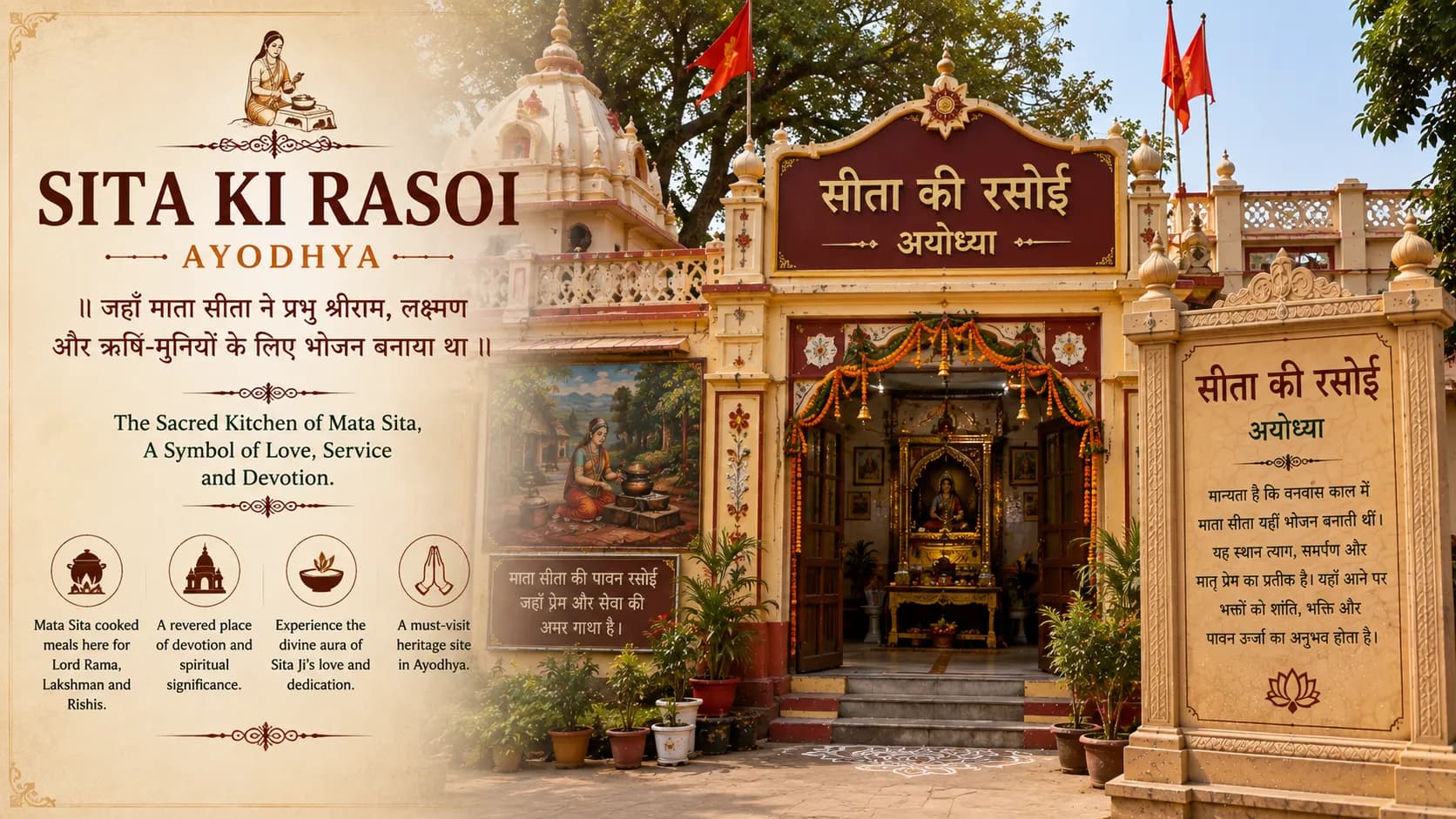
| What it is | The sacred kitchen of Goddess Sita, a small temple-monument with symbolic utensils, honouring Sita as the giver of food. |
| Opening hours | 8:00 AM to 6:00 PM daily; some adjoining sections from 6:00 AM to 9:00 PM. |
| Free meals (Annakshetra) | Free vegetarian meals or prasad are commonly served around 11:30 AM to 3:00 PM. |
| Entry fee | Completely free for all visitors. |
| Aartis | Morning around 6:30 AM and evening around 7:30 PM, close to Kanak Bhavan's schedule. |
| The meaning | Sita is worshipped here as Annapurna, the giver of food and nourishment to all. |
| What to see | The traditional kitchen with symbolic utensils, and idols of Ram and his brothers with their wives. |
| Location | Ramkot, right beside Kanak Bhavan, on the north-west of the Ram Janmabhoomi. |
Sita Ki Rasoi timings and aarti
The kitchen-temple is open through the day, and entry is free. Its aartis align closely with those of neighbouring Kanak Bhavan, and its most special feature is its free food: in the tradition of Sita's own kitchen, meals or prasad are served free to pilgrims around the middle of the day. It is a small site, so a visit takes only fifteen or twenty minutes, and it pairs perfectly with Kanak Bhavan right beside it.
| Detail | When | Notes |
|---|---|---|
| Opening hours | 8:00 AM to 6:00 PM | Some adjoining sections from 6:00 AM to 9:00 PM. |
| Morning aarti | Around 6:30 AM | Close to Kanak Bhavan's morning worship. |
| Evening aarti | Around 7:30 PM | Aligned with the nearby temples. |
| Free meals (Annakshetra) | About 11:30 AM to 3:00 PM | Free vegetarian meals or prasad served to pilgrims. |
*Entry is free.
Sita Ki Rasoi: the sacred kitchen of Sita
Among the tender treasures of Ayodhya is a small temple with a most unusual and lovely dedication: not to a god enthroned, but to a kitchen. Sita Ki Rasoi, Sita's Kitchen, stands just beside Kanak Bhavan, on the north-west of the Ram Janmabhoomi, and it is revered as the kitchen where Goddess Sita, the beloved consort of Lord Ram, cooked for her family after her marriage and her coming to Ayodhya. It is built in the traditional Hindu style, with an open floor and a raised central platform, and on it are displayed the symbolic utensils of that sacred kitchen, the chakla and the belan, the rolling-board and the rolling-pin, stone vessels and pots and a chulha, the hearth, all kept as holy relics of the divine household. Within are enshrined the idols of Ram and his three brothers, Lakshman, Bharat and Shatrughna, together with their wives, Sita, Urmila, Mandavi and Shrutakirti, the whole loving family of the royal house.
There is a great beauty in the idea of this place. In the Hindu home the kitchen is sacred, the hearth is holy, and the woman who cooks with love feeds not only the body but the soul; and here that everyday sanctity is lifted up and worshipped, in the figure of Sita, the ideal wife and homemaker, whose cooking was an act of devotion. To stand in Sita's Kitchen is to honour the sacredness of food, of care, of the loving labour of the home, and it is a small, quiet, deeply human place amid the grandeur of Ayodhya.
Sita as Annapurna, the giver of food
The deeper meaning of Sita Ki Rasoi reaches far beyond one family's meals, for here Sita is worshipped as Annapurna herself, the great goddess of food and nourishment, the one who fills all with food. Tradition tells that Sita's cooking was not for her household alone: it is said that she fed the wise sages, and that in her compassion she saw to it that no one in the whole kingdom of Ayodhya went hungry, feeding, in spirit, the entire world. And so this kitchen becomes a temple of Devi Annapurna in the form of Sita, and a shrine to the divine principle that to feed another is a holy act, that abundance shared is a form of worship. It is a beautiful truth, and it makes this humble kitchen one of the most quietly profound places in the city.
For pilgrims who have visited Kashi, there is a lovely echo here, for the great goddess Annapurna is worshipped there too, in her own famous temple beside Vishwanath; the giver of food is honoured in both of the holy cities. See our guide to the Annapurna Devi Temple.
The Annakshetra: feeding the pilgrim
The spirit of Sita's Kitchen is not only remembered but lived, in the tradition of the Annakshetra, the free kitchen. In keeping with the goddess who saw that none went hungry, free vegetarian meals and prasad are offered here to pilgrims, and on a far larger scale the great Mata Sita Rasoi Annakshetra, the mass-feeding kitchen run for the pilgrims of Ayodhya, carries Sita's compassion into the present day, feeding the multitudes who come to the holy city. To share a simple meal here, offered freely in Sita's name, is to receive not just food but blessing, and to feel the living warmth of a tradition thousands of years old. If you can, take the prasad, and taste the kindness of Sita's Kitchen.
Janaki Kund and the setting
Close beside the kitchen lies a sacred spot called the Janaki Kund, a small tank where, tradition holds, Sita, who is also called Janaki, the daughter of King Janak, bathed with her sisters. The whole little complex, kitchen and kund and shrine, sits in one of the quieter, more tranquil corners of the old city, with room to sit and be still, and, being right beside Kanak Bhavan, it is very naturally seen together with the golden palace of Ram and Sita, the two making a lovely pair: the couple's palace, and the goddess's kitchen.
The kitchen of the goddess, in my own words
By Rajeev Sharma, guide with Experience My India
Sita Ki Rasoi is a small place, and some visitors would hurry through it, but I always stop and explain, because its meaning is so beautiful. I tell my guests that this is Sita's kitchen, and I show them the old rolling-pin and the vessels, and I say: in our tradition, the kitchen is a temple and the woman who cooks with love is doing puja. And then I tell them the deeper thing, that Sita is worshipped here as Annapurna, the goddess who feeds the whole world, who made sure no one in Ayodhya went hungry. People who have seen the Annapurna temple in Kashi smile, because they understand at once. It is a place that honours mothers, and food, and kindness, and it moves people quietly.
I always encourage my guests to take the free prasad or meal if it is being served, because to eat in Sita's kitchen is a blessing. And I give one honest word of caution: it is a small temple, and sometimes a person will appear and press you hard for a donation, or a stranger will attach himself as a 'guide'. Entry is free, and you should give only what you wish, from the heart, and never feel pressured. When I bring my guests, I keep such touts away, so they can simply enjoy this gentle, lovely place, right next to Kanak Bhavan, in peace.
In more than forty years of guiding, this is the little place whose meaning most surprises and moves the people I bring.
What to see, and an honest tip
- See the traditional kitchen and its symbolic utensils, the chakla, belan, vessels and hearth.
- Take darshan of the idols of Ram and his brothers with their wives, the royal family.
- If meals or prasad are being served, take them; to eat in Sita's kitchen is a blessing.
- Entry is free; give a donation only if you wish and only what you wish. Do not feel pressured by anyone demanding money or posing as an official guide.
- Remove footwear, dress modestly, and see it together with Kanak Bhavan right beside it.
How to reach Sita Ki Rasoi
The temple is in Ramkot, right beside Kanak Bhavan, on the north-west of the Ram Janmabhoomi, at the heart of the old city, so it is very easily seen with the core temples. You reach it on foot from Kanak Bhavan or the Ram Mandir, or by e-rickshaw through the lanes.
| From | Distance | Notes |
|---|---|---|
| Kanak Bhavan | Right beside it | A minute's walk; see the two together. |
| Ram Janmabhoomi Mandir | A few minutes' walk | On its north-west; part of the core cluster. |
| Ayodhya Dham Junction (railway) | About 2 km | By e-rickshaw, auto or cycle rickshaw. |
| Maharishi Valmiki Airport, Ayodhya | About 10 km | The new airport; taxis and autos to the old city. |
Being so small and so central, it is best woven into your core-cluster darshan, with Kanak Bhavan, the Ram Mandir, Hanuman Garhi and Dashrath Mahal.
Best time to visit and how to plan it
| When | Why |
|---|---|
| With your core-cluster morning | See it right after Kanak Bhavan, a few steps away. |
| Around the Annakshetra meal, 11:30 AM to 3:00 PM | To receive the free prasad or meal, the heart of Sita's Kitchen. |
| Around the aartis | Morning near 6:30 AM and evening near 7:30 PM. |
| Festivals of Ram and Sita | Ram Navami, Vivah Panchami and the great days, when the whole area is joyful. |
- Pair it with Kanak Bhavan, and with the Ram Janmabhoomi Mandir, Hanuman Garhi and Dashrath Mahal in one core visit.
- Allow only 15 to 20 minutes; it is a small, quick, but meaningful stop.
For Ayodhya, or a combined Kashi and Ayodhya pilgrimage, planned end to end, see our tour packages.
Accessibility for elderly and mobility limited visitors
- The temple is small and at lane level, easier than a hilltop temple, though there are a few steps.
- It is a short, gentle visit, with a quiet corner to sit.
- Come at a non-peak hour for the easiest visit.
- We plan the order of the core temples so an elderly pilgrim is comfortable across the whole visit.
Nearby sacred sites in Ayodhya
Sita Ki Rasoi sits right beside Kanak Bhavan, in the core cluster of Ayodhya's great sites.
| Site | What it is | Internal link |
|---|---|---|
| Kanak Bhavan | The Golden Palace of Ram and Sita, right beside the kitchen. | /temple/ayodhya/kanak-bhavan |
| Shri Ram Janmabhoomi Mandir | The grand temple of Lord Ram, a few minutes' walk away. | /temple/ayodhya/ram-janmabhoomi-mandir |
| Hanuman Garhi | The guardian temple of Hanuman, visited first. | /temple/ayodhya/hanuman-garhi |
| Dashrath Mahal | The palace of King Dashrath, Ram's childhood home. | /temple/ayodhya/dashrath-mahal |
| Annapurna Devi Temple (Varanasi) | The temple of Annapurna, the giver of food, in Kashi. | /temple/varanasi/annapurna-devi-temple |
For the Ram Mandir darshan and its free Sugam booking, see our Ram Janmabhoomi Mandir guide.
Our guided darshan and Ayodhya tours
We are a Varanasi and Ayodhya based operator, a unit of Experience My India, with more than forty years of guiding pilgrims across Kashi, Ayodhya, and Prayagraj, and we have our own local guide and pandit in Ayodhya. Entry and meals at Sita Ki Rasoi are free, so what we arrange is a well-planned, unhurried darshan of the core of Ayodhya, with the meaning of each place explained, touts and donation-pressure kept away, and, if you wish, the free Sugam darshan of Ram Lalla at the Ram Mandir booked for you on the official portal.
| Service | Includes | Price |
|---|---|---|
| Guided core Ayodhya darshan | Sita Ki Rasoi, Kanak Bhavan, the Ram Mandir, Hanuman Garhi and Dashrath Mahal, with a guide. | Contact us for pricing |
| Free Ram Lalla Sugam booking | We book your free Sugam darshan on the official portal with your ID; the pass is free. | No charge for the pass; |
| Full Ayodhya darshan day | The core cluster with the wider Ayodhya sites, with a guide. | Contact us for pricing |
| Kashi and Ayodhya pilgrimage | Varanasi and Ayodhya combined, with darshan, transfers and a guide. | Contact us for pricing |
Inclusions and exclusions are stated up front, with any taxes and conditions, and no charge appears later that was not named. Entry, meals and all temple passes are free; our charge is only for guiding and services. See all our tour packages for the full range.
Experience My India is a travel operator, not the temple administration. Entry, the meals and the Ram Mandir Sugam pass are all free; our charge is only for our guiding and services. Temple timings and rules are set by the temples and can change.