Essential info at a glance
| Detail | At a glance |
|---|---|
| What it is | An ancient temple marking the site of Ram's Ashwamedha Yagna, famous for black idols carved from a single rock, whose sanctum opens to the public only once a year. |
| The one open day | Kartik Shukla Ekadashi, generally in October or November; the gates open for 24 hours. |
| Other days | Standard daily public access is generally limited or closed; you may see the exterior. |
| Entry fee | Free for all devotees. There is no VIP darshan. |
| The idols | Black-sandstone idols of Ram, Sita and their companions, all carved from a single block of stone. |
| The site | Believed to be where Lord Ram performed the great Ashwamedha Yagna after his victory over Ravana. |
| Built by | The King of Kullu, and renovated in 1784 by the Maratha queen Ahilyabai Holkar. |
| Location | Near Naya Ghat, on the bank of the Saryu. |
Timings and the once-a-year opening
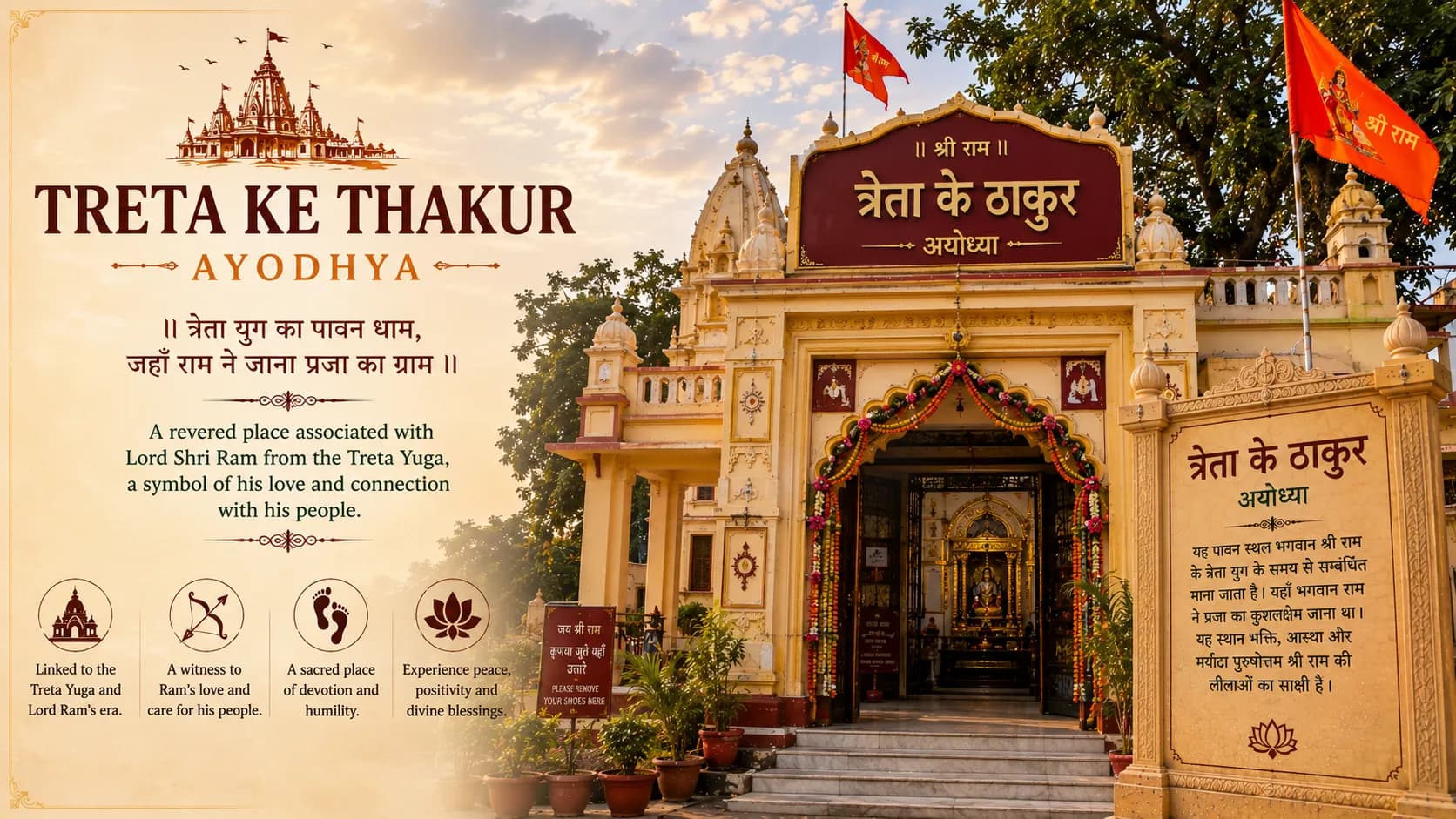
Treta Ke Thakur is unlike any other temple in Ayodhya, for it keeps its greatest treasure hidden almost all the year. Its inner sanctum, with its ancient black idols, is opened to the general public on only a single day each year: Kartik Shukla Ekadashi, the eleventh day of the bright half of the month of Kartik, which usually falls in October or November. On that one day, the gates are thrown open for a full twenty-four hours, and vast crowds of devotees gather for the rare and precious darshan. On the other days of the year, the sanctum is generally closed to the public, and visitors may see the temple only from outside.
| Detail | When | Notes |
|---|---|---|
| Public darshan | Kartik Shukla Ekadashi only (Oct or Nov) | The gates open for 24 hours; huge crowds gather. |
| Aarti (on the open day) | Evening about 7:00 to 8:00 PM; morning rituals near 6:00 AM | The worship on the great day. |
| Other days | Sanctum generally closed to the public | Some special days may have restricted evening windows; the exterior can be seen. |
| Entry fee | Free | There is no VIP darshan. |
Treta Ke Thakur: the temple that opens once a year
There is a special romance to a shrine that is hidden for all but one day of the year, and Treta Ke Thakur is exactly that. For three hundred and sixty-four days its ancient deities rest behind closed doors, unseen; and then, for a single day and night at Kartik Shukla Ekadashi, the gates swing open and the faithful pour in, in their thousands, to behold what is hidden the rest of the year. To take darshan here is therefore a rare and cherished thing, a once-a-year privilege that many pilgrims plan their whole Ayodhya visit around, and the atmosphere on that day, charged with anticipation and joy, is unlike any other in the city. If you can come to Ayodhya at that time, this is a darshan not to be missed; and if you cannot, the temple still rewards a visit from the outside, standing beautifully by the Saryu, for its history alone.
The black idols carved from a single rock
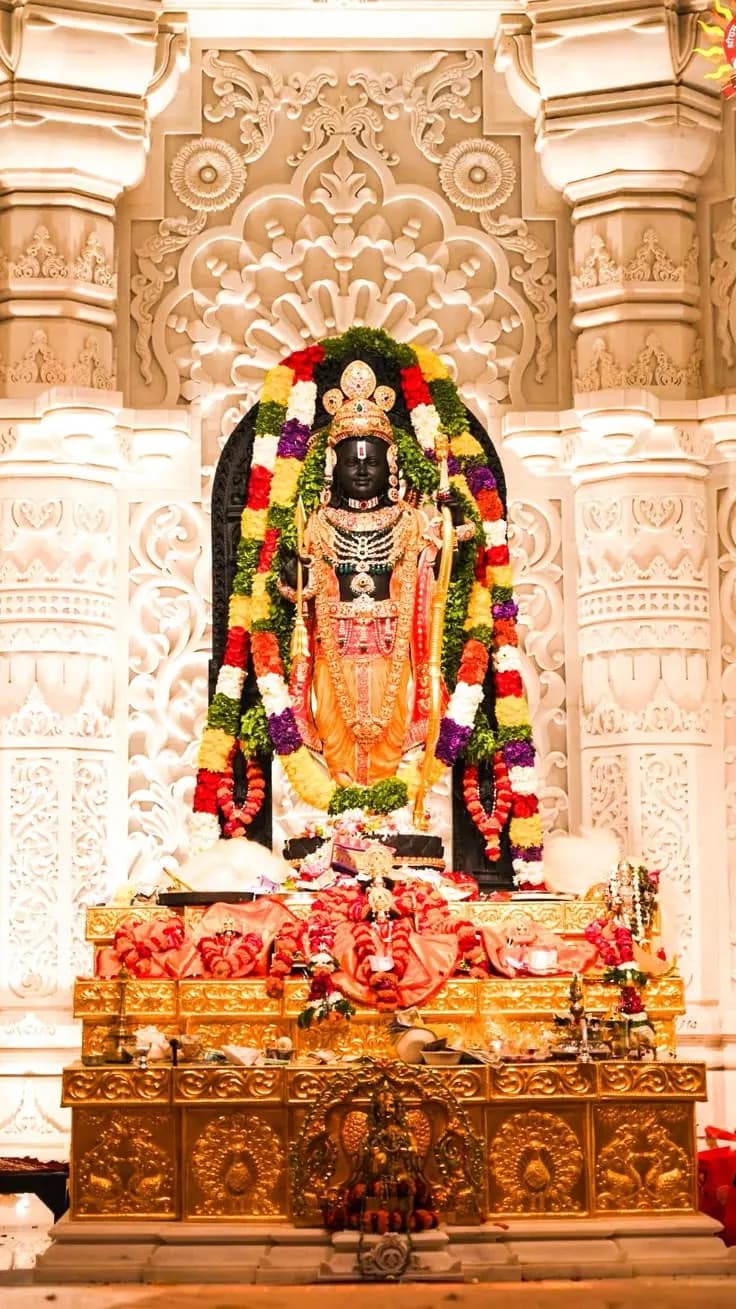
What the devotee beholds on that one day is extraordinary. Within the sanctum stand the idols of the whole company of the Ramayana: Lord Ram and his consort Sita, his brothers Lakshman, Bharat and Shatrughan, his guru Vashishtha, the mighty Hanuman, the monkey-king Sugriva, and the divine gate-guardians Jai and Vijaya. And the wonder of it is that all of these figures are said to have been carved from a single block of black sandstone, one great rock shaped into a whole divine assembly. The black stone gives the deities a deep, still, ancient beauty, quite different from the gilded idols of other temples, and it earned the temple, in older days, the loving name of the temple of Kale Ram, the Black Ram. Tradition holds that these very idols were recovered from an original, ancient temple of Ram that once stood on the bank of the Saryu, so that they carry the memory of Ayodhya's deepest past.
The site of Ram's Ashwamedha Yagna
The temple's name itself tells its meaning: Treta Ke Thakur means the Lord of the Treta age, for Lord Ram walked the earth in the Treta Yuga, the second of the four great ages of the world, and here he is honoured as its Lord. And the ground on which the temple stands is held to be one of the most significant in all of Ram's story, for it is believed to be the very place where Lord Ram, after his triumphant return and his victory over the demon king Ravana, performed the great Ashwamedha Yagna, the royal horse sacrifice by which an emperor proclaimed his sovereignty. It was in the course of this yagna, tradition tells, that Ram's own twin sons, Luv and Kush, raised in the ashram of the sage Valmiki, halted the sacred horse and, all unknowing, came at last face to face with their father. To stand on the site of that great yagna, where the emperor Ram set up images of himself and Sita, is to stand at a turning-point of the Ramayana.
Ahilyabai's temple
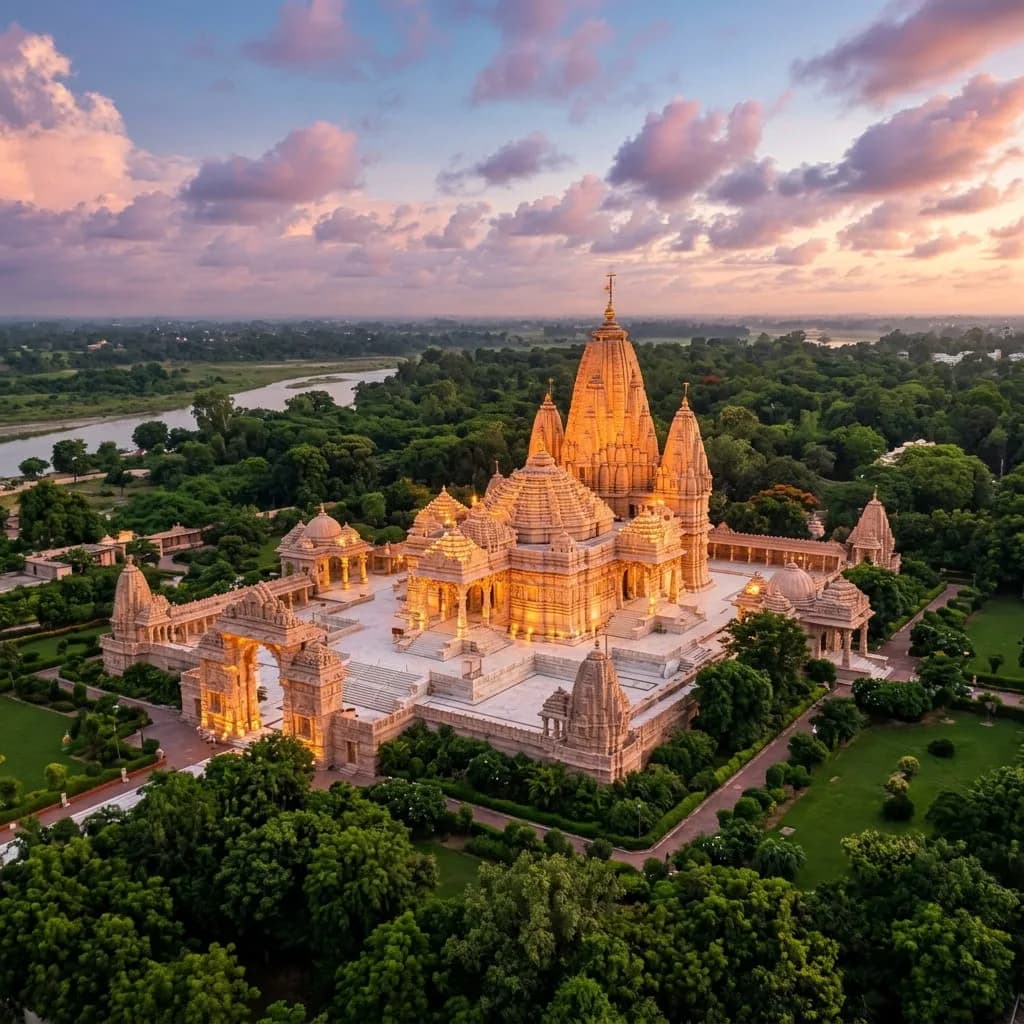
The temple as it stands today is not the ancient original but a later, loving reconstruction, built about three hundred years ago by the King of Kullu, in the Himalayan hills, and then renovated and restored in 1784 by one of the greatest figures in the whole history of Hindu temple-building: Ahilyabai Holkar, the pious Maratha queen of Indore. In her long and remarkable reign, Ahilyabai rebuilt and restored temples and ghats across the length and breadth of India, from Somnath in the west to Kashi in the east, and it was her hand that also raised the famous Kashi Vishwanath temple in Varanasi. That the same devout queen who gave Kashi its Vishwanath temple also restored this shrine in Ayodhya is a lovely thread binding the two holy cities. Built in the classical North Indian Nagara style, with its rising shikhara, Treta Ke Thakur is a fine and dignified temple, worthy of the great event it commemorates. See our guide to the Kashi Vishwanath Temple.
A once-a-year darshan, in my own words
By Rajeev Sharma, guide with Experience My India
Treta Ke Thakur is a temple I plan for very carefully, because it is not like the others: it opens to the public only on one single day in the whole year, Kartik Shukla Ekadashi, usually in November. So when a pilgrim tells me they long to see the black idols, I tell them the truth, that they must come to Ayodhya on that exact day, and I help them plan the trip around it. On that day the crowds are immense, and the feeling is electric, everyone waiting for a darshan they get only once a year. I have taken families for that rare darshan and seen how much more it means to them precisely because it is so hard to get.
I always explain the two wonders of the place: that all the idols, Ram, Sita, the brothers, Hanuman, everyone, are carved from one single block of black stone, which is why the old people call it the Kale Ram temple; and that this is the very ground where Ram did his great Ashwamedha Yagna, where Luv and Kush stopped the horse and met their father. Even on ordinary days, when the sanctum is closed, I bring people to see it from outside, by the Saryu, and tell them these stories, and I tell them that the great queen Ahilyabai, who built the Vishwanath temple in my own Kashi, restored this one too. It is a temple that rewards those who plan for it.
In more than forty years of guiding, this is the darshan I am most often asked to time to the very day.
How to see it
- The only public darshan of the sanctum is on Kartik Shukla Ekadashi (October or November); plan your visit for that exact day.
- On the open day the gates are open 24 hours; expect very large crowds and a joyful, charged atmosphere.
- On other days, the sanctum is generally closed; you can still see the temple from outside, by the Saryu.
- Entry is free; there is no VIP darshan, and on the open day everyone follows the general queue.
- Come with a guide who knows the day and the crowd, so you make the most of a rare darshan.
How to reach Treta Ke Thakur
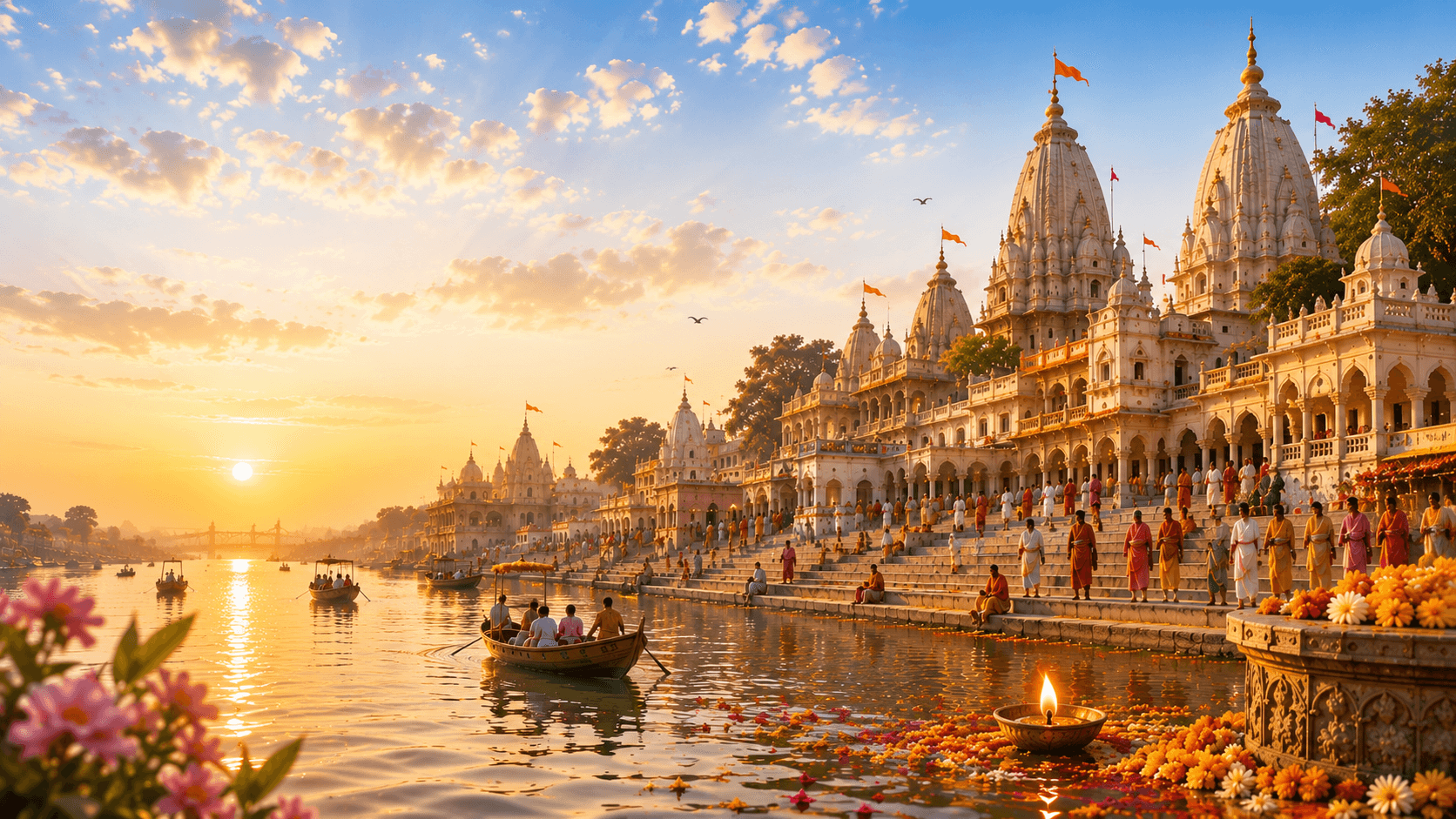
The temple is near Naya Ghat, on the bank of the Saryu, close to Ram ki Paidi, so it is easily seen with the riverfront and, on the open day, with the Kartik crowds along the ghats. You reach it on foot from the ghats or by e-rickshaw.
| From | Distance | Notes |
|---|---|---|
| Naya Ghat and Ram ki Paidi | A short walk | Right by the riverfront; combine with the Saryu ghats. |
| Nageshwarnath Temple | Nearby | The ancient Shiva temple, also by the river. |
| Ram Janmabhoomi Mandir | About 2 km | By e-rickshaw or a longer walk. |
| Ayodhya Dham Junction (railway) | About 2 km | By e-rickshaw, auto or taxi. |
| Maharishi Valmiki Airport, Ayodhya | About 12 km | The new airport; taxis and autos to the city. |
Because the one open day matters so much, the whole visit turns on timing, which is exactly what a good guide arranges.
Best time to visit and how to plan it
| When | Why |
|---|---|
| Kartik Shukla Ekadashi (Oct or Nov) | The one day the sanctum opens to the public, for 24 hours; the only chance for darshan. |
| The Kartik season and Dev Deepawali | Ayodhya's most beautiful festival time on the Saryu, around the open day. |
| Any clear day, for the exterior | To see the temple and its setting by the river, and hear its story. |
- If darshan of the idols matters to you, build your entire Ayodhya trip around Kartik Shukla Ekadashi.
- Pair it with the Saryu ghats, Ram ki Paidi and the Saryu aarti, and the core temples.
For Ayodhya, or a combined Kashi and Ayodhya pilgrimage, planned end to end, see our tour packages.
Accessibility for elderly and mobility limited visitors
- On the one open day the crowds are very heavy, which can be hard for elderly or frail pilgrims; plan and time carefully.
- The temple is near the ghats, reachable by road and e-rickshaw, with some steps.
- On ordinary days the exterior visit is gentle and uncrowded.
- We plan the timing, the transport and the crowd so an elderly pilgrim can have the rare darshan safely.
Nearby sacred sites in Ayodhya
Treta Ke Thakur is by the Saryu at Naya Ghat, so it pairs with the river and the core temples.
| Site | What it is | Internal link |
|---|---|---|
| Saryu Ghats and the aarti | The sacred river ghats and the evening Saryu aarti, right beside the temple. | /temple/ayodhya/saryu-ghat-aarti |
| Nageshwarnath Temple | The ancient guardian Shiva of Ayodhya, also by the river. | /temple/ayodhya/nageshwarnath-temple |
| Shri Ram Janmabhoomi Mandir | The grand temple of Lord Ram, about 2 km away. | /temple/ayodhya/ram-janmabhoomi-mandir |
| Hanuman Garhi | The guardian temple of Hanuman, visited first. | /temple/ayodhya/hanuman-garhi |
| Kashi Vishwanath (Varanasi) | The great Shiva temple of Kashi, also built by Ahilyabai Holkar. | /temple/varanasi/kashi-vishwanath-temple |
For the Ram Mandir darshan and its free Sugam booking, see our Ram Janmabhoomi Mandir guide.
Our guided visit and rare-darshan planning
We are a Varanasi and Ayodhya based operator, a unit of Experience My India, with more than forty years of guiding pilgrims across Kashi, Ayodhya, and Prayagraj, and we have our own local guide and pandit in Ayodhya. Darshan is free, so what we truly offer here is planning and knowledge: we time your Ayodhya visit to Kartik Shukla Ekadashi so that you actually get the once-a-year darshan of the black idols, guide you through the great crowds of the day, tell you the story of the yagna and the idols, and pair it with the Saryu ghats and the core temples.
| Service | Includes | Price |
|---|---|---|
| Kartik Ekadashi darshan planning | Timing your trip to the open day, and guiding you through the crowds for the rare darshan. | Contact us for pricing |
| Guided Treta Ke Thakur visit | The temple, its story and the Saryu setting, with a guide (exterior on closed days). | Contact us for pricing |
| Saryu and heritage day | Treta Ke Thakur with Nageshwarnath, the ghats and the Saryu aarti. | Contact us for pricing |
| Full Ayodhya darshan tour | The temple within a wider, well-timed Ayodhya pilgrimage. | Contact us for pricing |
Inclusions and exclusions are stated up front, with any taxes and conditions, and no charge appears later that was not named. Darshan itself is free; our charge is only for guiding, planning and services. See all our tour packages for the full range.
Experience My India is a travel operator, not the temple administration. Darshan is free; our charge is only for our guiding and services. Temple timings, above all the one open day, are set by the temple and can change, so we confirm them for your dates.