Essential info at a glance
| Detail | At a glance |
|---|---|
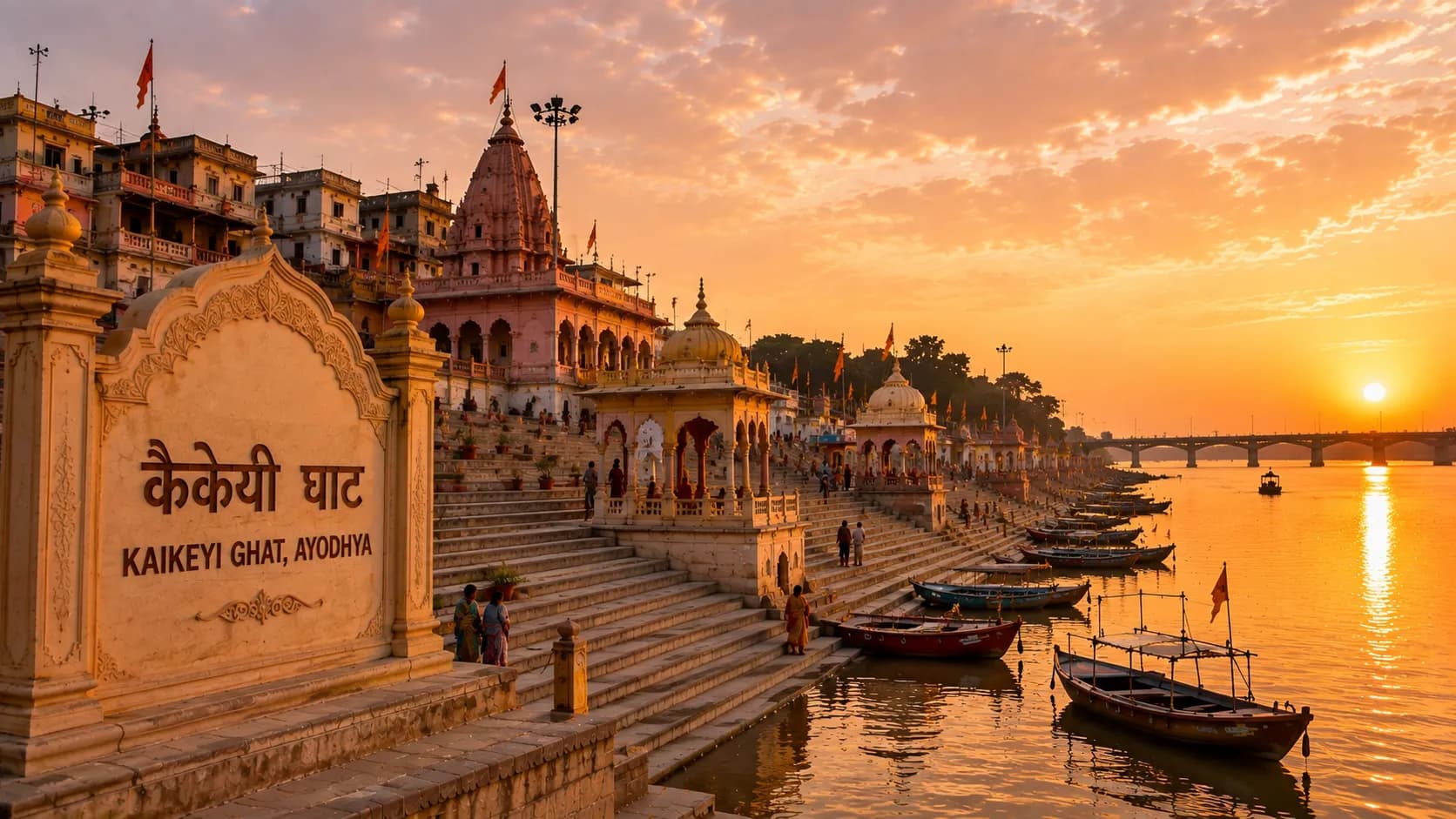
| What it is | A lesser-known, ancient Saryu ghat named for Queen Kaikeyi, the third queen of Dashrath and mother of Bharata. |
| Its state today | Largely in ruins; only remnants survive, with an old Lakshmi Kund inscription. |
| Water | Owing to a dam, the water reaches the ghat mainly in the monsoon season. |
| Ghat access | Open 24 hours; an open riverbank site. Best at sunrise or sunset. |
| Entry fee | Free. No ticket or VIP pass. |
| Saryu aarti | Held nearby at the main Ram ki Paidi ghats, around 6:00 to 7:30 PM; deepdaan here at dusk. |
| The queens' riverside | One of the ghats of Dashrath's queens, with Kaushalya Ghat. |
| Location | Near Ram ki Paidi / Naya Ghat, on the Saryu, Ayodhya. |
Kaikeyi Ghat timings and the aarti
Kaikeyi Ghat is an open riverbank site, accessible around the clock, and free, though it is best visited in the soft light of early morning or sunset. As it is a lesser-known and largely ruined ghat, there is no grand aarti here; the grand collective Saryu aarti is performed nearby at the main Ram ki Paidi ghats every evening, around 6:00 to 7:30 PM, and at dusk pilgrims may make their own deepdaan, the offering of a lamp to the river, at Kaikeyi Ghat. For the full guide to the Saryu aarti, see our Saryu aarti and Ram ki Paidi page.
| Detail | When | Notes |
|---|---|---|
| Ghat access | 24 hours, every day | An open riverbank site; free. |
| Best times | Sunrise and sunset | For the light and the quiet. |
| Deepdaan at Kaikeyi Ghat | At dusk | Individual lamp offerings to the river. |
| Saryu aarti (nearby) | Around 6:00 to 7:30 PM | At the main Ram ki Paidi ghats; see the full aarti guide. |
Kaikeyi Ghat: the ghat of the third queen
Kaikeyi Ghat is one of the quieter and more thought-provoking of all the ghats of Ayodhya, for it is named for Queen Kaikeyi, the third queen of King Dashrath and the mother of Bharata, one of the most complex and debated figures in all the Ramayana. It stands among the ghats of the royal riverside, where, tradition tells, the palaces of Dashrath's queens stood close to the Saryu, so that Kaikeyi Ghat sits beside Kaushalya Ghat as one of the queens' own bathing places by the holy river. Though little remains of it today, it is a place where a thoughtful pilgrim may pause and reflect on the great and difficult story of the Ramayana, and on the queen whose choice set so much of it in motion.
Queen Kaikeyi: a thoughtful look at a complex queen
Kaikeyi is a figure who deserves to be remembered with fairness and thought, for she was far more than the single act for which she is best known. A princess of the kingdom of Kekaya, the daughter of King Ashwapati, she was renowned for her beauty, her intelligence and her courage, and, uncommonly for a royal woman of her age, she was learned in statecraft and even in the arts of war, in archery and the driving of the chariot. For her spirit and her loyalty she became the most beloved of Dashrath's three queens; and, the tradition tells, she once saved the king's very life on the field of battle, driving his chariot through danger, for which grateful deed he granted her the two boons that would one day change the world. She loved her stepson Ram as dearly as her own son Bharata, and it was she, in her affection, who gave to Ram and Sita the golden palace of Kanak Bhavan as their home. For most of her life, Kaikeyi was a queen of virtue, courage and love.
Then came the turning. On the eve of Ram's coronation, her maid Manthara worked upon her fears for her son's future, and Kaikeyi, in a mother's dread and a moment of weakness, called in the two old boons: that Bharata be crowned, and that Ram be sent to the forest for fourteen years. The grief that followed was terrible, the exile of Ram, and the death of Dashrath from a broken heart; and Kaikeyi, it is said, came to blame herself bitterly and to repent her act for the rest of her days. Yet the tradition holds a deeper and more merciful view as well: that this sorrowful turn, for all its pain, served the divine plan, for it was Ram's exile that carried him to the forest and to the war in which Ravana was destroyed and the earth was freed of a great evil; so that Kaikeyi, whether as a flawed and grieving mother or as an unknowing instrument of a higher purpose, played her part in the working out of dharma. To this day the wise contemplate her story, of duty and desire, of love and its consequences, and ask whether she was villain or victim, or something more human and more sorrowful than either.
The queens' riverside and the royal family
Kaikeyi Ghat is best understood as part of the royal riverside of Ayodhya, the stretch of the Saryu by which, tradition tells, the palaces of King Dashrath's queens once stood. Here, beside Kaushalya Ghat, the ghat of Ram's mother, and near the palace of Dashrath himself and the golden Kanak Bhavan that Kaikeyi gave to Ram and Sita, lay the ghat of the third queen; and together these places trace the whole royal household of the Ramayana along the water, the king, his queens, their sons, and the sorrows and glories that bound them. To walk this royal riverside is to walk through the human heart of the great epic.
A place for reflection
More than a place of ritual, Kaikeyi Ghat is a place of reflection. In its quiet, ruined remnants by the river, the thoughtful visitor may sit and consider the deepest questions the Ramayana raises, of dharma and karma, of the terrible power of a single choice, of maternal love and where it may lead, of guilt and repentance, and of how the divine plan may work even through human frailty and sorrow. And Kaikeyi's own son, Bharata, gives the story its redeeming grace: for he utterly refused the throne his mother had won for him, holding it to be Ram's alone, and ruled only as Ram's servant and regent, the very model of devotion. To offer a quiet lamp here at dusk is to hold all of this in one's heart.
The queen's ghat, in my own words
By Rajeev Sharma, guide with Experience My India
I bring my thoughtful guests to Kaikeyi Ghat, though little of it remains, because its story is one of the most human in all the Ramayana, and I like to tell it with fairness. I say to them: do not remember Kaikeyi only for the one terrible thing. Remember that she was the bravest and most beloved of the queens, that she saved King Dashrath's life in battle, that she loved Ram as her own and gave him and Sita the beautiful Kanak Bhavan. And then, in a mother's fear, worked on by Manthara, she made the choice that broke everyone's heart, and she repented it all her life. People are always moved to hear the whole of her, not just the part they knew.
And I tell them the deeper thing, that her sorrowful act was, in the end, part of the divine plan, for it sent Ram to the forest and to the destroying of Ravana; so that even her fault served dharma. I show them how Kaikeyi Ghat sits beside Kaushalya Ghat, the two queens together on the royal riverside, near the palace of Dashrath and the Kanak Bhavan she gifted, so my guests feel the whole royal family by the river. And I always end with Bharata, her son, who refused the throne out of love for Ram, the finest answer to his mother's fault. It is a quiet, ruined, but deeply moving place, and for a pilgrim who loves the great story, I never let it be missed.
In more than forty years on the ghats, to tell the whole, fair, human story of Kaikeyi here is among the most thoughtful things I share.
What to see and do
- Reflect at the remnants of Kaikeyi Ghat on the complex story of the third queen.
- Hear the whole, fair story of Kaikeyi, her virtues, her fault, her repentance, and the divine plan.
- Offer a quiet deepdaan, a lamp to the river, at dusk.
- See how it sits beside Kaushalya Ghat on the royal riverside of the queens.
- Pair it with the family sites, the Kanak Bhavan she gifted and her son Bharata's places.
How to reach Kaikeyi Ghat
Kaikeyi Ghat is on the banks of the Saryu near the Ram ki Paidi and Naya Ghat area, among the ghats of the royal riverside, easily reached on foot or by e-rickshaw.
| From | Distance | Notes |
|---|---|---|
| Kaushalya Ghat | Near, on the royal riverside | The ghat of Ram's mother; the queens' pair. |
| Ram ki Paidi and the Saryu aarti | Nearby, on the riverfront | The main aarti ghats; a short way. |
| Kanak Bhavan | A short ride | The golden palace Kaikeyi gifted to Ram and Sita. |
| Ayodhya Dham Junction (railway) | A few km | By e-rickshaw, auto or taxi. |
| Maharishi Valmiki Airport, Ayodhya | About 12 km | The new airport; taxis and autos to the ghat. |
It sits among the queens' and family ghats of the royal riverside.
Best time to visit and how to plan it
| When | Why |
|---|---|
| Early morning or sunset | For the light and the quiet, best for reflection. |
| The monsoon (Jul to Sep) | When the Saryu's water reaches the ghat. |
| At dusk, for the deepdaan | To offer a lamp to the river as the aarti begins nearby. |
| With the queens' and family ghats | To walk the whole royal riverside of the Ramayana. |
- Pair it with Kaushalya Ghat, Kanak Bhavan and the Saryu aarti.
- Allow a short, reflective visit; it is a place of story more than of ritual.
For Ayodhya, or a combined Kashi and Ayodhya pilgrimage, planned end to end, see our tour packages.
Accessibility for elderly and mobility limited visitors
- As a ruined riverbank ghat, the ground may be uneven; the upper areas and the story can be enjoyed without going down to the water.
- It is quiet and unhurried, suiting a gentle, reflective pause for elderly visitors.
- We can arrange a comfortable spot and tell the story without difficult descents.
- We arrange transport and plan a gentle riverside visit within your Ayodhya day.
Etiquette at the ghat
- Treat the old remnants and the story with respect and thoughtfulness.
- Do not litter or put plastic in the river; offer only the leaf-boat lamps sold for the purpose.
- Speak of Kaikeyi with fairness and compassion, as the tradition itself does.
- Mind the uneven ground and any steps near the water.
Our guided riverside experiences and Ayodhya tours
We are a Varanasi and Ayodhya based operator, a unit of Experience My India, with more than forty years on the river ghats of Kashi and Ayodhya. The ghat is free, so what we offer is the story and the planning: a guide who tells the whole, fair, human story of Queen Kaikeyi and the royal riverside, the queens' and family ghats together, and the Ramayana brought to life along the water, woven into a fuller day of Ayodhya.
| Service | Includes | Price |
|---|---|---|
| Guided Ramayana riverside walk | Kaikeyi Ghat, Kaushalya Ghat and the queens' and family riverside, with a guide. | Contact us for pricing |
| Guided Saryu ghats and aarti | The riverside ghats and the Saryu aarti, with a guide. | Contact us for pricing |
| Full Ayodhya darshan with aarti | The riverside within a wider Ayodhya visit, with a guide. | Contact us for pricing |
| Kashi and Ayodhya pilgrimage | Varanasi and Ayodhya, with the river ghats and aartis, darshan and transfers. | Contact us for pricing |
Inclusions and exclusions are stated up front, with any taxes and conditions, and no charge appears later that was not named. The ghat, aarti and river are free; our charge is only for guiding and services. See all our tour packages for the full range.
Experience My India is a travel operator, not a temple or government body. The ghat, the aarti and the river are free; our charge is only for our guiding and services. Timings are set by the authorities and can change.
Nearby sacred sites in Ayodhya
Kaikeyi Ghat is on the royal riverside of Ayodhya, among the queens' and family sites.
| Site | What it is | Internal link |
|---|---|---|
| Kaushalya Ghat | The ghat of Kaushalya, the mother of Ram; the queens' pair. | /temple/ayodhya/kaushalya-ghat |
| Kanak Bhavan | The Golden Palace Kaikeyi gifted to Ram and Sita. | /temple/ayodhya/kanak-bhavan |
| Dashrath Mahal | The palace of King Dashrath, Kaikeyi's husband. | /temple/ayodhya/dashrath-mahal |
| Bharat Kund (Nandigram) | The place of Bharata, Kaikeyi's devoted son, who ruled as Ram's regent. | /temple/ayodhya/bharat-kund |
| Saryu Aarti and Ram ki Paidi | The grand Saryu aarti and the sacred riverfront, nearby. | /temple/ayodhya/saryu-ghat-aarti |
For the Ram Mandir darshan and its free Sugam booking, see our Ram Janmabhoomi Mandir guide.