Essential info at a glance
| Detail | At a glance |
|---|---|
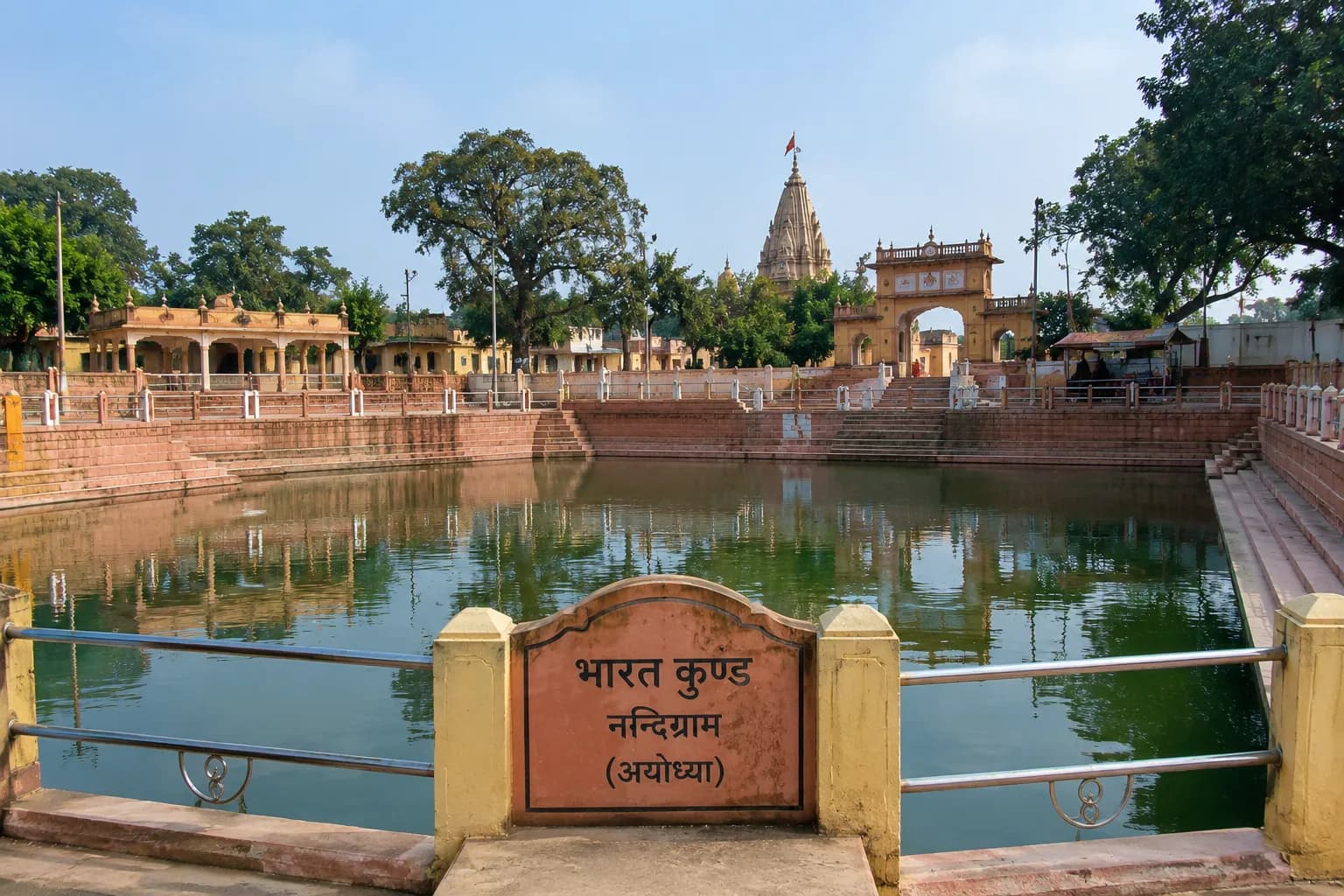
| What it is | The sacred pond and shrines at Nandigram, where Bharat ruled by Ram's sandals and did penance through the 14-year exile. |
| Opening hours | Around 5:00 AM to 8:00 PM daily. |
| Entry fee | Free. There is no VIP darshan or long queue. |
| Aarti | The Shri Bharat Sarovar Nitya Aarti, daily at the kund, around 5:00 to 5:30 PM. |
| Also known as | Chhota Gaya, the little Gaya, a great place for Pind Daan and ancestral rites. |
| The shrines | The Bharat Mandir with Ram's sandals on the throne, and the Bharat-Hanuman Milan Mandir. |
| The atmosphere | Serene, green and uncrowded, ideal for meditation and reflection. |
| Location | Nandigram, near Bhadarsa, about 15 to 22 km south of Ayodhya, roughly 45 minutes by road. |
Bharat Kund timings and aarti
Bharat Kund is open through the day, from around 5:00 AM to 8:00 PM, and entry is free. It is a peaceful, green, uncrowded place, free of the long queues of the great temples, and it is at its most beautiful in the calm of the morning and in the late afternoon, when the daily aarti of the Bharat Sarovar is offered by the water.
| Detail | When | Notes |
|---|---|---|
| Opening hours | About 5:00 AM to 8:00 PM | Open every day; free. |
| Shri Bharat Sarovar Nitya Aarti | About 5:00 to 5:30 PM | The daily evening aarti at the kund. |
| Best times | Morning (8 to 11 AM) and late afternoon | Calm and beautiful for darshan and meditation. |
| Pind Daan | Especially in Pitru Paksha | Ancestral rites are performed here; arrange with the priests. |
*Entry is free and there are no computerised queues.
Bharat Kund and Nandigram: the seat of Bharat's devotion
Of all the places touched by the Ramayana, few move the heart as deeply as Nandigram, for this is the place of Bharat, and of one of the most beautiful acts of devotion and sacrifice in all of India's sacred story. When Lord Ram was sent into his fourteen-year exile, through the demand of Bharat's own mother, Kaikeyi, Bharat, who had been away, returned to find his father dead of grief and his beloved elder brother banished; and he was filled with remorse and refused, utterly, to take the throne that was Ram's by right. He went to the forest and begged Ram to return and rule; but Ram, bound by their father's word, would not break the exile. And so Bharat asked for one thing: Ram's padukas, his simple wooden sandals. He carried them home upon his head, in reverence, and placed them upon the throne of Ayodhya to represent the true king, and he ruled the kingdom, not as king, but only as the regent of Ram's sandals.
And he did not rule from the palace. Refusing all royal comfort, Bharat came out to Nandigram, this village beyond the city, and there he lived for fourteen long years exactly as Ram lived in the forest: in matted hair and bark and the skin of a deer, sleeping on the bare ground, eating the food of an ascetic, in ceaseless penance and prayer, ruling the kingdom in Ram's name while he waited, counting the days, for his brother's return. This is why the sages call the placing of Ram's sandals upon the throne the very crux of the whole epic, the perfect image of selfless love, of dharma, of a devotion so complete that it asks nothing for itself. To stand at Nandigram is to stand where that supreme devotion was lived, and pilgrims come away moved as by few other places.
Bharat Kund and Chhota Gaya: the place of Pind Daan
At the heart of Nandigram lies the sacred pond, the Bharat Kund or Bharat Sarovar, in whose holy waters, tradition tells, Bharat bathed every single day through all the fourteen years of his penance. But the kund holds a second, solemn significance. For it was here, it is believed, that Lord Ram had a pond made and performed the Pind Daan, the last rites, of their father, King Dashrath; and so Bharat Kund became, and remains, one of the most sacred places in India for the rites of the ancestors. It is lovingly called Chhota Gaya, the little Gaya, after the great tirtha of Gaya where the departed are honoured, and the Skanda Purana promises that to offer tarpan to one's forefathers here cleanses every sin and grants liberation. Especially in the fortnight of Pitru Paksha, devotees come in numbers to perform Pind Daan and tarpan for their ancestors by these waters.
Pilgrims walk a reverent parikrama around the kund, take the daily aarti, and perform the ancestral rites with the priests. If you wish to offer Pind Daan or tarpan for your forebears at this holy place, we are glad to arrange it with the temple priests.
The Bharat-Hanuman Milan and the Bharat Mandir
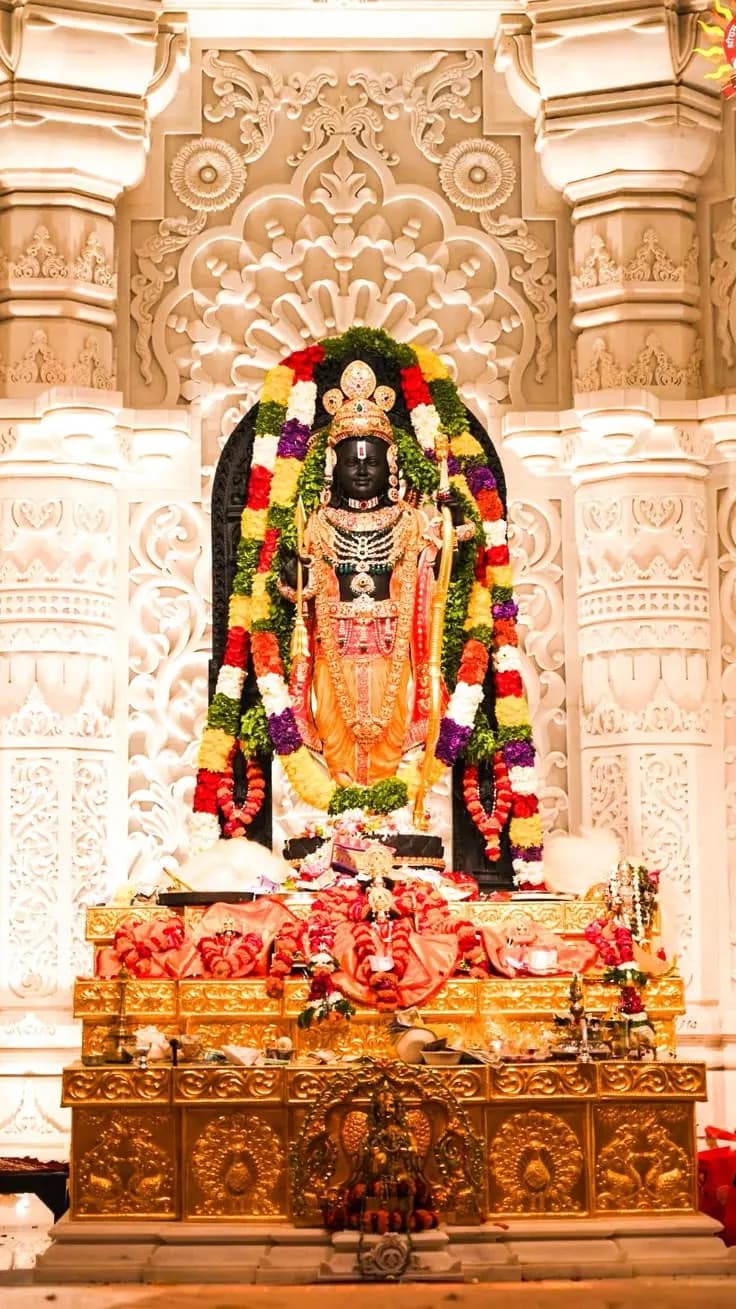
Nandigram is also the place of a joyful reunion. As the fourteen years drew to their close, Bharat had vowed that if Ram did not return on the appointed day, he could not live; and so Lord Ram, returning from Lanka, sent Hanuman ahead to Nandigram to carry the glad news of his coming and his victory, and to save Bharat's life. The meeting of Bharat and Hanuman, the devoted brother and the great devotee, embracing in joy, is one of the tender moments of the Ramayana, and it is honoured here at the Bharat-Hanuman Milan Mandir on the bank of the kund, where the image shows Bharat embracing Hanuman. And here, soon after, the brothers Ram and Bharat themselves were reunited at last, after fourteen years apart. In the Bharat Mandir nearby, you may see Ram's sandals enshrined upon a throne, just as Bharat kept them, while he himself slept upon the floor.
Nandigram: the village of Nandi and its holy places
The village takes its name not from Bharat but from Nandi, the bull who is the devoted companion of Lord Shiva, who is said to have performed great penance here; pleased with him, Shiva made him his chief attendant and granted his wish that every act of devotion done here should bear fruit, and the Shivalinga of Nandishwar Mahadev marks the spot. So Nandigram is holy to Shiva as well as to Bharat. Scattered through the village and its green fields are other sacred places: the Bharat Gufa, the cave where Bharat is said to have lived, meditated and ruled; the Bharat Koop, an ancient well said to hold the waters of twenty-seven sacred rivers, which Bharat gathered, and whose water, the priests say, never spoils, like the water of the Ganga; and, a little away, the Jata Kund, where Ram and Lakshman are said to have removed their matted hair after returning from Lanka. So sacred is this whole ground that the scriptures say a darshan of Nandigram gives merit like residing in holy Kashi itself, a beautiful thread joining Bharat's Nandigram to the city of Shiva.
The heart of devotion, in my own words
By Rajeev Sharma, guide with Experience My India
Bharat Kund is a little out of the city, and some visitors skip it, but I always take those who have the time, because for me it is the most moving place of all. I tell them the story slowly: how Bharat refused the throne, how he carried Ram's little wooden sandals home on his head and put them on the throne, and how he came out here to Nandigram and lived for fourteen years like a hermit, ruling the kingdom in his brother's name while he waited. I have seen strong men wipe their eyes when I tell it. This, I say, is what devotion means; this is why we love Bharat.
We walk around the peaceful pond, and I explain that this is Chhota Gaya, the little Gaya, where Ram did the last rites of their father, and that people come here to do Pind Daan for their own ancestors. When a family wishes it, I arrange the tarpan with the priests, which is a very sacred thing here. I show them the padukas on the throne in the Bharat Mandir, and the lovely image of Bharat embracing Hanuman. And I tell them the wonderful thing, that the scriptures say a darshan here is like living in my own Kashi, so the two holy places are joined. It is green and quiet and deep, and my guests are always so glad they came the extra distance.
In more than forty years of guiding, this is the place whose story most moves the pilgrims I bring.
What to see and do
- Take darshan and walk a reverent parikrama around the sacred Bharat Kund (Bharat Sarovar).
- Attend the daily Nitya Aarti of the Bharat Sarovar in the late afternoon.
- See Ram's sandals enshrined on the throne in the Bharat Mandir, and the Bharat-Hanuman Milan Mandir.
- Perform Pind Daan or tarpan for your ancestors at this Chhota Gaya, especially in Pitru Paksha.
- Visit the Bharat Gufa, the Bharat Koop and the Nandishwar Mahadev, and feel the deep peace of Nandigram.
How to reach Bharat Kund
Bharat Kund is at Nandigram, near Bhadarsa, about 15 to 22 km south of Ayodhya, roughly a 45-minute drive via the Sultanpur Road or the Darshan Nagar route. It is a little out of the city, so a car or taxi is the easiest way.
| From | Distance | Notes |
|---|---|---|
| Central Ayodhya and the Ram Mandir | About 15 to 22 km south | Roughly 45 minutes by road, via Sultanpur Road or Darshan Nagar. |
| Bhadarsa | Nearby | Nandigram is close to Bhadarsa on the Ayodhya road. |
| Ayodhya Dham Junction (railway) | About 20 km | By taxi or auto. |
| Maharishi Valmiki Airport, Ayodhya | About 25 to 30 km | The new airport; by road. |
Because it is out of town, a car and a guide make the visit easy and meaningful, and let you do the ancestral rites in comfort.
Best time to visit and how to plan it
| When | Why |
|---|---|
| Morning (8 to 11 AM) or late afternoon | The calmest, most beautiful time for darshan and meditation. |
| Late afternoon, for the aarti | The daily Bharat Sarovar aarti, around 5:00 to 5:30 PM. |
| Pitru Paksha (September or October) | The great fortnight for Pind Daan and ancestral rites at this Chhota Gaya. |
| A quiet, unhurried day | This is a place to feel, not to rush; allow time to sit and reflect. |
- Pair it with a day of the core Ayodhya temples, or make it a peaceful half-day excursion.
- Allow a couple of hours, longer for a Pind Daan or ancestral rite.
For Ayodhya, or a combined Kashi and Ayodhya pilgrimage, planned end to end, see our tour packages.
Accessibility for elderly and mobility limited visitors
- The site is out of the city but reached by road right up to it, and it is green, calm and largely level around the kund.
- There are steps down to the water and some walking among the shrines; a gentle pace suits it.
- It is uncrowded and peaceful, ideal for an unhurried, restful visit for elderly pilgrims.
- We arrange a comfortable car, plan a gentle visit, and can have a ritual performed in your name.
Nearby sacred sites in Ayodhya
Bharat Kund is south of the city; it connects beautifully to the family and the story of Ram.
| Site | What it is | Internal link |
|---|---|---|
| Dashrath Mahal | The palace of King Dashrath, Bharat's father, whose last rites Ram did at Bharat Kund. | /temple/ayodhya/dashrath-mahal |
| Hanuman Garhi | The temple of Hanuman, who met Bharat here with the news of Ram's return. | /temple/ayodhya/hanuman-garhi |
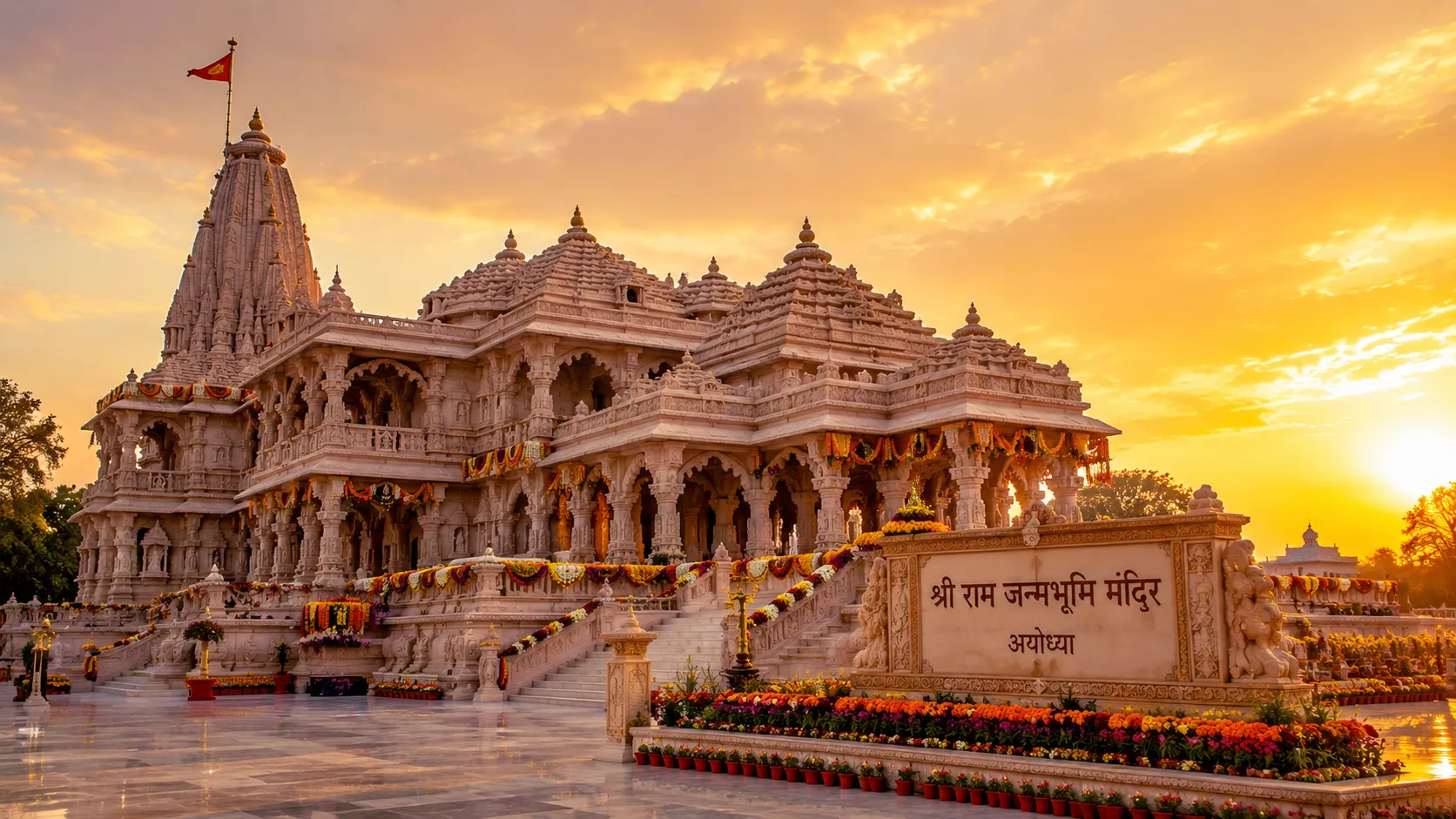
| Shri Ram Janmabhoomi Mandir | The grand temple of Lord Ram, in the city. | /temple/ayodhya/ram-janmabhoomi-mandir |
| Mani Parvat | The hillock of the Sanjeevani, tied to the Hanuman story near Nandigram. | /temple/ayodhya/mani-parvat |
| Manikarnika Ghat (Varanasi) | The great cremation ghat of Kashi, for the wider tradition of the ancestral rites. | /temple/varanasi/manikarnika-ghat |
For the Ram Mandir darshan and its free Sugam booking, see our Ram Janmabhoomi Mandir guide.
Our guided visits and Pind Daan
We are a Varanasi and Ayodhya based operator, a unit of Experience My India, with more than forty years of guiding pilgrims across Kashi, Ayodhya, and Prayagraj, and we have our own local guide and pandit in Ayodhya. Darshan is free, so what we arrange is the visit and the ritual around it: a comfortable car for the excursion, a guide who tells the moving story of Bharat and Nandigram, and, if you wish, a proper Pind Daan or tarpan for your ancestors performed by the temple priests at this sacred Chhota Gaya.
| Service | Includes | Price |
|---|---|---|
| Guided Bharat Kund visit | A car, a guide and the story, the kund, the shrines and the aarti. | Contact us for pricing |
| Pind Daan or tarpan | The ancestral rite performed by the temple priests, with guidance. | Priests' offering plus |
| Ramayana trail day | Bharat Kund with the core Ayodhya sites of the Ram story, with a guide. | Contact us for pricing |
| Full Ayodhya darshan tour | Bharat Kund within a wider Ayodhya pilgrimage, with a guide. | Contact us for pricing |
Inclusions and exclusions are stated up front, with any taxes and conditions, and no charge appears later that was not named. Darshan is free; the Pind Daan is by the temple priests, and our charge is only for guiding, transport and arrangements. See all our tour packages for the full range.
Experience My India is a travel operator, not the temple administration. Darshan is free; the Pind Daan is performed by the temple's own priests, and our charge is only for our guiding and services. Timings and rites are set by the temple and can change.