.webp&w=2048&q=75)
.webp&w=2048&q=75)
Essential info at a glance
| Detail | At a glance |
|---|---|
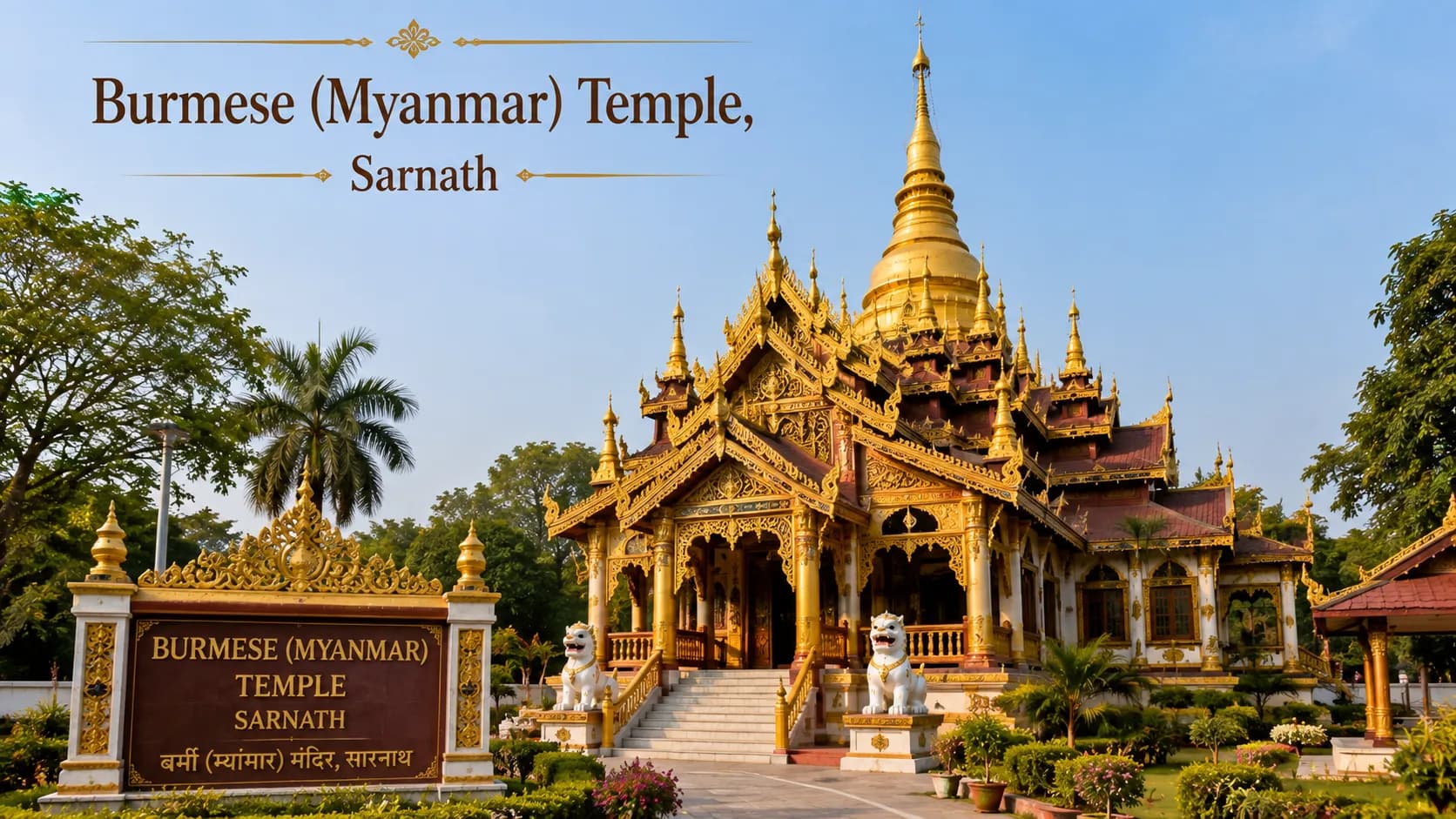
| What it is | The Burmese, or Myanmar, Buddhist temple of Sarnath, a serene Theravada temple and one of the oldest of Sarnath's modern temples. |
| Established | 1910, among the very first of the foreign Buddhist temples built at Sarnath. |
| Opening hours | Generally 6:00 AM to 8:00 PM, every day. |
| Entry fee | Free; voluntary donations are welcome. |
| Tradition | Theravada Buddhism, the tradition of Myanmar, Thailand and Sri Lanka. |
| The main image | A traditional, serene Burmese-style image of the Buddha. |
| Atmosphere | Much quieter and less crowded than the ruins, ideal for reflection and meditation. |
| Location | West of the Sarnath Deer Park, close to the Sarnath Museum, in Mugdarpur. |
Burmese Temple timings
The temple is generally open every day from 6:00 AM to 8:00 PM, and entry is free, with donations welcome. It is small, historic and understated, and a visit takes only fifteen to thirty minutes, best enjoyed as part of a wider half-day of Sarnath. Because it draws far fewer visitors than the great ruins, it is one of the most peaceful places in all of Sarnath, and a lovely spot for a few minutes of quiet.
| Detail | When | Notes |
|---|---|---|
| Opening hours | 6:00 AM to 8:00 PM | Open every day; broadly daylight hours. |
| Entry fee | Free | Voluntary donations are welcome. |
| Time needed | About 15 to 30 minutes | As part of a broader Sarnath visit. |
| Best times | Early morning and late afternoon | The quietest and most peaceful. |
The Burmese Temple: one of Sarnath's oldest modern temples
Sarnath is holy to Buddhists across the world, and over the last century the great Buddhist nations have each built a temple here. The Burmese Temple is special among them for its age, for it was established in 1910, among the very first of these foreign temples at Sarnath, raised in the very year the great museum was built, and long before the Thai, Chinese and Japanese temples that came later. It is, in other words, one of the elder statesmen of Sarnath's modern devotion, a quiet mark of Burma's early and deep love for the place where the Buddha first taught.
Burma, today Myanmar, is one of the great homelands of Buddhism, a golden land of pagodas, and its pilgrims and kings have honoured the holy places of India for many centuries. This temple at Sarnath, built in the distinctive architecture of Myanmar, is one of the earliest expressions of that long devotion, standing quietly on the western side of the ancient Deer Park, close to the museum, where the Buddha's teaching first went out into the world.
The Theravada tradition and the Burmese Buddha
The Burmese Temple follows the Theravada school of Buddhism, and it is worth knowing what that means, for it deepens the visit. Theravada means the Doctrine of the Elders, and it is the oldest surviving school of Buddhism, the tradition that holds most closely to the earliest teachings and the monastic discipline of the Buddha himself. It is the Buddhism of Myanmar, Thailand, Sri Lanka, Laos and Cambodia, and its followers revere the historical Buddha and follow the path of meditation and virtue toward liberation. So this temple, and its Thai neighbour, share the same ancient stream of the teaching.
Within the temple sits a traditional, serene image of the Buddha in the Burmese style, gilded and calm, its gentle face and posture unmistakably of Myanmar, the same beautiful tradition that fills the golden pagodas of Yangon and Bagan. Before it, pilgrims from Myanmar and beyond come to bow and to pray, and to make their quiet wishes at the place of the first sermon.
A haven of quiet
If the great ruins and the famous temples of Sarnath are its heart, the Burmese Temple is one of its most restful corners. It is typically much quieter and far less crowded than the archaeological site or the grand Mulagandha Kuti Vihar, and that stillness is precisely its gift. Here, without the press of visitors, one can sit before the serene Burmese Buddha and simply be quiet, reflect, or meditate, in a place steeped in more than a century of devotion. For travellers who find the intensity of Kashi and the crowds of the great sites tiring, this gentle, historic temple is a welcome breath of calm, and many say it is the most peaceful few minutes of their whole Sarnath visit.
Burma's long devotion to Sarnath
The temple is also a reminder of how far the Buddha's teaching travelled from this spot, and how faithfully it has been returned in devotion. From Sarnath and the holy places of India, Buddhism spread across Asia, and to Burma among the first; and down the centuries the Buddhists of Burma, kings and monks and ordinary pilgrims alike, have journeyed back to honour the land of the Buddha. This 1910 temple, one of the earliest of the modern shrines at Sarnath, is a quiet monument to that unbroken love, and to the family of Buddhist nations who have each planted a temple here at the source.
A century of quiet devotion, in my own words
By Rajeev Sharma, Varanasi local
I bring my guests to the Burmese Temple when I want to give them a few minutes of real peace at Sarnath. I tell them that this is one of the oldest of all the foreign temples here, built way back in 1910, the same year as the museum, long before the others, and people are always surprised by that. It is on the quiet, western side of the old Deer Park, and it is understated, not grand, but that is its beauty. Inside sits a lovely serene Burmese Buddha, golden and calm, in the style of Myanmar.
I explain a little about the Theravada tradition, the oldest school of Buddhism, so that people understand what they are looking at, and then I simply let them be quiet. Because so few visitors come, there is a stillness here that you do not find at the big sites, and I often see travellers close their eyes and just breathe. I tell them how Burma has loved these holy places for centuries, and sent its pilgrims back again and again. In a busy day of Sarnath, this calm old temple is the gentle pause I love to give people.
In more than forty years of guiding, this is one of the quiet corners I treasure most.
What to see and do
- Sit before the serene, gilded Burmese-style Buddha and take a few quiet minutes to reflect.
- Admire the distinctive architecture of Myanmar, a golden land of pagodas.
- Feel the peace of one of Sarnath's oldest and least-crowded temples.
- Learn a little of the Theravada tradition, the oldest school of Buddhism.
- Enjoy the calm setting on the western side of the ancient Deer Park.
How to reach the Burmese Temple
The temple is on the western side of the Sarnath Deer Park, in Mugdarpur, close to the Sarnath Museum, about 10 km from the city on the northern, airport side of Varanasi. It is easy to reach by road and close to the other Sarnath sights.
| From | Distance | Notes |
|---|---|---|
| The Deer Park, Dhamek Stupa and museum | Very close | West of the Deer Park, near the museum; see them together. |
| Varanasi Junction (Cantt) | About 3 to 10 km | By taxi or auto, via Gautam University Road. |
| Varanasi city | About 10 km | By taxi or auto to Sarnath. |
| Airport | About 27 km | Sarnath is on the airport side; easy to pair with an arrival or departure. |
It is best seen as part of a Sarnath visit. See our guide to Sarnath. We arrange the transport, timing and a guide, and take you to every temple you want to see.
Best time to visit and how to plan it
| When | Why |
|---|---|
| Early morning | The quietest, most peaceful atmosphere for reflection. |
| Late afternoon | Calm and cool, lovely for a gentle, contemplative visit. |
| October to March | The most pleasant season for Sarnath's temples. |
| As part of a Sarnath day | Combine it with the museum, the ruins and the other international temples. |
- Pair it with the Sarnath Archaeological Museum next door, the Deer Park and the other international temples.
- Allow 15 to 30 minutes; it is a short, restful stop.
For Sarnath planned as one route, see our Varanasi tour packages.
Etiquette for visiting
- This is a place of worship; keep silence, move gently, and do not disturb anyone at prayer or meditation.
- Dress modestly, covering shoulders and knees, and remove your footwear before entering the main shrine areas.
- Do not touch the Buddha image, and photograph respectfully; ask if unsure.
- Take a moment of stillness; the peace of the place is its gift, and worth receiving quietly.
Accessibility for elderly and mobility limited visitors
- The temple is small, largely level and reachable by road, easier than the old city, with a short, gentle visit.
- There may be a step or two into the shrine; a relaxed pace helps.
- It is quiet and calm, which suits a slow, seated, contemplative visit.
- We arrange transport to the temple and plan the Sarnath visit so a senior guest is comfortable.
Nearby sites to combine with your visit
The Burmese Temple is by the Deer Park, in the heart of Sarnath, on the northern, airport side of the city.
| Site | What it is | Internal link |
|---|---|---|
| Sarnath (Dhamek Stupa and site) | The great Buddhist site where the Buddha gave his first sermon, by the Deer Park. | /temple/varanasi/sarnath |
| Sarnath Archaeological Museum | The oldest site museum in India, home to the Lion Capital of Ashoka, close by. | /temple/varanasi/sarnath-archaeological-museum |
| Thai Temple (Wat Thai) | The Thai Theravada temple with its giant 80-foot standing Buddha and gardens. | /temple/varanasi/thai-temple-sarnath |
| Chinese Temple (Cheeni Mandir) | The red-and-gold Chinese temple with the Hiuen-Tsang map. | /temple/varanasi/chinese-temple-sarnath |
| Mulagandha Kuti Vihar | The beautiful modern Buddhist temple with the frescoes and relics. | /temple/varanasi/mulagandha-kuti-vihar |
For the grand evening Ganga aarti back in the city, see our Varanasi tour packages.
Our guided Sarnath and international-temples visits
We are a Varanasi based operator, a unit of Experience My India, with more than forty years of guiding travellers across Kashi, Sarnath, Ayodhya, and Prayagraj. The temple is free, so what we arrange is an honest, well-planned Sarnath visit: transport, timing, and a guide who tells the story of the Burmese Temple and the Theravada tradition, and takes you to the other international temples and the whole Sarnath site, with no rushing and no shop diversions, easily combined with an airport arrival or departure.
| Experience | Includes | Price |
|---|---|---|
| Sarnath half-day tour | The Burmese Temple, the Dhamek Stupa, the Mulagandha Kuti Vihar, the museum and more, with a guide. | Contact us for pricing |
| International temples of Sarnath | The Burmese, Thai, Chinese, Japanese and Tibetan temples, with a guide. | Contact us for pricing |
| Airport-side Sarnath visit | Sarnath on your arrival or departure day, with the Burmese Temple. | Contact us for pricing |
| Kashi and Sarnath day | The Buddhist Sarnath with the Hindu heart of Kashi. | Contact us for pricing |
Inclusions and exclusions are stated up front, with any taxes and conditions, and no charge appears later that was not named. We never divert you to shops. See all our Varanasi tour packages for the full range.
Experience My India is a travel operator, not the temple administration. Our guiding and transport are ours; the temple is a Burmese Buddhist temple, and entry is free. Timings and arrangements can change.