.webp&w=2048&q=75)
.webp&w=2048&q=75)
Essential info at a glance
| Detail | At a glance |
|---|---|
| What it is | The oldest site museum in India, holding the treasures excavated at Sarnath, including the original Lion Capital of Ashoka. |
| Opening hours | 9:00 AM to 5:00 PM, daily except Friday, when it is closed. |
| Entry fee | Indian nationals ₹5, foreign nationals ₹100, children under 15 free. |
| The star exhibit | The Lion Capital of Ashoka, India's national emblem, in the original. |
| The collection | Over 6,800 sculptures and artefacts, from the 3rd century BCE to the 12th century CE, in five galleries. |
| Also famous for | The exquisite Gupta-era image of the Buddha's first sermon. |
| Photography | Not permitted inside; cameras and bags are deposited at the entrance. |
| Location | Sarnath Station Road, about 500 m from the Dhamek Stupa and 10 km from the city. |
Sarnath Archaeological Museum timings and entry
The museum keeps standard daytime hours and, importantly, is closed on Fridays, so plan your visit for another day. It is a ticketed, ASI museum, and photography is not allowed inside, so cameras and bags are left at the entrance. It pairs perfectly with the adjacent Sarnath monuments, being only about 500 metres from the Dhamek Stupa.
| Detail | Value | Notes |
|---|---|---|
| Opening hours | 9:00 AM to 5:00 PM | Daily except Friday, when it is closed. |
| Entry fee | Indian ₹5; foreign ₹100 | Children under 15 free; buy tickets at the counter. |
| Photography | Not permitted inside | Deposit cameras and bags at the cloakroom. |
| Time needed | About 45 minutes to an hour | For the galleries and the great exhibits. |
Sarnath Archaeological Museum: the oldest site museum in India
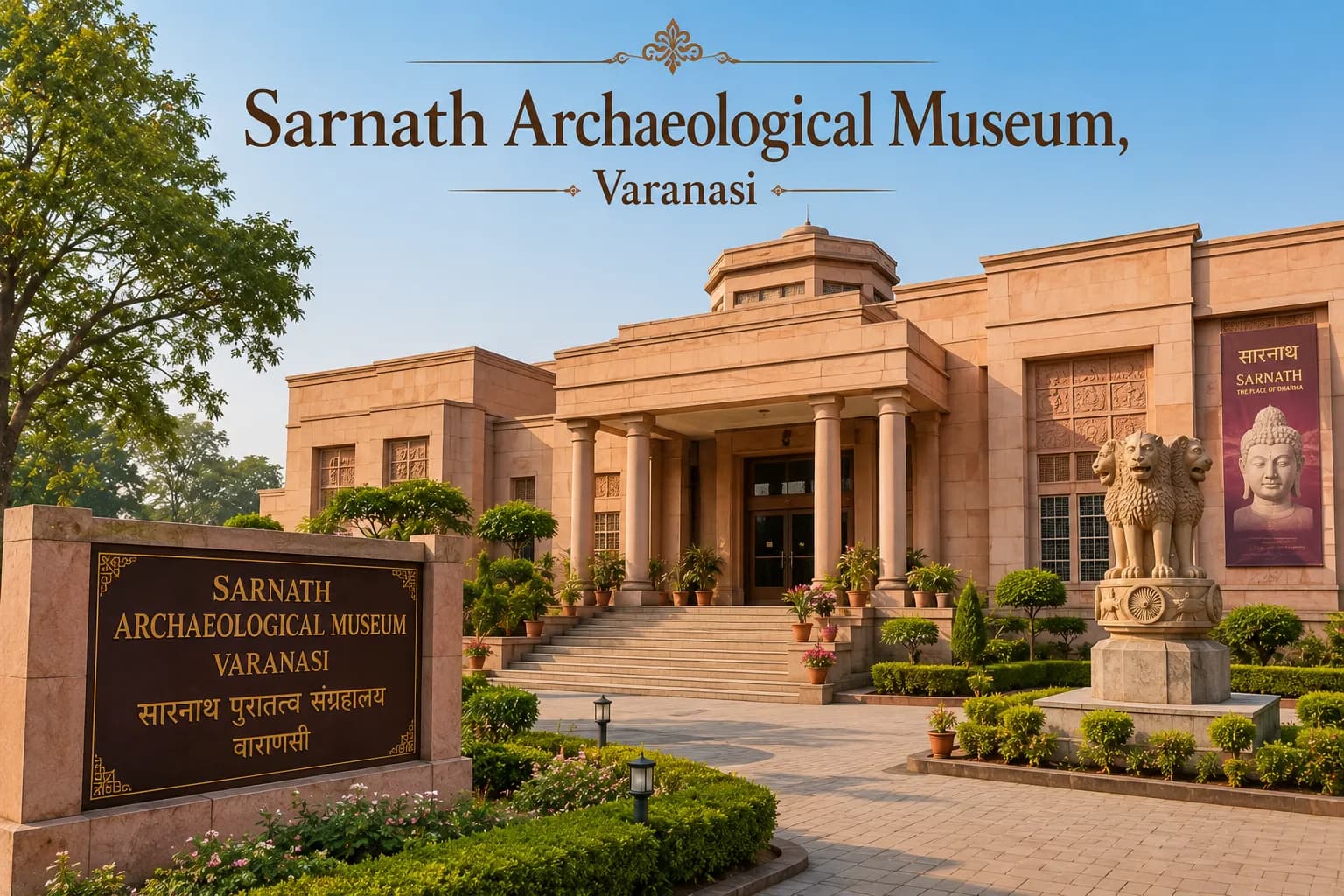
This is no ordinary museum. The Archaeological Museum at Sarnath, completed in 1910, is the oldest site museum of the Archaeological Survey of India, the very first of its kind in the country, built to house and display the extraordinary antiquities that archaeologists were unearthing from the sacred soil of Sarnath. It was the vision of Sir John Marshall, the great Director-General of the Survey, and its handsome sandstone building was designed by the architect James Ransome in the shape of a Buddhist monastery, a vihara, with a central hall, cell-like galleries and a verandah, so that the very form of the building echoes the monasteries whose treasures it holds.
Within, a magnificent collection of over six thousand eight hundred objects, spanning from the third century before the Common Era to the twelfth century after it, is arranged across five galleries and two verandahs, sculptures, terracottas, pottery, inscriptions and more, all found at Sarnath itself. To walk through it is to walk through more than a thousand years of Indian art and faith, gathered in one quiet, beautiful place beside the site of the Buddha's first sermon.
The Lion Capital of Ashoka
The heart of the museum, and one of the most important objects in all of India, is the Lion Capital of Ashoka. Carved around 250 BCE from a single block of polished sandstone, it once crowned the great pillar that the emperor Ashoka raised here at Sarnath to mark the spot of the Buddha's first sermon. Four magnificent Asiatic lions stand back to back, facing the four directions; beneath them runs a band bearing four animals, an elephant, a horse, a bull and a lion, and four wheels, the Dharmachakras; and the whole rests upon an inverted lotus. Even now, more than two thousand three hundred years later, its surface holds the astonishing mirror-like polish of the finest Mauryan craft.
Every Indian knows this sculpture, for after independence it was adopted, in 1950, as the National Emblem of India, and it appears on the currency, the passports and the seals of the nation, while the great wheel from its base, the Ashoka Chakra, turns at the centre of the national flag. And yet to stand before the original, here in the museum, rather than its familiar image on a banknote, is a genuinely stirring moment, a quiet surprise that makes the whole long history of India feel suddenly, powerfully present. For most visitors it is the reason to come, and it does not disappoint.
The Sarnath Buddha and other masterpieces
The Lion Capital is not the only treasure here. Among the museum's most beloved works is the exquisite seated Buddha of the Gupta age, from about the fifth century, shown in the Dharmachakra mudra, the gesture of teaching, at the very moment of the first sermon, with the wheel of the law and his five disciples carved on the pedestal below. Serene, graceful and perfectly balanced, it is counted among the finest images of the Buddha ever made, the masterpiece of the great Sarnath school of sculpture.
Near the Lion Capital stands a colossal red-sandstone Bodhisattva, one of the earliest great images here, gifted by the friar Bala of Mathura in the reign of the Kushana king Kanishka, nearly two thousand years ago. Around them, the galleries hold a wealth of Buddha and Bodhisattva figures, images of Hindu deities and Jain Tirthankaras, terracottas and inscriptions, the whole sweep of the art that flourished at this sacred crossroads over the centuries.
The galleries
The collection is arranged across five galleries and two verandahs, each with its own character.
- The main hall and the entrance, where the Lion Capital and the great early images hold pride of place.
- The Buddha galleries, filled with the serene images of the Buddha for which the Sarnath school is famous.
- The galleries of Buddhist deities and Bodhisattvas, radiant and finely carved.
- A gallery of Hindu deities and Jain Tirthankaras, showing the many faiths that met at Sarnath.
- The verandahs and cases of terracottas, pottery, inscriptions and smaller antiquities.
Standing before the nation's emblem, in my own words
By Rajeev Sharma, Varanasi local
I never let a guest leave Sarnath without the museum, because inside it is one of the most important things in all of India. I tell them, before we go in, that they have seen this next object their whole lives, on every rupee note, on the passport, on every government seal, and then we stand before the real Lion Capital of Ashoka, carved two thousand three hundred years ago, and I watch it land on them. People go quiet. It is one thing to see it on money; it is another to stand before the actual stone, still shining with that incredible ancient polish.
Then I take them to the Gupta Buddha of the first sermon, and I explain how it shows the very moment the Buddha began to teach, right here at Sarnath, and it is so beautiful that people simply stop. I remind them there is no photography inside, so they must look with their eyes and not their phones, which I think is a gift. This little museum, the oldest in India, holds the nation's emblem and one of the world's finest Buddhas, side by side. It is the perfect, moving end to a Sarnath day.
In more than forty years of guiding, this is the room where I have most often seen a traveller understand how deep India's history runs.
[Photography is not permitted inside the museum; any images here are of the exterior or from permitted sources.]
What to see and do
- Stand before the original Lion Capital of Ashoka, India's national emblem, the museum's great treasure.
- Admire the Gupta-era Buddha of the first sermon, one of the finest Buddha images in the world.
- See the colossal Friar Bala Bodhisattva and the early Kushana sculptures.
- Explore the galleries of Buddha, Bodhisattva, Hindu and Jain images and the terracottas.
- Notice the building itself, shaped like a monastery, the oldest site museum in India.
How to reach the museum
The museum is on Sarnath Station Road, at the edge of the archaeological complex, about 500 metres from the Dhamek Stupa, 1.5 km from Sarnath railway station and 10 km from the city, on the northern, airport side of Varanasi. It is easy to reach by road and sits right beside the main site.
| From | Distance | Notes |
|---|---|---|
| Dhamek Stupa and the main site | About 500 m | Right beside the site; see them together. |
| Sarnath railway station | About 1.5 km | A short ride. |
| Varanasi city | About 10 km | By taxi or auto to Sarnath. |
| Airport | About 20 km | Sarnath is on the airport side; easy to pair with an arrival or departure. |
It is best seen as part of a Sarnath visit. See our guide to Sarnath. We arrange the transport, tickets, timing and a guide.
Best time to visit and how to plan it
| When | Why |
|---|---|
| Any open day, 9 AM to 5 PM | The regular hours; do not come on a Friday, when it is closed. |
| Morning | Cooler and calmer, with time to see the great exhibits properly. |
| Winter (October to March) | The most pleasant season for Sarnath and its open monuments. |
| As part of a Sarnath day | Combine it with the Dhamek Stupa, the Mulagandha Kuti Vihar and the Chaukhandi Stupa. |
- Pair it with the whole Sarnath site for a full Buddhist heritage visit.
- Allow 45 minutes to an hour for the museum.
For Sarnath planned as one route, see our Varanasi tour packages.
Practical tips and etiquette
- It is closed on Fridays and on some public holidays; plan around this.
- Photography is not permitted inside; deposit your camera and bags at the cloakroom and look with your eyes.
- The ASI entry ticket is paid at the counter, separate from any tour arrangement.
- Keep your voice low and treat the sacred images with respect, as many are objects of devotion.
Accessibility for elderly and mobility limited visitors
- The museum is a single-storey building on largely level ground, reachable by road, easier than the old city.
- There are a few steps at the entrance; a relaxed pace helps.
- It is calm and quiet, which suits a slow, seated, contemplative visit.
- We arrange transport and plan the Sarnath visit so a senior guest is comfortable.
Nearby sites to combine with your visit
The museum is at the heart of Sarnath, on the northern, airport side of the city, and pairs with the other great museum of Varanasi too.
| Site | What it is | Internal link |
|---|---|---|
| Sarnath (Dhamek Stupa and site) | The great Buddhist site where the Buddha gave his first sermon, right beside the museum. | /temple/varanasi/sarnath |
| Mulagandha Kuti Vihar | The beautiful modern Buddhist temple of Sarnath, with the frescoes and relics. | /temple/varanasi/mulagandha-kuti-vihar |
| Chaukhandi Stupa | The stupa marking the Buddha's meeting with his first disciples, on the approach. | /temple/varanasi/chaukhandi-stupa |
| Bharat Kala Bhavan | The great art museum on the BHU campus, for more of India's heritage. | /temple/varanasi/bharat-kala-bhavan |
| Namo Ghat | The striking new ghat near Rajghat, on the way from the city. | /temple/varanasi/namo-ghat |
For the grand evening Ganga aarti back in the city, see our Varanasi tour packages.
Our guided Sarnath and heritage visits
We are a Varanasi based operator, a unit of Experience My India, with more than forty years of guiding travellers across Kashi, Sarnath, Ayodhya, and Prayagraj. What we arrange is a rich, well-informed Sarnath visit: transport, the tickets, and a guide who brings the Lion Capital, the great Buddha and the whole story of Sarnath to life, easily combined with an airport arrival or departure.
| Experience | Includes | Price |
|---|---|---|
| Sarnath half-day tour | The museum, the Dhamek Stupa, the ruins, the Mulagandha Kuti Vihar and the Chaukhandi Stupa, with a guide. | Contact us for pricing |
| Airport-side Sarnath visit | Sarnath on your arrival or departure day, with the museum. | Contact us for pricing |
| Buddhist heritage day | Sarnath's Buddhist sites and the museum with a knowledgeable guide. | Contact us for pricing |
| Museums of Varanasi | The Sarnath museum with Bharat Kala Bhavan on the BHU campus. | Contact us for pricing |
Inclusions and exclusions are stated up front, with any taxes and conditions, and no charge appears later that was not named. See all our Varanasi tour packages for the full range.
Experience My India is a travel operator, not the museum authority. Our guiding and transport are ours; the museum is run by the Archaeological Survey of India, and the entry ticket is paid separately. Timings and fees can change.