.webp&w=2048&q=75)
.webp&w=2048&q=75)
Essential info at a glance
| Detail | At a glance |
|---|---|
| What it is | The Thai Buddhist temple of Sarnath, Wat Thai, in traditional Thai style, with a giant standing Buddha and lovely gardens. |
| Opening hours | Sunrise to sunset, roughly 6:00 AM to 6:00 PM, every day. |
| Entry fee | Completely free. |
| Built | In 1933 by Thai dignitaries; the giant Buddha statue was added much later. |
| The landmark | An 80-foot standing Buddha, the tallest at Sarnath, carved of Chunar sandstone. |
| The gardens | Manicured lawns, fountains and lotus ponds, among the most beautiful in Sarnath. |
| Good for | A calm, contemplative stop, and wonderful photographs. |
| Location | Sarnath, in the international temples area near the ancient ruins, about 10 km from the city. |
Thai Temple timings
The temple is open every day from sunrise to sunset, roughly 6:00 AM to 6:00 PM, and entry is completely free. It is one of the calmest, greenest and most beautiful corners of Sarnath, and it takes about an hour to enjoy the temple, the great statue and the gardens at a gentle pace.
| Detail | When | Notes |
|---|---|---|
| Opening hours | Sunrise to sunset (about 6:00 AM to 6:00 PM) | Open every day of the week. |
| Entry fee | Free | No ticket is needed. |
| Time needed | About an hour | For the temple, the statue and the gardens. |
| Best light | Morning and late afternoon | The finest light on the giant Buddha and the gardens. |
The Thai Temple: a piece of Thailand at Sarnath
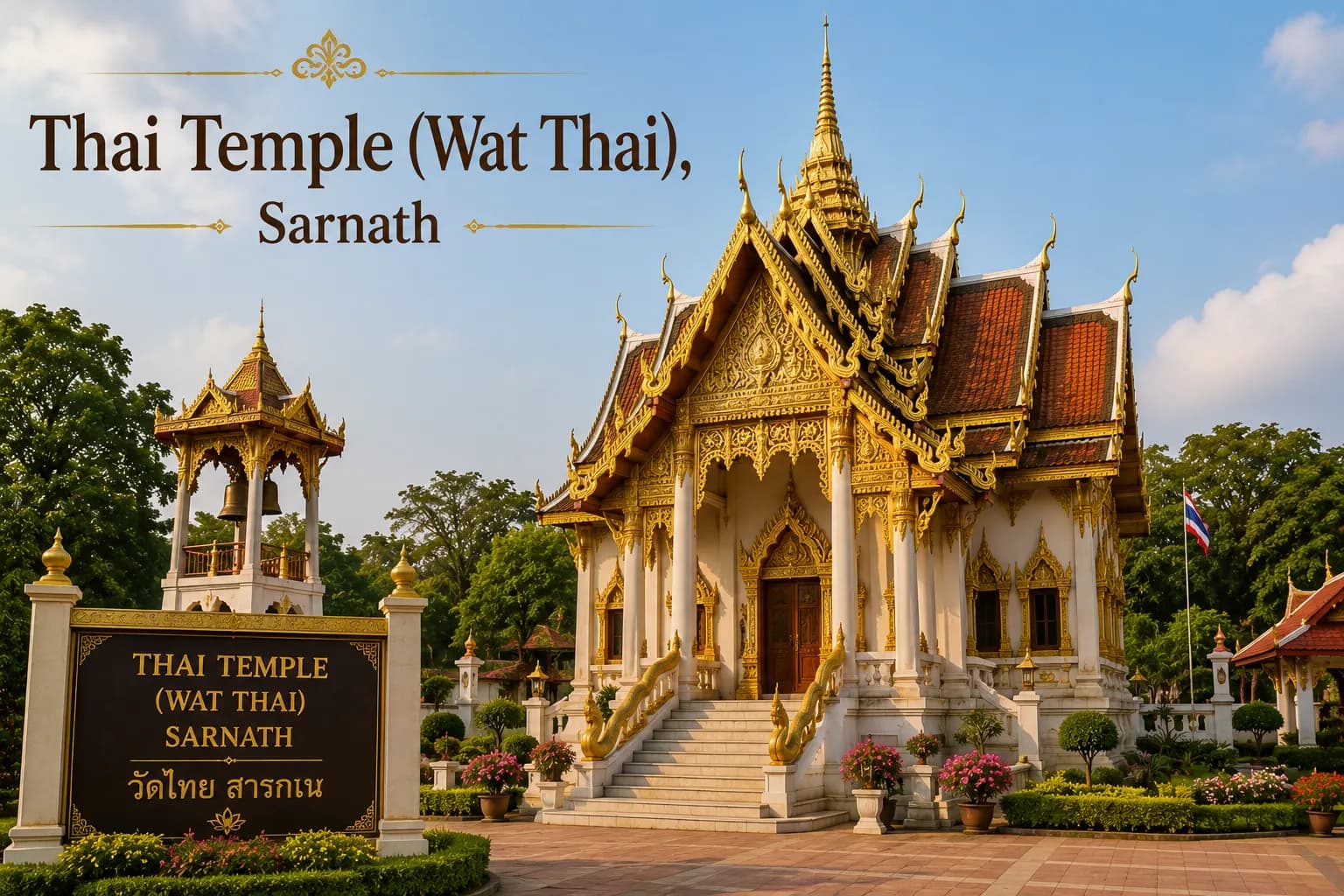
Sarnath is holy not only to India but to the whole Buddhist world, and over the last century many Buddhist nations have built their own temples here, around the place of the first sermon, so that a walk through Sarnath is a walk among the traditions of many lands. The Thai Temple, Wat Thai, is one of the loveliest of them. Built in 1933 by Thai dignitaries and monks, it is a serene temple of the Theravada tradition, and a cherished centre for the Thai Buddhist community in India, set in vast, beautifully kept gardens.
Its architecture is authentically Thai, and it brings a touch of Bangkok to the banks of the Ganga: graceful, steeply sloped and tiered roofs, intricate carving, vivid colour and gilding, all quite different from the temples of India, and a delight to behold. To step into its grounds is to step, for a little while, into Thailand, in the middle of the sacred Buddhist landscape of Sarnath.
The giant standing Buddha
The great landmark of the Thai Temple, and one of the most striking sights in all of Sarnath, is its colossal standing Buddha. Rising some eighty feet, it is the tallest Buddha statue at Sarnath, carved of Chunar sandstone over some fourteen years as a joint labour of India and Thailand, and inspired in its form by the great Bamiyan Buddhas of old. The Buddha stands with his hand raised in the Abhaya mudra, the gesture of fearlessness and reassurance, as if calming and blessing all who look up at him.
Approaching the statue, you pass fountains and ponds bright with blooming lotus, and then the great figure rises before you against the sky, serene and immense. It is a genuinely awe-inspiring sight, and one of the most photographed in Sarnath; standing at its feet and looking up is a moment visitors remember long afterward.
The gardens and the tranquility
Part of the joy of the Thai Temple is simply its peace. The complex is set among manicured lawns and lush greenery, with running fountains and ponds of waterlilies and lotus, and it is widely reckoned one of the most beautiful and restful places in Sarnath, a place to slow down, breathe and sit awhile. Scattered through the gardens are other images of the Buddha, a laughing Buddha, a reclining Buddha, a Buddha in the earth-touching Bhumisparsha mudra, and a tableau of the Buddha preaching to his disciples.
There is also a young Bodhi tree, grown from the sacred line that runs from Bodh Gaya through Sri Lanka, and a fine replica of the Ashoka pillar, carved with the emperor's edicts of compassion and tolerance, raised to honour the long friendship between India and Thailand. Together, temple and garden make a gentle, uplifting whole.
The international temples of Sarnath
The Thai Temple is one of a remarkable family. Because Sarnath is sacred to Buddhists everywhere, many nations have built temples and monasteries here in their own styles, Thailand, China, Tibet, Japan, Myanmar, Sri Lanka, Korea and others, so that the little town holds a living gathering of the whole Buddhist world. Visiting the Thai Temple, and one or two of its neighbours, gives a beautiful sense of how far the teaching that began here has travelled, and how many peoples still return to honour its source.
A quiet gift from Thailand, in my own words
By Rajeev Sharma, Varanasi local
I love the Thai Temple, and my guests always do too, because it is such a beautiful surprise, a piece of Thailand, with its golden Thai roofs and its lovely gardens, right here in Sarnath. I tell them the Thai community built it back in 1933, and that many countries have temples here, so we are walking through the whole Buddhist world. And then we come to the great standing Buddha, eighty feet tall, and everyone just stops and looks up. I explain that it took fourteen years to carve, an Indo-Thai labour of love, and that his raised hand means do not fear.
We walk slowly through the gardens, past the fountains and the lotus ponds and the other Buddhas, and it is one of the most peaceful hours I can give anyone in Varanasi. I will also tell you, honestly, that some auto-drivers around Sarnath try to rush visitors past the temples and steer them into saree shops instead; I make sure my guests actually see everything they came for, the Thai temple, the great statue, the museum, all of it, with no shop tricks. This calm, green, golden place is one of my favourite ways to end a Sarnath morning.
In more than forty years of guiding, this is where I most often see a tired traveller simply exhale.
What to see and do
- Stand at the feet of the giant 80-foot standing Buddha and look up; it is unforgettable.
- Admire the authentic Thai architecture, the sloped golden roofs and fine carving.
- Wander the manicured gardens, the fountains and the lotus ponds.
- Find the other statues, the laughing Buddha, the reclining Buddha and the earth-touching Buddha.
- See the young Bodhi tree and the replica of the Ashoka pillar.
How to reach the Thai Temple
The temple is in Sarnath, in the area of international temples near the ancient ruins and the museum, about 10 km from the city on the northern, airport side of Varanasi. It is easy to reach by road and sits close to the other Sarnath sights.
| From | Distance | Notes |
|---|---|---|
| Dhamek Stupa, the ruins and the museum | A short distance | See them together on a Sarnath visit. |
| Varanasi city | About 10 km | By taxi or auto to Sarnath. |
| Varanasi Junction (Cantt) | About 9 km | By taxi or auto. |
| Airport | About 20 km | Sarnath is on the airport side; easy to pair with an arrival or departure. |
It is best seen as part of a Sarnath visit. See our guide to Sarnath. We arrange the transport, timing and a guide, and take you to every temple you want to see.
Best time to visit and how to plan it
| When | Why |
|---|---|
| Morning | Cool and calm, with lovely light and the gardens at their freshest. |
| Late afternoon | Golden light on the great standing Buddha for photographs. |
| Winter (October to March) | The most pleasant season for Sarnath's open temples and gardens. |
| As part of a Sarnath day | Combine it with the Dhamek Stupa, the museum and the other temples. |
- Pair it with the Sarnath monuments and the other international temples for a full day.
- Allow about an hour to enjoy the statue, the temple and the gardens.
For Sarnath planned as one route, see our Varanasi tour packages.
Etiquette and tips
- This is a living temple; keep silence, move gently, and do not disturb worship or meditation.
- Remove your footwear where required; on hot days the matting can be very hot underfoot, so a pair of socks helps.
- Dress modestly, and photograph respectfully.
- Be wary of auto-drivers or touts who try to rush you past the temples and into saree or handicraft shops; insist on seeing what you came for, or come with a trusted guide.
Accessibility for elderly and mobility limited visitors
- The gardens are green, spacious and largely level, and reachable by road, easier than the old city.
- The giant Buddha and the temple can be enjoyed from the paths and lawns without much climbing.
- It is calm and unhurried, which suits a gentle, seated visit; there are shady spots to rest.
- We arrange transport to the temple and plan the Sarnath visit so a senior guest is comfortable.
Nearby sites to combine with your visit
The Thai Temple is in the international temples area of Sarnath, on the northern, airport side of the city.
| Site | What it is | Internal link |
|---|---|---|
| Sarnath (Dhamek Stupa and site) | The great Buddhist site where the Buddha gave his first sermon. | /temple/varanasi/sarnath |
| Sarnath Archaeological Museum | The oldest site museum in India, home to the Lion Capital of Ashoka. | /temple/varanasi/sarnath-archaeological-museum |
| Mulagandha Kuti Vihar | The beautiful modern Buddhist temple with the frescoes and relics. | /temple/varanasi/mulagandha-kuti-vihar |
| Chaukhandi Stupa | The stupa marking the Buddha's meeting with his first disciples. | /temple/varanasi/chaukhandi-stupa |
| Namo Ghat | The striking new ghat near Rajghat, on the way from the city. | /temple/varanasi/namo-ghat |
For the grand evening Ganga aarti back in the city, see our Varanasi tour packages.
Our guided Sarnath and international-temples visits
We are a Varanasi based operator, a unit of Experience My India, with more than forty years of guiding travellers across Kashi, Sarnath, Ayodhya, and Prayagraj. The temple is free, so what we arrange is an honest, well-planned Sarnath visit: transport, timing, and a guide who takes you to the Thai Temple and its great Buddha, the other international temples, and the whole Sarnath site, with no rushing and no shop diversions, easily combined with an airport arrival or departure.
| Experience | Includes | Price |
|---|---|---|
| Sarnath half-day tour | The Thai Temple, the Dhamek Stupa, the Mulagandha Kuti Vihar, the museum and more, with a guide. | Contact us for pricing |
| International temples of Sarnath | The Thai, Tibetan, Japanese and other temples, with a guide. | Contact us for pricing |
| Airport-side Sarnath visit | Sarnath on your arrival or departure day, with the Thai Temple. | Contact us for pricing |
| Kashi and Sarnath day | The Buddhist Sarnath with the Hindu heart of Kashi. | Contact us for pricing |
Inclusions and exclusions are stated up front, with any taxes and conditions, and no charge appears later that was not named. We never divert you to shops. See all our Varanasi tour packages for the full range.
Experience My India is a travel operator, not the temple administration. Our guiding and transport are ours; the temple is run by the Thai Buddhist community, and entry is free. Timings and arrangements can change.