.webp&w=2048&q=75)
.webp&w=2048&q=75)
Essential info at a glance
| Detail | At a glance |
|---|---|
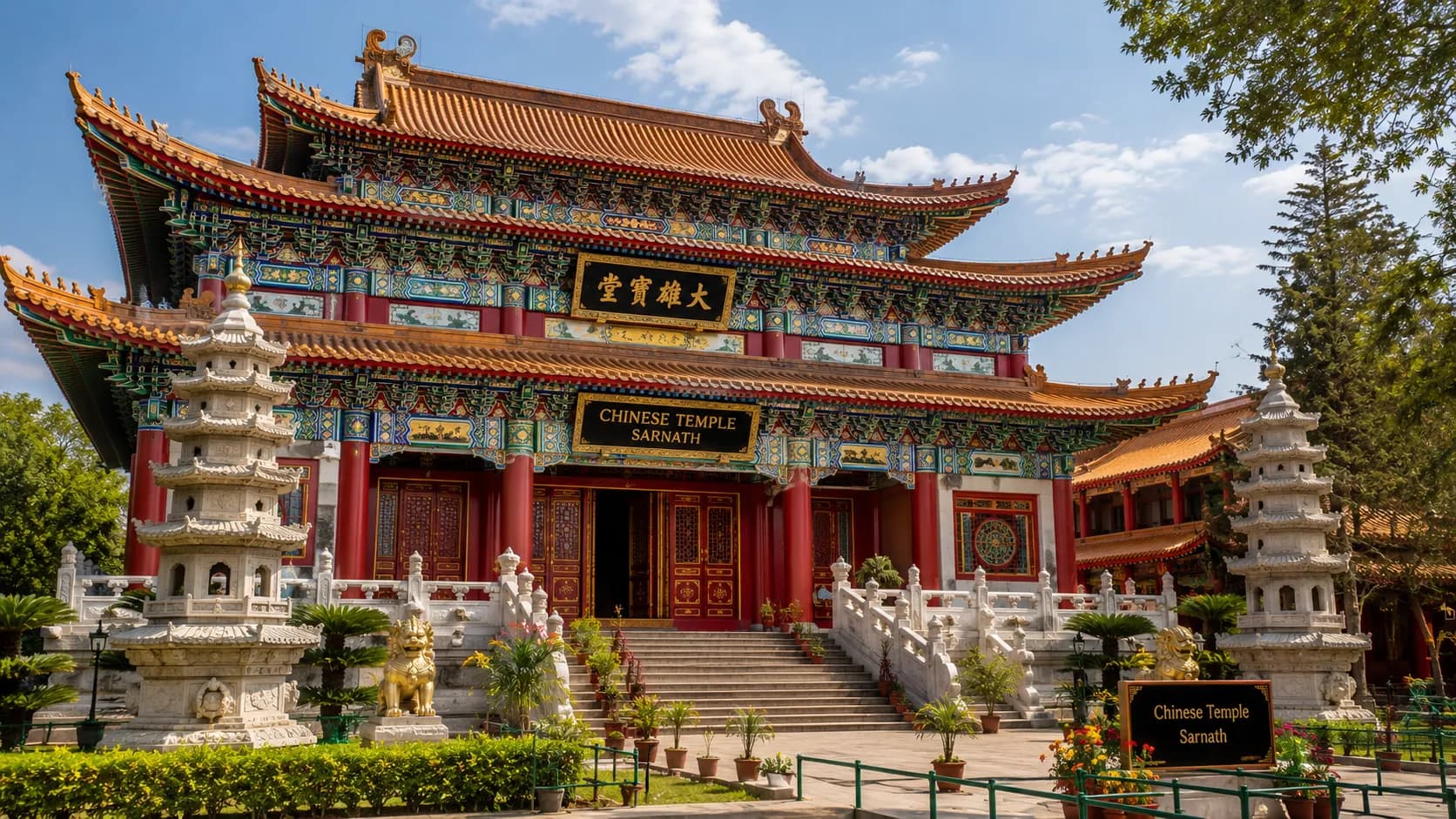
| What it is | The Chinese Buddhist temple of Sarnath, the Cheeni Mandir, a tranquil red-and-gold temple with Chinese lanterns and altars. |
| Opening hours | 6:00 AM to 6:00 PM, every day. |
| Entry fee | Free for all visitors. |
| Time needed | About 15 to 30 minutes for the small, serene courtyard and shrine. |
| Built | In 1939 by the Abbot of Beijing, Tao-Kai, and Fa-Yuan-Tsu of the Eastern Asian Buddhist Association. |
| Famous for | A large map tracing the 7th-century journey of the Chinese pilgrim Hiuen-Tsang (Xuanzang). |
| Also inside | Boards telling the whole life of the Buddha, in Hindi, English and Chinese. |
| Location | Sarnath, near the Mulagandha Kuti Vihar, about 650 m east of the ancient excavation site. |
Chinese Temple timings
The temple is open every day from 6:00 AM to 6:00 PM, and entry is free. It is small, quiet and understated, and about fifteen to thirty minutes is enough to take in its courtyard, its shrine and its wonderful map. Because so few pilgrims crowd it, it is one of the calmest places in Sarnath, and its educational boards make it an unusually thoughtful stop. The early morning and the golden light of late afternoon are the loveliest times.
| Detail | When | Notes |
|---|---|---|
| Opening hours | 6:00 AM to 6:00 PM | Open every day; some listings note minor seasonal variation. |
| Entry fee | Free | No ticket is needed. |
| Time needed | About 15 to 30 minutes | For the courtyard, the shrine and the exhibits. |
| Best times | Early morning and late afternoon | Quiet, with the best golden light. |
The Chinese Temple: a piece of China at Sarnath
Among the temples the Buddhist nations have raised at Sarnath, the Chinese Buddhist Temple, known locally as the Cheeni Mandir, is a quiet, colourful gem. It was established in 1939 by Tao-Kai, the Abbot of Beijing, and Fa-Yuan-Tsu of the Eastern Asian Buddhist Association, with its gate and compound added a little later, and it brings the aesthetic of Chinese Mahayana Buddhism to the banks of the Ganga. Its building glows in bright red and yellow, adorned with beautiful Chinese designs, and traditional Chinese lanterns hang along its walls, so that against the greenery of Sarnath it makes a warm, festive splash of colour.
Within, it is calm and understated, with Chinese-style images of the Buddha in various sizes, contemplative altars, and a small, well-kept garden. It is not a grand or crowded temple, and that is exactly its charm; it is a place to pause quietly, and it rewards the curious with something the other temples do not offer, a real window into a great chapter of Buddhist history.
Hiuen-Tsang: the pilgrim who helped rediscover Sarnath
The treasure of this temple is its great map, and the story it tells. It traces the journey of Hiuen-Tsang, known also as Xuanzang, the celebrated Chinese Buddhist monk and scholar who, in the seventh century, made an extraordinary overland journey from China to India, in the reign of the emperor Harshavardhana, to study the teaching at its source and to carry its scriptures home. He travelled for years across deserts and mountains, and among the holy places he visited was Sarnath, which he described in loving, careful detail, its priests and monasteries, its great stupas, the towering pillar of Ashoka, the very place where the Buddha first taught.
And here is why his memory is so fitting at Sarnath: over the centuries that followed, Sarnath fell into ruin and was largely forgotten, and when, in modern times, archaeologists set out to find and identify its buried monuments, it was the precise, detailed records of pilgrims like Hiuen-Tsang that guided them, telling them what had stood where. In a real sense, this Chinese scholar, walking here thirteen hundred years ago and writing down what he saw, helped bring Sarnath back to the light. To stand before his map, in a Chinese temple at Sarnath, is to feel the long, deep thread that binds India and China through the Buddha's teaching.
The life of the Buddha, told in three languages
The other lovely feature of the Chinese Temple is quietly educational. On two large boards, the entire life of the Buddha is laid out in photographs and text, in Hindi, English and Chinese, from his birth and his enlightenment through his first sermon here at Sarnath to his final passing. In the absence of the crowds that fill the great sites, this is one of the best and calmest places in all of Sarnath simply to sit and learn the whole story of the Buddha, and many visitors find it the most genuinely informative stop of their day.
An ancient bond, in a quiet temple
The Chinese Temple stands for something greater than itself: the deep and ancient bond between India and China through Buddhism. It was from India that the teaching of the Buddha travelled to China, long ago, and it was to India that the great Chinese pilgrims, Hiuen-Tsang and Faxian before him, journeyed in search of it, at the cost of enormous hardship. This little temple at Sarnath, built by Chinese monks at the place of the first sermon, is a modern token of that long cultural friendship, and a gentle reminder that the wisdom which began here once travelled across the whole of Asia and came home again.
A window into history, in my own words
By Rajeev Sharma, Varanasi local
The Chinese Temple is small, and many visitors would walk past it, but I always take my guests in, because it holds one of my favourite stories in all of Sarnath. It is a pretty red-and-gold temple with Chinese lanterns, very peaceful, and inside there is a great map of the journey of Hiuen-Tsang. I tell my guests who he was, a Chinese monk who walked all the way to India thirteen hundred years ago to study the Buddha's teaching, and who wrote down everything he saw at Sarnath. And then I tell them the wonderful part, that when Sarnath was lost and forgotten, it was his writing that helped our archaeologists find it again. People are always amazed by that.
I also love the two big boards inside that tell the whole life of the Buddha in three languages, because it is a quiet place, with no crowds, where a traveller can actually stop and learn the story properly. It is a gentle, thoughtful stop, and it reminds people how far the teaching that began right here at Sarnath once travelled, all the way to China and back. I never let anyone skip this little temple.
In more than forty years of guiding, this is the temple where I most love to tell the story of how Sarnath was found again.
What to see and do
- Admire the bright red-and-gold Chinese architecture and the hanging lanterns.
- Study the great map tracing Hiuen-Tsang's 7th-century journey to India.
- Read the whole life of the Buddha on the boards, in Hindi, English and Chinese.
- See the Chinese-style Buddha statues and the contemplative altars.
- Enjoy the small, calm garden and courtyard, one of the quietest spots in Sarnath.
How to reach the Chinese Temple
The temple is in Sarnath, near the Mulagandha Kuti Vihar and about 650 metres east of the main ancient excavation site, roughly 500 metres from Sarnath railway station and about 10 km from the city, on the northern, airport side of Varanasi. It is easy to reach by road and close to the other Sarnath sights.
| From | Distance | Notes |
|---|---|---|
| Mulagandha Kuti Vihar and the main site | About 650 m | A short walk; see them together on a Sarnath visit. |
| Sarnath railway station | About 500 m | A short walk or ride. |
| Varanasi city | About 10 km | By taxi or auto to Sarnath. |
| Airport | About 20 km | Sarnath is on the airport side; easy to pair with an arrival or departure. |
It is best seen as part of a Sarnath visit. See our guide to Sarnath. We arrange the transport, timing and a guide, and take you to every temple you want to see.
Best time to visit and how to plan it
| When | Why |
|---|---|
| Early morning | The quietest, most peaceful atmosphere. |
| Late afternoon, golden hour | The best light on the red-and-gold temple and the lanterns. |
| October to March | The most pleasant season for Sarnath's temples. |
| As part of a Sarnath day | Combine it with the museum, the ruins and the other international temples. |
- Pair it with the Mulagandha Kuti Vihar next door, the Sarnath Archaeological Museum and the other international temples.
- Allow 15 to 30 minutes; it is a short but rewarding stop.
For Sarnath planned as one route, see our Varanasi tour packages.
Etiquette for visiting
- This is a place of worship; keep silence, move gently, and do not disturb anyone at prayer or meditation.
- Dress modestly, and remove your footwear where required before the shrine.
- Do not touch the statues or the exhibits, and photograph respectfully.
- Take your time with the boards and the map; they are worth reading properly.
Accessibility for elderly and mobility limited visitors
- The temple is small, largely level and reachable by road, easier than the old city, with a short, gentle visit.
- There may be a step or two into the shrine; the courtyard and the boards are at ground level.
- It is quiet and unhurried, which suits a relaxed, seated visit.
- We arrange transport to the temple and plan the Sarnath visit so a senior guest is comfortable.
Nearby sites to combine with your visit
The Chinese Temple is in the international temples area of Sarnath, on the northern, airport side of the city.
| Site | What it is | Internal link |
|---|---|---|
| Mulagandha Kuti Vihar | The beautiful modern Buddhist temple with the frescoes and relics, right nearby. | /temple/varanasi/mulagandha-kuti-vihar |
| Sarnath (Dhamek Stupa and site) | The great Buddhist site where the Buddha gave his first sermon. | /temple/varanasi/sarnath |
| Sarnath Archaeological Museum | The oldest site museum in India, home to the Lion Capital of Ashoka. | /temple/varanasi/sarnath-archaeological-museum |
| Japanese Temple (Horinji) | The Kyoto-style temple with its fragrant sandalwood reclining Buddha. | /temple/varanasi/japanese-temple-sarnath |
| Tibetan Temple | The colourful Tibetan monastery with prayer wheels and Thangkas. | /temple/varanasi/tibetan-temple-sarnath |
For the grand evening Ganga aarti back in the city, see our Varanasi tour packages.
Our guided Sarnath and international-temples visits
We are a Varanasi based operator, a unit of Experience My India, with more than forty years of guiding travellers across Kashi, Sarnath, Ayodhya, and Prayagraj. The temple is free, so what we arrange is an honest, well-planned Sarnath visit: transport, timing, and a guide who tells the story of Hiuen-Tsang and how Sarnath was rediscovered, and takes you to the other international temples and the whole Sarnath site, with no rushing and no shop diversions, easily combined with an airport arrival or departure.
| Experience | Includes | Price |
|---|---|---|
| Sarnath half-day tour | The Chinese Temple, the Dhamek Stupa, the Mulagandha Kuti Vihar, the museum and more, with a guide. | Contact us for pricing |
| International temples of Sarnath | The Chinese, Japanese, Thai and Tibetan temples, with a guide. | Contact us for pricing |
| Airport-side Sarnath visit | Sarnath on your arrival or departure day, with the Chinese Temple. | Contact us for pricing |
| Kashi and Sarnath day | The Buddhist Sarnath with the Hindu heart of Kashi. | Contact us for pricing |
Inclusions and exclusions are stated up front, with any taxes and conditions, and no charge appears later that was not named. We never divert you to shops. See all our Varanasi tour packages for the full range.
Experience My India is a travel operator, not the temple administration. Our guiding and transport are ours; the temple is a Chinese Buddhist temple, and entry is free. Timings and arrangements can change.