.webp&w=2048&q=75)
.webp&w=2048&q=75)
Essential info at a glance
| Detail | At a glance |
|---|---|
| What it is | The principal modern Buddhist temple of Sarnath, built in 1931 by the Maha Bodhi Society at the place of the Buddha's first sermon. |
| Opening hours | 4:30 AM to 11:30 AM and 1:30 PM to 5:30 PM, daily. |
| Prayers | Evening chanting and prayers, typically in the late afternoon; the first sermon is chanted daily. |
| Entry fee | Free to enter, with perhaps a nominal charge or a small donation. |
| The frescoes | Magnificent Ajanta-style murals of the Buddha's life by the Japanese master Kosetsu Nosu. |
| The relics | Sacred relics of the Buddha are enshrined here, shown to the public on Buddha Purnima. |
| The Bodhi tree | A living descendant of the sacred Bodhi tree, planted here in 1931. |
| Location | Singhpuri, Sarnath, about 1 km from the Dhamek Stupa and 9 km from Varanasi Junction. |
Mulagandha Kuti Vihar timings
The temple keeps a split day, open in the morning and again in the afternoon, closing over the middle of the day. It is a serene, working temple of prayer and meditation, and the Buddha's first sermon is chanted here daily. Come in the cool morning or the late afternoon, when the chanting brings the hall to life.
| Detail | When | Notes |
|---|---|---|
| Morning hours | 4:30 AM to 11:30 AM | The calm of the early temple. |
| Afternoon hours | 1:30 PM to 5:30 PM | After the midday close. |
| Evening chanting and prayers | Typically in the late afternoon | The daily chanting of the first sermon; the time varies by season. |
| Entry | Free | A nominal charge or a small donation may apply. |
Mulagandha Kuti Vihar: the temple of the first sermon
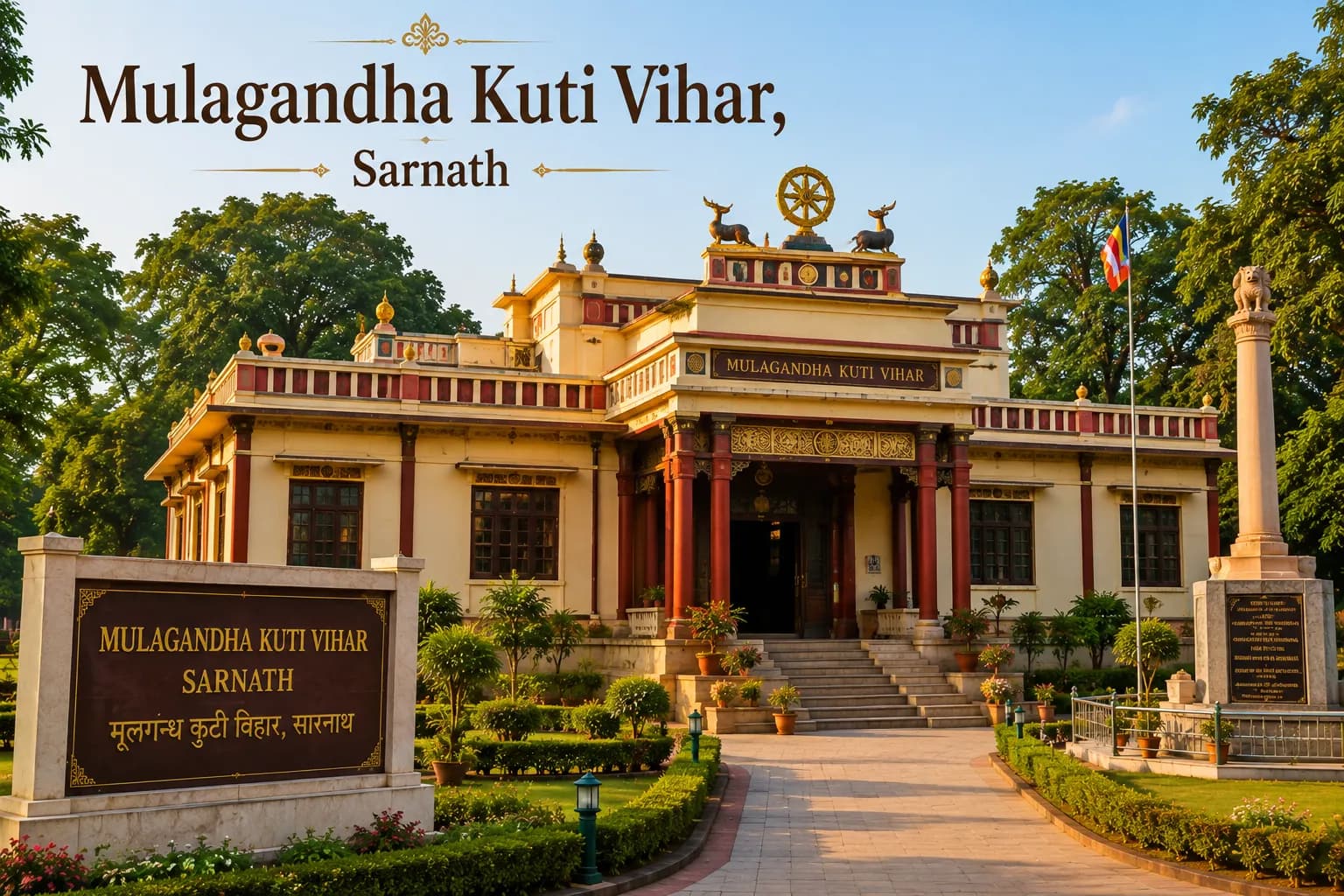
Sarnath is where, more than two and a half thousand years ago, the Buddha preached his very first sermon, setting in motion the wheel of the Dharma, and the Mulagandha Kuti Vihar is the temple raised in modern times to honour that sacred ground. Its name recalls the Mulagandhakuti, the abode where the Buddha is said to have stayed during his rainy-season retreats at Sarnath, and it stands close to the ancient ruins of that original shrine. This is the principal Buddhist temple of Sarnath, and a place of living worship, where monks and pilgrims from across the world come to pray, chant and meditate.
The temple was built by the Maha Bodhi Society and completed in 1931, the crowning achievement of the great Sri Lankan Buddhist reviver Anagarika Dharmapala, and it is maintained by the Society still. A turreted, graceful building set in beautiful gardens and lawns, it draws its visitors into a deep and gentle peace, and many who come say it is the most serene place in all of Sarnath.
The frescoes of Kosetsu Nosu
The glory of the temple's interior is its frescoes. The walls are covered, floor to ceiling, with magnificent murals by the celebrated Japanese painter Kosetsu Nosu, one of the foremost artists of his day, painted in the classical Ajanta style over the years following the temple's opening. They tell the whole life of the Buddha, from his birth as Prince Siddhartha, through his renunciation and enlightenment, his first sermon here at Sarnath, and on to his final passing, his Mahaparinirvana, and they weave in the Jataka tales and the deeds of his disciples. They are, in effect, the entire story of the Buddha painted in colour, a treasure of Buddhist art and a rich repository of its literature, and to stand among them is a quietly moving experience.
The sacred relics, the golden Buddha and the bell
The Mulagandha Kuti Vihar holds a treasure of the deepest sanctity: enshrined within it are sacred bodily relics of the Buddha, unearthed by archaeologists and presented to the Maha Bodhi Society, so that this temple is a true relic shrine and a place of pilgrimage for Buddhists the world over. Each year, on Buddha Purnima, the day of the Buddha's birth, enlightenment and passing, the relics are brought out for the public to behold and seek blessings, and the temple fills with devotees.
In the meditation hall, on a marble platform, sits a serene golden image of the Buddha in the Dharmachakra Pravartana mudra, the very gesture of the turning of the wheel of the law, his first sermon, a beautiful focus for prayer and contemplation. At the entrance hangs a great bronze bell, a gift from Japan, whose deep note calls the faithful to worship. Together they give the temple its air of living, cared-for devotion.
The Bodhi tree and the first sermon
Beside the temple grows a tree of extraordinary lineage. It is a living descendant of the sacred Bodhi tree of Bodh Gaya, under which the Buddha attained enlightenment. Long ago, the emperor Ashoka's daughter, the nun Sanghamitta, carried a cutting of that original tree to Anuradhapura in Sri Lanka, where it flourished for over two thousand years; and in 1931 Anagarika Dharmapala brought a sapling from the Anuradhapura tree and planted it here at Sarnath. So this tree carries, unbroken, the living line of the very tree of enlightenment.
Near it stands a sculptural scene of the Buddha delivering his first sermon to his five disciples, the moment that Sarnath is holy for, so that the whole spot brings together the tree of awakening and the giving of the teaching. To sit here quietly, in the shade of the Bodhi tree, is to be close to the heart of what Sarnath means.
Anagarika Dharmapala and the Maha Bodhi Society
The temple owes its existence to one remarkable man. Anagarika Dharmapala, born in Sri Lanka in 1864, came on pilgrimage to Sarnath and Bodh Gaya in 1891 and was heartbroken to find the great Buddhist sites of India fallen into ruin and neglect. He devoted his life to their revival, founding the Maha Bodhi Society that same year to restore the sacred places of Buddhism, and the Mulagandha Kuti Vihar, raised with donations from Buddhists across the world, was the great fruit of that mission. To visit the temple is also to honour the man who helped bring the light of the Buddha's own places back to life.
A place of deep peace, in my own words
By Rajeev Sharma, Varanasi local
When I bring travellers to Sarnath, I always save the Mulagandha Kuti Vihar for a quiet, unhurried visit, because it has a peace unlike anywhere else. I tell them that this is the temple of the Buddha's first sermon, built by a great Sri Lankan monk who gave his life to reviving these holy places. Inside, we stand before the frescoes, and I let people simply look, because the whole life of the Buddha is painted there by a Japanese master, and it is beautiful beyond words.
I show them the golden Buddha turning the wheel of the law, and I tell them, softly, that the very relics of the Buddha are enshrined here, and that on Buddha Purnima they are shown to all. Then we go out to sit beneath the Bodhi tree, and I explain its wonderful journey, from Bodh Gaya to Sri Lanka and back to Sarnath, an unbroken line from the tree of enlightenment itself. My guests, whatever their faith, grow very still here. In a lifetime of guiding around intense and crowded Kashi, this is the place I send people for calm.
In more than forty years of guiding, this is where I have most often watched a traveller find real peace.
, respecting any restrictions on photographing the frescoes and worship.]*
What to see and do
- Take in the Kosetsu Nosu frescoes, the whole life of the Buddha painted across the walls.
- Bow before the golden Buddha in the Dharmachakra mudra in the meditation hall.
- Know that the sacred relics of the Buddha are enshrined here, and shown on Buddha Purnima.
- Sit beneath the descendant of the Bodhi tree and see the first-sermon sculptures.
- Hear the daily chanting of the first sermon, and enjoy the peaceful gardens.
How to reach the Mulagandha Kuti Vihar
The temple is at Singhpuri, Sarnath, close to the ancient monuments, about 1 km from the Dhamek Stupa and 9 km from Varanasi Junction, on the northern, airport side of the city. It is easy to reach by road.
| From | Distance | Notes |
|---|---|---|
| Dhamek Stupa and the ancient site | About 1 km | A short walk or drive; see them together. |
| Varanasi city | About 10 km | By taxi or auto to Sarnath. |
| Varanasi Junction (Cantt) | About 9 km | By taxi or auto. |
| Airport | About 20 km | Sarnath is on the airport side; easy to pair with an arrival or departure. |
It is best seen as part of a Sarnath visit, with the Dhamek Stupa, the ruins and the museum. See our guide to Sarnath. We arrange the transport, timing and a guide.
Best time to visit and how to plan it
| When | Why |
|---|---|
| Morning | Cool and calm, with the temple at its most peaceful. |
| Late afternoon | For the evening chanting of the first sermon. |
| Buddha Purnima (Vaishakh Purnima, April or May) | The great Buddhist festival, when the sacred relics are shown to the public. |
| As part of a Sarnath day | Combine it with the Dhamek Stupa, the ruins and the museum. |
- Pair it with the whole Sarnath site and the museum for a full Buddhist heritage visit.
- Allow 30 to 45 minutes at the temple, more to sit in the gardens.
For Sarnath and the Buddhist heritage planned as one route, see our Varanasi tour packages.
Etiquette for visiting
- This is a living temple; keep silence, move gently, and do not disturb those in prayer or meditation.
- Remove your footwear before entering, and dress modestly.
- Check whether photography is allowed inside, especially of the frescoes, and follow the rules; never use flash near the murals.
- Show respect before the relics and the shrine, as pilgrims from around the world do.
Accessibility for elderly and mobility limited visitors
- The temple and its gardens are on fairly level ground and reachable by road, easier than the old city.
- There are a few steps into the temple; a relaxed pace helps.
- It is calm and uncrowded on most days, which suits a gentle, contemplative visit.
- We arrange transport to the temple and plan the Sarnath visit so a senior guest is comfortable.
Nearby sites to combine with your visit
The Mulagandha Kuti Vihar sits at the heart of Sarnath, on the northern, airport side of the city.
| Site | What it is | Internal link |
|---|---|---|
| Sarnath (Dhamek Stupa and site) | The great Buddhist site where the Buddha gave his first sermon, right beside the temple. | /temple/varanasi/sarnath |
| Trilochan Mahadev Dham (Jaunpur) | A Shiva dham on the airport side, easily paired with Sarnath. | /temple/varanasi/trilochan-mahadev-dham |
| Adi Keshava Temple | The first Vishnu of Kashi, near Rajghat on the northern side. | /temple/varanasi/adi-keshava-temple |
| Namo Ghat | The striking new ghat near Rajghat, on the way from the city. | /temple/varanasi/namo-ghat |
| Kashi Vishwanath Temple | The heart of Hindu Kashi, to see alongside the Buddhist Sarnath. | /temple/varanasi/kashi-vishwanath-temple |
For the grand evening Ganga aarti back in the city, see our Varanasi tour packages.
Our guided Sarnath and Buddhist heritage visits
We are a Varanasi based operator, a unit of Experience My India, with more than forty years of guiding travellers across Kashi, Sarnath, Ayodhya, and Prayagraj. The temple is free, so what we arrange is a rich, well-informed visit: transport, timing, and a guide who tells the story of the Buddha, of Sarnath and of this beautiful temple, as part of a full Sarnath and Buddhist heritage day, easily combined with an airport arrival or departure.
| Experience | Includes | Price |
|---|---|---|
| Sarnath half-day tour | The Mulagandha Kuti Vihar, the Dhamek Stupa, the ruins and the museum, with a guide. | Contact us for pricing |
| Airport-side Sarnath visit | Sarnath on your arrival or departure day, with the temple. | Contact us for pricing |
| Buddhist heritage day | Sarnath's Buddhist sites with a knowledgeable guide. | Contact us for pricing |
| Kashi and Sarnath day | The Buddhist Sarnath with the Hindu heart of Kashi. | Contact us for pricing |
Inclusions and exclusions are stated up front, with any taxes and conditions, and no charge appears later that was not named. See all our Varanasi tour packages for the full range.
Experience My India is a travel operator, not the temple administration. Our guiding and transport are ours; the temple is run by the Maha Bodhi Society, and entry is free. Timings and arrangements are set by the temple and can change.