.webp&w=2048&q=75)
.webp&w=2048&q=75)
Please note: which Vishwa Shanti Stupa this is
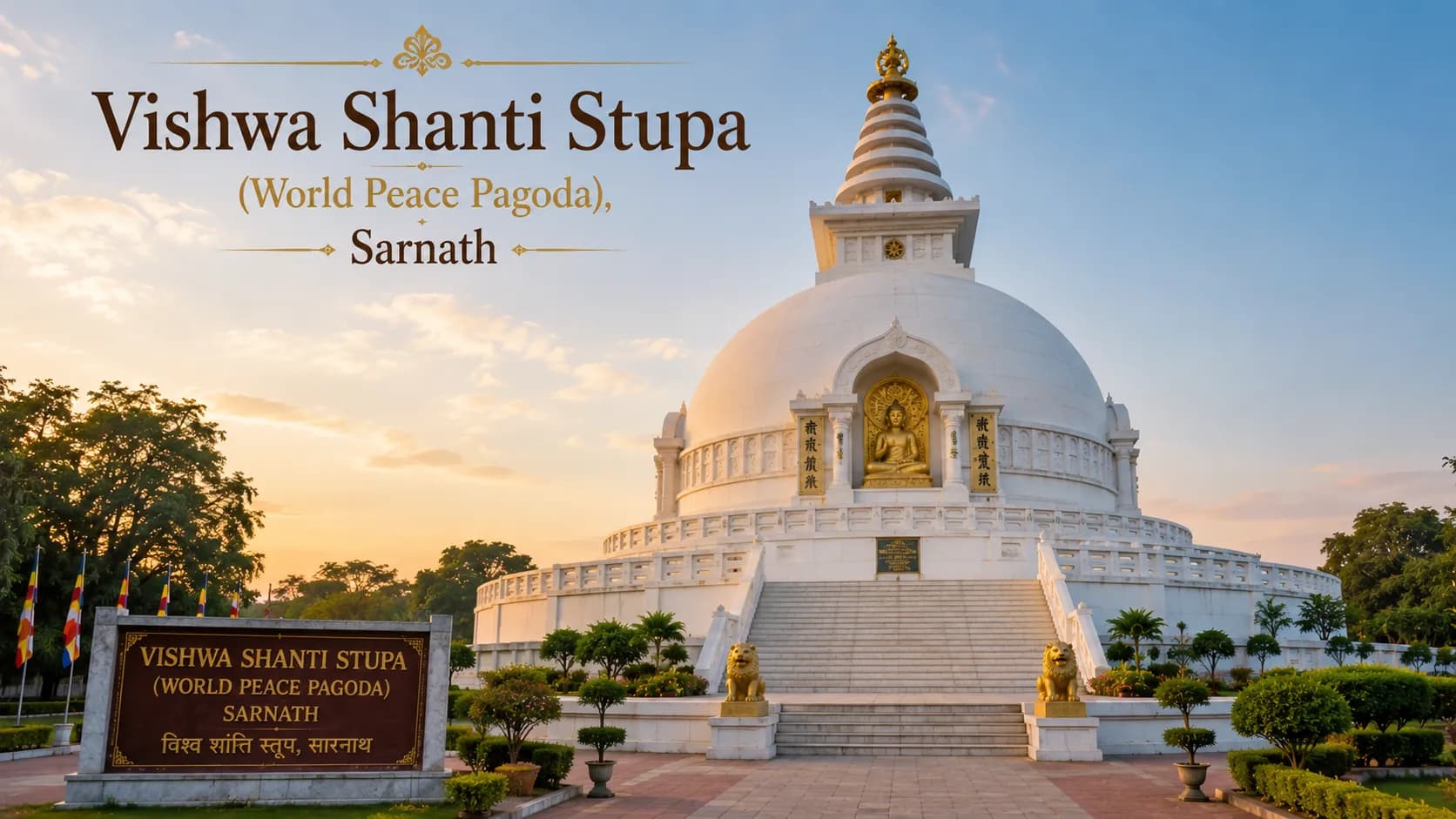
This page is about the Vishwa Shanti Stupa at Sarnath, Varanasi, beside the Japanese Temple. It is a different monument from the famous, larger Vishwa Shanti Stupa on Ratnagiri Hill at Rajgir in Bihar, which is the best-known Peace Pagoda in India. If you are looking for the Rajgir Peace Pagoda, that is a separate place; this guide is for the peaceful, Sanchi-style stupa here at Sarnath.
Essential info at a glance
| Detail | At a glance |
|---|---|
| What it is | The World Peace Pagoda of Sarnath, a monument to world peace built as a faithful replica of the great ancient stupa of Sanchi. |
| Opening hours | Generally sunrise to sunset, about 6:00 AM to 6:00 PM, every day. |
| Entry fee | Free to enter. |
| Inaugurated | 25 November 2010. |
| The highlight | A replica of Sanchi's famous carved gateway, with replicas of the Ashoka pillar and the lion-capital emblem. |
| Built with | Indo-Japanese cultural societies, to promote world peace and harmony. |
| Atmosphere | Quiet and uncrowded, ideal for meditation and reflection, away from the busier ruins. |
| Location | About 900 m south-east of the main Sarnath complex, beside the Japanese Temple. |
Vishwa Shanti Stupa timings
The stupa is generally open every day from sunrise to sunset, around 6:00 AM to 6:00 PM, and entry is free. It sits in a quiet back street of Sarnath, beside the Japanese Temple, and it is one of the calmest, least crowded corners of the town, a lovely place for a peaceful pause. A short visit of twenty minutes or so, longer if you wish to sit quietly, is enough to take it in.
| Detail | When | Notes |
|---|---|---|
| Opening hours | About 6:00 AM to 6:00 PM | Generally sunrise to sunset, every day. |
| Entry fee | Free | No ticket is needed. |
| Time needed | About 20 to 30 minutes | Longer if you sit to meditate. |
| Best times | Early morning and late afternoon | The quietest and loveliest light. |
The Vishwa Shanti Stupa: a monument to world peace
Vishwa Shanti Stupa means World Peace Stupa, and this beautiful monument at Sarnath belongs to a noble worldwide family. Across the globe stand many such Peace Pagodas, born of a Japanese Buddhist vision, in the aftermath of the terrible wars of the twentieth century, that the teaching of the Buddha might be enshrined in monuments dedicated to peace and to the harmony of all peoples. This one, at Sarnath, was inaugurated on the 25th of November 2010, built with the support of Indo-Japanese cultural societies, and dedicated, in the finest spirit, to the people of India and of the whole world, in the hope of a peaceful planet.
It was a fitting place to raise such a monument, for it stands at Sarnath, where the Buddha preached his very first sermon, the message of compassion and the end of suffering, which is itself a teaching of peace. And it stands beside the Japanese Temple, so that the two together, temple and peace stupa, form a single, harmonious expression of the friendship between India and Japan and of the universal longing for peace.
A taste of Sanchi at Sarnath
Here is what makes the Sarnath peace stupa so special, and so surprising. Most of the world's Peace Pagodas are great white domes in the Japanese style; but this one is something different and wonderful. It is a faithful replica of the Great Stupa of Sanchi, that most ancient and revered of India's Buddhist monuments, raised by the emperor Ashoka more than two thousand years ago in distant Madhya Pradesh. And so, stepping toward it, you pass through a beautiful replica of Sanchi's world-famous carved gateway, the torana, with its intricate reliefs, and beside it stand replicas of the Ashoka pillar and of the lion capital, the very emblem of India, whose original was found here at Sarnath.
The effect is quietly magical: without ever leaving Sarnath, and in a few peaceful minutes, you are carried across the centuries and across the country to stand before the forms of the Great Stupa of Sanchi, one of the oldest and greatest works of Buddhist art in the world. For anyone who will not have the chance to travel to Sanchi itself, this lovely replica is a real gift, and for everyone it is a beautiful place, where ancient Indian grandeur and a modern message of peace meet as one.
Indo-Japanese friendship and the peace pagodas
The Vishwa Shanti Stupa is, at heart, a monument of friendship. It was raised through the coming-together of Indian and Japanese devotion and effort, and it stands beside the Japanese Temple as a lasting sign of the deep bond between the two nations through the shared heritage of the Buddha. The worldwide movement of Peace Pagodas, of which it is a part, carries a simple, universal message that transcends every border: that peace and non-violence, the heart of the Buddha's teaching, are the hope of all humanity. To stand here, at the place where that teaching began, before a monument dedicated to peace for the whole world, is a gently moving thing.
A place of peace, in my own words
By Rajeev Sharma, Varanasi local
The Vishwa Shanti Stupa is one of my favourite surprises to spring on travellers at Sarnath, and I never tell them in advance. We visit the Japanese Temple, and then I lead them next door, and as we step through the gateway I watch their faces, because suddenly they are standing before what looks exactly like the great ancient stupa of Sanchi, the carved gate, the Ashoka pillar, all of it. People who have been to Sanchi cannot believe it, and people who have not are thrilled to see it. I explain that it is a World Peace Stupa, one of a family built all over the world for peace, and that this one was made in the beautiful old form of Sanchi.
I tell them, too, that the very emblem carved here, the four lions, is the emblem of India, and that the real one, found right here at Sarnath, is in the museum we will visit. So everything connects. And then I just let them be quiet, because it is a calm, uncrowded place, made for peace, and standing here, where the Buddha first taught peace, before a monument to peace for the whole world, is a lovely, gentle way to feel what Sarnath is really about.
In more than forty years of guiding, this is the spot where I most love to end a Sarnath visit, on a note of peace.
What to see and do
- Pass through the beautiful replica of Sanchi's carved gateway, the torana.
- See the replicas of the Ashoka pillar and the lion-capital emblem of India.
- Walk a quiet, clockwise circle around the peace stupa, as is the custom.
- Combine it with the Japanese Temple right next door, and its sandalwood Buddha.
- Sit awhile in the calm, uncrowded grounds, a place made for peace and reflection.
How to reach the Vishwa Shanti Stupa
The stupa is in Sarnath, about 900 metres south-east of the main Buddhist complex, in a quiet back street beside the Japanese Temple, roughly 10 km from the city and railway station, on the northern, airport side of Varanasi. It is easy to reach by road.
| From | Distance | Notes |
|---|---|---|
| The Japanese Temple | Adjacent | The two share a setting; see them together. |
| Dhamek Stupa and the main site | About 900 m | A short walk or drive. |
| Varanasi city and railway station | About 10 km | By auto, cab or local transport. |
| Airport | About 20 km | Sarnath is on the airport side; easy to pair with an arrival or departure. |
It is best seen as part of a Sarnath visit, together with the Japanese Temple. See our guide to Sarnath. We arrange the transport, timing and a guide.
Best time to visit and how to plan it
| When | Why |
|---|---|
| Early morning | The quietest, most peaceful atmosphere. |
| Late afternoon | Lovely light on the gateway and the stupa. |
| October to March | The most pleasant season for Sarnath's open monuments. |
| As part of a Sarnath day | Combine it with the Japanese Temple, the ruins, the museum and the other temples. |
- Pair it with the Japanese Temple next door and the wider Sarnath site.
- Allow 20 to 30 minutes, longer if you sit to meditate.
For Sarnath planned as one route, see our Varanasi tour packages.
Etiquette for visiting
- It is a monument of peace and worship; keep silence, move gently, and be respectful.
- Dress modestly, and remove footwear where required.
- Walk clockwise around the stupa, as is the Buddhist custom, and do not touch the carvings.
- Photography is generally welcome outdoors; be respectful of anyone in prayer or meditation.
Accessibility for elderly and mobility limited visitors
- The grounds are largely level and reachable by road, easier than the old city, with a short, gentle visit.
- There may be a step or two around the stupa; the gateway and grounds are mostly at ground level.
- It is calm and uncrowded, which suits a relaxed, contemplative visit; there are quiet spots to sit.
- We arrange transport and plan the Sarnath visit so a senior guest is comfortable.
Nearby sites to combine with your visit
The Vishwa Shanti Stupa is beside the Japanese Temple, in the international temples area of Sarnath, on the northern, airport side of the city.
| Site | What it is | Internal link |
|---|---|---|
| Japanese Temple (Horinji) | The Kyoto-style temple with its sandalwood reclining Buddha, right next door. | /temple/varanasi/japanese-temple-sarnath |
| Sarnath (Dhamek Stupa and site) | The great Buddhist site where the Buddha gave his first sermon. | /temple/varanasi/sarnath |
| Sarnath Archaeological Museum | The oldest site museum in India, home to the original Lion Capital of Ashoka. | /temple/varanasi/sarnath-archaeological-museum |
| Mulagandha Kuti Vihar | The beautiful modern Buddhist temple with the frescoes and relics. | /temple/varanasi/mulagandha-kuti-vihar |
| Thai Temple (Wat Thai) | The Thai temple with its giant 80-foot standing Buddha and gardens. | /temple/varanasi/thai-temple-sarnath |
For the grand evening Ganga aarti back in the city, see our Varanasi tour packages.
Our guided Sarnath and peace-and-temples visits
We are a Varanasi based operator, a unit of Experience My India, with more than forty years of guiding travellers across Kashi, Sarnath, Ayodhya, and Prayagraj. The stupa is free, so what we arrange is an honest, well-planned Sarnath visit: transport, timing, and a guide who explains the peace stupa, the Sanchi replica and its connection to the Lion Capital in the museum, and takes you to the Japanese Temple, the other international temples and the whole Sarnath site, with no rushing and no shop diversions, easily combined with an airport arrival or departure.
| Experience | Includes | Price |
|---|---|---|
| Sarnath half-day tour | The Peace Stupa and Japanese Temple, the Dhamek Stupa, the Mulagandha Kuti Vihar, the museum and more, with a guide. | Contact us for pricing |
| International temples of Sarnath | The Peace Stupa, the Japanese, Thai, Chinese, Tibetan and Burmese temples, with a guide. | Contact us for pricing |
| Airport-side Sarnath visit | Sarnath on your arrival or departure day, with the Peace Stupa. | Contact us for pricing |
| Kashi and Sarnath day | The Buddhist Sarnath with the Hindu heart of Kashi. | Contact us for pricing |
Inclusions and exclusions are stated up front, with any taxes and conditions, and no charge appears later that was not named. We never divert you to shops. See all our Varanasi tour packages for the full range.
Experience My India is a travel operator, not the stupa administration. Our guiding and transport are ours; the stupa is free to enter. Timings and arrangements can change.