.webp&w=2048&q=75)
.webp&w=2048&q=75)
Essential info at a glance
| Detail | At a glance |
|---|---|
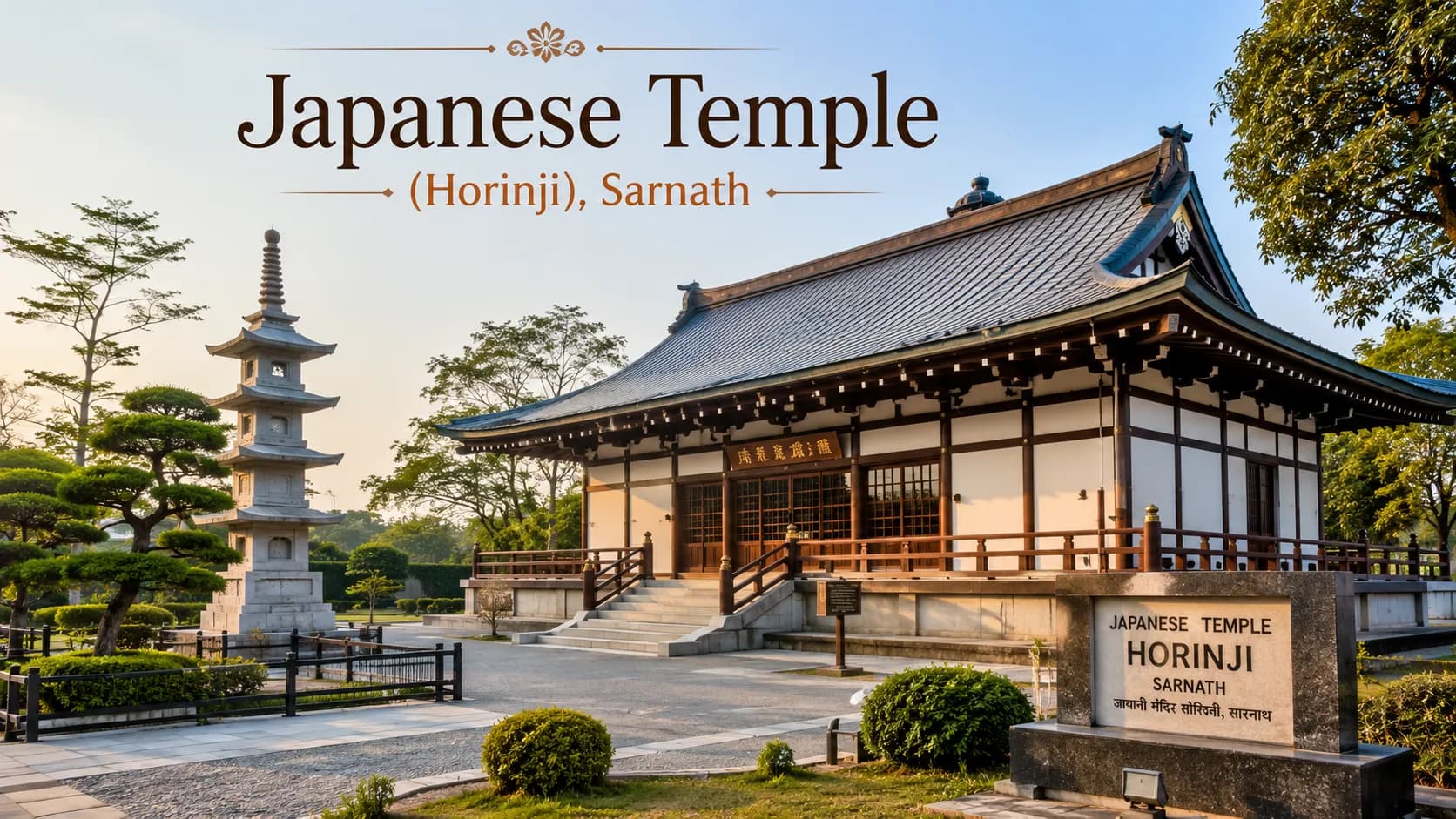
| What it is | The Japanese Buddhist temple of Sarnath, the Nichigai Suzan Horinji, in traditional Kyoto style, famous for its sandalwood reclining Buddha. |
| Opening hours | 6:00 AM to 6:00 PM, every day. |
| Entry fee | Free; donations are optional. |
| The main image | An imposing reclining Buddha, carved, like all the temple's furnishings, from fragrant sandalwood. |
| Architecture | A two-storey Japanese pagoda with a sloping, upturned roof, reminiscent of the temples of Kyoto. |
| Built by | The Japanese Buddhist community, managed by the Dharmachakra Indo-Japan Buddhist Cultural Society. |
| Right next door | The Vishwa Shanti Stupa, the World Peace Pagoda, a replica of the great stupa of Sanchi. |
| Location | Sarnath, next to the Peace Stupa, about 10 km from the city, near the main market. |
Japanese Temple timings
The temple is open every day from 6:00 AM to 6:00 PM, and entry is free, with donations optional. It is one of the most serene and unusual temples in Sarnath, and it is worth allowing an hour or so to enjoy the shrine, the fragrance of the sandalwood, the gardens and the Peace Stupa beside it. The early morning and the late afternoon are the quietest, loveliest times.
| Detail | When | Notes |
|---|---|---|
| Opening hours | 6:00 AM to 6:00 PM | Open every day of the week. |
| Entry fee | Free | Donations are optional. |
| Time needed | About an hour | For the temple, the sandalwood shrine and the Peace Stupa. |
| Best times | Early morning and late afternoon | The quietest, most peaceful atmosphere. |
The Japanese Temple: a piece of Kyoto at Sarnath
Among the temples that the Buddhist nations have built at Sarnath, the Japanese Temple, properly the Nichigai Suzan Horinji, is one of the most quietly beautiful. It was built in 1989 by the Japanese Buddhist community, and is cared for by the Dharmachakra Indo-Japan Buddhist Cultural Society, raised to promote peace, spirituality and the long friendship between Japan and India, in the very place where the Buddha first taught. Sarnath, one of the four holiest sites of Buddhism, was a fitting choice.
Its architecture is authentically Japanese: a graceful two-storey pagoda with a sloping roof and gently upturned eaves, unmistakably in the style of the famous old temples of Kyoto, and quite unlike anything else in Sarnath. It may look simple and understated from the outside, but that restraint is part of its Japanese character, and it makes the beauty and fragrance within all the more of a surprise. At the entrance, a statue of the Buddha sits calmly beneath a tree on one side, and on the other stands a pillar carved with Japanese inscriptions, a first hint that you are stepping into another world.
The sandalwood reclining Buddha
The wonder of the Japanese Temple is inside, and you smell it before you see it. The main shrine holds a large, imposing wooden sculpture of the reclining Buddha, the Buddha in his final rest, the Parinirvana, his passing into nirvana, exquisitely carved, with beautiful detail worked into the head. And here is the temple's magic: the great statue, and all the smaller statues, the furniture and the fittings of the shrine, are carved from sandalwood, so that the whole interior is filled with its sweet, calming fragrance. To step inside is to be wrapped at once in scent and stillness, an experience of the senses as much as the spirit, found nowhere else in Sarnath.
Near the reclining Buddha you will see the Japanese mantra Na Mu Myo Ho Ren Ge Kyo, the great chant of the Nichiren tradition, and at times you may see Japanese pilgrims prostrate upon the floor in deep devotion. It is a place made for meditation and calm, and many visitors say they could sit in its fragrant peace for hours.
The Vishwa Shanti Stupa: the World Peace Pagoda
Right beside the Japanese Temple, and connected to it, stands the Vishwa Shanti Stupa, the World Peace Pagoda, and it is a beautiful surprise in its own right. It is a gleaming white stupa built as a monument to world peace, and it is modelled on the great ancient stupa of Sanchi, so faithfully that stepping up to it can feel like being carried back across two thousand years: there is a fine replica of Sanchi's famous carved gateway, the eastern torana, and replicas of the Ashoka pillar and of the lion capital, India's national emblem.
Together, the Japanese temple and the Peace Stupa make a single, harmonious visit, a place where Japanese devotion, ancient Indian form and a universal message of peace all meet. There is a small passage between the two, so you can move easily from the fragrant shrine to the white stupa and its gardens, and the whole is one of the most restful corners of Sarnath.
The gardens and the calm
Around the temple and the stupa lie manicured lawns and a peaceful garden, well kept and green, with quiet corners to sit and reflect. After the intensity of Kashi across the river, this serene, fragrant, orderly place is a balm, and it is a favourite of travellers who want simply to slow down, breathe the sandalwood air, and rest the mind for a while by the site of the first sermon.
A fragrant stillness, in my own words
By Rajeev Sharma, Varanasi local
I love watching my guests step into the Japanese Temple, because the first thing that happens is they stop and breathe in. I tell them, before we go in, that the whole shrine is carved from sandalwood, and then we enter, and the fragrance just wraps around you, and there is the great reclining Buddha, the Buddha at his final peace. From the outside it is a simple, elegant Japanese pagoda, like something from Kyoto, but inside it is scent and silence, and people always go very quiet.
Then I take them next door to the White Peace Stupa, and I tell them to look closely, because it is a replica of ancient Sanchi, with the carved gateway and the Ashoka pillar, so in one visit they touch Japan, ancient India and the message of world peace all together. I explain the Japanese mantra by the Buddha, and I remind everyone to keep silence and to remove their shoes, because Japanese pilgrims come here to pray. In all of my Sarnath, this fragrant, peaceful spot is the one where I most often see a traveller simply close their eyes.
In more than forty years of guiding, this is the temple that stays with people through the nose as much as the heart.
, respecting any restrictions inside the shrine.]*
What to see and do
- Step inside to see the great sandalwood reclining Buddha and breathe in the fragrance of the shrine.
- Admire the authentic Japanese architecture, the two-storey Kyoto-style pagoda with its sloping roof.
- Visit the Vishwa Shanti Stupa next door, a replica of ancient Sanchi with its carved gateway and Ashoka pillar.
- See the entrance Buddha beneath the tree and the pillar of Japanese inscriptions.
- Sit awhile in the peaceful, manicured gardens, ideal for quiet meditation.
How to reach the Japanese Temple
The temple is in Sarnath, next to the Vishwa Shanti Stupa in the Baruipur area, close to the main market and behind the government tourist bungalow, about 10 km from the city and roughly 500 m from Sarnath railway station, on the northern, airport side of Varanasi. It is easy to reach by road.
| From | Distance | Notes |
|---|---|---|
| Dhamek Stupa and the main site | A short distance | See them together on a Sarnath visit. |
| Sarnath railway station | About 500 m | A short walk or ride. |
| Varanasi city | About 10 km | By taxi or auto to Sarnath. |
| Airport | About 20 km | Sarnath is on the airport side; easy to pair with an arrival or departure. |
It is best seen as part of a Sarnath visit. See our guide to Sarnath. We arrange the transport, timing and a guide, and take you to every temple you want to see.
Best time to visit and how to plan it
| When | Why |
|---|---|
| Early morning | The quietest, most peaceful atmosphere, with the sandalwood air at its freshest. |
| Late afternoon | Calm and cool, lovely for the temple and the gardens. |
| October to March | The most pleasant season for Sarnath's temples. |
| As part of a Sarnath day | Combine it with the museum, the ruins and the other international temples. |
- Pair it with the Sarnath monuments, the Sarnath Archaeological Museum and the other international temples for a full day.
- Allow about an hour for the temple, the shrine and the Peace Stupa.
For Sarnath planned as one route, see our Varanasi tour packages.
Etiquette for visiting
- This is a living temple; keep silence, move gently, and do not disturb the Japanese pilgrims at prayer.
- Dress modestly, covering shoulders and knees, and remove your footwear before entering the main shrine hall.
- Do not touch the sandalwood statues or furnishings, and photograph respectfully.
- Photography is generally fine outdoors; check or ask before taking photos inside the prayer hall.
Accessibility for elderly and mobility limited visitors
- The temple grounds are green, level and reachable by road, easier than the old city.
- There are a few steps into the shrine hall; the gardens and the Peace Stupa are largely at ground level.
- It is calm and unhurried, which suits a gentle, seated, contemplative visit.
- We arrange transport to the temple and plan the Sarnath visit so a senior guest is comfortable.
Nearby sites to combine with your visit
The Japanese Temple is in the international temples area of Sarnath, on the northern, airport side of the city.
| Site | What it is | Internal link |
|---|---|---|
| Sarnath (Dhamek Stupa and site) | The great Buddhist site where the Buddha gave his first sermon. | /temple/varanasi/sarnath |
| Tibetan Temple | The colourful Tibetan monastery with prayer wheels and Thangkas. | /temple/varanasi/tibetan-temple-sarnath |
| Thai Temple (Wat Thai) | The Thai temple with its giant 80-foot standing Buddha and gardens. | /temple/varanasi/thai-temple-sarnath |
| Sarnath Archaeological Museum | The oldest site museum in India, home to the Lion Capital of Ashoka. | /temple/varanasi/sarnath-archaeological-museum |
| Mulagandha Kuti Vihar | The beautiful modern Buddhist temple with the frescoes and relics. | /temple/varanasi/mulagandha-kuti-vihar |
For the grand evening Ganga aarti back in the city, see our Varanasi tour packages.
Our guided Sarnath and international-temples visits
We are a Varanasi based operator, a unit of Experience My India, with more than forty years of guiding travellers across Kashi, Sarnath, Ayodhya, and Prayagraj. The temple is free, so what we arrange is an honest, well-planned Sarnath visit: transport, timing, and a guide who takes you to the Japanese Temple and its Peace Stupa, the other international temples and the whole Sarnath site, with no rushing and no shop diversions, easily combined with an airport arrival or departure.
| Experience | Includes | Price |
|---|---|---|
| Sarnath half-day tour | The Japanese Temple and Peace Stupa, the Dhamek Stupa, the Mulagandha Kuti Vihar, the museum and more, with a guide. | Contact us for pricing |
| International temples of Sarnath | The Japanese, Thai, Tibetan and other temples, with a guide. | Contact us for pricing |
| Airport-side Sarnath visit | Sarnath on your arrival or departure day, with the Japanese Temple. | Contact us for pricing |
| Kashi and Sarnath day | The Buddhist Sarnath with the Hindu heart of Kashi. | Contact us for pricing |
Inclusions and exclusions are stated up front, with any taxes and conditions, and no charge appears later that was not named. We never divert you to shops. See all our Varanasi tour packages for the full range.
Experience My India is a travel operator, not the temple administration. Our guiding and transport are ours; the temple is run by the Dharmachakra Indo-Japan Buddhist Cultural Society, and entry is free. Timings and arrangements can change.