3 nights / 4 days
Pilgrimage
₹37,000
Starting From


Senior Citizen Kashi Ayodhya Yatra
Varanasi, Prayagraj & Ayodhya (Elders)|Pilgrimage
One City A Day Pace
Lift-Access Rooms
Daily Family WhatsApp
A complete 40-year guide to the 84 ghats of Varanasi lining the holy Ganga, including the five sacred ghats (Panchtirtha), cremation etiquette, and boat rides.
Drop your details and we'll craft a personalized spiritual package.
The Kashi Vishwanath Temple, the Dashashwamedh Ganga Aarti, a sunrise boat ride past the 80-plus ghats, and Sarnath, where the Buddha gave his first sermon
A ghat is a flight of steps leading down to the river, a landing place for bathing, worship and ritual. Varanasi's ghats run in an almost continuous chain along the western bank of the Ganga, about 6.5 km from Assi in the south to Adi Keshava in the north. The number 84 is the traditional count, and it carries meaning in Hindu numerology as a sign of wholeness. Most of the ghats were rebuilt in the 18th century under Maratha patronage, by the Marathas, Scindias, Holkars, Bhonsles, Peshwas and the Maharajas of Benares, which is why so many carry royal names and palace facades.
You do not need to see all 84. Focus on the top eight to ten, which a sunrise boat ride covers from the water, and you will experience the full range of the riverfront.
According to the Puranas, five ghats are especially sacred, collectively called the Panchtirtha
Varanasi's key ghats listed south to north
Of the 84 ghats, two are dedicated cremation sites: Manikarnika, the main and most famous, and Harishchandra, older and smaller. By tradition, cremation here grants moksha, which is why families bring their departed to Kashi. These are working, sacred sites, not attractions. Observe quietly from a distance, never photograph or film the pyres, and decline anyone soliciting “donations” for cremation wood, a known scam. Our Manikarnika Ghat page covers the sensitivities and the moksha tradition in full.
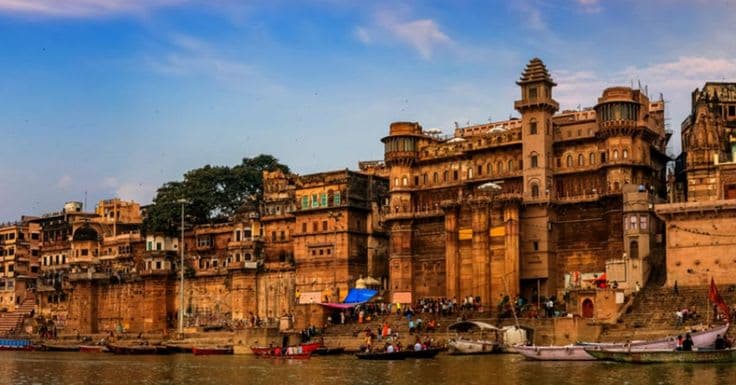
Many ghats rise into palaces built by royal patrons. Man Mandir Ghat carries Maharaja Man Singh's 16th-century palace and a later Jantar Mantar observatory. Scindia Ghat is famous for a Shiva temple that tilted and partly sank into the river under the weight of construction nearly two centuries ago, a favourite photograph at low water. Darbhanga and Munshi Ghats show grand palace facades, some now heritage hotels. Lalita Ghat holds a striking wooden Nepali temple modelled on Kathmandu's Pashupatinath. These give the riverfront its layered, lived-in grandeur.
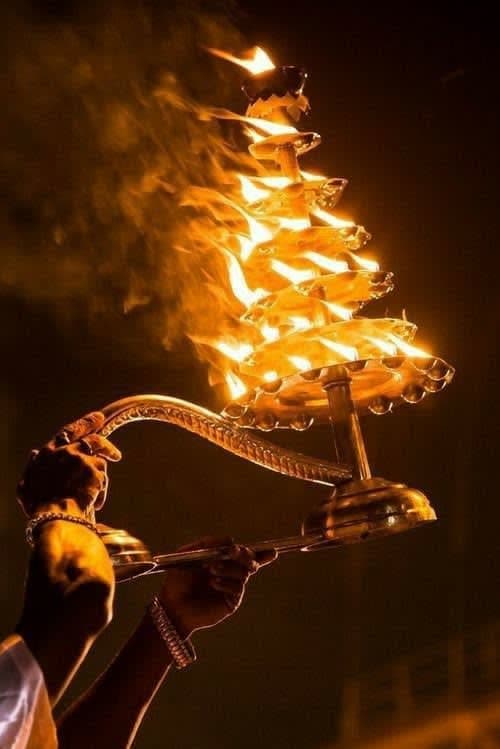
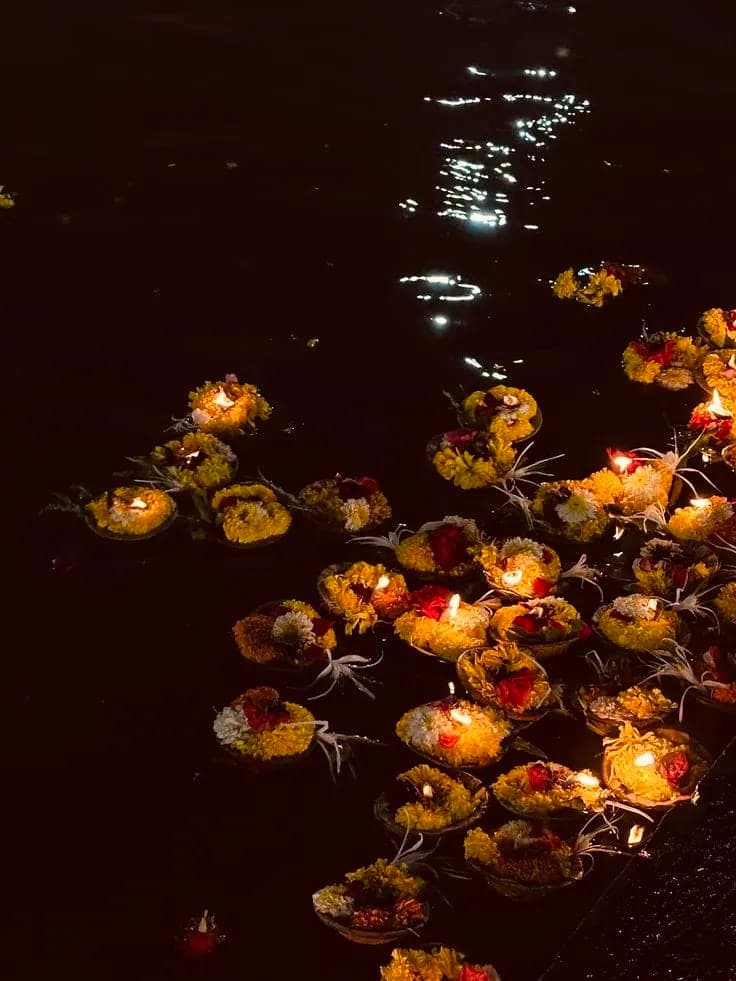
The river has two rhythms. At dawn, Assi Ghat hosts Subah-e-Banaras, a programme of Vedic chanting, music and yoga, while pilgrims bathe and the light is soft for a boat ride. At dusk, Dashashwamedh hosts the grand Ganga Aarti. A good plan uses both: a sunrise boat from Assi and the evening aarti at Dashashwamedh. See our Subah-e-Banaras page and the Dashashwamedh Ganga Aarti page.
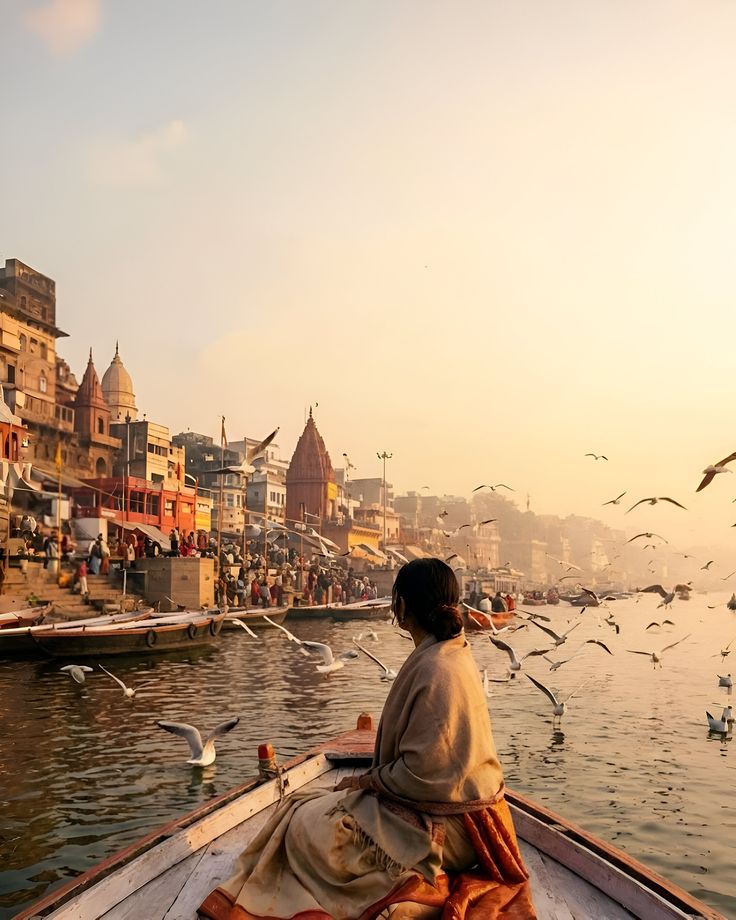
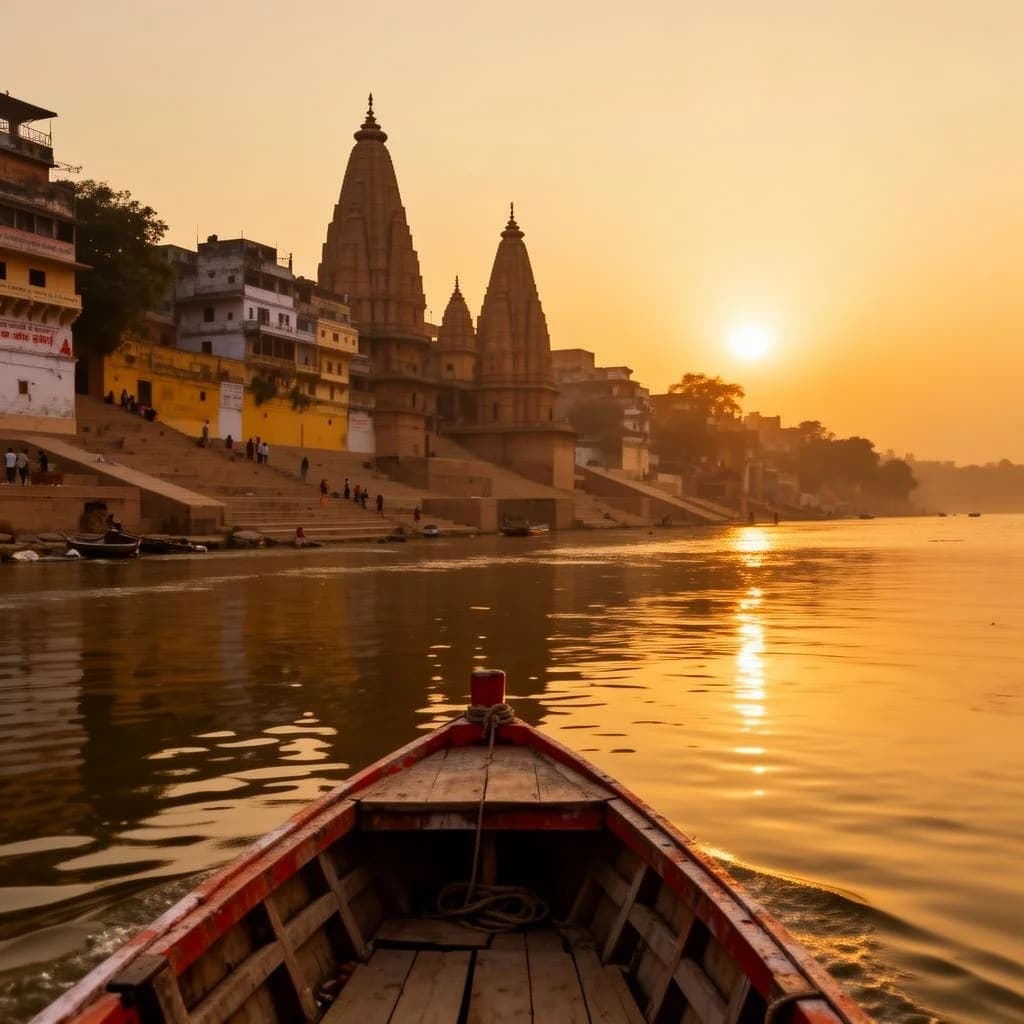
The single best way to take in the ghats is from the water. A sunrise boat ride glides past the whole sweep of the riverfront as the city wakes, the steps filling with bathers, priests and washermen. A typical route runs from Assi in the south up toward Manikarnika and Panchganga in the north. Shared and private boats are available; fares vary, so agree the total before boarding. Our Ganga boat ride guide covers the sunrise and evening rides, fares and how to avoid the boat scam in detail.
From the ground: If you have one morning, take a sunrise boat from Assi toward Manikarnika and back. You will see twenty ghats in an hour, in the best light of the day, and understand the whole city better than any walk can teach you.
You can also walk the ghats, which are mostly connected at the riverside. A good walk runs from Assi north through Tulsi and Kedar, past Harishchandra, to Dashashwamedh, then on through Man Mandir and Scindia to Manikarnika and Panchganga. Wear shoes with grip, as the steps can be slippery near the water, especially in the early morning and after the monsoon, and avoid walking unfamiliar stretches after dark.
Kedar Ghat has a special pull for South Indian and Bengali pilgrims. Its Kedareshwar temple, in a distinct South Indian style, links symbolically to Kedarnath, and the Parvati Kund beside it is believed to have healing properties. If you are visiting from Andhra Pradesh, Telangana or Karnataka, our Telugu and Kannada speaking guides can build your ghat morning around Kedar and the Panchtirtha, with everything explained in your language.
We are Experience My India, rated 4.5 stars on TripAdvisor and Google, with 50,000+ guests served since 2018. We arrange a vetted sunrise boat at a fixed price, a guided ghat walk, and the evening aarti, all sequenced so you see the best of the riverfront without touts. See our Varanasi packages or message Rajeev's team on WhatsApp at +91 7302265809. Start trip planning from our Varanasi travel guide, or book a Varanasi tour from your city.
Curated itineraries featuring this divine destination.






Grouped for quick scanning
Everything you need to know about Ghats of Varanasi.
Topic 01
8 questions
A ghat is a flight of stone steps leading down to the river, used as a landing place for bathing, worship and ritual. The word comes from Sanskrit for an embankment or landing place. In Varanasi, the ghats line the western bank of the Ganga in an almost continuous chain, and they are the heart of the city's life.
Varanasi has 84 ghats, the traditional and official count, though some lists mention close to 100 when minor ones are included. The number 84 carries meaning in Hindu numerology as a symbol of wholeness. They stretch along the western bank for about 6.5 km, from Assi in the south to Adi Keshava in the north.
The ghats run for roughly 6.5 km, about 4 miles, along the western bank of the Ganga. They form an almost continuous chain of steps and palaces from Assi Ghat at the southern end to Adi Keshava at the northern end. A sunrise boat ride covers most of this span in about an hour.
The five most sacred ghats, collectively called the Panchtirtha, are Assi, Dashashwamedh, Manikarnika, Panchganga and Adi Keshava. According to the Puranas, pilgrims aim to bathe or pay homage at these in particular. They span the riverfront from the southern boundary at Assi to the northern point at Adi Keshava.
Most of the present ghats were rebuilt in the 18th century under Maratha patronage, by the Marathas, Scindias, Holkars, Bhonsles, Peshwas and the Maharajas of Benares, along with other royal and noble families. This is why so many ghats carry royal names and rise into palaces and temples above the steps.
Most ghats are used for bathing and worship: ritual dips in the Ganga, morning and evening prayers, and aarti. Two, Manikarnika and Harishchandra, are cremation ghats. A few are used for washing clothes by dhobis or as boat-docking points. Together they host the full cycle of Hindu life, from birth rites to last rites.
No. Focus on the top eight to ten, which a sunrise boat ride covers from the water, and you will experience the full range of the riverfront. Trying to visit all 84 on foot is unnecessary and exhausting. The boat is the efficient and beautiful way to take in the whole sweep.
They run from Assi Ghat, the southernmost, to Adi Keshava Ghat, the northernmost, near the confluence with the Varuna. Raj Ghat, near the road and rail bridge, marks the northern edge of the main circuit. A boat ride or walk usually follows this south-to-north line.
Topic 02
11 questions
Assi Ghat is the southernmost and one of the largest and most popular ghats, where the Assi stream once met the Ganga. It hosts the Subah-e-Banaras morning programme of chanting, music and yoga, is linked to the poet Tulsidas, and sits near Banaras Hindu University. It is calmer and more traveller-friendly than the central ghats.
Dashashwamedh is the main and most famous ghat, the site of the grand evening Ganga Aarti and a short walk from Kashi Vishwanath Temple. Its name means the ghat of ten horse sacrifices. It is always busy with pilgrims, priests and vendors, and is the beating heart of the riverfront. See our dedicated Ganga Aarti page.
Manikarnika is the main cremation ghat of Varanasi, where, by tradition, the funeral fires have burned continuously for centuries and cremation grants moksha. It is also associated with a Shakti Peeth and the Manikarnika Kund. It is a sacred working site, not an attraction; observe respectfully and never photograph the cremations.
Harishchandra is the second, older and smaller cremation ghat, named after the truthful King Harishchandra who, by legend, worked here as a cremator. It handles fewer cremations than Manikarnika and is quieter, with an electric or gas crematorium alongside. The same rules apply: no photography of cremations, and respectful conduct.
Kedar Ghat is home to the Kedareshwar Shiva temple, in a distinct South Indian style, and is especially revered by South Indian and Bengali pilgrims. The Parvati Kund beside it is believed to have healing properties, and the ghat links symbolically to Kedarnath. It is one of the more colourful and atmospheric ghats.
Panchganga Ghat marks the believed confluence of five sacred rivers: Ganga, Yamuna, Saraswati, Kirana and Dhutapapa, of which only the Ganga is visible today. It is a calm, contemplative ghat with meditation chambers, sanctified by saints across history, with the Alamgir Mosque rising above it. It is one of the Panchtirtha.
Scindia Ghat is famous for a Shiva temple that tilted and partly sank into the river under the weight of construction nearly two centuries ago, a favourite photograph at low water. Built by the Scindias of Gwalior, it borders Manikarnika, and the alleys above it, the Siddha Kshetra, hold several influential shrines.
Man Mandir Ghat carries a palace built by Maharaja Man Singh of Amber in the 16th century and a later Jantar Mantar observatory added by Sawai Jai Singh II, with astronomical instruments still in place. Its Rajput architecture, carved balconies and ornate windows make it one of the finest palace ghats on the riverfront.
Lalita Ghat holds a striking wooden temple in the Nepali style, modelled on Kathmandu's Pashupatinath, built by an exiled Nepali king and completed by his son. Known locally as the Nepali Mandir, its terracotta and wood carving make it one of the most distinctive structures on the ghats. It sits near Manikarnika.
Namo Ghat is the newest ghat, with a modern design that contrasts with the historic palace ghats, featuring large sculpted hands in a greeting gesture. It has become a popular spot for its contemporary look and river views. It shows that the riverfront is still evolving alongside its ancient ghats.
Both are known for grand palace architecture rising directly from the steps, among the most photogenic on the riverfront, with the restored Darbhanga Palace now a heritage hotel. They sit near Dashashwamedh and are favourites for architectural photography, especially in warm morning light from a boat.
Topic 03
5 questions
Two ghats are dedicated cremation sites: Manikarnika, the main and most famous, and Harishchandra, older and smaller. By tradition, cremation at either grants moksha. They are sacred working sites, so visitors should observe quietly from a distance, never photograph the pyres, and avoid donation touts. See our Manikarnika Ghat page for the full guidance.
Yes, you may observe respectfully from a distance, but treat them as you would any funeral. Do not photograph or film the cremations, do not talk loudly or pose for pictures, and decline anyone soliciting donations for wood. If you are sensitive to the sight of cremation, it is fine to skip these ghats.
Because they are active cremation sites where families are grieving real loss. Photographing or filming the pyres is a deep violation of privacy and dignity, and it provokes strong, sometimes physical, reactions, with phones confiscated. Put your camera and phone away entirely near the burning ghats. This is the single firmest rule on the riverfront.
Manikarnika is the main, larger and most famous cremation ghat, with continuous fires and the greatest significance. Harishchandra is older and smaller, handles fewer cremations, and feels quieter and slightly less overwhelming. Both grant moksha by tradition, and both follow the same strict rules of respect and no photography.
There is no official fee to observe respectfully from a distance. Touts may quote a fee or demand a large "donation" for wood or for a "better viewpoint"; these are scams. Donations are voluntary, and you should never pay under emotional pressure. Our Manikarnika page explains how to handle this with dignity.
Topic 04
7 questions
A sunrise boat ride is the best way, gliding past the whole sweep of the riverfront in the soft morning light as the city wakes. From the water you see twenty or more ghats in about an hour, far more than a walk allows. Many visitors do a boat ride and a short ghat walk.
Fares vary with boat type and season. A shared sunrise boat is commonly cited around ₹200 to ₹400 per person, and a private boat for a short ghat circuit around ₹800 to ₹1,500 total. Agree the full price and route before boarding. Our Ganga boat ride guide has the detail.
A typical route runs from Assi Ghat in the south up toward Manikarnika and Panchganga in the north, then back, covering the main ghats from the water. The full circuit reaches Raj Ghat at the northern end. Sunrise is the classic time; the evening boat is for the Ganga Aarti.
A typical sunrise ghat ride takes about one to one and a half hours, enough to cover the main ghats from Assi to Manikarnika and back. A full ghat-to-ghat circuit to Raj Ghat takes longer. You can also do a short evening boat for the aarti. We tailor the length to your plan.
Mostly yes, as the ghats are largely connected at the riverside, so you can walk from Assi north toward Manikarnika and Panchganga. During high water in the monsoon, some lower steps are submerged and the route can break. Wear grip footwear, as the steps are slippery, and avoid unfamiliar stretches after dark.
From a sunrise boat you can see most of the major ghats in sequence: Assi, Tulsi, Kedar, Harishchandra, Dashashwamedh, Man Mandir, Scindia, Manikarnika, Panchganga and more. The boat gives the best vantage on the palace facades and the tilted temple at Scindia. It is the most efficient way to take them all in.
Sunrise, roughly 5:30 to 7 AM, is the classic and best time, with mist on the river, soft light and the ghats coming alive. The evening boat is timed for the Ganga Aarti. Avoid the harsh midday sun. October to March offers the most comfortable conditions overall.
Topic 05
6 questions
Yes, the ghats are among the safest, most patrolled public spaces in the city, with police on foot and by boat. The main cautions are slippery steps, pickpockets in the dense evening aarti crowd, and touts at the cremation ghats. Keep valuables secure, wear grip shoes, and avoid isolated steps late at night.
Devout pilgrims take a ritual dip at designated bathing ghats, and it is central to the Kashi experience for many. If you do, choose a proper bathing ghat, mind your footing on the steps, and do not swallow the water. Do not swim for leisure, as the water quality is a real concern.
Water quality is a genuine concern, with high bacterial levels, and clean-up programmes have been ongoing for decades. Pilgrims who take a brief ritual dip avoid swallowing the water and rinse afterward. For non-pilgrims, observing rather than bathing is the safer choice. Never drink the river water.
The main ghats around Dashashwamedh and Assi remain busy and lit during and after the evening aarti, and are generally fine then. Avoid walking unfamiliar or isolated stretches alone late at night, as the steps are dark and slippery and the lanes are a maze. After about 9 PM the ghats quieten considerably.
The ghats are stepped and uneven, so they are challenging for wheelchairs and difficult for some elders. The best option for limited mobility is a boat ride, which lets you see the ghats comfortably from the water. Tell us in advance and we arrange the most accessible vantage and the nearest practical drop-off.
Yes, monkeys are present around some ghats and the temple lanes above. They may snatch food, glasses or phones. Do not carry visible food, hold your belongings firmly, and do not tease them. They are generally not aggressive if you keep your distance and stay calm.
Topic 06
5 questions
Kedar Ghat, with its Kedareshwar Shiva temple in a South Indian style and the Parvati Kund beside it, has a special pull for South Indian and Bengali pilgrims. Many from Tamil Nadu, Andhra Pradesh, Telangana and Karnataka make a point of bathing and worshipping here during their Kashi visit.
Prioritise Dashashwamedh for the evening aarti, Assi for the morning programme and a sunrise boat, Manikarnika to witness the moksha tradition respectfully, and Kedar or Panchganga for a sacred bath. A single sunrise boat plus the evening aarti covers the essentials beautifully without rushing.
A sunrise boat ride of about an hour plus the evening Ganga Aarti covers the highlights in a single day. Add a morning ghat walk and a visit to Manikarnika for a fuller two-day experience. You can spend far longer if you love photography or the river's daily life.
Yes. We arrange a vetted sunrise boat at a fixed price with life jackets, a guided ghat walk that explains each ghat's history, and the evening aarti, all sequenced to avoid touts and crowds. For South Indian pilgrims, the guide explains everything in Telugu or Kannada. Message us on WhatsApp at +91 7302265809.
Yes, that is the natural plan. Dashashwamedh Ghat is a five-minute walk from Kashi Vishwanath, so most pilgrims do morning darshan at the Jyotirlinga and return for the evening aarti, with a sunrise boat earlier. We build the ghats, the darshan and the aarti into one smooth itinerary.
Topic 07
6 questions
Adi Keshava is the northernmost of the Panchtirtha, near the confluence of the Ganga and the Varuna. By tradition it is where Vishnu first set foot in Kashi, and an Adi Keshava temple stands here. It is quieter and less visited than the central ghats, at the far end of the riverfront circuit.
Tulsi Ghat, also called Lolark Ghat, is named after the poet-saint Tulsidas, who is associated with completing the Ramcharitmanas here. It has a calm atmosphere, beautiful architecture and the Lolark Kund nearby. It hosts cultural events and Ramleela performances, and sits toward the southern, quieter end of the ghats near Assi.
Raj Ghat marks the northern end of the main ghat circuit, near the road and rail bridge over the Ganga. It is where a comprehensive ghat-to-ghat boat tour typically ends. It carries ancient associations with the early city and excavated remains nearby that point to Varanasi's great antiquity.
The number 84 carries meaning in Hindu numerology as a symbol of wholeness and completeness, often linked to the idea of 84 lakh life forms in the cycle of existence. Walking or bathing across the 84 ghats is felt to represent a complete spiritual journey, which is why the count is preserved.
Yes. Assi Ghat hosts the Subah-e-Banaras morning programme with its own aarti, and smaller, calmer evening aartis take place at ghats such as Rajendra Prasad, Scindia and Tulsi. Dashashwamedh remains the grandest, but these quieter aartis offer a more intimate experience away from the largest crowds.
Chet Singh Ghat is named after Raja Chet Singh of Benares and is known for its fort-like structure on the riverfront, the site of an 18th-century conflict with the British. It is one of the historically significant ghats toward the southern stretch, with strong architectural character.
Topic 08
5 questions
For architecture, Scindia Ghat's tilted temple, the Darbhanga Palace facade and Man Mandir's observatory are favourites, best captured from a boat in soft morning light. For life and ritual, Dashashwamedh at aarti and Assi at dawn are unmatched. Never photograph at the cremation ghats, Manikarnika and Harishchandra.
Assi early in the morning, Panchganga, Kedar and the ghats toward the northern end like Adi Keshava are calmer than the central Dashashwamedh and Manikarnika stretch. If you want a contemplative experience, start at dawn or choose these quieter ghats, away from the peak evening aarti crowd.
Yes, and it is one of the great experiences of Varanasi. The ghats face east across the river, so the sun rises over the water and the far bank, lighting the steps and palaces. A sunrise boat ride from Assi gives the finest view as the city wakes and pilgrims begin their morning rituals.
The eastern bank opposite the ghats is a largely empty sandbank with no temples or ghats, by long tradition considered inauspicious for dwelling or last rites. This is why all the ghats, palaces and life are on the western bank, and the far side stays open sand, which also makes the sunrises striking.
Yes, many. Dev Deepawali on Kartik Purnima lights all the ghats with lakhs of lamps and is the most spectacular. Ganga Mahotsav brings music, and Chhath Puja sees devotees offer to the rising and setting sun at the river. The ghats are the stage for the city's biggest celebrations through the year.
Still have a question?
Message Rajeev on WhatsApp