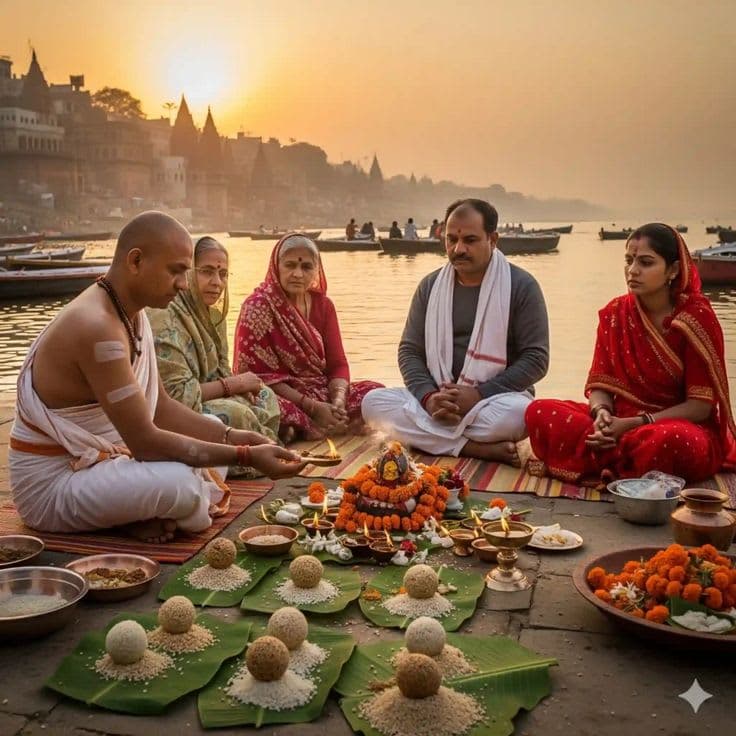
It helps to understand, before you arrive, what the two days actually hold - because a well-prepared family performs the rites with a settled mind rather than a hurried one. The ritual proper is performed on Day 2, in the early morning, across the three principal sites in their correct order: the tarpan and first offerings at the Phalgu, the central pind offering at the Vishnupad, and the closing rites and Brahman Bhoj beneath the Akshayavat. The whole sequence, performed with an experienced Pandit Ji, typically runs through the morning, which is why Day 1 is kept for arrival and preparation and the rites begin at six.
The Pandit Ji is central, and worth a word. Gaya's hereditary priests, the Gayawals, have performed these rites for families for generations, and the one assigned to you prepares the sankalp - the formal statement of intention - around your gotra and the names of the ancestors for whom you offer. This is why we ask you, gently, to come knowing your gotra and those names; if a family is unsure, the Pandit Ji helps work out the correct form. The pujan samagri - barley flour, sesame, honey, kush grass and the rest - is coordinated so that you arrive to find it ready and carry almost nothing yourself.
The order itself carries meaning, and the Pandit Ji holds you to it. The ancestors are first invoked and offered water at the Phalgu; they are then brought, in a sense, to the feet of Vishnu at the temple for the central offering; and the rite is sealed beneath the Akshayavat, where the banyan's inexhaustible shade stands for offerings whose merit never runs out. The Brahman Bhoj that closes the morning - feeding the priests and offering dakshina - is not an afterthought but part of the rite itself, the moment the giving is completed and the blessing returned to the family. Performed in this sequence, unhurried, the whole thing has a quiet rhythm that carries you, even if you arrive knowing none of it.
A few honest practicalities matter. The full traditional Gaya Shraddha, in its longest form, can run to many days across dozens of sacred altars; this two-day package covers the essential core at the three principal sites, which fulfils the central rites for the great majority of families, and we will happily arrange the extended ritual and extra days for a family whose tradition calls for it. The dakshina to the priests and the Brahman Bhoj are given directly by you, kept separate from the package price so that this most personal part is decided with a clear heart. Dress is simple and modest, suitable for riverbank rituals. And the timing of your visit is worth thinking about: Pitru Paksha, the sixteen-day fortnight in September and October, is the most traditional and auspicious window, but also the most crowded - the rest of the year offers the same devotion in a calmer setting. We advise honestly either way. WhatsApp +91-7302265809.