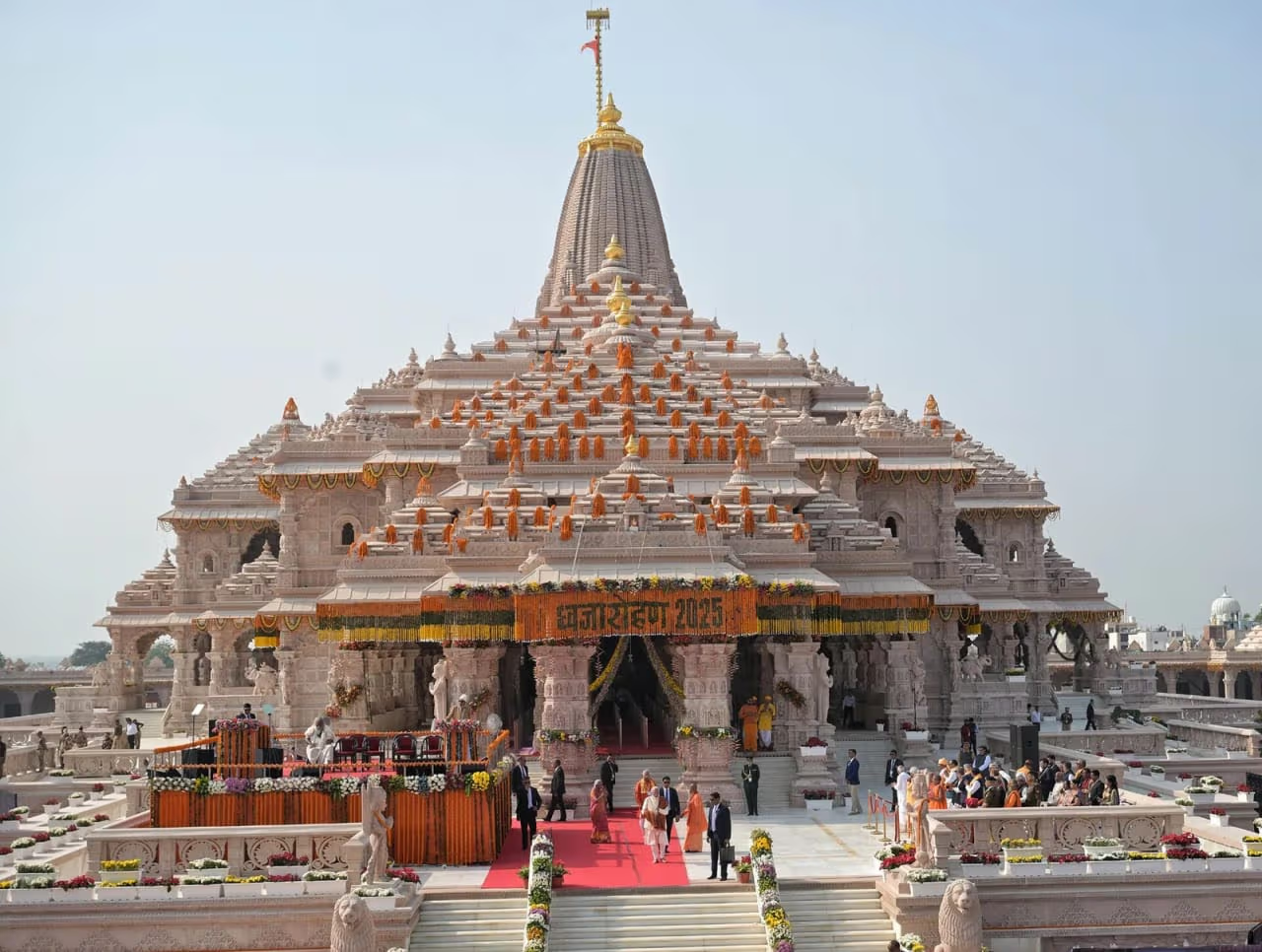
Of all the marvels of the new Ram Mandir, none has captured the imagination like the Surya Tilak - and for Ram Navami, it is the reason to be in Ayodhya rather than anywhere else. To understand why it moves people so, you need to know both what it is and what it means.
What it is, first, is a genuine feat of engineering. Scientists from the CSIR Central Building Research Institute at Roorkee and the Indian Institute of Astrophysics designed an optomechanical system - a precise arrangement of mirrors, lenses and brass tubing set into the temple - that catches the sunlight at the crown of the shikhara at exactly noon on Ram Navami and bends it, through the structure, down onto the forehead of the Ram Lalla idol in the sanctum. For a few minutes, a round tilak of pure sunlight rests on the deity's brow. The date and the moment are calculated afresh each year, because Ram Navami moves with the lunar calendar while the sun keeps solar time; the instrument is adjusted so the two meet.
And what it means is older than any instrument. Lord Rama is Suryavanshi - born of the Solar Dynasty, a descendant of Surya, the sun god himself. For the sun to descend, at the very noon of Rama's birth, and place its own light as a tilak upon his forehead, is for the ancestor to bless the descendant, the source of light to crown the one born of its line. Ancient symbolism and modern science meet in a single beam. There is nothing else quite like it in any temple in the world.
It is a young tradition, and that is part of its wonder. The first Surya Tilak was performed only in 2024, the first Ram Navami after the new temple was consecrated, and it was refined again the next year as the engineers tuned the mirrors and widened the beam. In a very few years it has become the single image the whole country associates with Ram Navami in Ayodhya - the round coin of sunlight resting on the dark stone of the idol's brow, broadcast to screens across the city and across India. To be present for it, rather than watching from home, is to stand inside the making of a tradition that will be kept for centuries to come.
One honest word on seeing it. At the moment of the Tilak the temple sanctum is, understandably, among the most restricted places in India - only a handful can be physically present. The vast majority of devotees, including those on every package, watch the Surya Tilak live on the large LED screens erected across Ram Ki Paidi and the ghats, where the beam is shown in close-up as it lands. It is a shared, roaring, joyful moment with tens of thousands around you, and Experience My India positions you where you can see the screens well. We tell you this plainly so you come knowing exactly what the day holds. Jai Shri Ram.