.webp&w=2048&q=75)
.webp&w=2048&q=75)
Essential info at a glance
| Detail | At a glance |
|---|---|
| Opening hours | The temple is open daily from 4:30 AM to 12:00 PM and from 3:00 PM to 10:30 PM, extending until midnight on Tuesdays and Saturdays. |
| Afternoon closing | The temple closes for the deity's rest from 12:00 PM to 3:00 PM, when the sanctum curtains are drawn. |
| Aartis | Pratah aarti 4:30 to 5:00 AM, Sandhya aarti 8:00 to 9:00 PM, and Ratri aarti around 10:00 PM, with extra night aartis at 9:30 PM, 10:30 PM and midnight on Tuesdays and Saturdays. |
| Entry fee | Entry is free for all devotees, and the temple is open to non-Hindus and foreign visitors. |
| Prasad | The famous offering is besan laddu, Hanuman's favourite, bought from authorised counters inside. |
| Not allowed inside | Mobile phones, cameras, smartwatches, bags and footwear are not allowed inside; deposit them in the lockers at the gate. |
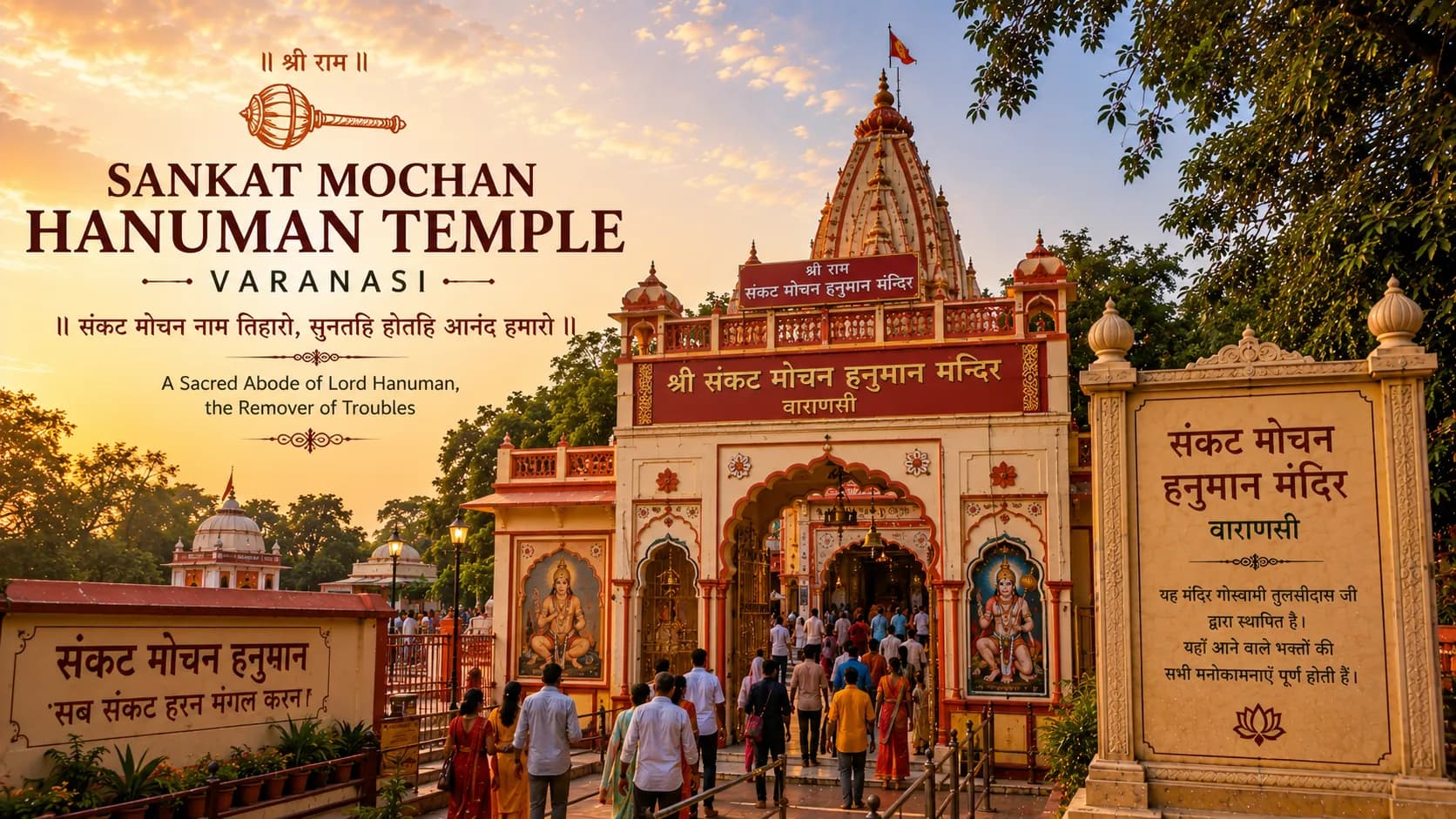
| Founded by | Goswami Tulsidas in the early 16th century, at the spot where he is said to have had a vision of Hanuman. |
| Location | Sankat Mochan Road, Saket Nagar, Nagwa Lanka, Varanasi 221005, about 5 km from Kashi Vishwanath and 3 km from BHU. |
Sankat Mochan temple timings in full
The temple opens before dawn and runs late into the night, but it closes for a few hours in the middle of the day so the deity can rest. If you arrive at midday, the sanctum curtains will be drawn and there will be no priest to receive your offering, though the courtyard stays open. Plan around the windows below.
| Session | Timing | Notes |
|---|---|---|
| Morning darshan | 4:30 AM to 12:00 PM | Opens with the Pratah aarti. The calmest darshan of the day, especially before 8 AM. |
| Afternoon closing | 12:00 PM to 3:00 PM | The temple closes for the deity's rest. The sanctum is curtained; the courtyard stays open. |
| Evening darshan (regular days) | 3:00 PM to 10:30 PM | Reopens in the afternoon and closes around 10:30 PM after the night prayers. |
| Extended days (Tuesday and Saturday) | 3:00 PM to midnight | On Hanuman's days the temple stays open later, with extra night aartis and heavy crowds. |
Aarti schedule at Sankat Mochan
The aartis are the heart of a visit here, and the Sandhya aarti in particular draws a devoted evening crowd. On Tuesdays and Saturdays the temple adds special night aartis that carry the worship through to midnight.
| Aarti | Timing | Notes |
|---|---|---|
| Pratah (morning) aarti | 4:30 AM to 5:00 AM | Marks the opening of the temple doors for the day. |
| Sandhya (evening) aarti | 8:00 PM to 9:00 PM | The most popular aarti, with bhajans and the Hanuman Chalisa. |
| Ratri (night) aarti | Around 10:00 PM | The final prayers before the temple closes on regular days. |
| Special Tuesday and Saturday night aartis | 9:30 PM, 10:30 PM and midnight | Additional aartis on Hanuman's auspicious days, when the temple stays open late. |
Tuesday and Saturday: Hanuman's days at Sankat Mochan
If you can choose, know what you are choosing. Tuesdays and Saturdays are the days traditionally dedicated to Hanuman, and at Sankat Mochan the crowd doubles. Thousands of devotees queue to recite the Hanuman Chalisa, offer besan laddu and marigold garlands, and sit in the courtyard chanting. In Vedic astrology, Hanuman is believed to shield devotees from the harsh effects of Shani, Saturn, and Mangal, Mars, so people with an ill placed Saturn in their horoscope come especially on these days for relief.
The trade off is simple. A Tuesday or Saturday evening gives you the temple at its most alive, the chanting, the bells, the packed courtyard, the extra night aartis running to midnight. A weekday morning gives you a calm, unhurried darshan. Neither is wrong; they are different experiences, and we help you pick the one that matches what you came for.
Security is also tightest on these days, so expect a thorough check and longer queues. Coming with someone who knows the gates and the timing turns a two hour scramble into a smooth visit.
How to plan a smooth darshan, in a few steps
-
Leave your phone, camera, smartwatch, bag and footwear in the car or the gate lockers before you approach the entrance, because none of these are allowed inside.
-
Enter through the main gate, where most autos and cabs drop you, and pass through the security check.
-
Buy besan laddu and a marigold garland from the authorised counters inside, not from pushy sellers outside.
-
Join the darshan queue for the sanctum, where the red sindoor idol of Hanuman faces Lord Rama.
-
Afterwards, sit in the courtyard for the Hanuman Chalisa if you have time, and keep an eye on the monkeys.
A visit at Sandhya aarti, in my own words
By Rajeev Sharma, Varanasi local
Sankat Mochan is where I take people when the intensity of the old city and the Kashi Vishwanath queue has worn them down. It sits to the south, out toward BHU, wrapped in greenery, and the moment you step into the courtyard the pace of Banaras drops. I always tell guests to leave their phones and anything loose in the car, not only because the rules require it, but because the monkeys here are quick and completely unbothered by you, and a phone or a pair of sunglasses can vanish in a second.
We time it for the Sandhya aarti, around 8 in the evening. The idol is red with sindoor, garlanded with marigold, and it faces Rama, the way Hanuman always chose to face his lord. As the bells start and the Hanuman Chalisa rises from a courtyard full of people, even first time visitors who did not grow up with any of this go quiet. On the way out we buy the besan laddu, the prasad this temple is famous for, and more than one of my guests over the years has told me it was the best sweet they ate in India.
In more than forty years of bringing travellers here, the thing I notice is that people arrive with something weighing on them, and they leave lighter. Sankat Mochan means the one who removes troubles, and the place lives up to its name.
Rules, prasad, and what to carry
This temple takes entry seriously, in part because of a security upgrade some years ago, so the check is real and the list of what you cannot bring in is longer than at most temples. Knowing it in advance saves you a return trip to the car.
Not allowed inside
- Mobile phones, cameras and smartwatches; photography is not permitted inside the temple premises.
- Bags and electronics, which must be deposited in the lockers at the gate.
- Footwear, left at the shoe counter or in the car.
Dress and conduct
- Dress modestly; cover shoulders and knees and avoid revealing clothing.
- Keep your voice low inside the prayer hall and do not disturb others who are chanting.
- Foreign visitors are welcome, but may be asked to show a passport at security.
Prasad and the monkeys
- Buy besan laddu, bananas, sindoor and marigold garlands from the authorised counters inside, not from touts outside.
- Do not carry open food or prasad in the open, and do not feed or tease the monkeys; keep glasses and small items secured.
What to carry
- A little cash for prasad and the locker or shoe stand donation, and a valid ID or passport.
- Water in summer, and as little else as possible so you clear security quickly.
How to reach Sankat Mochan Temple and parking
The temple stands in the Nagwa Lanka area in the south of Varanasi, near Banaras Hindu University and the Assi end of the ghats, which makes it easy to pair with that cluster.
| By | Distance | Notes |
|---|---|---|
| From Kashi Vishwanath | About 5 km | An easy add on to your main Kashi darshan, best done as one planned route. |
| From BHU | About 3 km | Very close to Banaras Hindu University and the New Vishwanath Temple on campus. |
| From Varanasi Cantt station | About 11 km | Autos, taxis and app cabs run throughout the city. |
| From the airport | About 25 km | Lal Bahadur Shastri International Airport, roughly an hour by road. |
There are three gates, and most autos and cabs drop you at the newer grand main entrance. Parking near the temple is reasonably spacious compared with the old city. We arrange a car and a guide so you are dropped at the right gate and collected without the usual haggling.
Best time to visit and how to avoid the crowds
| When | Crowds | Best for |
|---|---|---|
| October to March | Comfortable | Pleasant weather and calm darshan; the ideal season. |
| Tuesday and Saturday | Very heavy | The temple at its most alive, with extra night aartis to midnight. |
| Hanuman Jayanti and festivals | Extremely heavy | The grandest atmosphere, not a quick darshan. |
| Weekday mornings | Lightest | The quietest, most unhurried visit. |
- Quietest window: a weekday morning before 8 AM, soon after the Pratah aarti.
- Most atmospheric: the Sandhya aarti around 8 PM, and the Tuesday and Saturday night aartis.
- Avoid the 12:00 PM to 3:00 PM closing, when the sanctum is curtained.
Because the temple sits near BHU and Assi, the natural plan is to make it part of the southern temple cluster in one calm morning or evening, alongside Durga Kund and Tulsi Manas Mandir, and to combine it with the Assi Ghat sunrise or the evening on the river. See our Varanasi tour packages for how we sequence it.
The Tulsidas story, the idol, and why Sankat Mochan matters
Sankat Mochan means the one who removes troubles, and that is exactly what devotees come here for. The temple was founded in the early 16th century by Goswami Tulsidas, the saint poet who composed the Ramcharitmanas and the Hanuman Chalisa, at the very spot where he is said to have had a vision of Hanuman. That single fact gives the temple a weight few others carry, because the man who wrote the hymn recited by millions built this place after meeting, in his telling, the deity himself.
| History at a glance | Detail |
|---|---|
| Founded by | Goswami Tulsidas in the early 16th century, author of the Ramcharitmanas and the Hanuman Chalisa. |
| The legend | Built at the spot where Tulsidas is said to have had a vision of Hanuman. |
| The idol | The red, sindoor covered idol of Hanuman faces Lord Rama, whom he served with total devotion. |
| The name | Sankat Mochan, the reliever of all troubles, problems and pain. |
| Later development | The premises were extended around 1900 by Pandit Madan Mohan Malaviya, giving the temple its present form. |
| Astrological role | Widely visited on Tuesdays and Saturdays for relief from the effects of Shani and Mangal. |
The temple itself is simple, in the North Indian style, with a courtyard, small shrines, and a green setting near the old course of the Assi. It is the second most visited temple in Varanasi after Kashi Vishwanath, and it also runs charitable work, free meals, and medical camps, which is part of why locals hold it so close.
The Sankat Mochan Sangeet Samaroh
Once a year the temple becomes a stage. The Sankat Mochan Sangeet Samaroh is a classical music and dance festival, held annually in April, that draws some of the biggest names in Indian classical music to perform through the night as an offering to Hanuman. It is one of the oldest and most respected music festivals in the country, and it turns the temple courtyard into something extraordinary, devotion and art in the same breath.
If your visit can line up with it, it is worth planning around, though the crowds and the atmosphere are intense. If you would like us to check the festival dates for your travel window and arrange your visit accordingly, we are happy to.
Accessibility for elderly and mobility limited visitors
- The temple is largely at ground level with an open courtyard, gentler than the steep lanes around Kashi Vishwanath.
- Parking is reasonably spacious, so the walk from the car to the gate is short.
- Avoid the Tuesday and Saturday crush if mobility is a concern; a weekday morning is far easier.
- We arrange a car to the main gate, help with the lockers, and plan the route so a senior visitor is comfortable.
Nearby sacred sites to combine with your darshan
Sankat Mochan sits at the heart of the southern temple cluster, so it is easy to see several important sites in one calm outing.
| Site | What it is | Internal link |
|---|---|---|
| Durga Kund (Durga Mandir) | The striking red temple to the goddess Durga, a short distance away. | /varanasi/durga-kund |
| Tulsi Manas Mandir | The marble temple linked to Tulsidas and the Ramcharitmanas, right next door. | /varanasi/tulsi-manas-mandir |
| New Vishwanath Temple (BHU) | The modern Shiva temple on the Banaras Hindu University campus. | /varanasi/new-vishwanath-temple-bhu |
| Assi Ghat | The southern ghat, famous for the sunrise Subah-e-Banaras and evening aarti. | /varanasi/assi-ghat |
| Kashi Vishwanath Temple | The Jyotirlinga at the heart of Kashi, about 5 km north. | /varanasi/kashi-vishwanath-temple |
For the full northern pilgrimage beyond the city, see the combined Kashi, Ayodhya and Prayagraj circuit, and to add the river, our evening Ganga aarti experience.
Safety and common scams to know before you go
Sankat Mochan is a calm, well run temple, but two things catch visitors out: the monkeys and the sellers outside. After a security upgrade some years ago, the temple also runs a thorough check, which is why phones and bags stay in the lockers.
| Watch out for | How to stay safe |
|---|---|
| The monkeys, which will grab glasses, phones and open prasad. | Keep small items secured, do not carry open food, and never tease or feed them. |
| Pushy flower and prasad sellers outside the gate. | Buy besan laddu and garlands only from the authorised counters inside. |
| Self appointed guides or priests demanding a fee. | Agree nothing on the spot; a booked guide removes the pressure entirely. |
| Inflated auto fares from the station or ghats. | Fix the fare before you set off, or travel with an arranged car. |
Our guided visit removes the guesswork, gets you to the right gate, and lets you focus on the darshan rather than the hustle.
Our guided Varanasi visits including Sankat Mochan
We are a Varanasi based operator, a unit of Experience My India, with more than forty years of guiding pilgrims across Kashi, Ayodhya, and Prayagraj. Entry to Sankat Mochan is free, so what we arrange is the visit around it: transport to a temple that sits away from the centre, a local guide, and a smooth route through the southern cluster.
| Package | Includes | Price |
|---|---|---|
| Southern temple cluster half day | Car, a Varanasi local guide, and darshan at Sankat Mochan, Durga Kund and Tulsi Manas Mandir. | Contact us for pricing |
| Sankat Mochan with Assi Ghat | The temple paired with the Assi Ghat sunrise or evening on the river. | Contact us for pricing |
| Full Kashi darshan day | Kashi Vishwanath, the corridor, Sankat Mochan, and the evening Ganga aarti. | Contact us for pricing |
| Full pilgrimage circuit | Multi day, combining Varanasi with Ayodhya and Prayagraj. | Contact us for pricing |
Inclusions and exclusions are stated up front, with any taxes and conditions, and no charge appears later that was not named.
Experience My India is a travel operator, not the temple administration. Prices are ours. Temple timings and rules are set by the temple trust and can change.