.webp&w=2048&q=75)
.webp&w=2048&q=75)
Essential info at a glance
| Detail | At a glance |
|---|---|
| Opening hours | Tulsi Manas Mandir is open daily from 5:30 AM to 12:00 PM and from 3:30 PM to 9:00 PM. |
| Midday closing | The temple closes from 12:00 PM to 3:30 PM, so plan your visit for the morning or the evening. |
| Aartis | The morning aarti is at 6:00 AM and the evening aarti is at 4:00 PM. |
| Entry fee | Entry is free. A small separate fee applies for the animated Ramayana display on the upper floor. |
| Dedicated to | Lord Rama, Goddess Sita, Lakshmana and Lord Hanuman, with shrines to Shiva, Annapurna and Satyanarayan. |
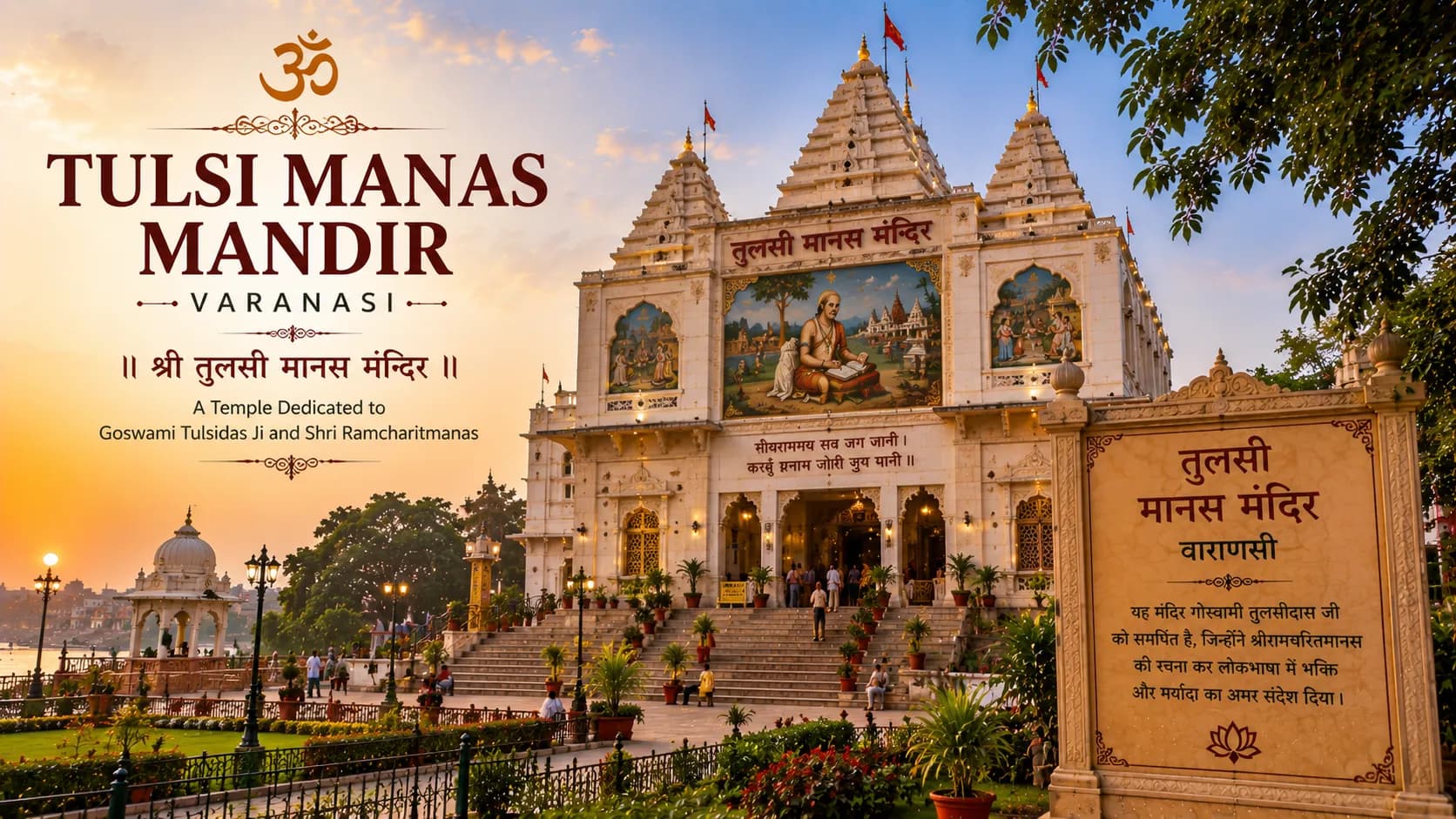
| Built | In 1964 by the Sureka family, on the site where Tulsidas is believed to have composed the Ramcharitmanas. |
| Highlight | The entire Ramcharitmanas is inscribed on the white marble walls, and the upper floor has an animated Ramayana display and a library. |
| Location | Near Durga Kund, about 250 metres south of the Durga temple and 700 metres northeast of Sankat Mochan. |
Tulsi Manas Mandir timings and darshan
Unlike the busy sanctums of Kashi, Tulsi Manas is a calm, spacious marble temple set in gardens, so a visit here is unhurried. It keeps a morning and an evening session and closes through the middle of the day, so time your visit to either side of the afternoon break.
| Session | Timing | Notes |
|---|---|---|
| Morning darshan | 5:30 AM to 12:00 PM | Cool, quiet and best for reading the wall inscriptions in good light. |
| Midday closing | 12:00 PM to 3:30 PM | The temple is closed; plan around this gap. |
| Evening darshan | 3:30 PM to 9:00 PM | Pleasant in the gardens; the evening aarti falls early in this window. |
Aarti times at Tulsi Manas Mandir
| Aarti | Timing | Notes |
|---|---|---|
| Morning aarti | 6:00 AM | Soon after the temple opens, a calm start to the day. |
| Evening aarti | 4:00 PM | Early in the evening session, before the temple fills. |
What to see inside Tulsi Manas Mandir
This is a temple you read as much as you pray in. Give it more time than its size suggests, because the detail is the whole point.
| Feature | What to look for |
|---|---|
| The inscribed marble walls | The complete Ramcharitmanas, its chaupais, dohas, chhandas and sorathas, carved into the white marble, so the whole building reads as living scripture. |
| The main shrines | Rama, Sita, Lakshmana and Hanuman in the centre, with Shiva and Annapurna on one side and Satyanarayan on the other. |
| The upper floor | A statue of Tulsidas, a library of rare Ramayana editions in many languages, and scenes from the Ramayana and the Mahabharata. |
| The animated Ramayana display | Electrically operated, brightly dressed moving figures acting out scenes from the Ramayana, a small extra fee, a favourite with children and rural visitors. |
| The gardens and pond | Landscaped grounds and a pond with four ghats, each bank carrying a statue from the epics, with Shiva to the east and Tulsidas writing to the west. |
A quiet hour at Tulsi Manas, in my own words
By Rajeev Sharma, Varanasi local
After the crush of Kashi Vishwanath and the packed courtyard of Sankat Mochan, Tulsi Manas is where I bring people to breathe. It is a modern temple by Banaras standards, white marble set in a garden, and the first thing I do is slow my guests down and point at the walls. The entire Ramcharitmanas is carved there. I tell them that the man believed to have composed this epic, right on this spot, wrote it not in Sanskrit but in Awadhi, the language of ordinary people, so that a farmer and a king could hear the same story of Rama. Once you know that, the plain marble stops looking plain.
Upstairs I take them to the moving figures, the little animated Ramayana that runs for a small fee. Grand it is not, but I have watched serious, tired travellers stand in front of it and smile like children, and the village families who come here love it most of all. Then we sit for a while by the pond in the garden, where the noise of the city cannot reach, before heading the short distance to Durga Kund or Sankat Mochan.
In more than forty years of guiding here, I have learned that Tulsi Manas is the temple people underestimate on the way in and remember on the way out. It rewards the visitor who reads it.
Rules, dress, and what to carry
Dress and conduct
- Dress modestly, covering shoulders and knees, as at any temple.
- Footwear comes off at the entrance; leave it at the counter or in the car.
- Keep your voice low inside, especially near the shrines and the reading areas.
Photography
- Photography is generally allowed in the gardens and grounds, which are very photogenic, but check for any signs near the sanctum and avoid flash during aarti.
What to carry
- A little cash for the animated display fee and any offering.
- Water in summer, and comfortable footwear that slips on and off.
How to reach Tulsi Manas Mandir and parking
The temple sits in the Durgakund and Naria area in the south of Varanasi, in the same cluster as Durga Kund and Sankat Mochan, which makes it very easy to combine the three.
| From | Distance | Notes |
|---|---|---|
| Durga Kund | About 250 metres | A two minute walk south; the two are almost neighbours. |
| Sankat Mochan Mandir | About 700 metres | A short walk or hop to the northeast. |
| Kashi Vishwanath | About 5 km | An easy add on to your main Kashi darshan. |
| Varanasi Cantt station | About 11 km | Autos, taxis and app cabs run throughout the city. |
| Airport | About 27 km | Lal Bahadur Shastri International Airport, roughly an hour by road. |
Parking is easier here than in the old city, and most cabs and autos drop you close to the gate. We arrange a car and a guide so the southern cluster flows as one smooth outing rather than three separate trips.
Best time to visit and how to plan it
| When | Why |
|---|---|
| October to March | Pleasant weather; ideal for the gardens and the wall inscriptions. |
| Early morning or late afternoon | Cooler light and fewer people; avoid the harsh midday even aside from the closing. |
| Ram Navami and Janmashtami | The temple is at its most festive, though busier than usual. |
| Avoid 12:00 PM to 3:30 PM | The temple is closed for the midday break. |
- Give yourself at least 30 to 45 minutes, more if you want to read the walls and see the upper floor.
- Pair it with Durga Kund next door and Sankat Mochan a short distance away for one calm morning or evening.
For the full southern cluster planned as a single outing, see our Varanasi tour packages.
The Ramcharitmanas story and why Tulsi Manas matters
The heart of this temple is a book. In the 16th century, the poet saint Goswami Tulsidas composed the Ramcharitmanas, his retelling of the Ramayana, in Awadhi rather than the classical Sanskrit of Valmiki's original. That choice mattered enormously, because it put the story of Rama into a language ordinary people could sing and understand, and it shaped the devotion of northern India for centuries. Tulsi Manas Mandir is built on the site where Tulsidas is believed to have composed the epic, which is why the whole temple is given over to the text itself.
| History at a glance | Detail |
|---|---|
| The connection | Built on the site where Tulsidas is believed to have composed the Ramcharitmanas. |
| Built | In 1964 by the Sureka family of Howrah, West Bengal, on the former Bhinga Raj garden. |
| Inaugurated by | Dr Sarvepalli Radhakrishnan, then President of India. |
| Material and style | White marble, in the North Indian shikhara style, set in landscaped gardens. |
| Dedicated to | Lord Rama, with Sita, Lakshmana and Hanuman, and shrines to Shiva, Annapurna and Satyanarayan. |
| Signature feature | The complete Ramcharitmanas inscribed across the marble walls. |
The temple is modern by the standards of Kashi, and it does not try to overwhelm. Its importance lies in its simplicity and in what it holds: a whole epic turned into a building, in the place where that epic is believed to have been born.
The animated Ramayana displays and the library
Two features set Tulsi Manas apart from every other temple in the city. The first is the animated display in the back passage of the upper floor, where electrically operated, three dimensional figures in bright costume act out scenes from the Ramayana that many visitors know by heart. It runs for a small separate fee, and it delights children and the village families who travel in from around Banaras. It is not high art, but it is pure, warm devotion, and it is one of the few places in Varanasi where the epic is shown rather than only recited.
The second is the library on the upper floor, where rare editions and translations of the Ramayana are kept in glass cases, alongside a statue of Tulsidas himself. For anyone interested in the text and its journey across languages, it is a quiet treasure, and it is exactly the kind of detail that makes this temple reward a slower visit.
Festivals at Tulsi Manas Mandir
Being a Rama temple built around the Ramcharitmanas, Tulsi Manas comes alive on the festivals tied to Rama and to the epics. Ram Navami, the birth of Rama, is the biggest, with recitations and a festive crowd. Krishna Janmashtami and the Annakoot or Annapurna puja are also marked here with devotion. On these days the temple is busier and more atmospheric, so plan a little extra time and expect larger crowds.
Accessibility for elderly and mobility limited visitors
- The temple and gardens are largely at ground level and far easier to move around than the old city lanes.
- Parking is close to the gate, so the walk is short.
- The animated display and library are on the upper floor, reached by stairs, which may not suit everyone.
- We arrange a car to the gate and plan the southern cluster so a senior visitor is comfortable throughout.
Nearby sacred sites to combine with your visit
Tulsi Manas sits at the centre of the southern temple cluster, so it is easy to see several sites in one calm outing.
| Site | What it is | Internal link |
|---|---|---|
| Durga Kund (Durga Mandir) | The striking red temple to the goddess Durga, about 250 metres away. | /varanasi/durga-kund |
| Sankat Mochan Hanuman Temple | The Hanuman temple founded by Tulsidas, a short distance to the southwest. | /varanasi/sankat-mochan-hanuman-temple |
| New Vishwanath Temple (BHU) | The modern Shiva temple on the Banaras Hindu University campus. | /varanasi/new-vishwanath-temple-bhu |
| Assi Ghat | The southern ghat, famous for the sunrise Subah-e-Banaras and evening aarti. | /varanasi/assi-ghat |
| Kashi Vishwanath Temple | The Jyotirlinga at the heart of Kashi, about 5 km north. | /varanasi/kashi-vishwanath-temple |
To add the river to your day, see our evening Ganga aarti experience.
Practical tips and things to know
Tulsi Manas is one of the easier, calmer temples to visit, but a few small things help.
| Watch out for | How to handle it |
|---|---|
| The midday closing, 12:00 PM to 3:30 PM. | Come in the morning or the late afternoon so you do not find it shut. |
| Monkeys around the wider Durgakund area. | Keep glasses, phones and open food secured, as you would near Durga Kund. |
| Pushy sellers outside temples nearby. | Buy any offering from proper stalls and agree prices first. |
| The animated display fee. | Carry a little change; the fee is small and separate from the free temple entry. |
Our guided Varanasi visits including Tulsi Manas
We are a Varanasi based operator, a unit of Experience My India, with more than forty years of guiding pilgrims across Kashi, Ayodhya, and Prayagraj. Entry to Tulsi Manas is free, so what we arrange is the visit around it: transport, a local guide who brings the Ramcharitmanas walls to life, and a smooth route through the southern cluster.
| Package | Includes | Price |
|---|---|---|
| Southern temple cluster half day | Car, a Varanasi local guide, and darshan at Tulsi Manas, Durga Kund and Sankat Mochan. | Contact us for pricing |
| Tulsi Manas with Assi Ghat | The temple paired with the Assi Ghat sunrise or evening on the river. | Contact us for pricing |
| Full Kashi darshan day | Kashi Vishwanath, the corridor, the southern cluster, and the evening Ganga aarti. | Contact us for pricing |
Inclusions and exclusions are stated up front, with any taxes and conditions, and no charge appears later that was not named.
Experience My India is a travel operator, not the temple administration. Prices are ours. Temple timings and rules are set by the temple and can change.