Essential info at a glance
| Detail | At a glance |
|---|---|
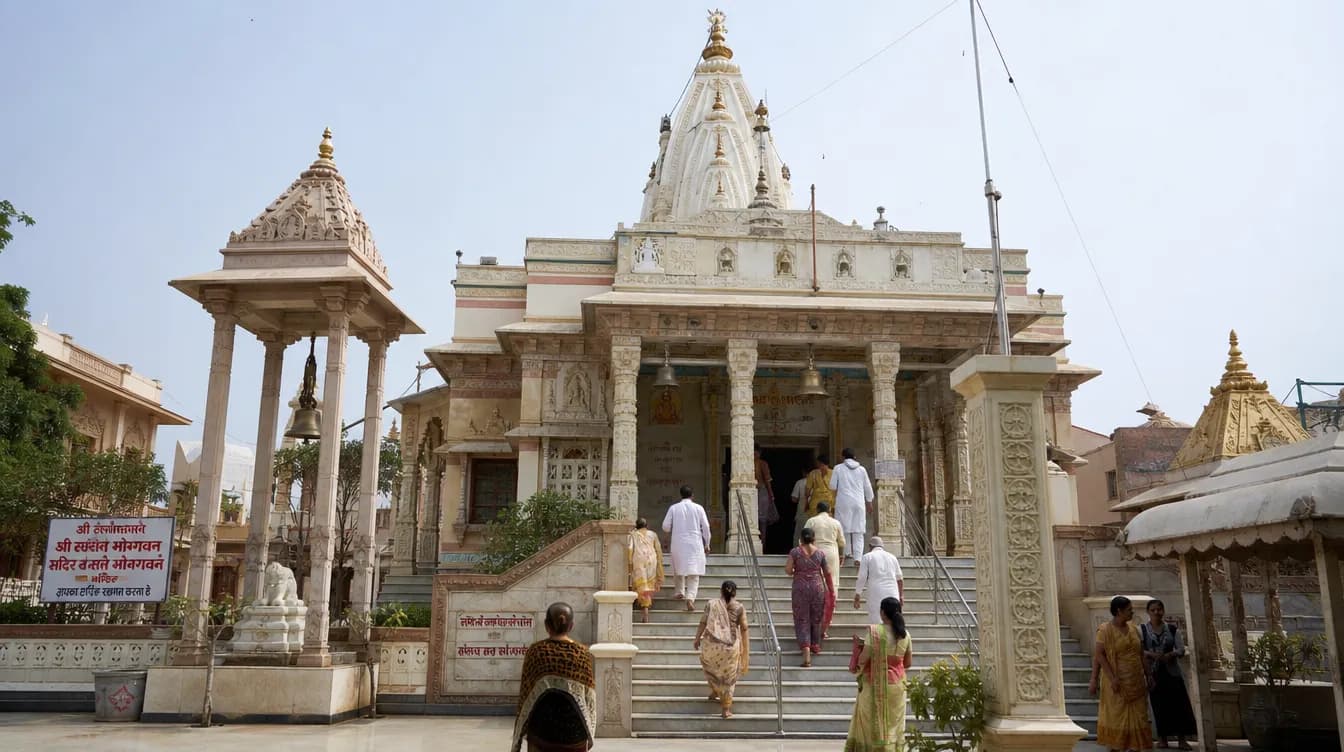
| What it is | A Digambar Jain temple with a magnificent 31-foot statue of Bhagwan Rishabhdev (Adinath), the first Tirthankara. |
| Opening hours | Typically 6:00 AM to 8:00 PM daily. |
| Entry fee | Free. There is no VIP darshan. |
| Rituals | Morning abhishek and pujan around 6:30 to 7:00 AM, and evening aarti around sunset. |
| The great fact | Ayodhya is revered by Jains as the birthplace of the first Tirthankara, Rishabhdev, and four others. |
| The Badi Murti | The towering 31-foot standing marble statue of Adinath, a landmark of the city. |
| Shared heritage | Rishabhdev founded the Ikshvaku dynasty, the very line of Lord Ram. |
| Location | Badi Murti, Raiganj, Ayodhya. |
Rishabhdev Jain Mandir timings and rituals
The temple is generally open from 6:00 AM to 8:00 PM, and entry is free. Its worship follows the beautiful traditions of the Digambar Jain faith: the morning begins early, around 6:30 to 7:00 AM, with the abhishek, the ceremonial bathing of the Tirthankara, and the pujan, and there is worship again around sunset in the evening. It is a peaceful, uncrowded, and deeply serene temple, so darshan of the great statue is calm and unhurried.
| Detail | When | Notes |
|---|---|---|
| Opening hours | 6:00 AM to 8:00 PM | Open daily; free. |
| Morning abhishek and pujan | Around 6:30 to 7:00 AM | The ceremonial worship of Rishabhdev. |
| Evening worship | Around sunset, near 7:00 PM | The evening rituals. |
| Entry fee | Free | No VIP or paid darshan. |
The Badi Murti: the great statue of Rishabhdev
The temple takes its popular name, the Badi Murti, the great statue, from its magnificent centrepiece: a towering standing image of Bhagwan Rishabhdev, the first Tirthankara, some thirty-one feet high, carved in gleaming white marble. It rises, serene and majestic, in the tranquil, unclad dignity of the Digambar tradition, its calm face the very image of spiritual awakening and inner peace, and it is one of the tallest and most beautiful statues of Adinath anywhere. This grand murti was established in the year 1965, at the inspiration of the revered Acharya Deshbhushanji, to honour Ayodhya as the birthplace of the Lord, and the sacred site around it has since been lovingly developed. To stand before this great, calm figure is a deeply moving darshan, and it draws Jain pilgrims from across India and the world.
Ayodhya, the birthplace of the first Tirthankara
Ayodhya is known to the world as the city of Lord Ram, but it holds another, equal glory that far fewer know: it is one of the very holiest cities in all of Jainism. For Ayodhya is the birthplace of Bhagwan Rishabhdev, also called Adinath, the first of the twenty-four Tirthankaras, the great ford-maker who founded the Jain dharma itself, and who lived, tradition holds, in the remotest antiquity, long before the age of Ram. And not Rishabhdev alone: Ayodhya is revered as the birthplace of five Tirthankaras in all, for besides Adinath, the Lords Ajitnath, Abhinandannath, Sumatinath and Anantnath were also born in this sacred city. Indeed the Jain tradition counts some eighteen of the great Kalyanaks, the auspicious life-events of these Tirthankaras, their conception, their birth, their renunciation, as having taken place upon this one holy ground, a concentration of sanctity found almost nowhere else. So for a Jain, Ayodhya is a supreme tirtha, a place of pilgrimage of the first rank, the very cradle of the faith; and this temple, with its great statue of the first Tirthankara, is its heart.
Bhagwan Rishabhdev, Adinath, the first Tirthankara
The Lord this temple honours is one of the most towering figures in all of Indian spirituality. Bhagwan Rishabhdev, Adinath, the First Lord, was the first of the Tirthankaras and the founder of the Jain path. Born here in Ayodhya, tradition tells, to King Nabhi and Queen Marudevi, he was, before he renounced the world, the first great king of the age, and he is revered as the founder of the Ikshvaku dynasty. And he was, above all, the teacher of civilization itself: for it was Rishabhdev, the tradition holds, who taught struggling humanity the arts by which we live, agriculture and the working of the land, the crafts and the arts, commerce and governance, the seventy-two skills; and he taught these to his sons, chief among them Bharata and Bahubali, and his daughters Brahmi and Sundari. Then, having established the order of the world, he renounced all, became the first great ascetic, and, attaining supreme knowledge, showed humanity the path across the ocean of rebirth. His emblem is the bull, and to Jains he is the eternal first teacher, the Adinath, the beginning of the sacred tradition.
A city sacred to two faiths: the shared heritage of Ayodhya
There is something wonderful in the fact that Ayodhya is the birthplace both of Lord Ram, beloved of the Hindus, and of Bhagwan Rishabhdev, first Lord of the Jains; and the two are woven together more closely still. For Rishabhdev is revered as the founder of the very Ikshvaku dynasty, the Solar line, of which Lord Ram, ages later, was the most glorious descendant; so the same great royal lineage of Ayodhya is honoured by both faiths, its first ancestor a Jain Tirthankara and its later glory the Hindu Lord Ram. And there is a further, lovely echo: Rishabhdev's own son Bharata, the great Chakravarti emperor, is he after whom, tradition tells, our whole country is named Bharatavarsha, Bharat; while Ram's own devoted brother is also Bharata. Ayodhya, then, is a city of profound shared heritage, sacred to two of India's great faiths at once; and this bond reaches to Kashi too, for that other holy city is the birthplace of Bhagwan Parshvanatha, the twenty-third Tirthankara, so that Kashi and Ayodhya are joined as birthplaces of the Jain Lords as they are joined in so much else. To visit this temple is to feel the deep unity of India's spiritual heritage.
The Jain trail of Ayodhya
The Badi Murti temple is the grandest, but not the only, Jain sacred place of Ayodhya, and pilgrims may follow a whole Jain trail through the city. There is the ancient Katra Jain temple, some three centuries old, with its cherished old idols of Rishabhdev and other Tirthankaras; and there are the tonks, the small memorial shrines that mark the sacred sites of the Tirthankaras, including one of Anantnath by the bank of the Saryu, bearing his holy footprints, and others across the city. Together with the Badi Murti and its Samavasaran and Chaubeesee shrines, these make a rich pilgrimage of some ten Jain holy places, tracing the presence of the Tirthankaras through their eternal birthplace. We are glad to guide Jain pilgrims through the whole of this trail.
The cradle of the Jain faith, in my own words
By Rajeev Sharma, guide with Experience My India
I love bringing my guests to the Badi Murti, and I especially love welcoming Jain pilgrims here, because I get to honour a glory of Ayodhya that most people never hear about. I tell them: yes, this is Ram's city, but it is also the birthplace of Bhagwan Rishabhdev, the very first Tirthankara, the founder of the Jain faith, and of four more Tirthankaras besides. For a Jain, this is one of the holiest places on earth. And then I show them the great thirty-one-foot statue of Adinath, so calm and majestic, and I see my Jain guests overcome to stand before the first Lord in his own birthplace.
The thing I most love to tell everyone is the beautiful shared story: that Rishabhdev founded the Ikshvaku dynasty, the very same line that Ram was born into, so both faiths honour the same great royal house of Ayodhya; and that Rishabhdev's son Bharata is the one our whole country, Bharat, is named after. It shows people the deep unity of our traditions, all rooted in this one holy city. I take my Jain pilgrims through the whole trail, the Badi Murti, the old Katra temple, the tonks by the Saryu, and I always tell them that Kashi, my own city, is the birthplace of Parshvanath, so the two holy cities are joined for the Jains too. It is a profound, peaceful, majestic side of Ayodhya, and I never let a Jain pilgrim, or a lover of our shared heritage, miss it.
In more than forty years of guiding, this is the temple whose great statue and hidden glory most move the Jain pilgrims I bring.
What to see and do
- Behold the towering 31-foot marble statue of Bhagwan Rishabhdev (Adinath), the Badi Murti.
- Take darshan and, if you can, attend the morning abhishek and pujan of the first Tirthankara.
- Reflect on Ayodhya as the birthplace of Rishabhdev and five Tirthankaras, a supreme Jain tirtha.
- Follow the Jain trail, the ancient Katra temple and the tonks of the Tirthankaras by the Saryu.
- Feel the shared heritage of the Ikshvaku dynasty, honoured by both the Jain and Hindu faiths.
How to reach Rishabhdev Jain Mandir
The temple is at Badi Murti, in the Raiganj locality (Tarun Pura Road, New Colony) of Ayodhya, easily reached by road. It is a landmark of the area, its great statue visible from afar.
| From | Distance | Notes |
|---|---|---|
| The core temples (Ram Mandir, Hanuman Garhi) | A short ride | By auto or e-rickshaw. |
| Ayodhya Dham Junction (railway) | A short ride | By e-rickshaw, auto or taxi to Raiganj. |
| The Katra Jain temple and the tonks | In the city | The other Jain sites; do the Jain trail together. |
| Maharishi Valmiki Airport, Ayodhya | About 10 to 15 km | The new airport; taxis and autos to the city. |
It pairs naturally with the other Jain sites for a full Jain trail of Ayodhya.
Best time to visit and how to plan it
| When | Why |
|---|---|
| Morning, for the abhishek | The ceremonial bathing and worship of the Tirthankara, the loveliest darshan. |
| Rishabhdev's birth day (Chaitra Krishna Navami) | The Lord's birth anniversary, and the temple's annual fair. |
| Akshaya Tritiya | The great day linked to Rishabhdev, especially auspicious. |
| Paryushan and Das Lakshan | The great Jain festivals of penance and reflection. |
- Pair it with the Katra Jain temple, the tonks and, if you can, the Kashi Jain tirthas.
- Allow 30 to 45 minutes for the great statue and the temple; longer for the full Jain trail.
For Ayodhya, or a combined Kashi and Ayodhya pilgrimage, planned end to end, see our tour packages.
Etiquette for visiting
- This is a Jain temple; be respectful, keep your voice low, and follow any guidance.
- Remove footwear and any leather items before entering, and dress modestly.
- Do not carry food, and follow the temple's rules of purity, especially near the sanctum and during rituals.
- The Digambar tradition depicts the Tirthankara unclad, as a symbol of complete non-attachment; behold it with reverence.
Accessibility for elderly and mobility limited visitors
- The temple is reachable by road and generally well laid out; check on any steps to the sanctum.
- It is peaceful and uncrowded, which suits a slow, restful, direct darshan.
- The great statue can be seen and revered easily, even from the courtyard.
- We arrange transport and plan a gentle Jain-trail visit within your Ayodhya day.
Our guided visits and the Jain trail
We are a Varanasi and Ayodhya based operator, a unit of Experience My India, with more than forty years of guiding pilgrims across Kashi, Ayodhya, and Prayagraj. Entry and darshan are free, so what we offer is the story and the planning: a guide who tells the great, little-known story of Ayodhya as the birthplace of the first Tirthankara, and, for our Jain pilgrims, the whole Jain trail of the city, and the joining of the two Jain birthplace cities, Ayodhya and Kashi.
| Service | Includes | Price |
|---|---|---|
| Guided Ayodhya Jain trail | The Badi Murti, the Katra temple and the tonks of the Tirthankaras, with a guide. | Contact us for pricing |
| Guided Rishabhdev Mandir visit | The great statue, its story and the abhishek, with a guide. | Contact us for pricing |
| Kashi and Ayodhya Jain pilgrimage | The Jain tirthas of both cities, from Rishabhdev's Ayodhya to Parshvanath's Kashi. | Contact us for pricing |
| Full Ayodhya darshan day | The Jain Mandir within a wider Ayodhya visit, with a guide. | Contact us for pricing |
Inclusions and exclusions are stated up front, with any taxes and conditions, and no charge appears later that was not named. Darshan is free; our charge is only for guiding and services. See all our tour packages for the full range.
Experience My India is a travel operator, not the temple administration. Darshan is free; our charge is only for our guiding and services. Timings and rules are set by the temple and can change.
Nearby sacred sites in Ayodhya
The Rishabhdev Jain Mandir is at Raiganj, in the shared sacred city of Ayodhya.
| Site | What it is | Internal link |
|---|---|---|
| Shri Ram Janmabhoomi Mandir | The birthplace of Ram, of the Ikshvaku dynasty founded by Rishabhdev. | /temple/ayodhya/ram-janmabhoomi-mandir |
| Surajkund | The Sun pond of Ram's Suryavanshi (Ikshvaku) line, the shared dynasty. | /temple/ayodhya/surajkund |
| Hanuman Garhi | The guardian temple of Hanuman, in the core. | /temple/ayodhya/hanuman-garhi |
| Saryu Ghats and the aarti | The sacred river, by which the tonks of the Tirthankaras stand. | /temple/ayodhya/saryu-ghat-aarti |
| Kashi Jain tirthas (Varanasi) | The birthplace of Parshvanath, the 23rd Tirthankara, in Kashi. | /temple/varanasi/jain-temples |
For the Ram Mandir darshan and its free Sugam booking, see our Ram Janmabhoomi Mandir guide.