.webp&w=2048&q=75)
.webp&w=2048&q=75)
Essential info at a glance
| Detail | At a glance |
|---|---|
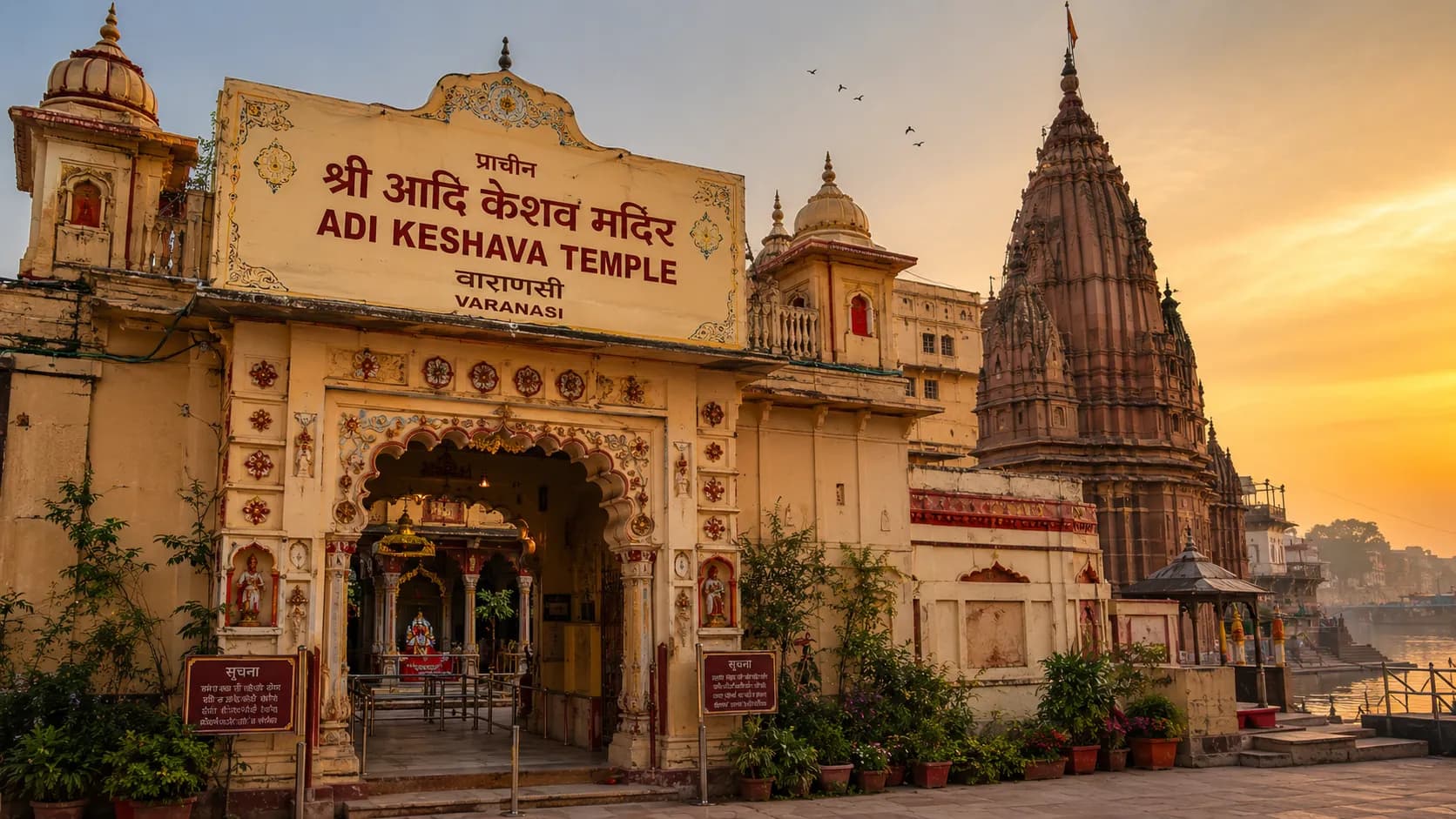
| What it is | The Adi Keshava temple, the first Vishnu of Kashi and one of its oldest shrines, at the Varuna and Ganga confluence. |
| Morning hours | 6:00 AM to 12:00 PM, with the morning aarti at 7:00 AM. |
| Afternoon close | 12:00 PM to 4:00 PM, when the temple closes for the deity's rest. |
| Evening hours | 4:00 PM to 10:00 PM, with the evening aarti at 8:00 PM. |
| Entry fee | Free for everyone. There is no VIP darshan or paid pass. |
| Why it matters | Where Lord Vishnu is said to have first set foot in Kashi, and the final stop of the Panchatirthi Yatra. |
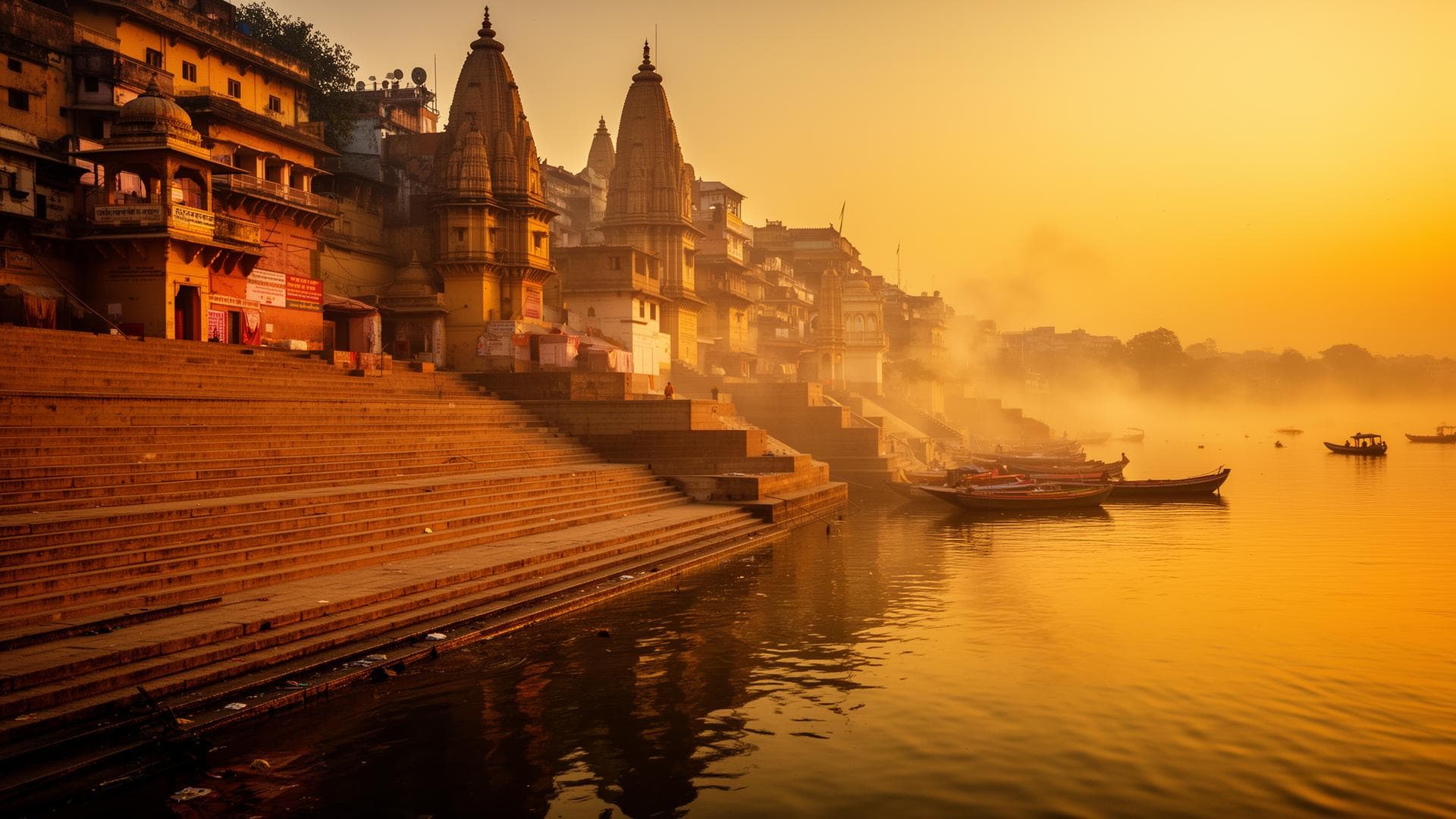
| Setting | A peaceful, uncrowded temple on a plateau at the northern edge of the ghats, over the river confluence. |
| Time needed | About 30 minutes to an hour. |
Adi Keshava temple timings and aarti
The temple keeps a split day, open morning and evening, closing in the afternoon for the deity's rest. Because it lies away from the congested central lanes, at the quiet northern edge of the city, it is a peaceful, uncrowded shrine where you can have a close, unhurried darshan without the waits of the great temples.
| Session or ritual | Timing | Notes |
|---|---|---|
| Morning hours | 6:00 AM to 12:00 PM | The public morning window. |
| Afternoon close | 12:00 PM to 4:00 PM | The temple closes while the deity rests. |
| Evening hours | 4:00 PM to 10:00 PM | The public evening window. |
| Morning aarti | 7:00 AM | Daily. |
| Evening aarti | 8:00 PM | Daily. |
*Entry is free and there is no VIP darshan.
Adi Keshava: the first Vishnu of Kashi
Kashi is the city of Shiva, but its very gateway belongs to Vishnu. Adi Keshava means the first, or original, Keshava, a name of Lord Vishnu, and this is believed to be the place where Vishnu first set foot in Kashi. It is one of the oldest temples in the whole city, named in the ancient Puranas, and though few travellers find their way here, it holds a place of quiet primacy in the sacred geography of Kashi.
The legend is beautiful. When Lord Shiva was away from Kashi for a time, he asked Vishnu to go and watch over the sacred city, and Vishnu came, with Lakshmi and his eagle Garuda, and first set foot at the meeting of the Varuna and the Ganga. There he bathed and washed his lotus feet, so that the confluence is called Padodaka Tirtha, the water of the feet, and there he carved an image of himself and worshipped it, settling in Kashi as Adi Keshava. In the old way of seeing the city as a living body, mapped along its ghats, Adi Keshava is the feet of Kashi, the place where the divine first touched the ground.
The Sangameshwar linga: Vishnu and Shiva as one
The temple holds a rare treasure that captures the whole spirit of Kashi. On the terrace stands the four-faced Sangameshwar linga, the Lord of the Confluence, and here Adi Keshava, a form of Vishnu, is joined with Sangameshwara, a form of Shiva, in a single sacred presence, the rare Adi Keshav-Sangameshwar deity that represents the unity of Vishnu and Shiva. In a city where devotees sometimes think of Shiva and Vishnu as rivals, this shrine at the very edge of Kashi quietly declares them one. It is said that Adi Keshava himself installed the Sangameshwar linga at the confluence, and that worship here grants moksha, the release from the cycle of birth and death.
The Varuna-Ganga Sangam and the Panchatirthi
Adi Keshava stands where the Varuna river pours into the Ganga, at the northernmost edge of the eighty-four ghats, the very boundary of the sacred city, a spot the old texts say is where the Ganga bows as she enters Kashi. This confluence, the Padodaka Tirtha, is itself a holy bathing place, sanctified by Vishnu's feet, and a dip here is believed to carry great merit.
The temple is the final, essential stop of the Panchatirthi Yatra, the sacred pilgrimage of five tirthas that pilgrims make in a single day: Asi, Dashashwamedh, Manikarnika, Panchganga, and last of all Adi Keshava at the northern edge. In the tradition that maps the five to the body of Kashi, Assi is the head, Dashashwamedh the chest, Manikarnika the navel, Panchganga the thighs, and Adi Keshava the feet, so that to complete the yatra here is to touch the feet of the sacred city. To take darshan at this quiet, ancient shrine, with the two rivers meeting below, is a fitting and moving end to that great circuit.
The gateway of Kashi, in my own words
By Rajeev Sharma, Varanasi local
Adi Keshava is one of the great secrets of Kashi, and I only take the traveller who truly wants to go deep. It is right up at the northern end, where the Varuna meets the Ganga, away from all the crowds, and I explain that this is where Lord Vishnu first stepped into the city, that it is one of the oldest temples of all, the very feet of Kashi. People are always surprised that such an important place is so quiet and so little visited.
I show them the four-faced Sangameshwar linga and tell them what I love most about this temple, that here Vishnu and Shiva are worshipped as one, at the very edge of the city. If we are doing the Panchatirthi, the five-tirtha pilgrimage, this is our final stop, and there is something very complete about ending at the feet of Kashi, by the confluence, with the rivers meeting below. I always warn my guests to ignore anyone outside promising a shortcut for money, because the darshan here is free, quick and peaceful for everyone. People leave this place feeling they have seen the real, hidden Kashi.
In more than forty years of guiding, this is the temple that best rewards the pilgrim willing to go all the way to the edge of the sacred city.
Entry, rules, and what to know
- Entry is free for everyone. There is no VIP darshan or paid pass; darshan is quick and peaceful through the main line.
- Ignore any tout outside promising a special shortcut for money; it is neither official nor needed.
- Dress modestly, remove footwear before entry, and keep your voice low.
- A dip at the Varuna-Ganga confluence, the Padodaka Tirtha, is traditional; carry a change of clothes if you wish to bathe.
- Carry a little cash for offerings; photograph respectfully.
How to reach the Adi Keshava Temple
The temple is at Rajghat, at the far northern edge of the city, over the Varuna-Ganga confluence. It is a little out of the way, and there is no direct public transport, so you come by hired transport or, best of all, by boat.
| Route | How | Notes |
|---|---|---|
| Auto or car from the centre | From Dashashwamedh or Godowlia | An auto-rickshaw ride is around a few hundred rupees; agree the fare first. |
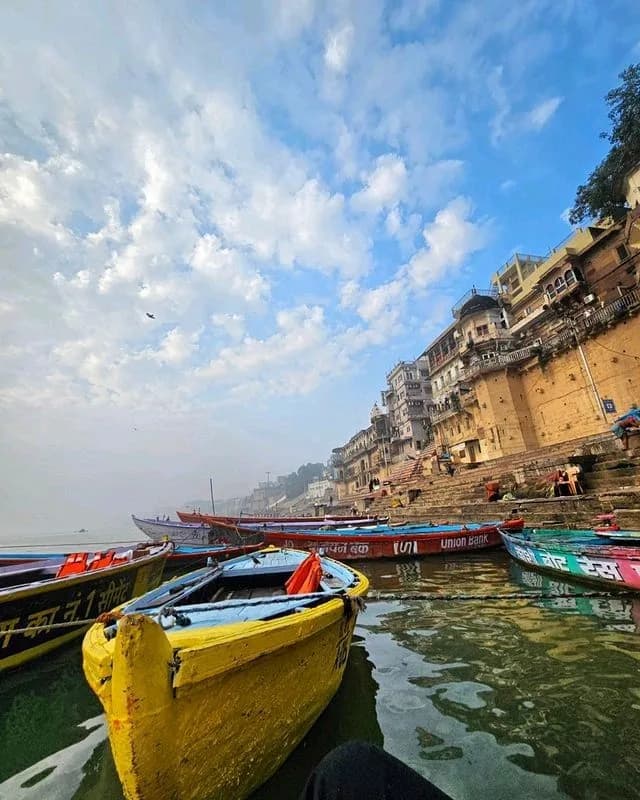
| By boat | Down the river to Adi Keshav Ghat | An uncrowded, beautiful approach to the attached ghat. |
| Cycle rickshaw or private car | From central locations | Comfortable for the drive up to the northern edge. |
| Varanasi Junction (Cantt) | By taxi or auto | To the Rajghat area at the north of the city. |
| Airport | About 25 km | Lal Bahadur Shastri International Airport, roughly an hour by road. |
The loveliest way is by boat to Adi Keshav Ghat, and a car or auto is easy for the return. We arrange the transport, the boat and a guide.
Best time to visit and how to plan it
| When | Why |
|---|---|
| Early morning | A calm darshan and a beautiful sunrise over the confluence. |
| Ekadashi and Vaishnava days | Auspicious for Vishnu darshan, with special pujas. |
| As the final Panchatirthi stop | End the five-tirtha pilgrimage here at the feet of Kashi. |
| Kartik and by boat at dawn | The northern river reaches are especially lovely then. |
- Pair it with a boat ride and with Bindu Madhav and Panchganga on the Panchatirthi route.
- Allow about 30 minutes to an hour, more if you bathe at the confluence.
For the Panchatirthi and the ghats planned as one route, see our Varanasi tour packages.
Accessibility for elderly and mobility limited visitors
- The temple is reachable by road up to the Rajghat area, easier than the central old city lanes, though the plateau and ghat steps call for care.
- It is calm and uncrowded, which suits a gentle, unhurried visit.
- Coming by boat means climbing the ghat steps; plan a slow pace.
- We arrange the transport, timing and a guide to make the visit comfortable.
Nearby sacred sites to combine with your darshan
Adi Keshava is the northern anchor of the Panchatirthi, so it pairs naturally with the other Vishnu shrine and the sacred ghats.
| Site | What it is | Internal link |
|---|---|---|
| Bindu Madhav Temple | The great Vishnu shrine above Panchganga Ghat, the other Vishnu stop of the Panchatirthi. | /temple/varanasi/bindu-madhav-temple |
| Panchganga Ghat | The ghat of five rivers, the thighs of Kashi on the Panchatirthi. | /temple/varanasi/panchganga-ghat |
| Manikarnika Ghat | The great cremation ghat, the navel of Kashi. | /temple/varanasi/manikarnika-ghat |
| Dashashwamedh Ghat | Home of the grand evening Ganga aarti, the chest of Kashi. | /temple/varanasi/dashashwamedh-ghat |
| Kashi Vishwanath Temple | The Jyotirlinga of Shiva; Adi Keshava's Sangameshwar linga unites Vishnu and Shiva. | /temple/varanasi/kashi-vishwanath-temple |
For the grand evening aarti and a boat ride, see our Varanasi tour packages.
Practical tips
| Good to know | Detail |
|---|---|
| It is off the beaten path. | At the far northern edge; plan your transport, and consider coming by boat. |
| It is peaceful and quick. | Low crowds mean a close, hassle-free darshan; a lovely calm after the busy centre. |
| Ignore shortcut touts. | Darshan is free and quick for all; no one needs a paid shortcut. |
| The confluence. | The Varuna-Ganga sangam below is itself sacred; a dip is traditional. |
Our guided darshan and Panchatirthi visits
We are a Varanasi based operator, a unit of Experience My India, with more than forty years of guiding pilgrims across Kashi, Ayodhya, and Prayagraj. Entry is free, so what we arrange is the visit around it: the transport up to this out of the way shrine or a boat to Adi Keshav Ghat, a guide who brings its ancient story alive, and, for pilgrims, the full Panchatirthi Yatra ending here at the feet of Kashi.
| Package | Includes | Price |
|---|---|---|
| Adi Keshava darshan and boat | Transport or a boat to Adi Keshav Ghat, darshan, and a guide. | Contact us for pricing |
| Panchatirthi Yatra | The five sacred tirthas ending at Adi Keshava, by boat, with a guide. | Contact us for pricing |
| Vishnu of Kashi darshan | Adi Keshava with Bindu Madhav, the two Vishnu shrines, with a guide. | Contact us for pricing |
| Northern Kashi and Rajghat | Adi Keshava and the historic Rajghat area on the river. | Contact us for pricing |
Inclusions and exclusions are stated up front, with any taxes and conditions, and no charge appears later that was not named. See all our Varanasi tour packages for the full range.
Experience My India is a travel operator, not the temple administration. Prices are ours. Temple timings and rules are set by the temple and can change.