.webp&w=2048&q=75)
.webp&w=2048&q=75)
Please read first: visiting a cremation ghat
Harishchandra Ghat is not a sightseeing spot. It is a working cremation ground, where families bring their dead for their final rites, and where cremations continue day and night. For Hindus it is a sacred threshold, a place of grief, of release, and of profound faith, and it deserves to be approached with quietness and reverence, not curiosity.
If you visit, do so gently and with respect. Never photograph or film the cremations, the pyres, or the mourning families; this is the single most important rule, and it matters deeply. Keep your distance, lower your voice, and remember that every fire here is a family's farewell. Approached in this spirit, the ghat can teach a visitor something Kashi understands better than almost anywhere on earth: how to face death with acceptance and even with peace. This guide is written to help you understand and honour that, not to treat it as a spectacle.
Essential info at a glance
| Detail | At a glance |
|---|---|
| What it is | One of the two cremation ghats of Varanasi, also known as Adi Manikarnika, the original cremation ground. |
| Timings | Open 24 hours, every day; cremations continue day and night. |
| Entry fee | Free. It is a public riverfront. |
| Aarti and VIP | There are none here; the grand Ganga aarti and temple darshan belong to Dashashwamedh and Kashi Vishwanath nearby. |
| Significance | One of the oldest and most sacred cremation ghats, named after the truthful King Harishchandra; cremation here is believed to grant moksha. |
| Atmosphere | Quieter and more somber than Manikarnika, the busier cremation ghat. |
| Location | The southern riverfront, about 2 km from Assi Ghat and 6 km from Varanasi Junction. |
| How to visit | Quietly and respectfully, ideally from a boat at a distance or with a sensitive guide. |
The legend of King Harishchandra
The ghat carries one of the most moving stories in all of Hindu tradition, the story of King Harishchandra, remembered above every other virtue for his truth. To keep a promise made to the sage Vishwamitra, Harishchandra gave up everything, his kingdom, his wealth, his freedom. He sold himself into the service of a Dom, a keeper of the cremation ground, and worked here at this very ghat, collecting the due for each cremation, a king brought to the lowest station, and never once breaking his word or his duty.
Then came the hardest test of all. His own young son died, and his wife, herself reduced to poverty, carried the boy to this ghat for cremation. Bound by his duty as the ground's servant, Harishchandra had to ask even her, in her grief, for the cremation fee, unable to make an exception for his own child. He held to the truth even there, in the face of unbearable sorrow. The gods, who had set this test, were moved beyond measure by his steadfastness, and they restored his kingdom to him and gave him back his son. And so this ghat is forever bound to the ideals of Satya, truth, and of sacrifice, duty and the acceptance of what must be, which is why so many are drawn to it.
Cremation, moksha, and the meaning of the ghat
Varanasi is held to be the place where the cycle of birth and death can be broken, and Hindus believe that to be cremated in Kashi is to attain moksha, liberation from the endless round of rebirth. It is said that Lord Shiva himself whispers the Taraka mantra, the prayer of crossing over, into the ear of those who die here, granting release. For this reason families bring their dead from great distances to the cremation ghats of Kashi, so that their loved one may find that liberation.
Harishchandra Ghat is one of the two grounds where this sacred work is done, and it is often called Adi Manikarnika, the original cremation ground, older even than the great Manikarnika. The cremations are carried out by the Dom community, whose hereditary and deeply respected role it is to tend the fires and guard the sacred flame, a duty they have held for countless generations. To understand this ghat is to understand how Kashi holds death not as an ending to be feared but as a doorway, tended with unbroken care.
The ghat today
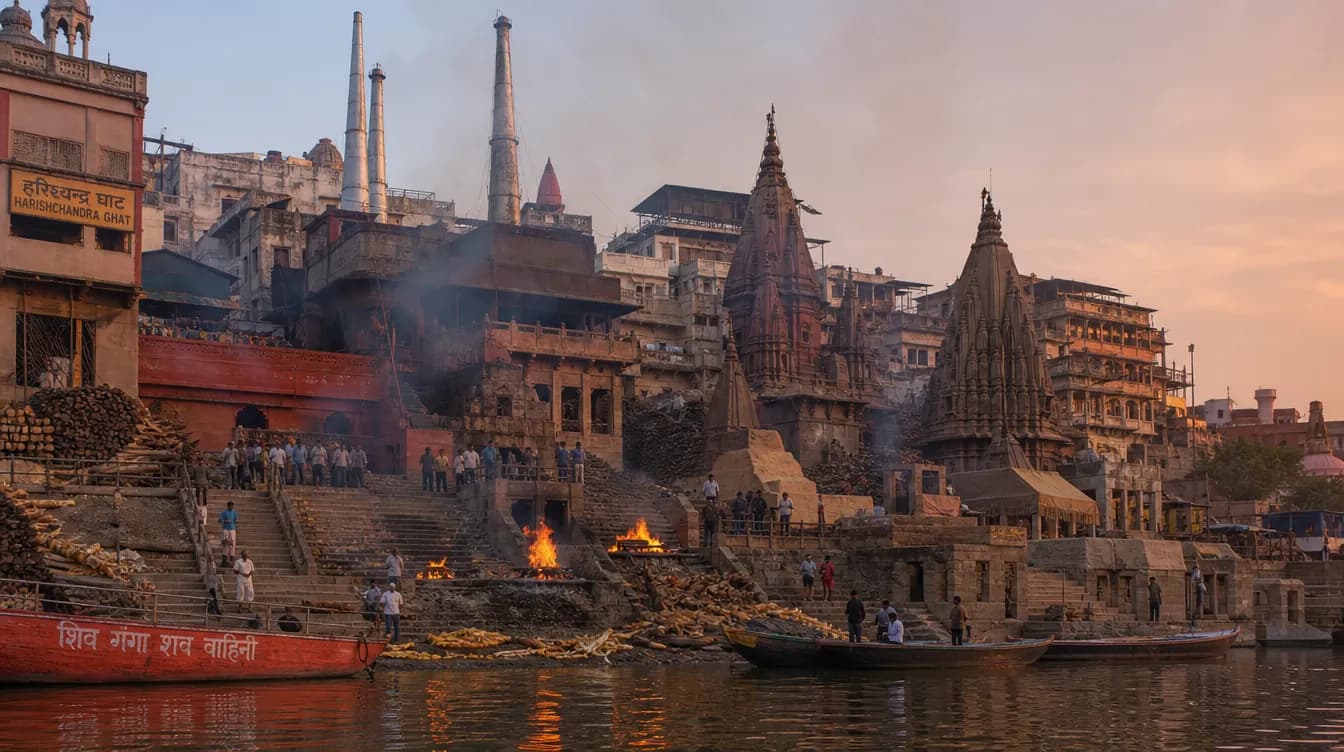
Today Harishchandra Ghat shows two faces of the same devotion side by side. The traditional cremations on wood pyres continue as they have for centuries, and beside them stands an electric crematorium, opened in the late 1980s, which offers a more affordable and less polluting alternative and is used alongside the wood fires. The quiet coexistence of the old chimney of smoke and the new one is, in its way, a picture of the whole city, ancient faith and modern life meeting at the water's edge.
The ghat is smaller and generally more somber and less chaotic than Manikarnika, and above its steps stand old shrines, among them Harishchandreshwara and Adi Manikarnikeshwara, that mark its antiquity. It is a place that asks for stillness.
Understanding the last rites
Knowing a little of what unfolds here helps a visitor stand in the right spirit. The rites follow age-old customs rooted in the Garuda Purana and other texts. The body is bathed and wrapped in cloth, white, or red for a married woman, and carried through the lanes to the ghat on a bamboo bier, while the family chants the name of Ram. At the river it is given a final touch of the Ganga's water, and then placed upon the pyre.
It is traditionally the eldest son, his head shaved and dressed in white, who performs the most sacred act, the mukhagni, lighting the pyre, and later the kapal kriya, releasing the soul. The fire is kindled from the sacred flame kept by the Dom community. When the cremation is complete, the ashes and remains are given to the Ganga. Everything is done with a quiet, practised care, and understanding this is enough to know why a visitor should watch, if at all, only from a respectful distance and in silence. It is not a performance; it is the most intimate passage a family will ever make.
How to visit with respect
If you choose to visit, please hold to the etiquette of a cremation ground. It costs nothing and means everything to the families who are here.
- Never photograph or film the cremations, the pyres, or the mourners. This is the most important rule; put the camera away.
- Keep a respectful distance from the pyres and the families, and do not intrude on the rituals.
- Dress modestly, keep your voice low, and stay quiet and unobtrusive.
- Do not treat it as a tourist attraction or a photo opportunity; come to understand, not to gawk.
- Be wary of anyone who approaches you demanding money, for wood, for a donation, or for a fee to watch. Such people prey on visitors and on grief; you are under no obligation, and a genuine guide will shield you from them.
- Perhaps the most respectful way to witness the ghat is from a boat on the river, at a quiet distance.
Reflections, in my own words
By Rajeev Sharma, Varanasi local
When I bring someone to Harishchandra Ghat, I speak differently than I do anywhere else in Kashi. I ask them to put their cameras away before we arrive, and I explain that this is a place of real grief and real farewell, not a sight to be collected. I tell them the story of King Harishchandra, how he gave up his throne and served here for the sake of truth, and how he had to ask even his own wife for the fee when his son died, and people fall silent when they hear it. It changes how they stand here.
I often prefer to bring guests past the ghat by boat, at a distance, so they can feel it without intruding. I explain what the Dom families do, why families travel so far to bring their dead to Kashi, and what moksha means to them. Many of my visitors tell me afterwards that this quiet, sober half hour was the most profound part of their whole time in Varanasi, that it changed how they think about death and about life. That is what this ghat offers, if you come to it with respect.
In more than forty years of guiding, this is the place where I have seen visitors most changed, and it is the one I treat with the greatest care.
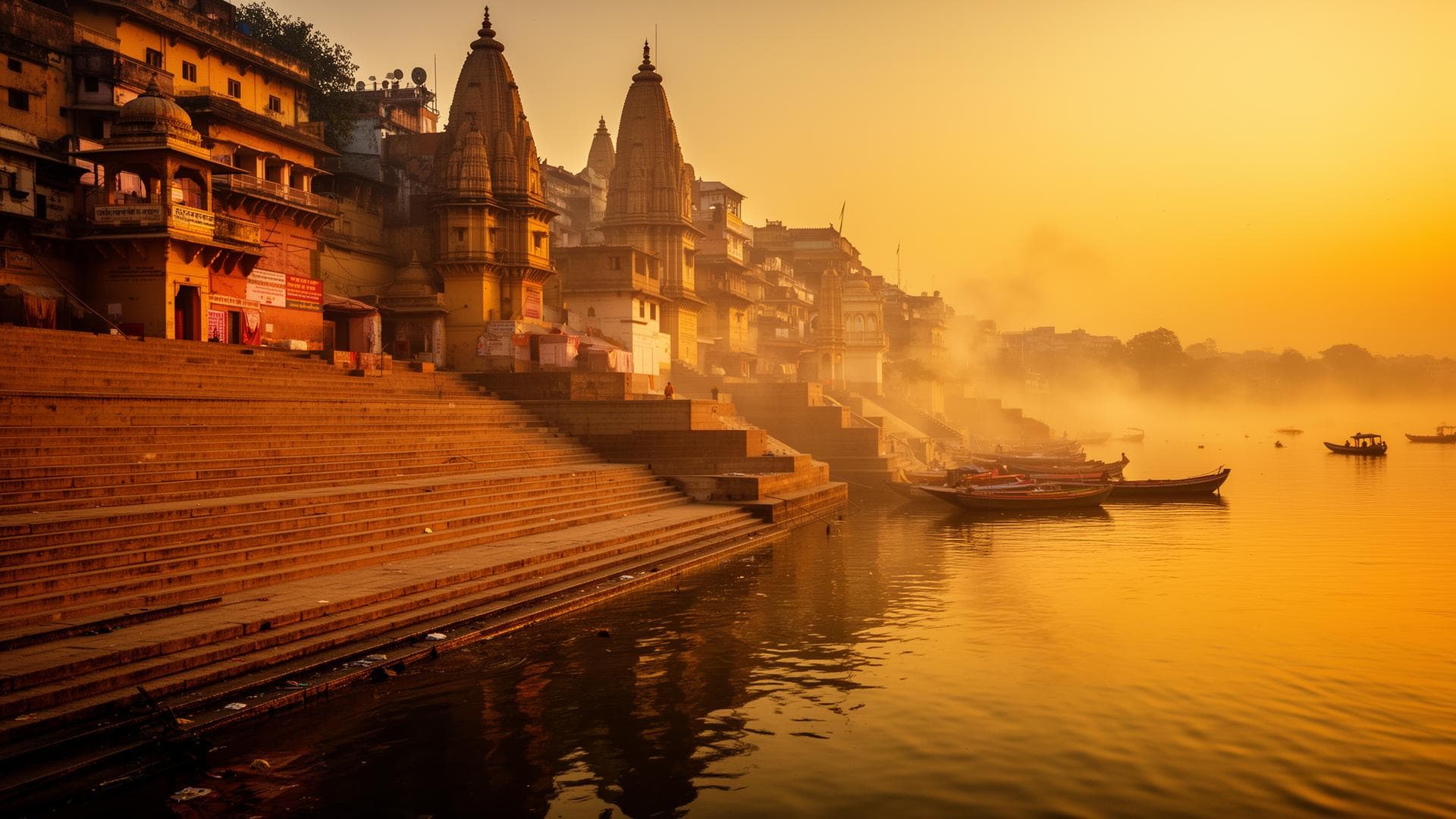
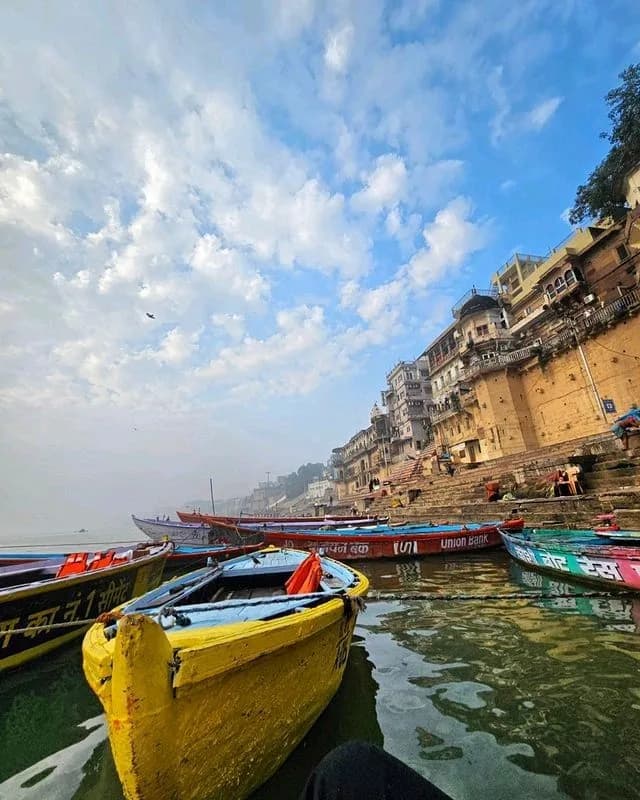
[Any photos are wide, respectful views taken from a distance, with no cremation or mourners in frame.]
How to reach Harishchandra Ghat
The ghat is on the southern stretch of the riverfront, about 2 km from Assi Ghat, near Kedar Ghat. You can reach it on foot along the ghats or through the lanes, or, most respectfully, view it from a boat on the river.
| From | Distance | Notes |
|---|---|---|
| Assi Ghat | About 2 km | Along the southern riverfront; walk or take a boat. |
| Kedar Ghat | Close by | Just along the riverfront to the south. |
| By boat | Along the river | The most respectful way to witness the ghat, from a distance. |
| Varanasi Junction (Cantt) | About 6 km | By taxi or auto to the old city edge, then on foot or by boat. |
| Airport | About 25 km | Lal Bahadur Shastri International Airport, roughly an hour by road. |
For families arranging last rites
If you have come to Kashi to perform the last rites of a loved one, or to immerse their ashes in the Ganga, we understand that this is a tender and difficult time. We can help arrange the necessary rituals, the priest, and the practical needs with care, dignity and honesty, and without any pressure, so that your family can focus on your farewell and your prayers. Please simply reach out, and we will help quietly and respectfully.
Nearby ghats
Harishchandra sits on the southern riverfront among the other ghats of Kashi.
| Site | What it is | Internal link |
|---|---|---|
| Manikarnika Ghat | The other, busier cremation ghat, with its eternal sacred flame. | /temple/varanasi/manikarnika-ghat |
| Kedar Ghat | A colourful, sacred bathing ghat close by to the south. | /temple/varanasi/kedar-ghat |
| Assi Ghat | The southern ghat, famous for the sunrise Subah-e-Banaras aarti. | /temple/varanasi/assi-ghat |
| Dashashwamedh Ghat | Home of the grand evening Ganga aarti, to the north. | /temple/varanasi/dashashwamedh-ghat |
The grand evening Ganga aarti is held at Dashashwamedh, around 6:45 PM after sunset and lasting about 45 minutes. For that experience and a boat ride, see our Varanasi tour packages.
Accessibility for elderly and mobility limited visitors
- The ghat has stone steps and uneven ground; those with limited mobility should take care.
- Viewing from a boat is gentler and also the most respectful way to witness the ghat.
- Come at a quieter hour, and let a guide manage the approach so the visit stays calm and dignified.
- We arrange a boat and a sensitive guide for a comfortable, respectful visit.
A respectful visit with us
We are a Varanasi based operator, a unit of Experience My India, with more than forty years of guiding pilgrims across Kashi, Ayodhya, and Prayagraj. We do not sell the cremation ghat as a spectacle. What we offer is a respectful, well-informed way to understand this profound side of Kashi: a knowledgeable, sensitive guide who tells the story of the ghat and its meaning, a boat from which to witness it at a dignified distance, and, for families who need it, quiet help with last rites. Our guides make sure you are not troubled by touts, and that your visit honours the place and the families in it.
For a wider, respectful tour of the ghats and the old city, see our Varanasi tour packages.
Experience My India is a travel operator, not a temple or government body. Ghat access is free and public. Please treat the ghat and its families with reverence.