.webp&w=2048&q=75)
.webp&w=2048&q=75)
Essential info at a glance
| Detail | At a glance |
|---|---|
| What it is | One of the oldest, most colourful ghats of Kashi, home to the Gauri Kedareshwar Temple, the Kedarnath of Varanasi. |
| Ghat access | Open 24 hours, a public riverfront, free. |
| Temple hours | The Kedareshwar Temple is open daily 4:00 AM to 10:00 PM, with worship from about 3:00 AM to 11:00 PM. |
| Entry fee | Free. There is no VIP darshan or paid pass. |
| The lingam | A rare, self-manifest rock lingam with a white line, giving the same merit as a visit to Kedarnath. |
| Gauri Kund | The sacred tank at the base of the temple, glorified as the greatest of Kashi's bathing tirthas. |
| Its people | Especially loved by pilgrims from South India and Bengal; South Indian in style and spirit. |
| Location | Sonarpura, Bengali Tola, between Chauki Ghat and Harishchandra Ghat. |
Kedar Ghat and temple timings and aarti
The ghat is open around the clock as a public riverfront, and it is one of the liveliest for bathing and worship, often said to be the busiest ghat after Dashashwamedh. The Kedareshwar Temple above it keeps a long day, with aartis from before dawn to late at night.
| Ritual or session | Timing | Notes |
|---|---|---|
| Ghat access | 24 hours | A public riverfront; come at any time. |
| Kedareshwar Temple | 4:00 AM to 10:00 PM | Worship spans roughly 3:00 AM to 11:00 PM. |
| Mangala aarti | About 3:00 to 4:00 AM | The pre-dawn aarti. |
| Morning aarti | About 10:00 AM | The mid-morning worship. |
| Sandhya (evening) aarti | About 5:30 to 7:00 PM | Varies with the season and sunset. |
| Shayan aarti | About 10:00 to 10:30 PM | The night aarti before closing. |
*Entry is free and there is no VIP darshan.
Kedareshwar: the Kedarnath of Kashi
Kedar Ghat takes its name and its greatness from the Kedareshwar Temple that crowns it, and this is one of the most beloved Shiva temples in all of Varanasi. Here Shiva is worshipped as Kedareshwar, the very form he takes at Kedarnath in the high Himalayas, and it is believed that a holy dip here followed by darshan at this temple brings the same blessing as the long, hard pilgrimage to Kedarnath itself. Tradition holds that the temple was established by a saint from South India so that the old and the frail, who could never climb to the mountain shrine, might still have their Kedarnath here on the banks of the Ganga.
In the sacred geography of Kashi, Kedareshwar is no minor shrine. The city is divided into three great segments, and Kedareshwar is the presiding Lord of the southern one, the Kedar Khand, just as Vishwanath presides over the centre. The scriptures call this the field, the kedara, where the crop of liberation grows. Remarkably, the temple is thought to have survived the destruction of the seventeenth century, so that it is older than the present Vishwanath temple, and a mark on the shrine is shown as the trace of a sword that could not bring it down. It is a place of deep and ancient power.
The self-manifest rock lingam
The lingam within the sanctum is unlike any ordinary shivling. It is not a smooth, carved stone but a rough, lumpish outcropping of rock with a distinct white line running through it, and tradition holds that it was never installed by human hands but arose here of its own accord, a swayambhu, self-manifest appearance of Shiva as pure energy. The white line, devotees say, divides the rock as rice and lentils are divided, and a simple, homely bhog is offered here in keeping with that. To stand before this raw, natural form of the god, so different from a polished idol, is to feel something very old and elemental, the presence of Shiva in the living stone.
Gauri Kund and Gauri Kedareshwar
At the foot of the temple steps lies the Gauri Kund, a sacred water tank watched over by an image of Gauri, the goddess Parvati, set in its wall. This kund is no ordinary pool: tradition glorifies it as the Adi Manikarnika, the first Manikarnika, and thus as the greatest of all the bathing tirthas of Kashi, and it is said to mirror the sacred pond beside Kedarnath in the mountains. Devotees bathe here, or in the Ganga, before climbing to the darshan.
The temple is properly called Gauri Kedareshwar, for here Shiva is worshipped together with Gauri, and it is told that the goddess performed her penance at this very spot to win Shiva as her husband. So the shrine is dear not only to those seeking the blessing of Kedarnath but to couples and to all who pray for devotion, union and steadfast love.
The colourful ghat and its people
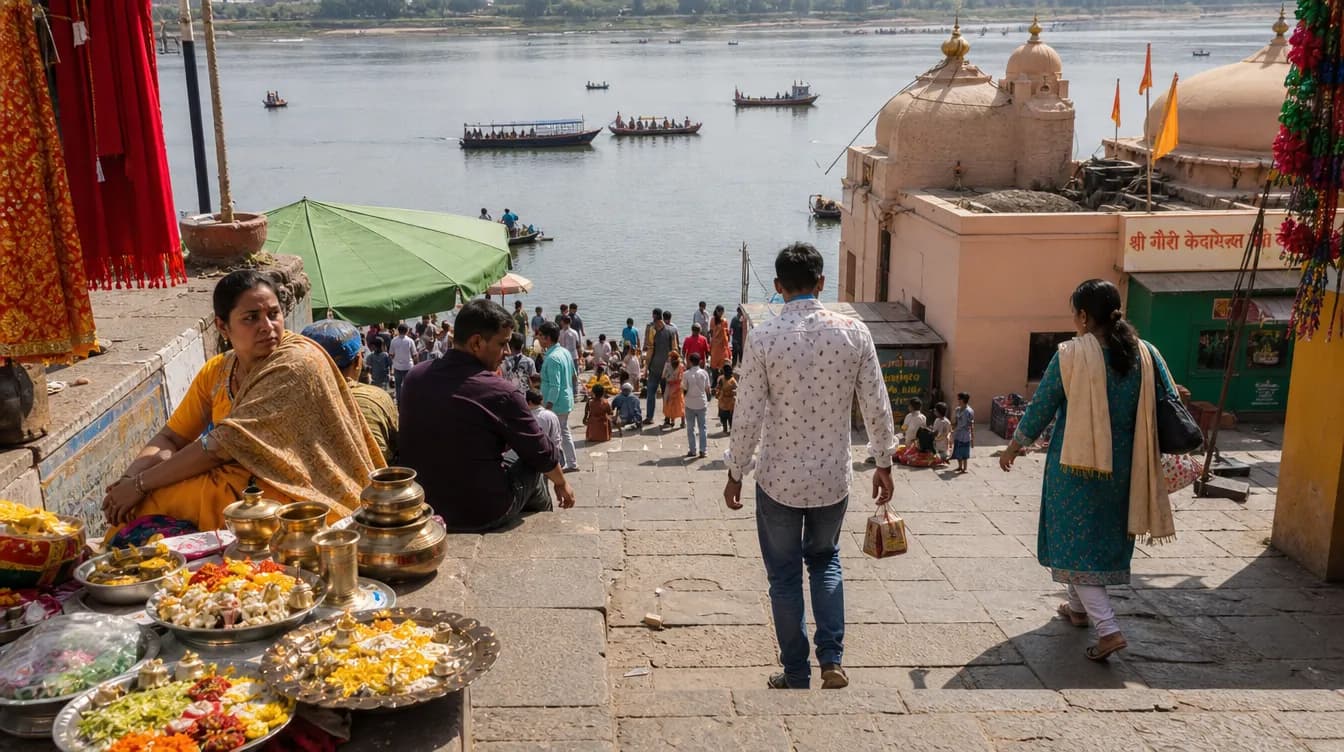
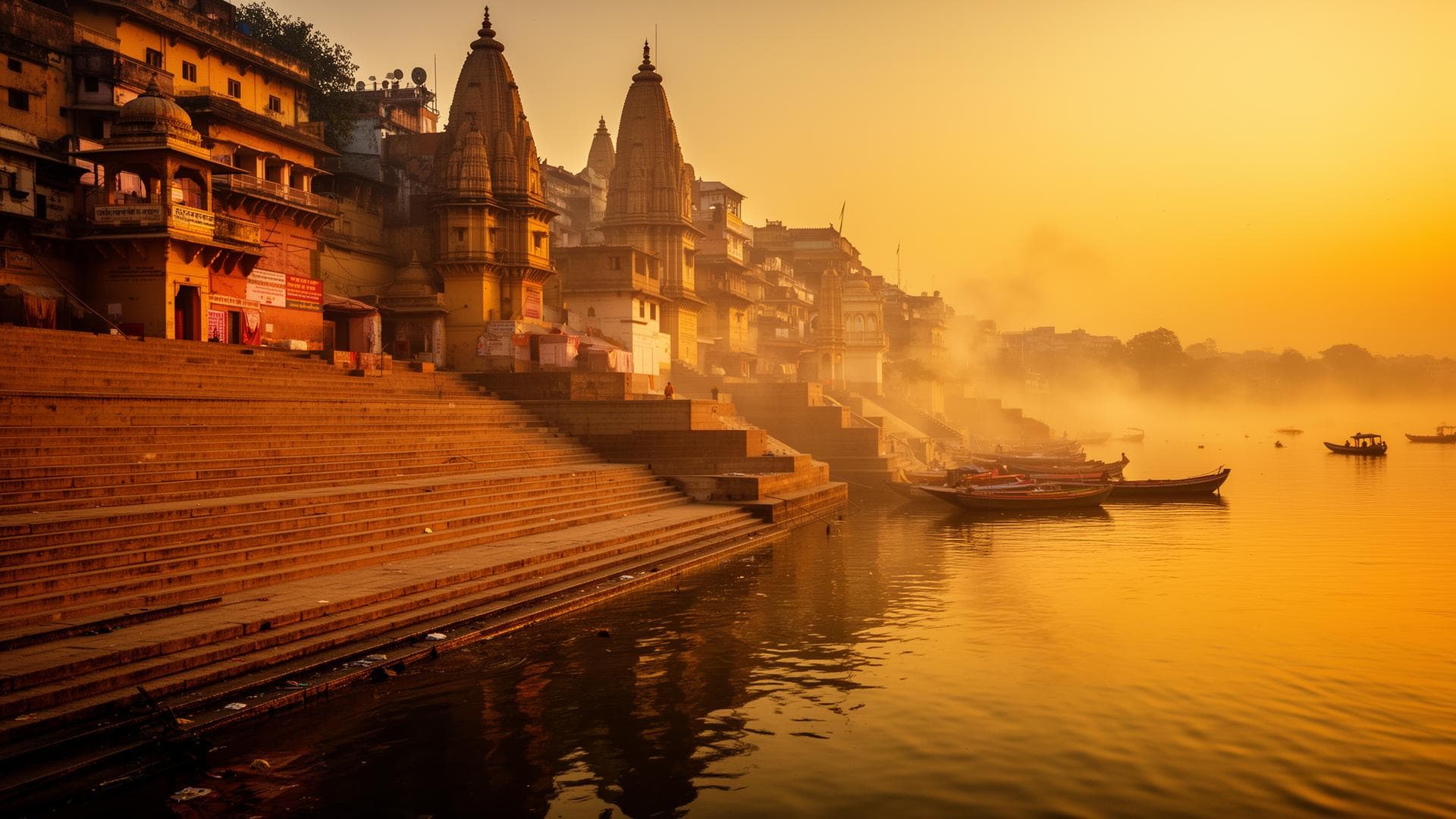
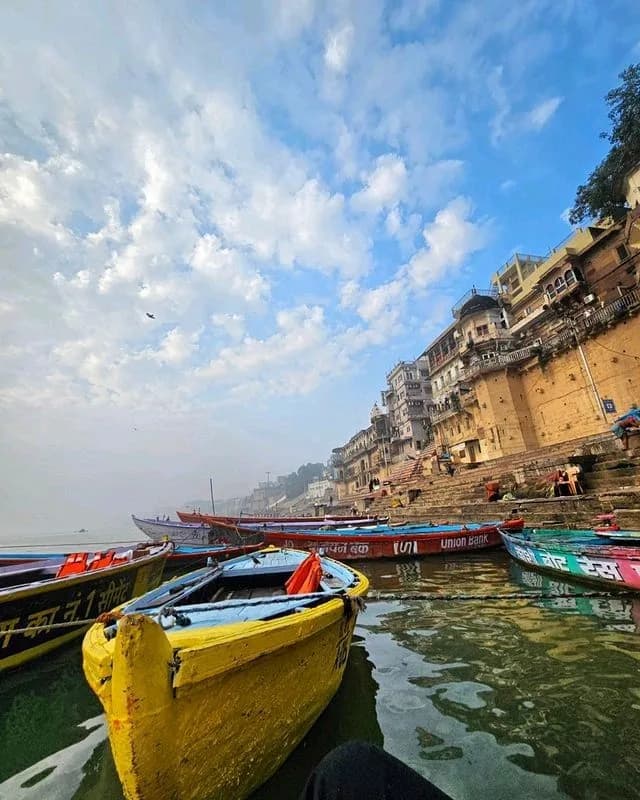
Kedar Ghat is, quite simply, one of the most beautiful and photographed ghats in Varanasi. Its steep steps are famously painted in bold vertical stripes of ochre-red and white, so that the whole ghat glows with colour, rising to the temple above. Early each morning it comes alive with bathers, with washing and worship, less overwhelming than Dashashwamedh but wonderfully vivid, and a dawn boat drifting past it is one of the classic sights of the river.
The ghat and the temple have a distinctly South Indian character, in their architecture and their spirit, and Kedar is especially beloved by pilgrims from South India and from Bengal, many of whom stay in the guesthouses of the surrounding Bengali Tola. It is a place where the far south and the east of India come to worship on the banks of the Ganga, and that mingling gives it a warmth and a colour all its own.
A raw and radiant ghat, in my own words
By Rajeev Sharma, Varanasi local
Kedar is one of the ghats I most love to show people, because it delights the eye and moves the heart at once. I bring my guests at dawn to see those famous red and white striped steps, alive with bathers, and I tell them that the Shiva here is Kedareshwar, the very Kedarnath of the Himalayas, brought to Kashi so that anyone, however old or frail, could have that great darshan. People find that idea beautiful.
Inside, I show them the lingam, and I always watch their faces, because it is not a smooth idol but a rough natural rock with a white line, which surprises them, this raw stone that is said to have risen on its own. We see the Gauri Kund below, the first Manikarnika, and I tell the story of Gauri's penance here. When a family wants it, I arrange a Rudrabhishek or an abhishek with the priests, which is beautiful in this ancient, less-crowded temple. And I explain that this is a special place for our brothers and sisters from the South and from Bengal, so it has a flavour you will not find at the other ghats.
In more than forty years of guiding, this is the ghat where beauty and devotion meet most vividly for me.
Rituals and offerings at Kedareshwar
As one of the great Shiva temples of Kashi, and a calmer one than Vishwanath, Kedareshwar is a wonderful place for the sacred abhishek rituals, which can be performed here with care and space. Private rituals are arranged with the temple priests, which is what we help with.
| Ritual | What it is and why it is done |
|---|---|
| Abhishekam | The bathing of the lingam with milk, water, honey, ghee and curd, the loving daily worship of Shiva. |
| Rudrabhishek | The abhishek with Vedic chanting, for health, prosperity and the removal of obstacles. |
| Gauri-Shankar puja | A worship of Shiva and Gauri together, especially for marital harmony and devotion. |
| Offerings | Bilva leaves, flowers, water and the temple's traditional bhog. |
We arrange these with verified temple priests, on the day and in the name you choose, with the prasad sent to you. You can also arrange a Rudrabhishek at the main Jyotirlinga; see our Kashi Vishwanath Temple guide.
Entry, rules, and what to know
- Entry to the ghat and the temple is free; there is no VIP darshan. Private rituals can be booked with the priests, which we arrange.
- Take a dip in the Ganga or the Gauri Kund before darshan, as devotees do, if you wish.
- Dress modestly, remove footwear before the temple, and note that photography may be restricted in the sanctum.
- Offer bilva leaves, flowers and water; carry a little cash for offerings and any ritual.
- Come early for a peaceful darshan; Mahashivratri and the Mondays of Shrawan are very crowded.
How to reach Kedar Ghat
The ghat is at Sonarpura, in Bengali Tola, on the southern riverfront between Chauki Ghat and Harishchandra Ghat. You reach it by boat, or on foot through the lanes near Sonarpura Chauraha.
| From | Distance | Notes |
|---|---|---|
| Assi Ghat | A short walk or boat | To the south along the riverfront; combine with the southern ghats. |
| Harishchandra Ghat | Adjacent | Just to the north; the cremation ghat, to be visited with respect. |
| Sonarpura and Godowlia | A short walk | Reach the old city by auto, then walk down through the lanes. |
| Varanasi Junction (Cantt) | About 6 km | By taxi or auto to the old city edge, then on foot or by boat. |
| Airport | About 25 to 30 km | Lal Bahadur Shastri International Airport, roughly an hour by road. |
A dawn boat to Kedar and along the southern ghats is one of the loveliest experiences on the river. We arrange the boat, the timing and a guide.
Best time to visit and how to plan it
| When | Why |
|---|---|
| Early morning | The bathers, the colour and the Mangala aarti; the ghat at its most vivid, by boat. |
| Evening, for the Sandhya aarti | The temple worship as the day cools, around 5:30 to 7:00 PM. |
| Mahashivratri | The great night of Shiva, with night vigil and special abhishek; intense and crowded. |
| Shrawan Mondays | The holy month of Shiva; powerful but very busy. |
- Pair it with Assi Ghat, Tulsi Ghat and the southern ghats, and with Tilbhandeshwar Mahadev Temple nearby in Sonarpura.
- Allow 30 to 45 minutes for the ghat and the darshan, longer for a ritual or a boat.
For the ghats and temples planned as one route, see our Varanasi tour packages.
Accessibility for elderly and mobility limited visitors
- The ghat has steep steps up to the temple, which can be hard for those with limited mobility.
- A boat lets you enjoy the famous striped ghat from the water with less climbing.
- Come at a quieter hour, and avoid the Mahashivratri and Shrawan peaks if a queue is difficult.
- If a visit is not possible, we can arrange for a ritual to be performed in your name and the prasad sent to you.
Nearby sites to combine with your visit
Kedar sits on the southern riverfront, among the ghats and temples of that stretch.
| Site | What it is | Internal link |
|---|---|---|
| Assi Ghat | The southern ghat, famous for the sunrise Subah-e-Banaras aarti. | /temple/varanasi/assi-ghat |
| Tulsi Ghat | The home of Tulsidas, just to the south. | /temple/varanasi/tulsi-ghat |
| Harishchandra Ghat | The sacred cremation ghat, adjacent to the north, visited with respect. | /temple/varanasi/harishchandra-ghat |
| Tilbhandeshwar Mahadev Temple | The Shiva temple with the growing lingam, nearby in Sonarpura. | /temple/varanasi/tilbhandeshwar-mahadev-temple |
| Dashashwamedh Ghat | Home of the grand evening Ganga aarti, to the north. | /temple/varanasi/dashashwamedh-ghat |
For the grand evening aarti and a boat ride, see our Varanasi tour packages.
Practical tips
| Good to know | Detail |
|---|---|
| The striped steps are the icon. | Kedar's ochre-and-white steps are among the most photographed in Varanasi, best at dawn. |
| Bathe before darshan. | A dip in the Ganga or the Gauri Kund before the temple is the custom. |
| The lingam is a natural rock. | Do not expect a smooth idol; the raw, self-manifest stone is the point. |
| It is busy at festivals. | Mahashivratri and Shrawan Mondays draw big crowds; come early. |
Our guided darshan and ritual bookings
We are a Varanasi based operator, a unit of Experience My India, with more than forty years of guiding pilgrims across Kashi, Ayodhya, and Prayagraj. Entry is free, so what we arrange is the visit and the ritual around it: a guide through the ghat and the temple and its story, a dawn boat along the striped steps, and, if you wish, an abhishek, a Rudrabhishek or a Gauri-Shankar puja performed by the temple priests, in your name, with the prasad sent to you.
| Service | Includes | Price |
|---|---|---|
| Kedareshwar darshan and boat | A guide, the darshan, the Gauri Kund and a dawn boat. | Contact us for pricing |
| Rudrabhishek at Kedareshwar | The abhishek performed by the temple priests, with prasad. | Contact us for pricing |
| Gauri-Shankar puja | A worship of Shiva and Gauri, for harmony and devotion. | Contact us for pricing |
| Southern ghats darshan | Kedar with Assi, Tulsi and the southern ghats, with a guide. | Contact us for pricing |
Inclusions and exclusions are stated up front, with any taxes and conditions, and no charge appears later that was not named. See all our Varanasi tour packages for the full range.
Experience My India is a travel operator, not the temple administration. Ritual and tour prices are ours; the puja is performed by the temple's own priests. Temple timings and rules are set by the temple and can change.