.webp&w=2048&q=75)
.webp&w=2048&q=75)
Essential info at a glance
| Detail | At a glance |
|---|---|
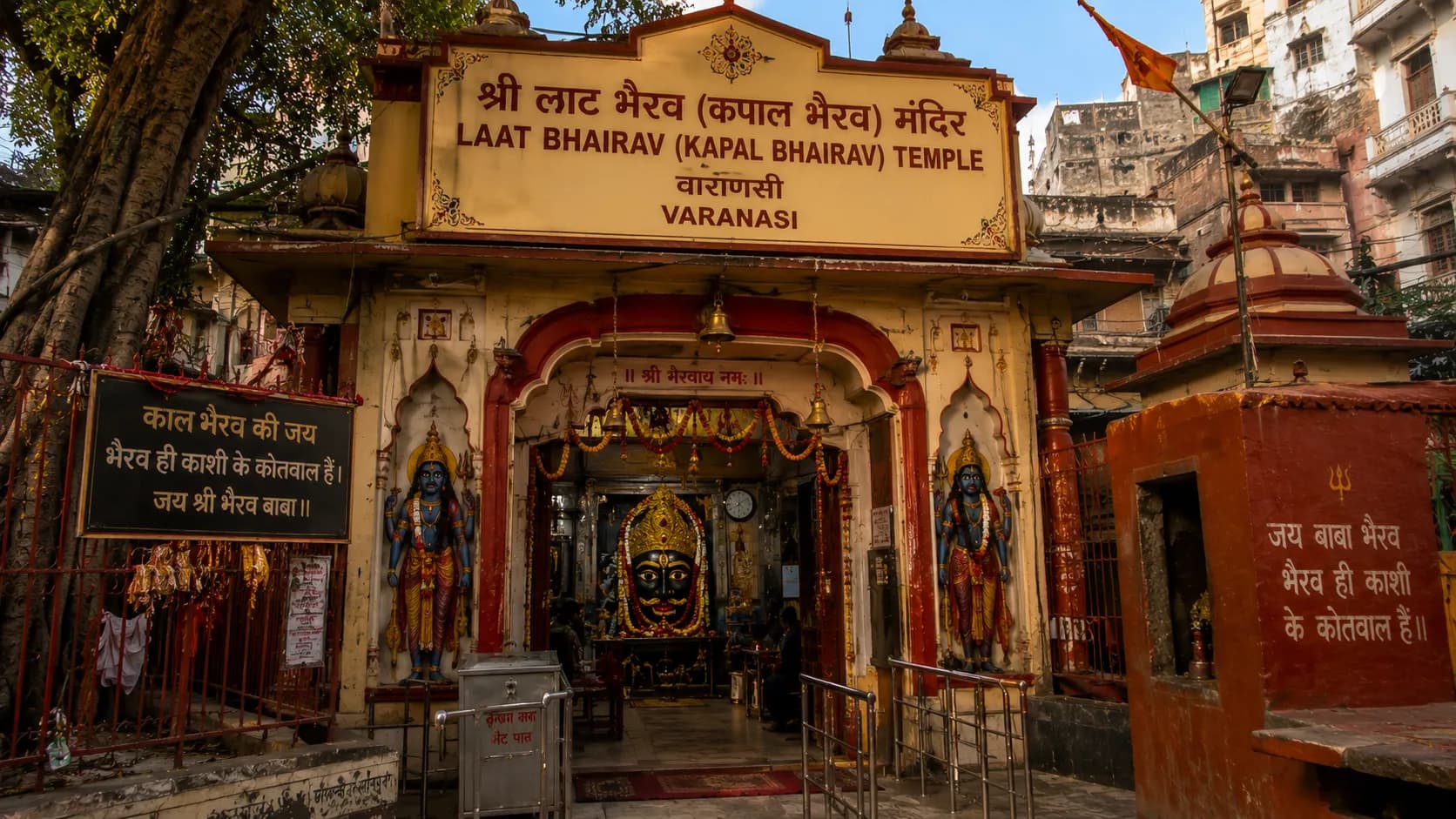
| What it is | The Laat Bhairav, or Kapal Bhairav, temple, one of the eight guardian Bhairavs of Kashi, worshipped as an ancient stone pillar. |
| Opening hours | Open daily from 5:00 AM to 10:30 PM, with flexible local worship hours. |
| Peak times | Mornings around 6:00 to 11:00 AM and evenings around 6:00 to 9:00 PM. |
| Entry fee | Free. Entry is open, with no official or paid VIP darshan; worship is managed informally by the local priests. |
| The deity | A rare form: Bhairav worshipped not as a figure but as a pillar, a stump wrapped in red cloth and sindoor, with a small mask of Bhairava. |
| Also called | Kapal Bhairav, and linked to the sacred Kapal Mochan tradition. |
| Setting | In a shared, historic neighbourhood in the north of the city; visit quietly and respectfully. |
| Location | Kazzakpura, Jalalipura, near a railway crossing, reached by auto or cab from the centre. |
Laat Bhairav temple timings
The temple keeps a long, open day and is worshipped informally by its resident priests rather than on a fixed corporate schedule, so timings are flexible. It is quieter and more out of the way than the great temples, which is part of its character.
| Detail | Timing | Notes |
|---|---|---|
| Opening hours | 5:00 AM to 10:30 PM | Open every day, with flexible local worship hours. |
| Morning peak | About 6:00 to 11:00 AM | The main morning worship and darshan. |
| Evening peak | About 6:00 to 9:00 PM | The evening sandhya worship. |
| Entry | Free | No official or paid VIP darshan; managed informally by the priests. |
The Bhairav worshipped as a pillar
Of all the Bhairav shrines in Kashi, this is the most unusual, because here Bhairav has no fierce face, no eyes, no weapons. He is worshipped instead as a Laat, a great stone pillar or staff, believed to have risen from the earth itself. What you see today is the stump of that ancient pillar, partly buried, wrapped in red cloth, covered with sindoor and marigolds, encased in copper, with only a small mask of Bhairava affixed to it. There is no towering temple over it; it stands under a simple open shed. As the local saying goes, here Bhairav is not to be seen, only felt, and devotees come in silence, whispering prayers for protection, grounding and inner strength.
This is Kapal Bhairav, named in the Puranas, and he is regarded as a kind of Chief Justice of Kashi, the one under whose gaze the karmic accounts of souls are believed to be settled, a fitting role for a guardian who stands, quite literally, as an immovable pillar at the edge of the sacred city.
The ancient pillar and its history
The Laat is genuinely ancient, and its story runs through the whole long history of the city. In the 17th century the French traveller Tavernier saw it still standing tall, a single shaft of some thirty-two to thirty-five feet topped by a pyramid and a sphere, and many scholars believe it was originally an Ashokan-era pillar, perhaps the very pillar an early Chinese pilgrim described standing before a Buddhist stupa here in the 7th century. Over the centuries the pillar was damaged and much reduced, including during the unrest of 1809, until only the revered stump that stands today remained.
The shrine sits in a historic, mixed neighbourhood in the north of the city, among the homes and prayer-places of more than one community, and it has long been a quiet point of shared space in Kashi. Visitors should come gently and keep silence on the premises, out of respect for everyone who lives and worships nearby. It is a place that rewards a calm, unhurried and respectful visit.
Kapal Mochan and the eight Bhairavs of Kashi
The temple is deeply tied to the tradition of Kapal Mochan, the liberation from the skull. In the great legend, Bhairav severed the fifth head of Brahma and carried the burden of that act until he was freed of it at the sacred Kapal Mochan tirtha, and a pond by this name lies near the temple, remembered and revered even where the water no longer stands. It is this that gives Kapal Bhairav his name and his role as the settler of the gravest debts.
Laat Bhairav is one of the Ashta Bhairav, the eight Bhairavs who guard the eight directions of Kashi and watch over Lord Vishwanath himself. Pilgrims who wish to honour the guardians of the city often take darshan of the Bhairavs together, and the three most visited make a natural circuit.
| Bhairav | Form | Internal link |
|---|---|---|
| Kaal Bhairav | The fierce Kotwal, the chief guardian of Kashi. | /temple/varanasi/kaal-bhairav-temple |
| Batuk Bhairav | The gentle child form, the tender protector. | /temple/varanasi/batuk-bhairav-temple |
| Laat Bhairav | The ancient pillar, Kapal Bhairav, this temple. | /temple/varanasi/lat-bhairav-temple |
Why devotees come to Laat Bhairav
- For the protection of one of the eight guardians of Kashi.
- For grounding, steadiness and inner strength, the gifts of the immovable pillar.
- For the settling of karmic burdens, in the tradition of Kapal Mochan.
- For freedom from fear, as with all the Bhairavs of the city.
A pillar of the old city, in my own words
By Rajeev Sharma, Varanasi local
Laat Bhairav is the Bhairav I take the traveller who really wants to understand Kashi, because it surprises them completely. There is no grand temple, no idol with eyes and weapons; there is an ancient stone pillar, wrapped in red cloth and sindoor, under a simple shed, and I explain that this is Bhairav himself, one of the eight guardians of the city, worshipped as a pillar that rose from the earth. People fall quiet in front of it, which is right, because here, as we say, Bhairav is not seen but felt.
I tell them the pillar is truly ancient, that a French traveller saw it tall and whole centuries ago, and that history has worn it down to this revered stump. It is out in the north of the city, in an old mixed neighbourhood, so I always ask my guests to keep silence and be respectful of everyone around. I like to bring it together with Kaal Bhairav and Batuk Bhairav, so people meet all three faces of the guardian, fierce, gentle, and immovable. It is one of the quiet, deep places that stay with a traveller long after the famous sights fade.
In more than forty years of guiding, this is the shrine that best teaches how much history and faith one old stone can hold.
Entry, rules, and what to know
- Entry is free, and worship is informal; there is no VIP darshan or ticket.
- Keep silence on the premises and be respectful, as the shrine sits in a shared neighbourhood near a masjid.
- Dress modestly and remove footwear before approaching the shrine.
- You may offer sindoor, cloth, flowers or a thread, as devotees do; carry a little cash for offerings.
- Photograph respectfully, and avoid photographing people at prayer, of any community.
How to reach the Laat Bhairav Temple
The temple is at Kazzakpura, Jalalipura, in the north of the city, near a railway crossing, and it is a little out of the way and can be tricky to find. Unlike the old city temples, you can drive close to it.
| From | Distance | Notes |
|---|---|---|
| City centre (Godowlia) | A drive across the city | Take an auto or cab; it is north of the old city, near a railway crossing. |
| Kaal Bhairav Temple | A short drive | The chief Bhairav, in the old city; do the Bhairavs together. |
| Sarnath | A short drive | On the same northern side of the city; easy to pair. |
| Varanasi Junction (Cantt) | A short to moderate drive | By taxi or auto. |
| Airport | About 25 km | Lal Bahadur Shastri International Airport, roughly an hour by road. |
Because it is out of the centre and hard to find, a car with a driver who knows the way makes it simple, and lets you pair it with the other Bhairavs or with Sarnath.
Best time to visit and how to plan it
| When | Why |
|---|---|
| Morning or evening | The main worship, around 6 to 11 AM and 6 to 9 PM; calmer and cooler. |
| Tuesdays, Saturdays and Sundays | Days especially associated with Bhairav; more devotees. |
| Bhairava Ashtami and Mahashivratri | The great Bhairav festivals, when the shrine is at its most active. |
| Laat Bhairon ki Barat | The famous local procession, the wedding of Lat Bhairo, a vivid Banarasi festival. |
- Pair it with Kaal Bhairav and Batuk Bhairav for the three Bhairavs, or with Sarnath on the north side.
- Allow 20 to 30 minutes; it is a small, quiet shrine.
For the Bhairavs and the city planned as one route, see our Varanasi tour packages.
Accessibility for elderly and mobility limited visitors
- The shrine is reachable by road and set on open ground, easier than the old city lanes, though the last approach can be rough.
- It is a small, calm shrine; a short, gentle visit suits most travellers.
- We arrange a car close to the shrine and a guide to find it and bring the story alive.
- Come in the cooler morning or evening for the most comfortable visit.
Nearby sacred sites to combine with your darshan
Laat Bhairav pairs naturally with the other Bhairavs and with the northern sights.
| Site | What it is | Internal link |
|---|---|---|
| Kaal Bhairav Temple | The fierce Kotwal of Kashi, the chief of the eight Bhairavs. | /temple/varanasi/kaal-bhairav-temple |
| Batuk Bhairav Temple | The gentle child form of Bhairav, in Bhelupur. | /temple/varanasi/batuk-bhairav-temple |
| Kashi Vishwanath Temple | The Jyotirlinga the Bhairavs guard, at the heart of Kashi. | /temple/varanasi/kashi-vishwanath-temple |
| Sarnath (Dhamek Stupa) | The great Buddhist site, on the same northern side of the city. | /temple/varanasi/sarnath |
For the grand evening aarti on the river, see our Varanasi tour packages.
Practical tips
| Good to know | Detail |
|---|---|
| It is out of the way and hard to find. | Plan your transport; a car and a guide who knows it saves time and confusion. |
| Keep silence and be respectful. | The shrine is in a shared neighbourhood near a masjid; visit quietly, respecting all. |
| Bhairav is felt, not seen. | Do not expect a grand idol or temple; the power is in the ancient pillar itself. |
| Combine the Bhairavs. | Best visited with Kaal Bhairav and Batuk Bhairav as the three Bhairavs of Kashi. |
Our guided Bhairav darshan
We are a Varanasi based operator, a unit of Experience My India, with more than forty years of guiding pilgrims across Kashi, Ayodhya, and Prayagraj. Entry is free, so what we arrange is the visit around it: a car and a guide who can find this out of the way shrine and tell its story, and a route that brings together the three Bhairavs of Kashi, or pairs Laat Bhairav with Sarnath on the north side.
| Package | Includes | Price |
|---|---|---|
| The three Bhairavs of Kashi | Kaal Bhairav, Batuk Bhairav and Laat Bhairav together, with a car and guide. | Contact us for pricing |
| Laat Bhairav and Sarnath | The pillar shrine and the great Buddhist site on the north side in one outing. | Contact us for pricing |
| Guided Laat Bhairav visit | A car, a guide, and darshan of the ancient pillar. | Contact us for pricing |
Inclusions and exclusions are stated up front, with any taxes and conditions, and no charge appears later that was not named. See all our Varanasi tour packages for the full range.
Experience My India is a travel operator, not the temple administration. Prices are ours. Temple timings and worship here are informal and set by the local priests, and can change.