.webp&w=2048&q=75)
Essential info at a glance
| Detail | At a glance |
|---|---|
| What it is | A magnificent 19th-century Gothic Revival cathedral of the Church of North India, called Patthar Girja. |
| Opening hours | 8:30 AM to 5:30 PM daily, for visitors. |
| Sunday services | English service around 9:00 AM; Hindi service immediately after. |
| Entry fee | Free, and equal for all. There is no VIP system. |
| Architect | Sir William Emerson, who also designed the Victoria Memorial, Kolkata. |
| Style | Gothic Revival, in cream sandstone, with beautiful stained glass. |
| Accessibility | The main entrance is wheelchair accessible; free parking on-site. |
| Location | Sarojini Naidu Marg at the M.G. Marg crossing, Civil Lines, near the railway station. |
All Saints Cathedral timings and services
The cathedral is open to visitors every day from 8:30 AM to 5:30 PM, and entry is free for all. As an active cathedral, it holds its worship on Sundays: the English service at around 9:00 AM (a little earlier in summer), followed immediately by the Hindi service; and there are special services at Christmas, Easter and the great days of the Christian calendar. If you wish to admire and photograph the stained glass and the architecture without disturbing the prayers, it is best to come on a weekday, or about fifteen minutes before the Sunday service begins.
| Detail | When | Notes |
|---|---|---|
| Visiting hours | 8:30 AM to 5:30 PM, all days | Free entry for all. |
| Sunday English service | Around 9:00 AM | A little earlier in summer. |
| Sunday Hindi service | Immediately after the English service | The living worship of the cathedral. |
| Best for architecture | Weekdays, or 15 min before the service | To see the stained glass without disturbing prayers. |
All Saints Cathedral: the Church of Stones
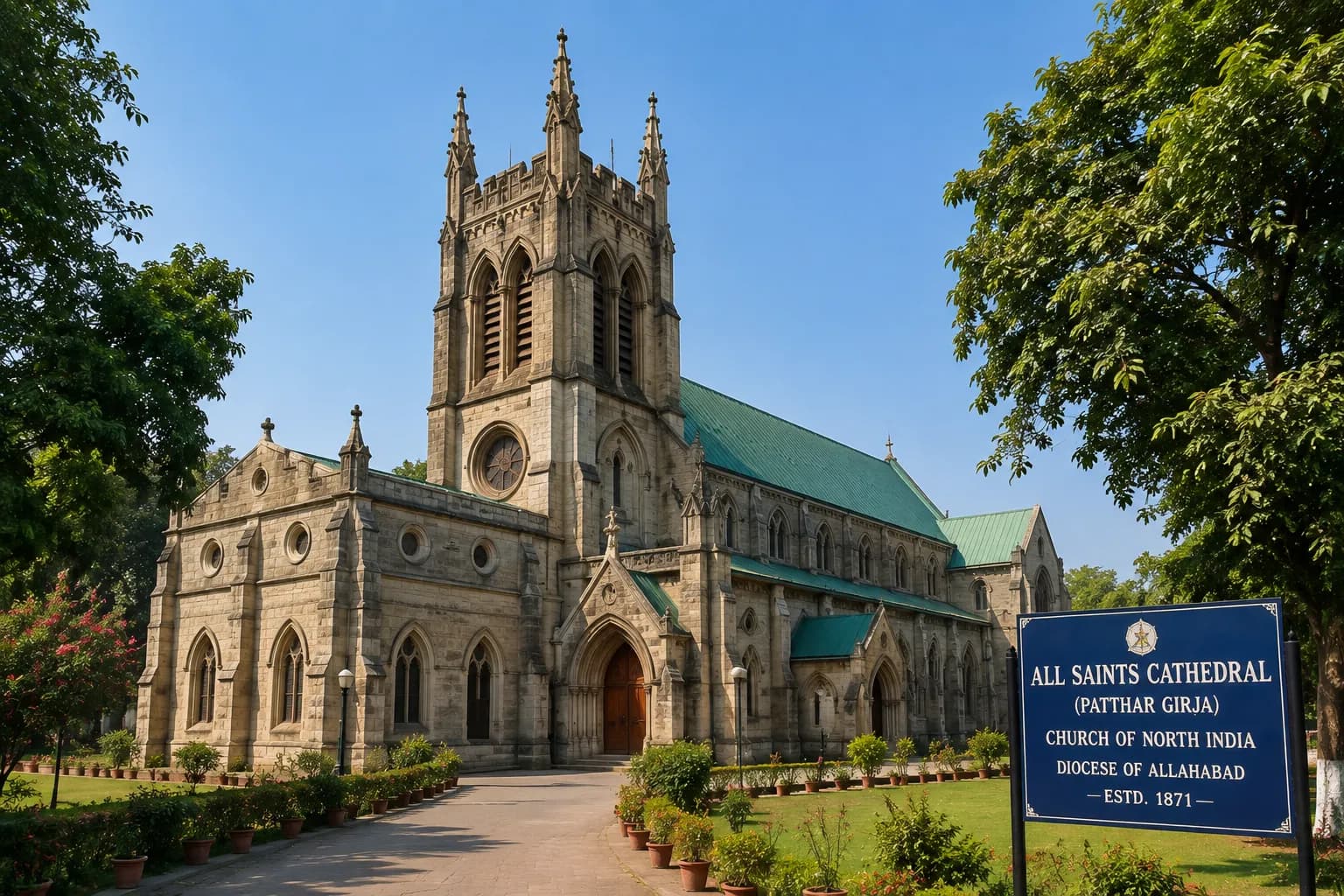
Rising in soaring spires of pale stone above a green island in the heart of Prayagraj, in the Civil Lines quarter, stands one of the most beautiful churches in all of India: All Saints Cathedral, known and loved by everyone in the city as Patthar Girja, the Church of Stones. It is a cathedral of the Church of North India, a magnificent work of Gothic Revival architecture from the days of the British Raj, and among the grandest colonial buildings in the whole of the north. It stands upon what is, in effect, a great traffic island, the roads looping around its circular churchyard, so that the huge stone church looms above the trees in the middle of the city, a landmark that every traveller through Prayagraj remembers. It is a place of great beauty, of history, and of peace.
The Gothic Revival masterpiece of William Emerson
The cathedral is, above all, an architectural masterpiece, and the work of a master. It was designed by Sir William Emerson, one of the most eminent British architects of his age, the same hand that gave India the celebrated Victoria Memorial of Kolkata, the Crawford Market of Mumbai, and the Muir College here in Allahabad. He designed All Saints in the grand Gothic Revival style, modelled on the great Gothic churches of thirteenth-century England, with all their soaring beauty: the tall spires and turrets, the pointed arches, the flying buttresses, the ribbed and vaulted ceilings, and the great rose window. Its foundation stone was laid in 1871 by Lady Muir, the wife of the Lieutenant-Governor; it was consecrated in 1887 and completed four years later. And it is built of the pale, cream sandstone of the region, dressed with red stone, and it is from this beautiful stone that the people gave it its beloved name, Patthar Girja, the Church of Stones. A vast cruciform building, some two hundred and forty feet long and a hundred feet high, it was cleverly designed, too, to stay cool through the Indian summer; it stands as one of the finest expressions of colonial architecture in India, where Western Gothic grandeur meets Indian stone and craft.
The stained glass and the serene interior
If the cathedral is grand without, it is lovelier still within. Its glory is its stained glass: the beautiful old windows, brought, it is said, from as far as Argentina, glow with the rich colours of their biblical scenes, and the great rose window blazes at the end; and when the sun streams through them into the soaring, vaulted nave, it fills the great stone hall with a jewelled and tranquil light, a light for prayer. There is a fine altar of marble and mosaic, and rows of classical columns and graceful archways. And the cathedral holds its memories, too, in the many marble plaques upon its walls, and in the memorial chapel to the soldiers who fell in the First World War, whose names are carved in the stone. To sit a while in that coloured, silent light is to feel the deep peace of the place, whatever one's faith.
An active cathedral and the city's shared heritage
All Saints is no mere monument but a living, worshipping cathedral, the seat of the Church of North India in this region, under the Diocese of Lucknow. Its Sunday services, in English and in Hindi, and its great celebrations at Christmas and Easter, fill it with prayer and song; and, in the Christian spirit, it welcomes all who come, with entry free and equal to every visitor. And there is something fitting in its presence here, for Prayagraj is the city of the Sangam, the great confluence, a meeting not only of the sacred rivers but of the faiths and peoples of India; and this beautiful cathedral stands, alongside the temples and the mosques and the gurudwaras of the city, as a cherished part of its shared and many-coloured heritage, a reminder of the richness and the diversity that meet at the confluence.
The beautiful Church of Stones, in my own words
By Rajeev Sharma, guide with Experience My India
I love bringing my visitors to All Saints Cathedral, our Patthar Girja, because it is simply one of the most beautiful buildings in the city, and a lovely change from the temples. I tell them it was designed by the same great architect who did the Victoria Memorial in Kolkata, and that it is one of the finest Gothic churches in all of India, built of our local pale stone, which is why we call it the Church of Stones. And when I take them inside, into that quiet, and they see the sunlight coming through the old stained glass in all its colours, they are always struck by the peace and the beauty of it.
I explain the architecture, the spires and the arches and the rose window, and show them the beautiful altar and the old memorials; it is a treat for anyone who loves buildings and history. And I always tell my visitors that this church, standing here among our temples and mosques, is a lovely sign of the diversity of our holy city, where all faiths meet, as the rivers do at the Sangam. I remind them, of course, that it is an active church, so we go quietly and dress respectfully, and if they want to see the glass in peace, I bring them on a weekday. I pair it with Azad Park and the Civil Lines heritage. A beautiful, peaceful, dignified place.
In more than forty years of guiding, sharing the quiet, coloured beauty of this great Church of Stones is among the loveliest things I do.
What to see and do
- Admire the Gothic Revival exterior: the spires, turrets, pointed arches and flying buttresses in pale stone.
- Step inside for the stained-glass windows and the great rose window, glowing in the vaulted nave.
- See the marble and mosaic altar, the columns and archways, and the old memorial plaques.
- Visit the memorial chapel to the soldiers of the First World War.
- Come on a weekday for quiet photography, and pair it with the Civil Lines heritage.
How to reach All Saints Cathedral
The cathedral is at the crossing of Sarojini Naidu Marg and M.G. Marg in Civil Lines, near Subhash Chauraha and about a km from the railway station, in the heart of the city, easily reached by road, with free parking on-site.
| From | Distance | Notes |
|---|---|---|
| Prayagraj Junction (railway) | About 1 km | By auto, e-rickshaw or a short walk. |
| Chandra Shekhar Azad Park | A short ride | The great park and the Civil Lines heritage. |
| Anand Bhawan | A short ride | The Nehru museum; the city's heritage. |
| The Triveni Sangam | A few km | The sacred confluence. |
| Prayagraj (Bamrauli) Airport | About 12 to 15 km | The city airport; cabs to Civil Lines. |
It is in the heart of Civil Lines, near the station.
Best time to visit and how to plan it
| When | Why |
|---|---|
| Weekday mornings, 8:30 AM onwards | To admire and photograph the architecture and glass in quiet. |
| About 15 minutes before the Sunday service | To see the stained glass without disturbing the prayers. |
| Christmas and Easter | For the great services and the festive spirit of the cathedral. |
| Morning light | When the sun through the stained glass is at its most beautiful. |
- Pair it with Azad Park, Anand Bhawan and the Civil Lines heritage.
- Allow 30 to 45 minutes for the cathedral, more to attend a service.
For Prayagraj, or a combined Kashi, Ayodhya and Prayagraj visit, planned end to end, see our tour packages.
Accessibility for elderly and mobility limited visitors
- The main entrance is wheelchair accessible, and there is free parking on-site.
- The great nave is level and open, easy and restful to move through.
- The pews offer plenty of seating to sit and enjoy the peace and the light.
- We arrange transport to the gate and plan a comfortable, gentle heritage visit.
Etiquette for visiting
- It is an active place of worship; keep strict silence once inside the stone hall.
- Dress modestly, as a sign of respect, and set your phone to silent.
- Do not disturb any prayers or services in progress; ask before photographing during worship.
- Be reverent and considerate, as you would in any place of prayer.
Our guided heritage visits and Prayagraj tours
We are a Varanasi, Ayodhya and Prayagraj based operator, a unit of Experience My India, with more than forty years of guiding visitors across all three cities, and our own local guide in Prayagraj. Entry is free, so what we offer is the story and the planning: a guide who tells the history of the cathedral and the genius of its architecture, respectfully and well, the visit paired with Azad Park and Anand Bhawan and the Civil Lines heritage, and the whole many-faith heritage of the city, woven into a full Prayag day.
| Service | Includes | Price |
|---|---|---|
| Guided All Saints Cathedral and heritage visit | The cathedral with Azad Park or Anand Bhawan, and the story, with a guide. | Contact us for pricing |
| Prayagraj Civil Lines heritage circuit | The cathedral, Azad Park and Anand Bhawan, with a guide. | Contact us for pricing |
| Full Prayagraj day | The cathedral within a wider Prayagraj visit, with a guide. | Contact us for pricing |
| Kashi, Ayodhya and Prayagraj tour | The three cities, sacred and heritage, with a guide. | Contact us for pricing |
Inclusions and exclusions are stated up front, with any taxes and conditions, and no charge appears later that was not named. Entry is free; our charge is only for guiding and services. See all our tour packages for the full range.
Experience My India is a travel operator, not the cathedral administration. Entry is free; our charge is only for our guiding and services. Timings, service times and rules are set by the cathedral and can change.
Nearby sites in Prayagraj
All Saints Cathedral is in the Civil Lines heart of Prayagraj, among its heritage sites.
| Site | What it is | Internal link |
|---|---|---|
| Chandra Shekhar Azad Park | The great park and martyr's memorial, with the colonial Victoria canopy, nearby. | /temple/prayagraj/chandra-shekhar-azad-park |
| Anand Bhawan | The Nehru family mansion and museum; the city's heritage. | /temple/prayagraj/anand-bhawan |
| Triveni Sangam | The sacred confluence of the Ganga, Yamuna and Saraswati. | /temple/prayagraj/triveni-sangam |
| Khusro Bagh | The Mughal garden and tombs, near the railway station. | /temple/prayagraj/khusro-bagh |
| Ramnagar Fort (Varanasi) | The great riverside fort of Kashi, for more of the region's architecture. | /temple/varanasi/ramnagar-fort |
For the great park and colonial heritage nearby, see our Chandra Shekhar Azad Park guide.