.webp&w=2048&q=75)

Essential info at a glance
| Detail | At a glance |
|---|---|
| What it is | A historic 40-acre Mughal walled garden and tomb complex, in the Persian Charbagh style. |
| Opening hours | 6:00 AM to 7:00 PM, all days. |
| Entry fee | Free (a small tip to the attendants for the tomb interiors is customary). |
| Time needed | About 1 to 2 hours to walk the whole complex. |
| The tombs | Prince Khusro, Shah Begum, Nithar Begum, and Bibi Tamolan. |
| Also | A famous orchard of the premium Prayagraj guavas and mango trees. |
| History | Built under Emperor Jahangir; a sepoy headquarters in the 1857 uprising. |
| Location | G T Road, Khuldabad, right next to Prayagraj Junction railway station. |
Khusro Bagh timings and entry
Khusro Bagh is open every day from 6:00 AM to 7:00 PM, and entry is free; it is customary only to give a small tip to the attendants if they unlock the interiors of the tombs. Allow about one to two hours to walk the whole forty-acre complex. The best time is the early morning, from about 6:00 to 9:00 AM, quiet and lovely for a walk and for photography; the evenings are busy, when the people of the city come to the open lawns for recreation and games. Smoking, matches and alcohol are strictly prohibited within the historical grounds.
| Detail | When | Notes |
|---|---|---|
| Opening hours | 6:00 AM to 7:00 PM, all days | Free; a small tip for the tomb interiors. |
| Best time | 6:00 to 9:00 AM | Quiet and lovely for a walk and photography. |
| Evenings | Busy | Locals use the lawns for recreation and sport. |
| Time needed | About 1 to 2 hours | To walk the whole 40-acre complex. |
Khusro Bagh: the Mughal garden and tombs
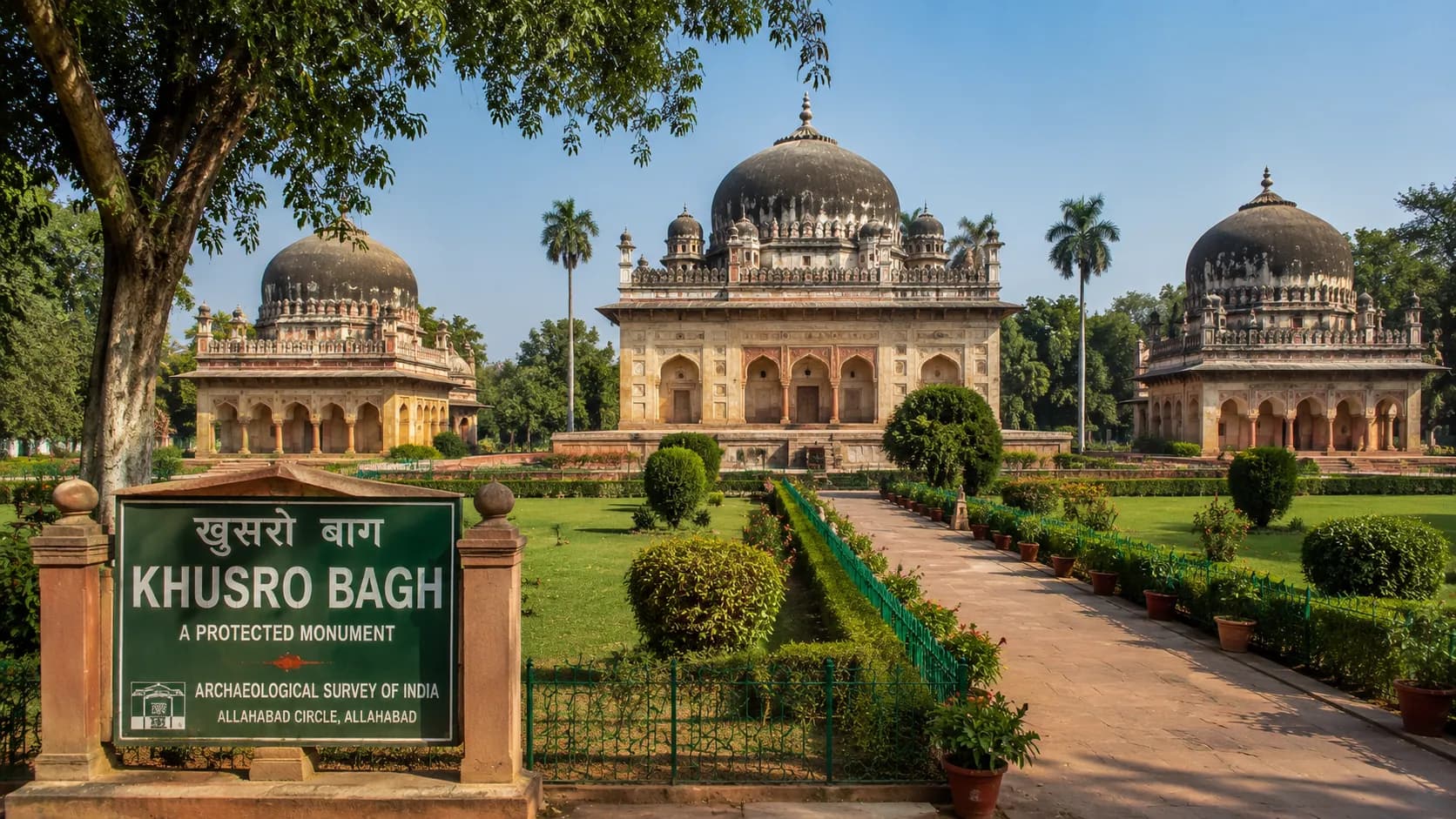
A short walk from Prayagraj Junction railway station lies one of the finest pieces of Mughal heritage in the city: Khusro Bagh, a great walled garden of some forty acres, laid out in the classic Persian Charbagh style, the four-quartered garden of the Mughal imagination, with its ordered pathways and water features, and, set within it, the exquisite sandstone tombs of a Mughal prince and his family. Built in the reign of the Emperor Jahangir in the early seventeenth century, and protected today by the Archaeological Survey of India, the garden takes its name from Prince Khusro, whose tragic story it quietly holds. It is a place of a certain still and melancholy beauty, of fine old stone and green lawns and fruiting orchards, a silent witness to the grandeur and the sorrows of the Mughal age.
The tragic tale of Prince Khusro and his family
The tombs of Khusro Bagh hold one of the more poignant and tragic stories of the Mughal house, and it is told here with dignity and without judgment. Prince Khusro Mirza was the eldest son of the Emperor Jahangir and his first wife, Shah Begum. Early in his father's reign, the young prince, with the support of some of the nobles, rose in rebellion against Jahangir in a bid for the throne; but the rebellion failed, and Khusro was captured, and, after years of captivity and the loss of his sight, he was at the last put to death in the year 1622, it is widely believed at the hand of his younger brother, the future Emperor Shah Jahan, who saw in him a rival. He was laid to rest here.
His mother, Shah Begum, was a Rajput princess of the house of Amber, the first wife of Jahangir; and, torn beyond bearing by the deadly conflict between her husband and her beloved son, she took her own life in the year 1604. Her tomb was raised here two years later. And here too rests Khusro's sister, Nithar Begum, a daughter of Jahangir, who, the tradition tells, devoted her whole life to the service of her father and her brother and never married, and whose beautiful tomb has earned the name of a second Taj Mahal. A fourth and simpler tomb, of Bibi Tamolan, stands within the complex. Together they make Khusro Bagh a resting-place of a whole Mughal family bound by love and by tragedy.
The architecture: the Charbagh and the three great tombs
Khusro Bagh is a treasure for the lover of architecture, for its tombs are among the finest expressions of Mughal art, a rich blend of the Indo-Islamic, the Persian and the Rajput, wrought in warm red sandstone, with bulbous domes, delicate stone jaalis, floral and geometric ornament, and painted frescoes. The design of the great gateway, the gardens and the tomb of Shah Begum is attributed to Aqa Reza, the principal court artist of Jahangir himself. The tomb of Shah Begum is a striking three-tiered terrace, crowned with a chhatri, and adorned with fine arabesque inscriptions carved, it is said, by Mir Abdullah Mushkin Qalam, the emperor's own celebrated calligrapher. The tomb of Nithar Begum is the loveliest of all, the so-called second Taj Mahal, a two-storeyed sandstone structure with wonderful Mughal frescoes, star-painted ceilings and elaborate floral work within. And the tomb of Prince Khusro, simpler and single-storeyed, carries lovely inscriptions and frescoes of its own, with, beside it, a small grave said to be that of the prince's own beloved mare. To walk among them is to walk through a gallery of Mughal beauty.
The uprising of 1857 and the orchard
Khusro Bagh holds a place, too, in the later history of India, for in the great uprising of 1857 it became the headquarters of the revolting sepoys of the region, under the leadership of Maulvi Liaquat Ali, who from here declared himself the governor of the liberated Allahabad, until the British forces retook the garden and the city. And beyond its tombs and its history, Khusro Bagh is a living garden, a great and famous orchard: it is renowned for its premium Prayagraj guavas, the celebrated Allahabadi amrud that is loved across India, and for its mango trees, so that in season the old Mughal garden is heavy with fruit, a working orchard as well as a monument, green and alive around the silent tombs.
The silent Mughal garden, in my own words
By Rajeev Sharma, guide with Experience My India
I love bringing my visitors to Khusro Bagh, especially in the quiet of the early morning, for it is a beautiful and peaceful place, and a change from the temples and the ghats. I explain that it is a Mughal garden and the tombs of a royal family, and I tell them the sad story with respect: Prince Khusro, who rebelled against his father Jahangir and came to a tragic end; his mother the Rajput queen Shah Begum, who died of a broken heart over it; his devoted sister Nithar Begum, whose tomb they call the second Taj Mahal. People are always moved by the human tragedy of it, told plainly and kindly.
And I show them the beautiful architecture, the Charbagh garden, the fine sandstone, the frescoes and the star-painted ceilings, and I tell them it was designed by Jahangir's own court artist. I point out the 1857 history, and, if it is the season, I let them enjoy the famous Allahabadi guavas from the orchard. I pair it with Anand Bhawan and the Fort, so my visitors see the whole sweep of Prayag's heritage, the Mughal and the modern. It is right by the railway station, so easy to fit in, and I always keep the history dignified and fair. A quiet, lovely, moving place.
In more than forty years of guiding, this silent Mughal garden and its tragic, beautiful tombs are among the most atmospheric places I share.
What to see and do
- See the four sandstone tombs: Prince Khusro, Shah Begum, Nithar Begum, and Bibi Tamolan.
- Admire the tomb of Nithar Begum, the second Taj Mahal, with its frescoes and star-painted ceilings.
- Walk the Persian Charbagh garden and its ordered pathways.
- Enjoy the famous orchard of Prayagraj guavas and mango trees, in season.
- Come at dawn for the peace and the photography, and pair it with Anand Bhawan.
How to reach Khusro Bagh
Khusro Bagh is on G T Road in Khuldabad, right next to Prayagraj Junction railway station, less than a ten-minute walk from the station exit, and easily reached from anywhere in the city.
| From | Distance | Notes |
|---|---|---|
| Prayagraj Junction railway station | Under a 10-minute walk | Directly next to the station. |
| Anand Bhawan | A short ride | The Nehru museum; pair the heritage sites. |
| The Allahabad Fort | About 6 km | The Mughal fort by the Sangam. |
| The Triveni Sangam | A few km | The sacred confluence. |
| Prayagraj (Bamrauli) Airport | About 12 to 15 km | The city airport; cabs to the garden. |
Its nearness to the station makes it an easy first or last stop.
Best time to visit and how to plan it
| When | Why |
|---|---|
| Early morning (6:00 to 9:00 AM) | Quiet and lovely for the walk, the tombs and photography. |
| Winter (Nov to Feb) | The most pleasant season, and the season of the famous guavas. |
| Avoid the busy evenings | When the lawns fill with locals at recreation and sport. |
| With Anand Bhawan and the Fort | To see the whole Mughal and modern heritage of the city. |
- Pair it with Anand Bhawan and the Allahabad Fort for the city's heritage.
- Allow 1 to 2 hours, and come early for the calm and the light.
For Prayagraj, or a combined Kashi, Ayodhya and Prayagraj visit, planned end to end, see our tour packages.
Accessibility for elderly and mobility limited visitors
- The garden is large but level, with broad paths, pleasant for a gentle walk; the tomb interiors involve some steps.
- Come in the cool of the morning, and pace the walk across the wide grounds.
- There are lawns and shade to rest in; drinking water is available.
- We arrange transport to the gate and plan a comfortable, well-paced heritage visit.
Etiquette for visiting
- These are tombs, a burial place; be respectful and quiet within and around them.
- Smoking, matches and alcohol are strictly prohibited in the grounds; do not bring them.
- Do not damage the old stone, the frescoes or the trees; a small tip to the attendants for the tomb interiors is customary.
- Keep the garden clean, and mind children among the monuments and the orchard.
Our guided heritage visits and Prayagraj tours
We are a Varanasi, Ayodhya and Prayagraj based operator, a unit of Experience My India, with more than forty years of guiding visitors across all three cities, and our own local guide in Prayagraj. Entry is free, so what we offer is the story and the planning: a guide who tells the Mughal history and the tragic tale of the prince and his family, fairly and with respect, and the beauty of the architecture, the visit paired with Anand Bhawan and the Fort and the Sangam, and the whole heritage of the city, woven into a full Prayag day.
| Service | Includes | Price |
|---|---|---|
| Guided Khusro Bagh and heritage visit | Khusro Bagh with Anand Bhawan or the Fort, and the story, with a guide. | Contact us for pricing |
| Prayagraj Mughal and modern heritage circuit | Khusro Bagh, the Fort and Anand Bhawan, with a guide. | Contact us for pricing |
| Full Prayagraj day | Khusro Bagh within a wider Prayagraj visit, with a guide. | Contact us for pricing |
| Kashi, Ayodhya and Prayagraj tour | The three cities, sacred and heritage, with a guide. | Contact us for pricing |
Inclusions and exclusions are stated up front, with any taxes and conditions, and no charge appears later that was not named. Entry is free; our charge is only for guiding and services. See all our tour packages for the full range.
Experience My India is a travel operator, not the monument administration. Entry is free (the monument is ASI-protected); our charge is only for our guiding and services. Timings and rules are set by the authorities and can change.
Nearby sites in Prayagraj
Khusro Bagh is near the station, among the heritage sites of Prayagraj.
| Site | What it is | Internal link |
|---|---|---|
| Anand Bhawan | The Nehru family mansion and museum; the modern heritage of the city. | /temple/prayagraj/anand-bhawan |
| Allahabad Fort and Akshayavat | Akbar's great Mughal fort by the Sangam. | /temple/prayagraj/allahabad-fort-akshayavat |
| Triveni Sangam | The sacred confluence of the Ganga, Yamuna and Saraswati. | /temple/prayagraj/triveni-sangam |
| Bahu Begum ka Maqbara (Ayodhya) | The great Nawabi tomb-garden of Faizabad; more Indo-Islamic heritage. | /temple/ayodhya/bahu-begum-ka-maqbara |
| Gulab Bari (Ayodhya) | The Nawabi garden-tomb of Faizabad, for the region's garden heritage. | /temple/ayodhya/gulab-bari |
For the Nehru family mansion nearby, see our Anand Bhawan guide.