.webp&w=2048&q=75)
Essential info at a glance
| Detail | At a glance |
|---|---|
| What it is | An ancient Shiva temple across the Yamuna at Arail, the Lord established and worshipped by the Moon; one of the four principal deities of Prayag. |
| General hours | 4:00 AM to 9:00 PM daily (afternoon break 12:00 to 3:00 PM). |
| Best for darshan and jalabhishek | 5:00 AM to 8:00 AM, in the quiet of the morning. |
| Evening aarti | Around 7:00 PM to 8:00 PM. |
| Entry fee | Free for all devotees. There is no VIP darshan. |
| Sought for | The Moon's grace: relief from Chandra Dosha and peace to the troubled mind. |
| The wonder | The trishul on the spire is said to turn with the movement of the moon. |
| Location | Arail Ghat, Naini, across the Yamuna from the Sangam. |
Someshwar Mahadev Temple timings and aarti
The temple is open from 4:00 AM to 9:00 PM, with an afternoon break usually from about noon to 3:00 PM, and entry is free. The loveliest time to come is the early morning, from about 5:00 to 8:00 AM, for a quiet darshan and the jalabhishek, the bathing of the lingam, in the calm before the day. The evening aarti is around 7:00 to 8:00 PM, and the evening rituals wrap up towards 9:00 PM. Being across the river at Arail, it is a calmer and less crowded place than the great city shrines, though on Maha Shivratri and through the month of Shravan the local crowds are heavy.
| Detail | When | Notes |
|---|---|---|
| Morning session | 4:00 AM to 12:00 PM | Best darshan and jalabhishek 5:00 to 8:00 AM. |
| Afternoon break | 12:00 PM to 3:00 PM | The temple doors usually close. |
| Evening session | 3:00 PM to 9:00 PM | With the evening aarti around 7:00 to 8:00 PM. |
| Busiest | Maha Shivratri, Shravan, Mondays | Heavier local crowds; Rudrabhishek and Bilva offerings. |
Shri Someshwar Mahadev Mandir: the Moon's own Shiva
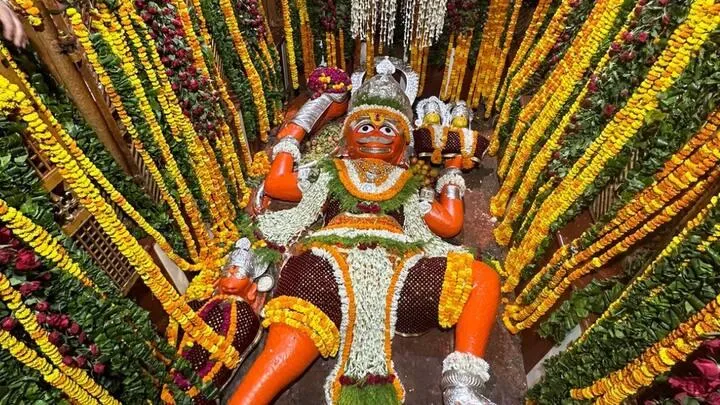
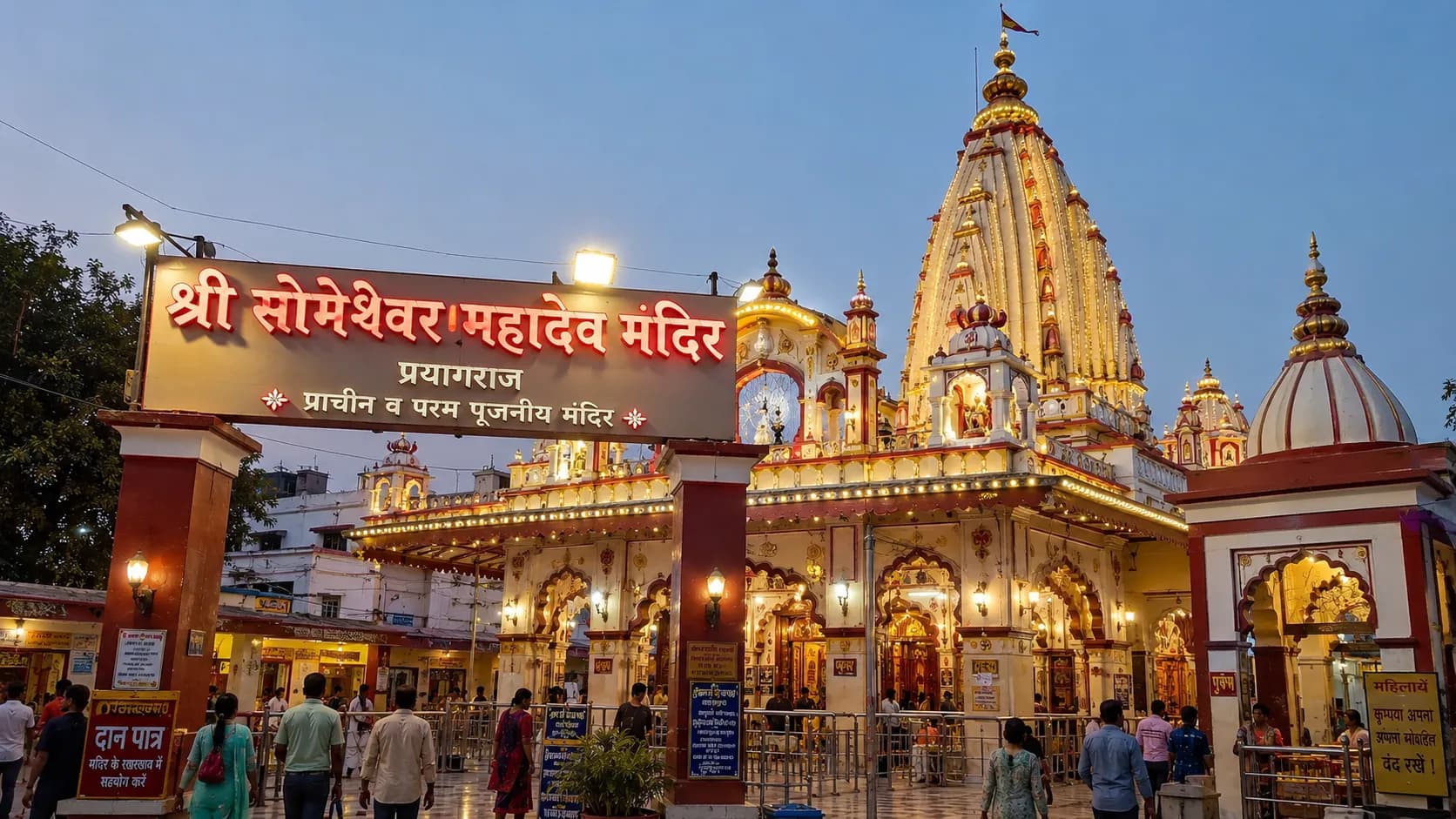
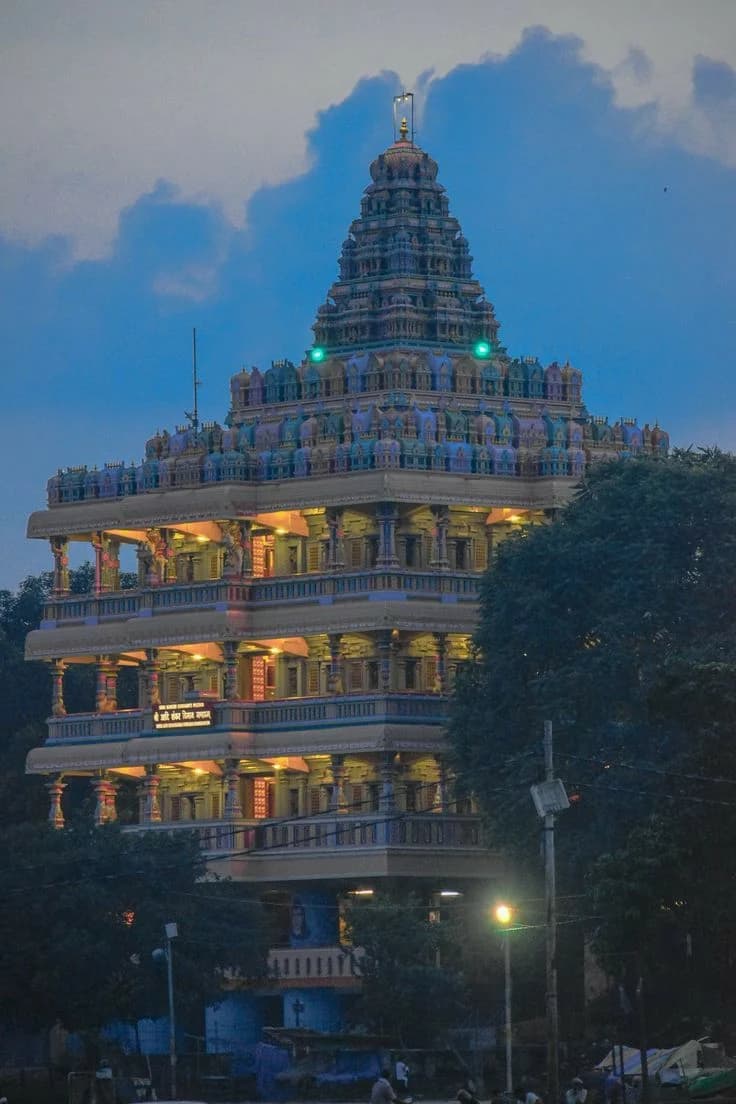
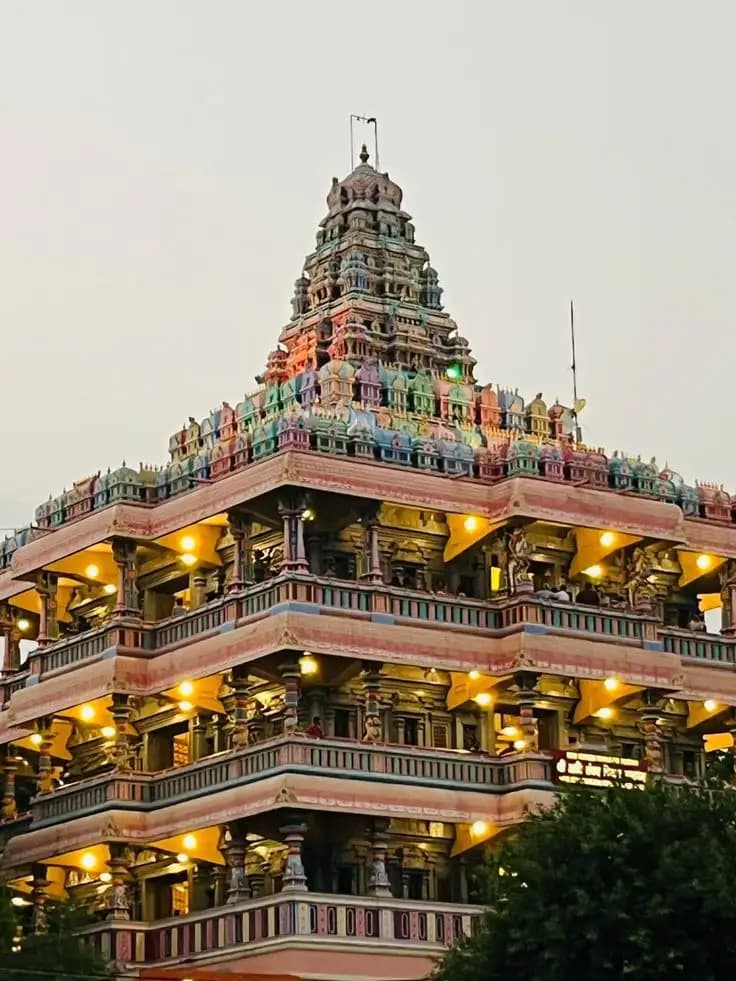
Across the holy Yamuna from the Sangam, in the village of Arail at Naini, stands one of the most ancient and evocative of all the Shiva temples of Prayag: the Shri Someshwar Mahadev Mandir, also called the Someshwar Nath temple. It is reckoned among the very oldest temples of the holy city and among its eight great tirthas, praised in the Padma Purana and the Shiva Purana, and worshipped by the pilgrims who come for the Kumbh and the Magh Mela; its striking shikhara, its spire, rises above the Arail shore. And it is one of the four principal deities of Prayag, the Vishnu Veni Madhav, the Mother Alopi Devi, and the two great Shivas, Mankameshwar within the city and Someshwar here across the river; so that to bow before Someshwar is to complete the round of the four great lords of the tirtharaj. But what makes this temple wondrous above all is whose temple it is: for this is the Shiva of the Moon.
Someshwar: the Lord worshipped by the Moon
The name tells the tale: Someshwar is made of Som, or Soma, the Moon, and Ishwar, the Lord Shiva; and so Someshwar is the Lord of the Moon, the Shiva whom the Moon himself established and worships. And the story of how this came to be is one of the most beautiful in all the sky-lore of our tradition. Chandra, the Moon god, had married the twenty-seven daughters of Daksha Prajapati, who are the twenty-seven nakshatras, the lunar mansions of the heavens; but of all his wives he loved Rohini alone, and neglected the others, who went in their sorrow to their father. And Daksha, angered on his daughters' behalf, laid a curse upon the Moon, that he should waste away and lose his light, wasting with a kshaya, a consuming sickness; and so the bright Moon began to fade and dwindle, dark and diminished. In his despair the Moon sought refuge with Lord Vishnu, who counselled him to go to holy Prayag, and there to worship Lord Shiva. And so the Moon came here, across the Yamuna to Arail, and with his own hands established a Shivalinga and worshipped it with all his heart; and Lord Shiva, pleased with his devotion, lifted the worst of the curse and restored to the Moon his light, though something of the waxing and the waning remained, as we see in the Moon to this day. And ever since, this Lord has been Someshwar, the Lord of the Moon, for the Moon set him here and worships him still.
The wonders: the turning trishul and the rain of nectar
Around this ancient shrine of the Moon-Lord there cling several beautiful wonders that the devout hold dear. The tradition tells, and the priests affirm, that the Shivalinga here was established by the Moon god himself, at Lord Shiva's own bidding. It is said that the trishul, the trident, mounted upon the spire of the temple changes its direction with the very movement of the Moon in the heavens, turning as the Moon turns, a marvel bound up with the temple's lunar Lord. And it is believed that around this temple there falls, softly and unseen, a rain of nectar, of the amrit, the soma, which is the very essence of the Moon; for the Moon is the cup of the nectar of the gods. To stand at Someshwar, then, is to stand in a place touched by the Moon and the nectar of heaven.
The boons: the Moon's grace
Because this is the Lord who healed the Moon, the devout come to Someshwar for the Moon's own grace, and above all for two blessings. The first is relief from the Chandra Dosha, the affliction of a weak or ill-placed Moon in one's horoscope, which the astrologers hold to bring instability and trouble; the worship of the Moon-Lord here, with the proper puja, is believed to soften that affliction. The second is peace of mind, for in our tradition the Moon is the lord of the mind and the emotions, so that the grace of Someshwar is sought for the calming of a troubled, restless or grieving heart, and many find here a deep and healing peace. And, as the Lord once cured the Moon of his wasting sickness, the tradition holds his worship a blessing for health; but for any illness a doctor should always be seen, and the temple visited in faith alongside proper care. The great acts of worship are the jalabhishek and, on the holy days, the Rudrabhishek, above all through Shravan and on Maha Shivratri. Our pandit can arrange the puja for those who seek the Moon-Lord's grace.
The Moon-Lord across the river, in my own words
By Rajeev Sharma, guide with Experience My India
I love to take my pilgrims across the Yamuna to Arail, to Someshwar Mahadev, because it is a quieter, more peaceful place than the busy city temples, and the story is so beautiful. I tell them: this is the Shiva of the Moon; here the Moon himself, cursed by Daksha to waste away and lose his light, came and worshipped Lord Shiva, and was healed and given back his glow, which is why he waxes bright again each month. So we call the Lord Someshwar, the Lord of the Moon. And I show them the wonder, the trishul on the spire that they say turns with the Moon, and I tell them the nectar of the Moon is said to rain here.
Many of my guests come for a reason: for the Chandra Dosha in their stars, or for peace of mind, for the Moon rules the mind, and I arrange the jalabhishek and the puja with our pandit; and I always tell them, if there is real illness, to see a doctor too, and to come here in faith alongside. And I fit Someshwar into the round of the four great lords of Prayag, so my guests complete them all, Veni Madhav, Alopi Devi, Mankameshwar and Someshwar. It is a calm, powerful, moon-touched place across the river, with a lovely view back to the Sangam, and I never let a devotee of Shiva miss it.
In more than forty years of guiding, this quiet Moon-Lord across the river, and the peace people find here, are among the most tender things I share.
What to see and do
- Take the darshan of the Shivalinga established by the Moon himself, at Arail.
- Perform the jalabhishek at dawn, and seek the Moon-Lord's grace for peace of mind.
- See the trishul on the spire, said to turn with the movement of the moon.
- Arrange the puja for relief from Chandra Dosha, with our pandit, if it troubles your stars.
- Enjoy the calm Arail shore and the view back to the Sangam, and complete the four lords of Prayag.
How to reach Someshwar Mahadev Temple
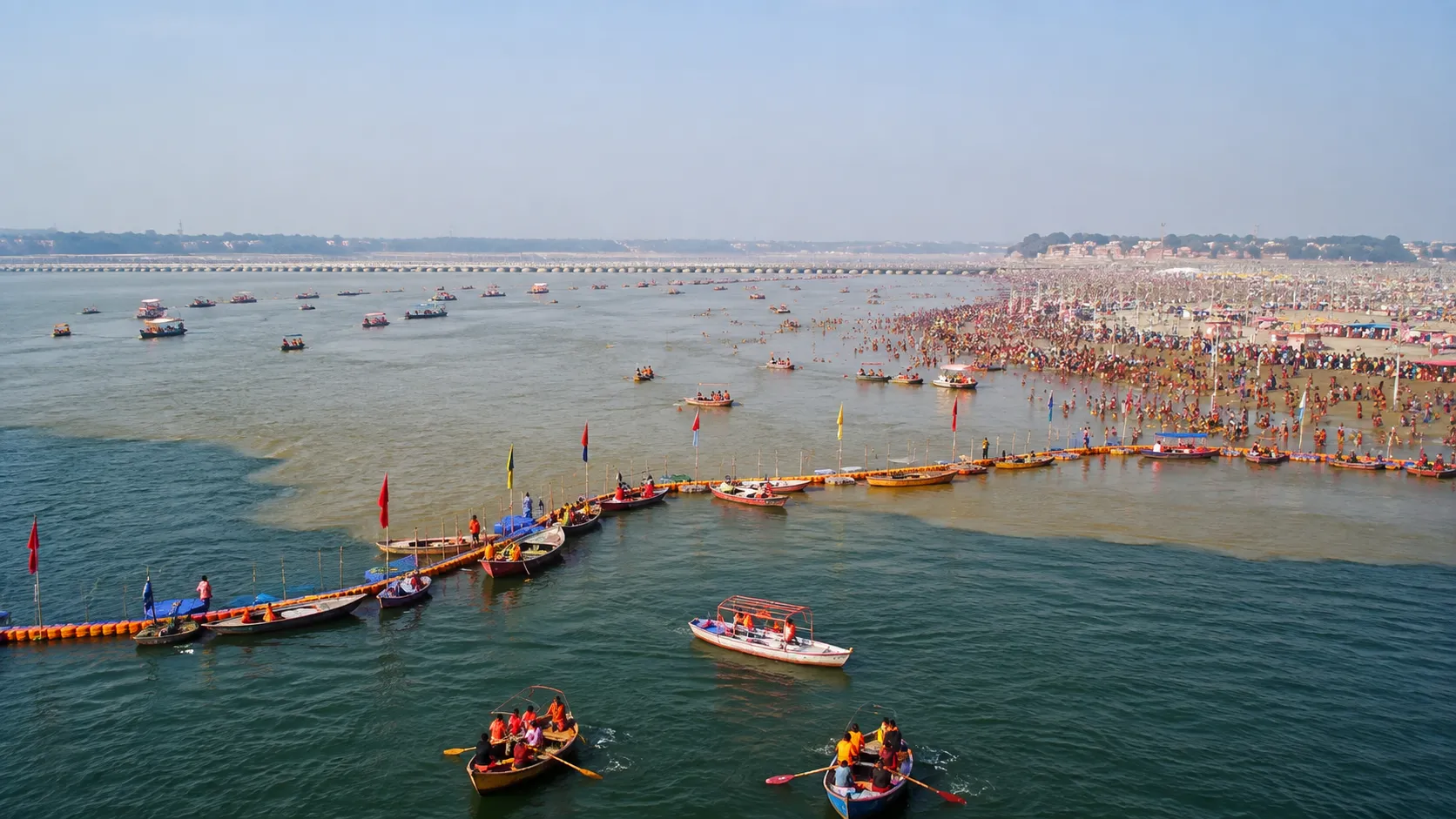
The temple is at Arail Ghat, in Naini, across the Yamuna from the Sangam, reached by the Yamuna bridge by road, or by boat across from the Sangam; about 10 km from the railway station.
| From | Distance | Notes |
|---|---|---|
| The Triveni Sangam | Across the Yamuna | By boat from the Sangam, or by road over the Yamuna bridge. |
| Mankameshwar Mahadev | Across the river | The other great Shiva of the four principal deities. |
| Naini / Arail | In Arail village | On the southern bank; the Arail Ghat and Kumbh area. |
| Prayagraj Junction (railway) | About 10 km | By auto or taxi over the Yamuna bridge. |
| Prayagraj (Bamrauli) Airport | About 20 km | The city airport; taxis to Arail. |
It is a peaceful counterpart across the river to the Sangam.
Best time to visit and how to plan it
| When | Why |
|---|---|
| Mondays, and the month of Shravan | The days of Shiva, most auspicious for the jalabhishek. |
| Maha Shivratri | The grand festival of Shiva, with night-long worship and Rudrabhishek. |
| Dawn, for the jalabhishek | The calmest and loveliest time, in the quiet of the morning. |
| Purnima (the full moon) | The day of the Moon, especially fitting for the Moon-Lord. |
- Pair it with the Sangam, and cross the river to Arail as part of the visit.
- Allow 30 to 45 minutes for the darshan and abhishek; longer for a puja.
For Prayagraj, or a combined Kashi, Ayodhya and Prayagraj pilgrimage, planned end to end, see our tour packages.
Accessibility for elderly and mobility limited visitors
- The temple is reached across the river by bridge or boat; the road approach is the easier for the frail.
- It is calm and uncrowded on ordinary days, suiting a gentle, restful visit.
- Our pandit can perform the jalabhishek and puja comfortably, seated as needed.
- We arrange transport across the Yamuna and plan a gentle darshan within your Prayagraj day.
Etiquette for visiting
- Remove footwear and dress modestly; be reverent before the Shivalinga.
- Offer water, Bilva leaves and your prayers in the abhishek, in the local custom.
- Keep to the queue and follow the priests, especially on Maha Shivratri and in Shravan.
- Keep the calm Arail shore clean, and mind the river and the boats if you cross by water.
Our guided darshan and Prayagraj tours
We are a Varanasi, Ayodhya and Prayagraj based operator, a unit of Experience My India, with more than forty years of guiding pilgrims across all three holy cities, and our own local guide and pandit in Prayagraj. Darshan is free, so what we offer is the experience made smooth and meaningful: the crossing to peaceful Arail and the darshan and jalabhishek of the Moon-Lord, a pandit for the puja and for those who seek relief from Chandra Dosha, a guide who tells the beautiful story of the Moon, and the round of the four principal lords of Prayag, woven with the Sangam and the whole three-city pilgrimage.
| Service | Includes | Price |
|---|---|---|
| Guided Someshwar darshan and jalabhishek | The crossing to Arail, the darshan and jalabhishek with a pandit, with a guide. | Contact us for pricing |
| Chandra Dosha puja | The puja for relief from Chandra Dosha with the pandit, with a guide. | Contact us for pricing |
| The four principal lords of Prayag | Veni Madhav, Alopi Devi, Mankameshwar and Someshwar, with a guide. | Contact us for pricing |
| Kashi, Ayodhya and Prayagraj pilgrimage | The three holy cities and their great Shiva temples, with a guide. | Contact us for pricing |
Inclusions and exclusions are stated up front, with any taxes and conditions, and no charge appears later that was not named. Darshan is free; our charge is only for guiding, the pandit, the boat and services. See all our tour packages for the full range.
Experience My India is a travel operator, not the temple administration. Darshan is free; our charge is only for our guiding and services. Timings and rules are set by the temple and can change.
Nearby sacred sites in Prayagraj
Someshwar is the Moon-Lord of Prayag, across the river from the Sangam.
| Site | What it is | Internal link |
|---|---|---|
| Mankameshwar Mahadev | The wish-fulfilling Shiva; the other great Shiva of the four principal deities. | /temple/prayagraj/mankameshwar-temple |
| Veni Madhav Temple | The presiding Vishnu of Prayag; one of the four principal deities. | /temple/prayagraj/veni-madhav-temple |
| Alopi Devi Mandir | The Devi shrine; one of the four principal deities of Prayag. | /temple/prayagraj/alopi-devi-mandir |
| Triveni Sangam | The sacred confluence, across the Yamuna; cross to Arail for Someshwar. | /temple/prayagraj/triveni-sangam |
| Nagvasuki Temple | The serpent-king; also sought for astrological relief (Kaal Sarp Dosha). | /temple/prayagraj/nagvasuki-temple |
For the Sangam snan and the confluence, see our Triveni Sangam guide.