.webp&w=2048&q=75)
.webp&w=2048&q=75)
Essential info at a glance
| Detail | At a glance |
|---|---|
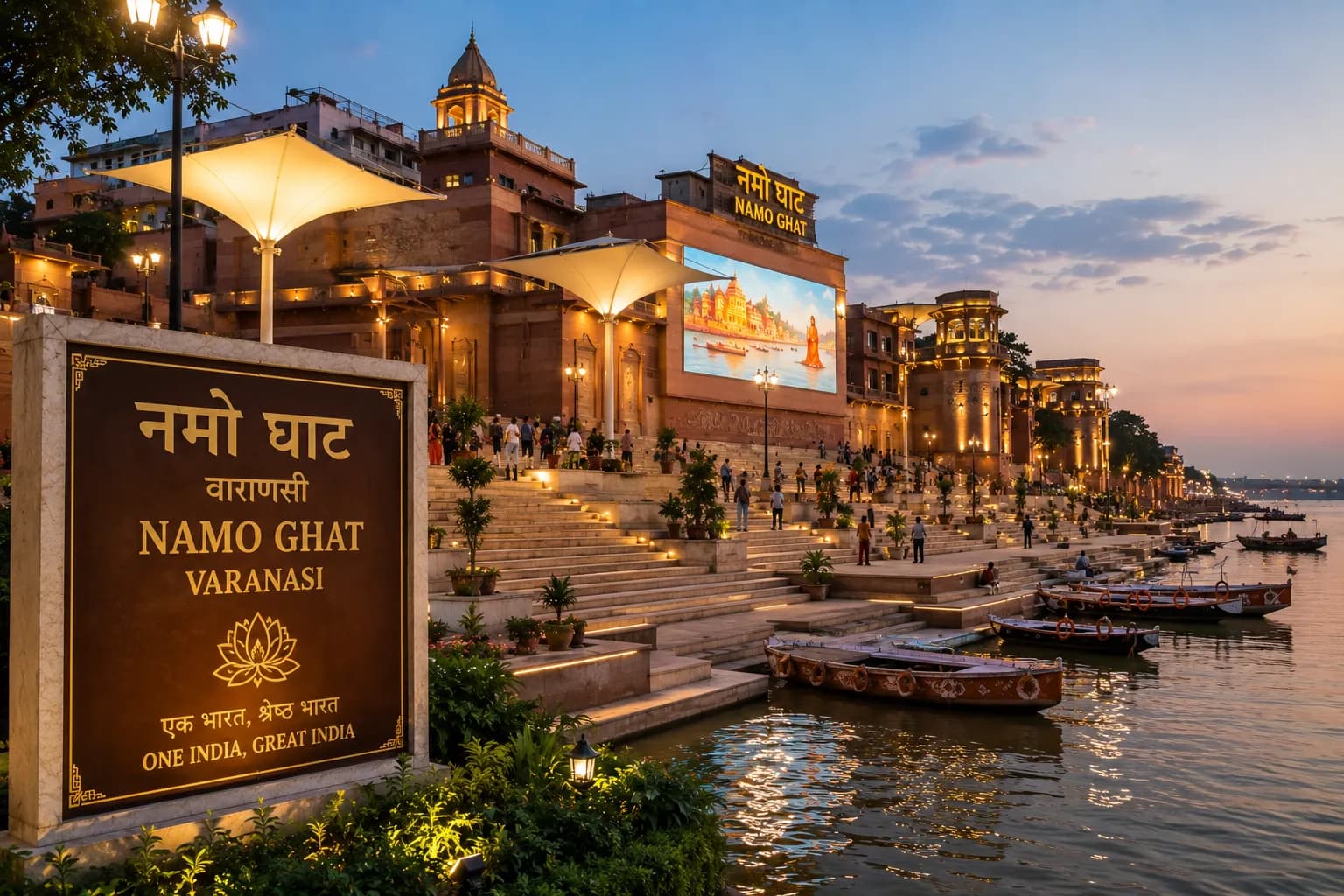
| What it is | Varanasi's striking, modern new ghat, the redeveloped Khirkiya Ghat, famous for its giant Namaste sculptures. |
| Opening hours | Open daily from 5:00 AM to 9:00 PM. |
| Ganga aarti | Its own evening aarti, around 7:00 to 7:45 PM in summer and 6:00 to 6:45 PM in winter. |
| Entry fee | Free. No ticket is needed to walk around or watch the aarti from the steps. |
| The icon | Three huge folded-hands, Namaste, sculptures greeting the Ganga and the rising sun. |
| Why it stands out | Modern, clean, eco-friendly and, unusually, wheelchair-accessible, with ramps to the river. |
| Atmosphere | Spacious and much less crowded than Dashashwamedh; family-friendly. |
| Location | Near Rajghat, by the Malviya Bridge, at the northern end of the riverfront. |
Namo Ghat timings and aarti
Namo Ghat keeps set daytime hours rather than the round-the-clock openness of the old ghats, and it has its own evening Ganga aarti, a newer, calmer and far less crowded ceremony than the great one at Dashashwamedh. The best times to come are early morning for the sunrise and the cool quiet, or the evening for the aarti and the river breeze.
| Detail | When | Notes |
|---|---|---|
| Opening hours | 5:00 AM to 9:00 PM | Open daily; a modern, managed riverfront. |
| Ganga aarti (summer) | About 7:00 to 7:45 PM | Its own evening aarti, much less crowded than Dashashwamedh. |
| Ganga aarti (winter) | About 6:00 to 6:45 PM | Starts around sunset as the days shorten. |
| Best times | 5:00 to 8:00 AM, or 5:00 PM onwards | Sunrise for calm and light; evening for the aarti and the breeze. |
Namo Ghat: Varanasi's striking new riverfront
Almost every ghat in Varanasi is centuries or millennia old, which makes Namo Ghat something rare and refreshing: a brand-new one. It is the beautifully redeveloped Khirkiya Ghat, once a lesser-known ghat whose name meant the window ghat, transformed under the city's Smart City project into one of the finest and most modern riverfronts in all of India, spread over some twenty-one thousand square metres near Rajghat, beneath the old Malviya Bridge at the northern edge of the city. It is a place where the timeless spirit of the Ganga meets clean, contemporary design, and it has quickly become one of the most popular and photographed spots in Varanasi.
For a traveller, it offers a completely different experience of the river: open, spacious, spotless, and easy, a lovely contrast to the beautiful but intense old ghats, and a wonderful place simply to sit, stroll and breathe by the Ganga.
The Namaste sculptures
The heart of Namo Ghat, and the reason for its name, is its set of three huge sculptures of hands folded in namaste, the traditional Indian greeting. They depict a man, a woman and a child, all offering their salutation to the holy Ganga and to the rising sun, and they express one of the most beautiful ideas in Indian culture, Atithi Devo Bhava, the guest is as a god, the spirit of welcome. Rising above the steps, they are magnificent, and they have become the ghat's identity and its most iconic photo spot, from which the ghat took its name, Namo, from namaste. To stand beneath these giant welcoming hands, with the Ganga flowing before them, is a genuinely moving and joyful sight.
Modern, accessible and welcoming
What truly sets Namo Ghat apart, beyond its beauty, is how thoughtfully it has been built for everyone. This is, remarkably, the one ghat in Varanasi genuinely accessible to all: alongside its steps it has gentle ramps right down to the river, so that it can be enjoyed by wheelchair users, by the elderly and by families with young children, who find the steep, uneven steps of the old ghats so difficult. It is, quite literally, reachable by road, by water and even by air, the only ghat with its own helipad.
It is also eco-friendly in design, and generously equipped, with a broad promenade and walkways, a jetty for safely boarding boats, a cafeteria and food court serving Banarasi treats, an open-air theatre, green gardens and seating, a children's play area, a water-sports zone, clean toilets and parking. In short, it is the easiest, most comfortable ghat to visit, and for travellers with mobility needs or with children, it is a genuine gift, all the beauty and spirit of the Ganga, with none of the usual obstacles.
A Ganga aarti without the crowds
Namo Ghat now holds its own evening Ganga aarti, one of only a handful of ghats in the city to do so, and it is a lovely thing. It has the lamps, the chanting and the devotion of the great ceremony, but in a spacious, modern setting and with a fraction of the crowd of Dashashwamedh Ghat. For travellers who want to experience the beauty of the Ganga aarti without the crush, especially families and elderly visitors, this is one of the best places in Varanasi to do it. It is busier on weekends and holidays, when it takes on a cheerful, fair-like buzz, so a weekday evening is calmest.
A new kind of ghat, in my own words
By Rajeev Sharma, Varanasi local
Namo Ghat has become one of my most useful places in all of Varanasi, and I will tell you why. When I have guests who are elderly, or in a wheelchair, or families with small children, the old ghats with their steep, broken steps can be very hard, and it used to break my heart. Now I bring them to Namo Ghat, where there are proper ramps right down to the river, and they can enjoy the Ganga, and even the aarti, in comfort and dignity. I have seen older pilgrims moved to tears that they could finally get close to the water.
And it is beautiful in its own modern way. I take everyone to stand under the great Namaste hands, the man, the woman and the child greeting the river, and it makes people smile every time. In the evening we watch the aarti here, calmer and more spacious than the big one, and afterwards we can sit with a Banarasi snack by the river. I tell my guests that Kashi is the oldest city on earth, and yet here it is, building something new and welcoming for everyone. It is a lovely note to end a day on.
In more than forty years of guiding, this is the ghat that has let me share the Ganga with people I once could not.
What to see and do
- Stand beneath the giant Namaste sculptures and take the classic photograph of Namo Ghat.
- Watch the evening Ganga aarti in a spacious, uncrowded setting, wonderful for families and elders.
- Come at sunrise for calm, cool air and beautiful light on the river and the Malviya Bridge.
- Stroll the promenade, enjoy the café and food court, and let children play in the play area.
- Take a boat from the jetty for a peaceful view of the river and the ghat.
How to reach Namo Ghat
The ghat is near Rajghat, by the Malviya Bridge, at the northern end of the riverfront. Being modern and purpose-built, it is the easiest ghat to reach: you can come by road right up to it, by boat on the river, and it even has a helipad.
| From | Distance | Notes |
|---|---|---|
| Rajghat | Adjacent | Connected by accessible walkways under the Malviya Bridge. |
| The old city and Godowlia | A short drive | By auto or cab to the northern riverfront. |
| Varanasi Junction (Cantt) | About 5 to 6 km | By taxi or auto; easy road access right to the ghat. |
| By boat | Along the river | A jetty makes boarding easy and safe. |
| Airport | About 25 km | Lal Bahadur Shastri International Airport, roughly an hour by road. |
Because you can drive right up to it and it has ramps and parking, it is the simplest ghat of all to visit, especially for families and those with mobility needs. We arrange the transport, the timing and a guide.
Best time to visit and how to plan it
| When | Why |
|---|---|
| Sunrise, 5 to 8 AM | Calm, cool and beautiful, with lovely light on the sculptures and the bridge. |
| Evening, from 5 PM | The Ganga aarti and the river breeze; the ghat lit up after dark. |
| Weekdays | Quieter; weekends and holidays get busy and fair-like. |
| Golden hour | The best light for photographs of the Namaste sculptures. |
- Pair it with Rajghat, Adi Keshava Temple nearby, and with Sarnath on the northern side.
- Allow an hour or more, longer to enjoy the aarti, the café and the promenade.
For the ghats and the aarti planned together, see our Varanasi tour packages.
Accessibility: the most accessible ghat in Varanasi
- Gentle ramps run right down to the river alongside the steps, so wheelchair users can reach the water, unlike at any old ghat.
- You can drive right up to the ghat, with parking, and there are clean toilets and seating.
- The broad, level promenade is easy for the elderly, for children and for anyone who finds steps hard.
- It is the best place in Varanasi to experience the Ganga and the aarti comfortably for those with mobility needs.
Practical tips
| Good to know | Detail |
|---|---|
| It is the accessible ghat. | Ramps, road access and parking make it the easiest ghat for elders, wheelchair users and families. |
| Its aarti is calmer. | A lovely, far less crowded alternative to the Dashashwamedh aarti; busier on weekends. |
| Great for photos. | The giant Namaste sculptures are the icon; golden hour is best. |
| Amenities on site. | A café, food court, play area and clean facilities make a relaxed, comfortable visit. |
Nearby sites to combine with your visit
Namo Ghat sits at the northern end of the riverfront, near Rajghat and the northern sights.
| Site | What it is | Internal link |
|---|---|---|
| Adi Keshava Temple | The first Vishnu of Kashi, at the Varuna confluence near Rajghat, close by. | /temple/varanasi/adi-keshava-temple |
| Sarnath (Dhamek Stupa) | The great Buddhist site, on the same northern side of the city. | /temple/varanasi/sarnath |
| Panchganga Ghat | The ghat of five rivers and the Kartik lamps, along the riverfront. | /temple/varanasi/panchganga-ghat |
| Dashashwamedh Ghat | Home of the grand evening Ganga aarti, for the traditional spectacle. | /temple/varanasi/dashashwamedh-ghat |
| Assi Ghat | The southern ghat, famous for the sunrise Subah-e-Banaras aarti. | /temple/varanasi/assi-ghat |
For the grand evening aarti and a boat ride, see our Varanasi tour packages.
Our guided visits, aarti views and accessible tours
We are a Varanasi based operator, a unit of Experience My India, with more than forty years of guiding travellers across Kashi, Ayodhya, and Prayagraj. The ghat is free and public, so what we arrange is a smooth, comfortable experience: a private guided visit, a reserved spot or a boat for the evening aarti, a private pickup and drop, and, above all, thoughtfully planned accessible and family visits for elderly guests, wheelchair users and children, for whom this ghat is uniquely suited.
| Experience | Includes | Price |
|---|---|---|
| Private guided Namo Ghat visit | A guide, the sculptures, the promenade and the story, with a private pickup. | Contact us for pricing |
| Aarti view or boat | A reserved spot or a boat for the evening Ganga aarti here. | Contact us for pricing |
| Accessible or family visit | A thoughtfully planned, comfortable visit for elders, wheelchair users or children. | Contact us for pricing |
| Northern ghats and Sarnath | Namo Ghat with Rajghat, Adi Keshava and Sarnath, with a guide. | Contact us for pricing |
Inclusions and exclusions are stated up front, with any taxes and conditions, and no charge appears later that was not named. See all our Varanasi tour packages for the full range.
Experience My India is a travel operator, not a temple or government body. The ghat is free and public; our guiding, boats and services are ours. Facilities and timings are managed by the authorities and can change.