Essential info at a glance
| Detail | At a glance |
|---|---|
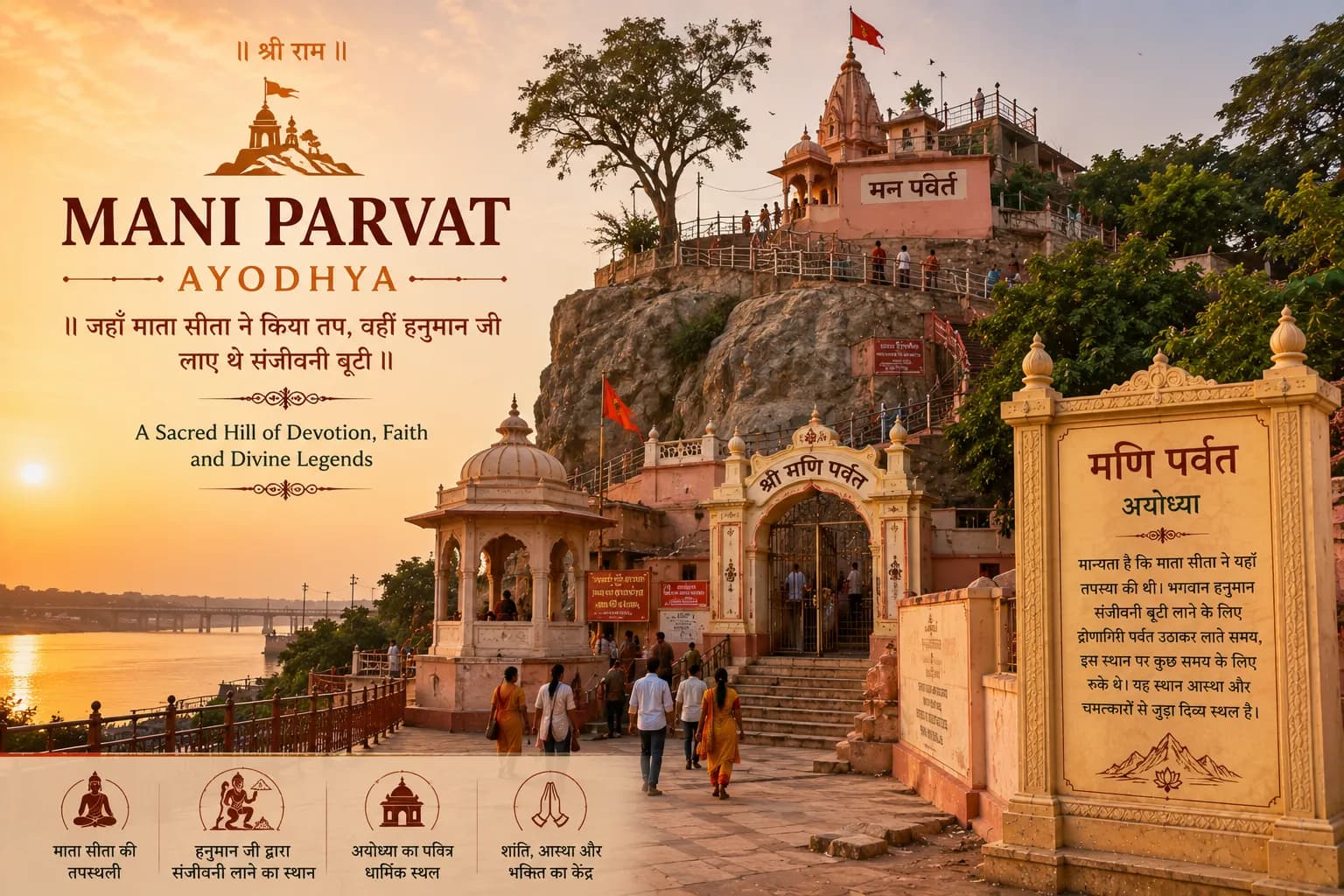
| What it is | An ancient 65-foot hillock of legend, believed to be a fragment of Hanuman's Sanjeevani mountain and an old Buddhist stupa, with panoramic views of Ayodhya. |
| Opening hours | 6:00 AM to 6:00 PM daily; an open site, not a formal temple. |
| Entry fee | Free. There is no VIP darshan or ticket. |
| Ramayana legend | A fragment of the Sanjeevani mountain fell here as Hanuman carried it to save Lakshman. |
| Buddhist heritage | A stupa built by Emperor Ashoka, with an old monastery mound nearby; Buddha is said to have preached here. |
| The views | From the summit, a spectacular view over Ayodhya and the Saryu; lovely at sunrise and sunset. |
| Festival | A Jhula (swing) fair is held here in the month of Shravan. |
| Location | Kami Ganj, about 2 km east of the Ram Janmabhoomi, near Sugriv Parvat. |
Mani Parvat timings and logistics
Mani Parvat is an open hillock rather than a formal temple, so there are no strict aarti or darshan schedules; it is simply open through the day, from 6:00 AM to 6:00 PM, and entry is free. Being one of the highest points in Ayodhya, it is at its most beautiful at sunrise and at sunset, when the light is soft on the city and the river below. It involves a short climb, so wear comfortable shoes.
| Detail | When | Notes |
|---|---|---|
| Opening hours | 6:00 AM to 6:00 PM | An open site; no formal aarti or VIP darshan. |
| Best times | Sunrise and sunset | The finest views over Ayodhya and the Saryu. |
| Entry fee | Free | There is no ticket. |
| Festival | Shravan (Jul or Aug) | A Jhula, or swing, fair is held here. |
Mani Parvat: the hillock of legend
Rising some sixty-five feet above the flat plain of Ayodhya, at Kami Ganj a little to the east of the great temples, is a green, ancient hillock called Mani Parvat, the Jewel Mountain. Beside it stands a companion mound, Sugriv Parvat, and together they are among the oldest and most intriguing places in the whole holy city, for they carry not one but two great streams of India's spiritual history, the Hindu and the Buddhist, layered one upon the other in these silent, grassy mounds. Mani Parvat is scattered with small shrines, including a temple of Ram and Sita, and crowned by the finest views in Ayodhya; and it is a place where legend and archaeology, story and stone, meet in the most fascinating way.
A fragment of the Sanjeevani mountain
The name and the fame of Mani Parvat come from one of the most beloved episodes in the whole Ramayana. In the great war at Lanka, Lord Ram's brother Lakshman was struck down and left senseless by the weapon of Meghnad, and only one thing could save him: the Sanjeevani, the miraculous life-restoring herb that grew on a mountain far away in the Himalayas. Hanuman, the mighty devotee, flew to the mountain, and, unable to tell which herb was the healing one, uprooted the entire mountain and carried it back through the sky in his palm to save Lakshman's life. And it is believed that as Hanuman flew, a fragment of that very mountain, the mountain of the healing herbs, broke off and fell to earth here, in Ayodhya, and became Mani Parvat. So this hillock is held to be a piece of the Sanjeevani itself, a fragment of the mountain of life, brought here by the flight of Hanuman, and that gives it a deep and tender place in the hearts of the devotees of Ram.
The ancient Buddhist stupa
Beneath the Ramayana legend lies a second, equally remarkable history, for Mani Parvat is also one of the most important Buddhist sites in Ayodhya. Long ago, Ayodhya was known as Saketa, and it was a great and flourishing centre of Buddhism; the Buddha himself is said to have stayed in the city for some years, and, tradition tells, to have preached the law of the Dharma from this very hillock. And the mound is believed to be, in fact, an ancient Buddhist stupa, raised by the great emperor Ashoka, who studded his empire with such monuments to the Buddha, while the neighbouring Sugriv Parvat is thought to be the mound of an ancient Buddhist monastery. So this quiet green hill is at once a fragment of Hanuman's mountain and a monument of the Buddha, a place where the Ramayana and the life of the Buddha meet, a rare and wonderful layering of India's sacred past. For travellers who also visit Sarnath, where the Buddha gave his first sermon and Ashoka raised his famous pillar, there is a lovely thread here. See our guide to Sarnath.
The views and the Jhula fair
Whatever brings you to Mani Parvat, the reward at the top is the same: one of the most spectacular views in all of Ayodhya. From the summit of the hillock, the whole holy city spreads out below, its temples and lanes and the shining ribbon of the Saryu, and it is a favourite of photographers and of anyone who loves to see a sacred landscape whole. At sunrise and sunset the view is at its most beautiful, the light gold on Ayodhya. And once a year, in the holy month of Shravan, the hillock comes alive with the Jhula fair, when swings are hung and the deities are joyfully swung, and the quiet mound fills with festival colour and song. It is a lovely, breezy, uplifting place, and a wonderful change of pace from the temples below.
Legend and stone, in my own words
By Rajeev Sharma, guide with Experience My India
Mani Parvat is one of my favourite places to bring a curious traveller, because it holds two great stories in one little hill. I walk them up, and at the top I first tell them the Ramayana tale: that this hillock is believed to be a piece of the Sanjeevani mountain that Hanuman carried from the Himalayas to save Lakshman, a fragment that fell from his hand as he flew. People love that; they look at the green mound with new eyes. And then I tell them the second story, that this is also an ancient Buddhist stupa of Emperor Ashoka, that the Buddha himself is said to have preached from here when Ayodhya was called Saketa. To stand on a hill that is both a piece of Hanuman's mountain and a monument of the Buddha, that surprises and delights everyone.
And then I simply let them look, because the view from the top is the best in Ayodhya, the whole city and the Saryu laid out below, beautiful at sunrise or sunset. I tell them to wear good shoes for the climb. If they come in Shravan, they see the Jhula fair, with the swings and the singing, which is a joy. After the crowds and intensity of the temples, this breezy green hill, with its two ancient stories and its wide view, is one of the loveliest, most peaceful hours I can give a pilgrim in Ayodhya.
In more than forty years of guiding, this is the offbeat spot whose double story most delights the travellers I bring.
What to see and do
- Climb to the summit for the finest panoramic view of Ayodhya and the Saryu, especially at sunrise or sunset.
- Hear the Ramayana legend of the fragment of Hanuman's Sanjeevani mountain.
- See the ancient Buddhist stupa and learn of Ayodhya's past as the Buddhist city of Saketa.
- Visit the small shrines on the hill, including the temple of Ram and Sita.
- If you come in Shravan, enjoy the Jhula, the swing fair; and see nearby Sugriv Parvat.
How to reach Mani Parvat
Mani Parvat is at Kami Ganj, about 2 km east of the Ram Janmabhoomi, a little apart from the busiest core. You reach it easily by auto or e-rickshaw.
| From | Distance | Notes |
|---|---|---|
| Ram ki Paidi and Nageshwarnath | A short ride east | Take an auto toward Nageshwarnath, then a little further east. |
| Hanuman Garhi | A short auto ride | From the core temples out to the hillock. |
| Ram Janmabhoomi Mandir | About 2 km east | By e-rickshaw or auto. |
| Ayodhya Dham Junction (railway) | About 3 km | By e-rickshaw, auto or taxi. |
| Maharishi Valmiki Airport, Ayodhya | About 12 km | The new airport; taxis and autos to the town. |
Because it is a little off the main circuit and its stories are easy to miss, a guide makes the visit far richer.
Best time to visit and how to plan it
| When | Why |
|---|---|
| Sunrise or sunset | The finest light and the best panoramic views over Ayodhya and the Saryu. |
| The Shravan month | For the joyful Jhula, the swing fair, held on the hillock. |
| Cooler weather (October to March) | The most pleasant for the climb and the views. |
| With the riverfront | Combine it with Nageshwarnath, Ram ki Paidi and the Saryu. |
- Pair it with the Saryu ghats and Nageshwarnath Temple, a little to the west, and the core temples.
- Allow 30 to 45 minutes, including the climb and time for the view.
For Ayodhya, or a combined Kashi and Ayodhya pilgrimage, planned end to end, see our tour packages.
Accessibility for elderly and mobility limited visitors
- Mani Parvat is a hillock with a short climb, which can be hard for elderly or frail visitors; take it slowly and wear good shoes.
- Come in the cool of the morning or evening, when the climb is easiest and the view best.
- Those who cannot climb can still enjoy the setting and the story from the base.
- We plan the timing and help so a keen elderly pilgrim can manage the climb comfortably.
Nearby sacred sites in Ayodhya
Mani Parvat is a little east of the core, near the river and the northern sites.
| Site | What it is | Internal link |
|---|---|---|
| Nageshwarnath Temple | The ancient guardian Shiva of Ayodhya, by the Saryu, to the west. | /temple/ayodhya/nageshwarnath-temple |
| Saryu Ghats and the aarti | The sacred river of Ayodhya and its evening aarti. | /temple/ayodhya/saryu-ghat-aarti |
| Hanuman Garhi | The guardian temple of Hanuman, whose Sanjeevani feat this hill recalls. | /temple/ayodhya/hanuman-garhi |
| Shri Ram Janmabhoomi Mandir | The grand temple of Lord Ram, about 2 km to the west. | /temple/ayodhya/ram-janmabhoomi-mandir |
| Sarnath (Varanasi) | The great Buddhist site, for the Ashokan and Buddhist heritage thread. | /temple/varanasi/sarnath |
For the Ram Mandir darshan and its free Sugam booking, see our Ram Janmabhoomi Mandir guide.
Our guided visit and Ayodhya tours
We are a Varanasi and Ayodhya based operator, a unit of Experience My India, with more than forty years of guiding pilgrims across Kashi, Ayodhya, and Prayagraj, and we have our own local guide and pandit in Ayodhya. Mani Parvat is a free, open site, so what we offer is the knowledge and the planning that turn a green mound into a wonder: a guide who tells both its stories, the Sanjeevani legend and the Buddhist stupa, times the visit for the finest light and views, and weaves this offbeat gem into a full day of Ayodhya with the riverfront and the temples.
| Service | Includes | Price |
|---|---|---|
| Guided Mani Parvat visit | A guide, both the Ramayana and Buddhist stories, and the summit view. | Contact us for pricing |
| Saryu and heritage day | Mani Parvat with Nageshwarnath, Ram ki Paidi and the Saryu aarti. | Contact us for pricing |
| Full Ayodhya darshan tour | Mani Parvat within a wider Ayodhya pilgrimage, with a guide. | Contact us for pricing |
| Kashi, Ayodhya and Sarnath heritage | The Buddhist thread from Ayodhya's Saketa to Sarnath, with a guide. | Contact us for pricing |
Inclusions and exclusions are stated up front, with any taxes and conditions, and no charge appears later that was not named. Entry is free; our charge is only for guiding, transport and services. See all our tour packages for the full range.
Experience My India is a travel operator, not a temple or government body. Mani Parvat is a free, open site; our charge is only for our guiding and services. Access and any facilities can change.