Essential info at a glance
| Detail | At a glance |
|---|---|
| What it is | The sacred Saryu ghat where Lord Ram is believed to have taken Jal Samadhi and departed for Vaikuntha, with the Chakrahari and Guptahari temples of Vishnu. |
| Ghat access | The riverfront and ghat steps are open 24 hours; free. |
| Temple hours | Morning 6:00 AM to 12:00 PM, and evening 4:00 PM to 8:30 PM; closed midday 12:00 to 4:00 PM. |
| Entry fee | Completely free. There is no VIP darshan or ticket. |
| Aarti | No grand river aarti; quiet, contemplative, with small local evening prayers around sunset. |
| Significance | The place of Ram's Great Departure, the poignant end of his earthly life, the counterpart to his birthplace. |
| The shrines | Chakrahari (Chakra Harji Vishnu), Guptahari, Sita-Ram and Narsingh temples along the ghat. |
| Location | Guptar Ghat, Faizabad Cantt, about 8 to 9 km from central Ayodhya, on the Saryu. |
Guptar Ghat timings and darshan
The open riverfront and the ghat steps are accessible around the clock, and entry is free. The temples along the ghat keep a split day, open in the morning and again in the evening, with a midday break. Unlike the grand nightly aarti at Ram ki Paidi, the mood here is quiet and contemplative, with only small local evening prayers around sunset; and that stillness is very much part of the ghat's character, for this is a place for reflection more than spectacle.
| Detail | When | Notes |
|---|---|---|
| Ghat access | 24 hours | The riverfront and steps are always open; free. |
| Temple morning | 6:00 AM to 12:00 PM | The shrines of Chakrahari, Guptahari, Sita-Ram and Narsingh. |
| Midday break | 12:00 PM to 4:00 PM | The temples close. |
| Temple evening | 4:00 PM to 8:30 PM | Small local evening prayers around 6:30 to 7:00 PM. |
*Entry is free and there is no VIP darshan.
Guptar Ghat: where Lord Ram departed the world
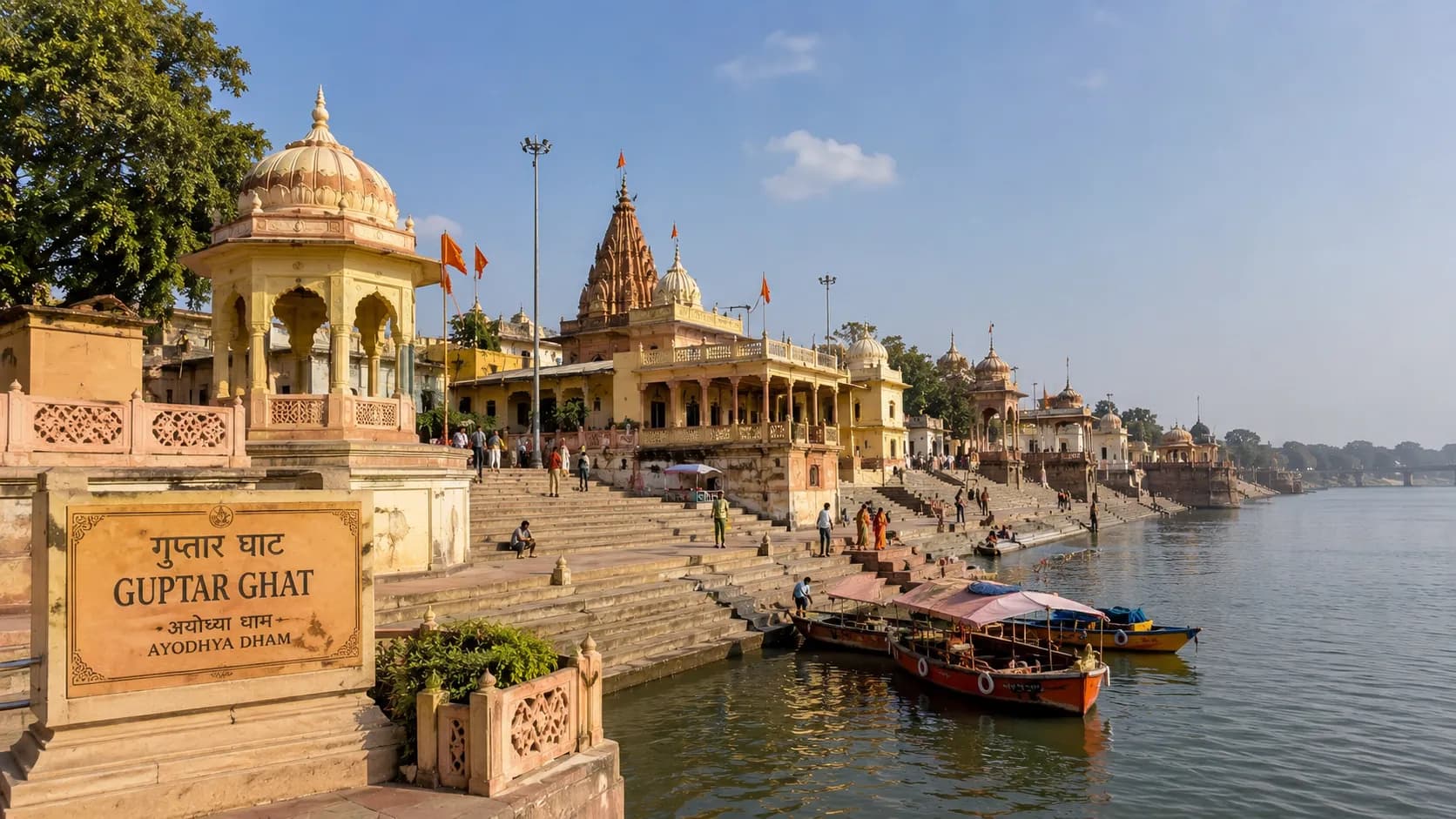
If the Ram Janmabhoomi is where the story of Lord Ram on earth begins, Guptar Ghat is where it ends, and there is no more moving place in all of Ayodhya. For it is here, on the peaceful banks of the Saryu, that Lord Ram, having ruled Ayodhya through the golden age of Ram Rajya and completed the whole of his divine mission on earth, is believed to have made his Great Departure, his Mahaprayana. The Skanda Purana tells that Ram, together with his beloved brothers Bharat and Shatrughna, and indeed the whole of Ayodhya, the citizens, the sages, even the animals following him, walked into the waters of the sacred Saryu and took Jal Samadhi, a voluntary immersion, leaving their earthly forms and ascending to Vaikuntha, the eternal abode of Vishnu, whose avatar Ram is. And because this divine departure of Hari happened quietly, secretly, gupt, the place has ever since been called Guptar Ghat, the ghat of the hidden departure.
To stand at Guptar Ghat, then, is to stand at the very close of the Ramayana, at the spot where Ram laid down his human life and returned, radiant, to his eternal form. It is a place of deep and tender reverence, poignant beyond words, and devotees who come here often speak of a stillness and an emotion they find nowhere else. Many take a holy dip in the Saryu at this sacred spot, believing, as the scriptures promise, that it cleanses every sin and leads toward liberation, most of all on the great day of Kartik Purnima.
The Chakrahari and Guptahari temples
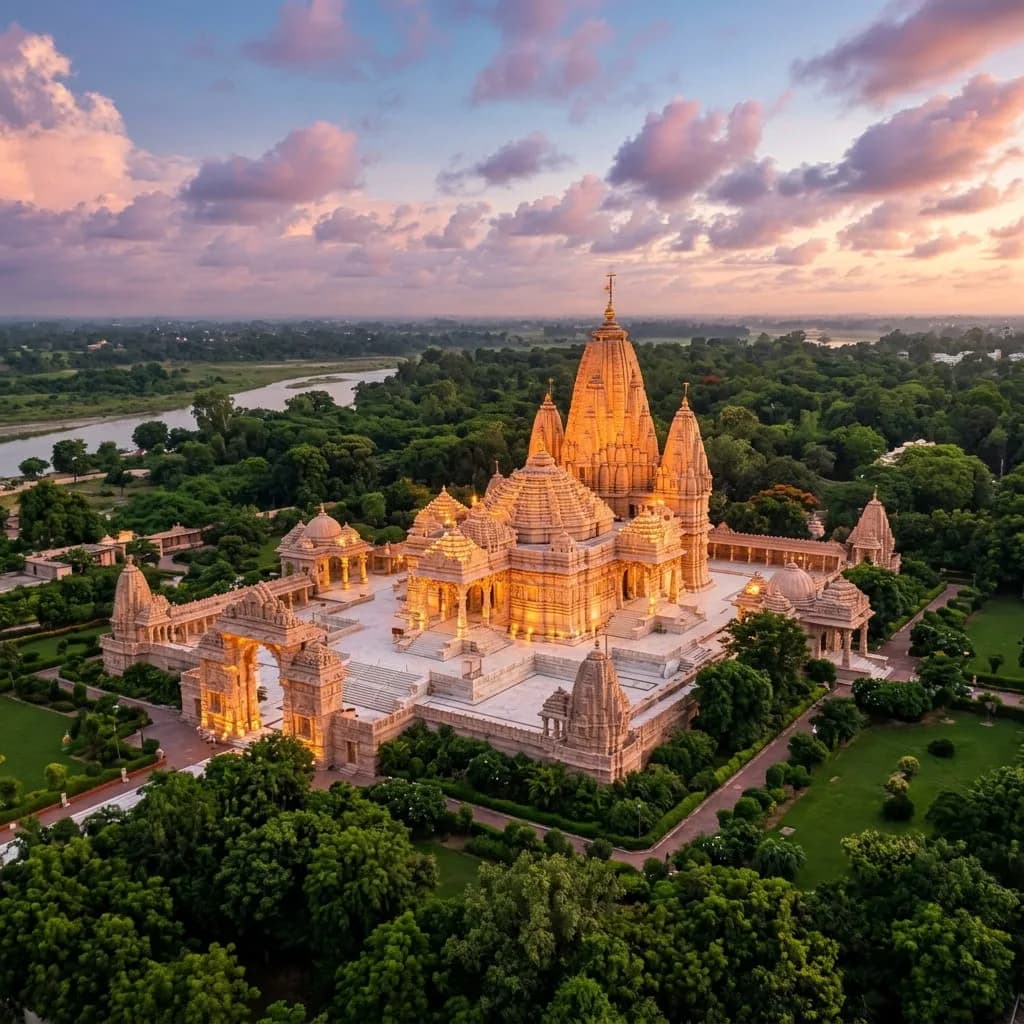
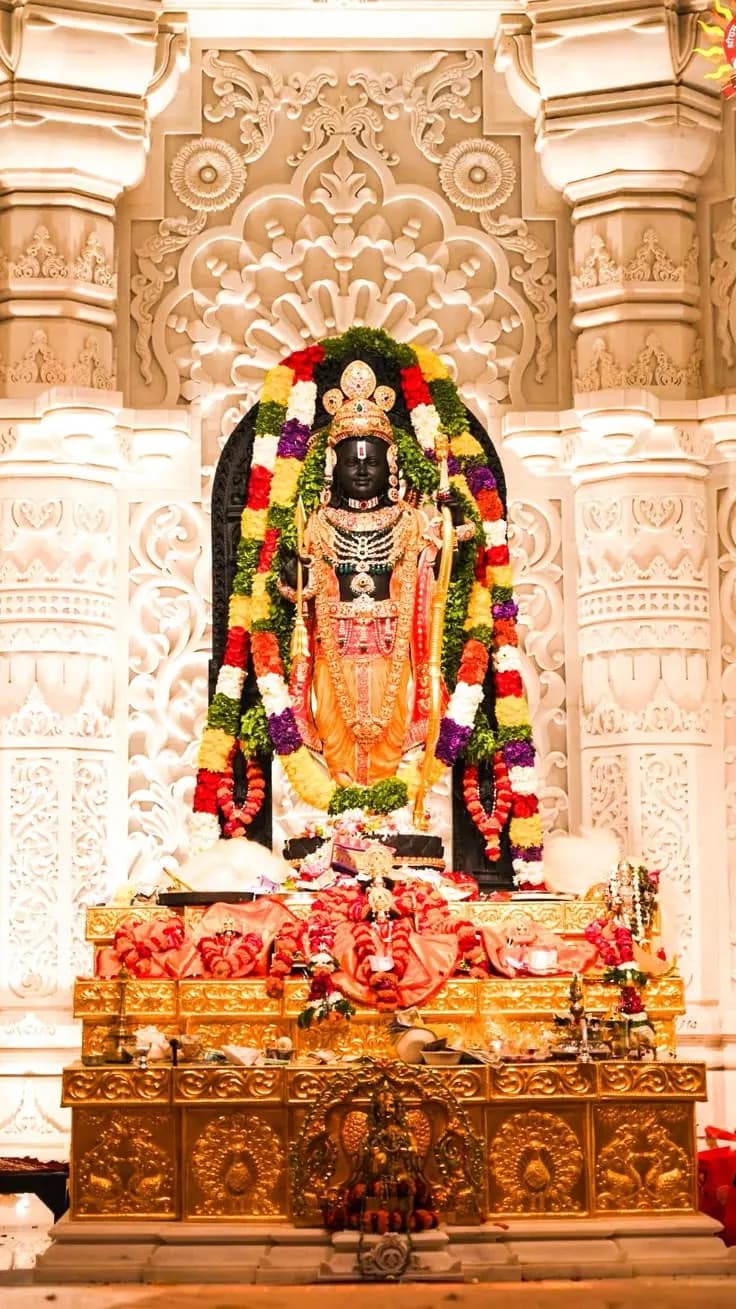
Along the ghat stand several ancient and beloved temples, and the most important of them honour Ram in his true and eternal form as Lord Vishnu, for it was as Vishnu that he departed here. The Chakrahari temple, the Chakra Harji Vishnu temple, worships the Lord bearing his divine discus, the chakra; and the Guptahari temple takes its name, tradition tells, from Vishnu having secretly, gupt, performed penance here to strengthen the gods in their eternal struggle against the demons. In these shrines, Ram and Vishnu are worshipped as one. Nearby along the ghat are the Sita-Ram temple, where the divine couple are enshrined in serene majesty, the Narsingh temple to the fierce man-lion avatar of Vishnu, and the Raja Mandir. Day and night, the priests and pilgrims of these shrines sing the name of Ram, so that the whole ghat is filled with soft, ceaseless devotion.
The serene Saryu ghat
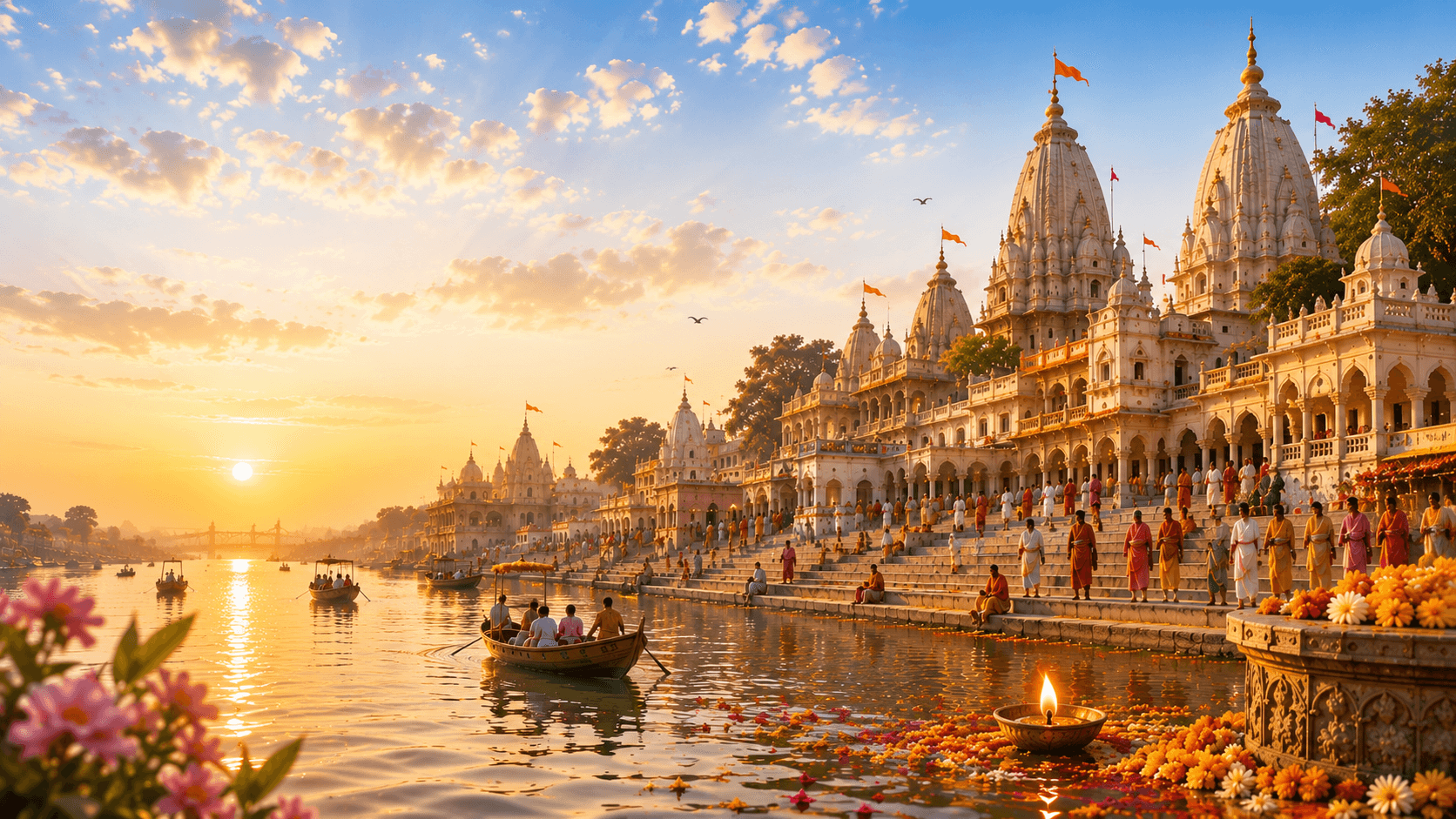
Guptar Ghat is one of the loveliest and most peaceful stretches of the Saryu, quite different in feeling from the busy, festive Ram ki Paidi. A long flight of fine stone steps, laid in the eighteenth and nineteenth centuries, descends to the holy river, and around it lies green, gentle country; beside it stretches the Guptar Ghat Van, a wooded garden that was once the colonial Company Gardens, adding a soft, shady beauty to the place. It is a ghat for the contemplative pilgrim: for a quiet dawn or dusk by the water, for a holy dip, for prayer and reflection, and for a peaceful boat ride out upon the sacred Saryu, drifting where Ram himself is said to have departed. In its stillness and its greenery and its profound meaning, it is a balm and a benediction.
The beginning and the end: the whole arc of Ram
There is a beautiful completeness to a pilgrimage that holds both the birth and the departure of Lord Ram. At the Ram Janmabhoomi, in the heart of the city, we behold the place where Ram came into the world as a child; here at Guptar Ghat, at the quiet edge of the city by the river, we stand where he left it and returned to the eternal. The two are the great poles of the whole Ramayana, the first breath and the last, the coming and the going of the Lord, and to visit both is to honour the complete arc of Ram's earthly journey. Many pilgrims find it deeply moving to close their Ayodhya at Guptar Ghat, having begun it at the birthplace, tracing, in a day, the whole span of the beloved story. See our guide to the Ram Janmabhoomi Mandir.
The last shore of Ram, in my own words
By Rajeev Sharma, guide with Experience My India
Guptar Ghat is a place I take my pilgrims to with a quiet heart, usually to close their Ayodhya, because of what it is. I tell them: we began at the Ram Janmabhoomi, where the Lord was born; now we have come to the place where he left the world. And I tell them the story softly, how Ram, having done all he came to do, walked into the Saryu here with his brothers and all his people, and disappeared into the water, going home to Vaikuntha as Vishnu; how the departure was gupt, hidden, and gave the ghat its name. People go very still when I tell it. It is the most tender place in Ayodhya.
It is beautiful and quiet here, not crowded like Ram ki Paidi, with the old steps and the green garden and the peaceful river. We take darshan at the Chakrahari, the Vishnu temple, and I explain that here Ram is worshipped as Vishnu, his true form. Sometimes we take a small boat on the Saryu, which is lovely. And because I am a Kashi man, I tell my guests the deep thought: that just as people come to my Kashi to leave the world in the hope of liberation, so here Ram himself left the world; the river and the shore hold that same great mystery of the soul's release. To stand at the beginning and the end of Ram's life in one day is a rare and moving thing, and I am glad to give it to people.
In more than forty years of guiding, this is the shore where the pilgrims I bring have most often stood in silence.
What to see and do
- Stand at the sacred ghat where Lord Ram departed the world, and take the peace of the Saryu.
- Take a holy dip in the Saryu, believed to cleanse sins and lead toward liberation, especially at Kartik Purnima.
- Take darshan at the Chakrahari (Chakra Harji Vishnu) and Guptahari temples, where Ram is worshipped as Vishnu.
- Visit the Sita-Ram, Narsingh and Raja Mandir shrines, and hear the ceaseless chanting of Ram's name.
- Enjoy a peaceful boat ride on the Saryu, and the green Guptar Ghat Van beside the ghat.
How to reach Guptar Ghat
Guptar Ghat is on the Saryu in the Faizabad Cantonment area, about 8 to 9 km from central Ayodhya and from Hanuman Garhi, a little apart from the busy core. It is easily reached by road, or by a lovely boat along the river.
| From | Distance | Notes |
|---|---|---|
| Central Ayodhya and Hanuman Garhi | About 8 to 9 km | By auto, e-rickshaw or taxi. |
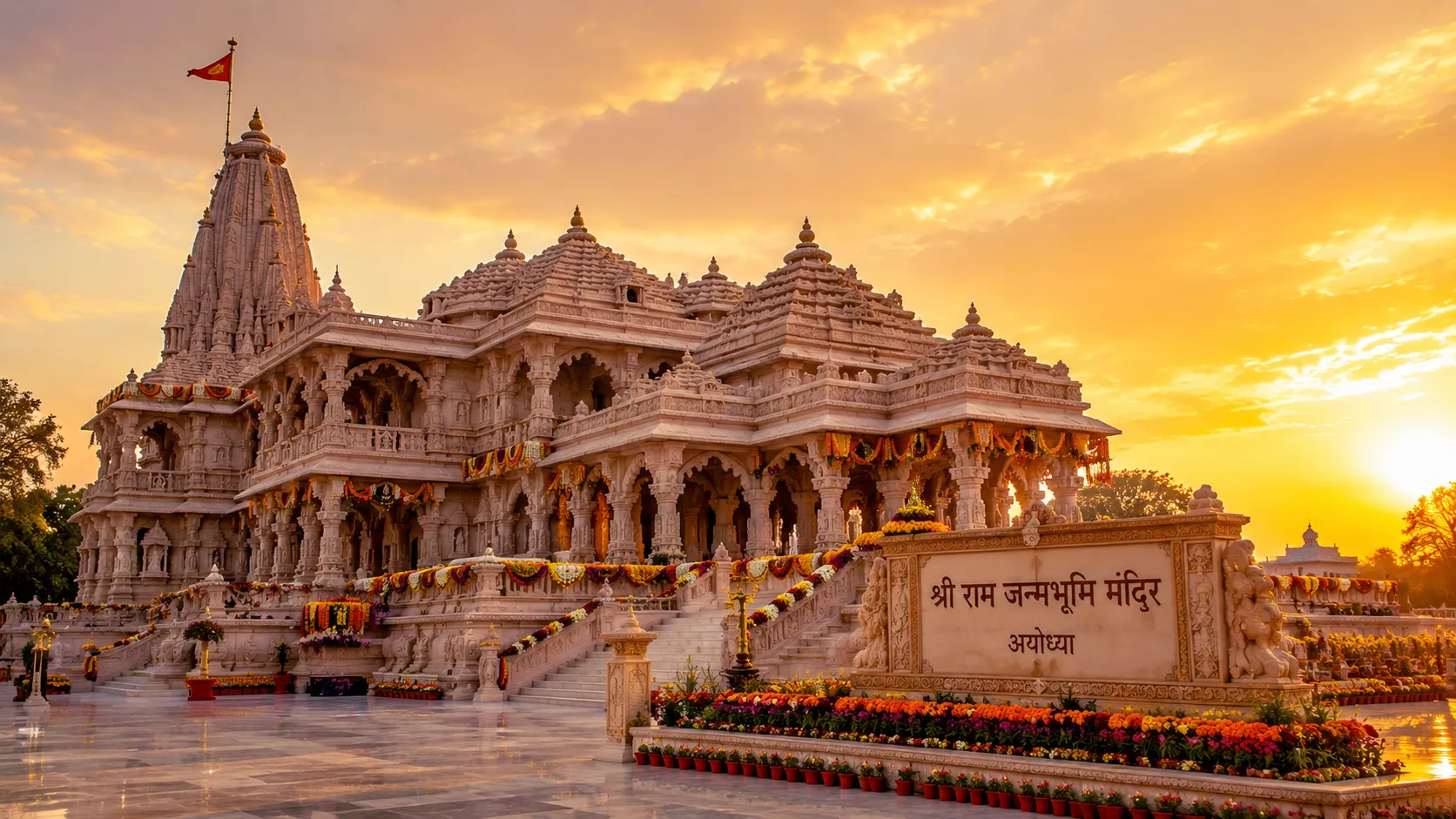
| Ram Janmabhoomi Mandir | About 8 to 9 km | The birthplace; pair the two for the whole arc of Ram. |
| By boat | Along the Saryu | A peaceful river approach, the loveliest way to arrive. |
| Ayodhya Dham Junction (railway) | About 10 km | By taxi or auto. |
| Maharishi Valmiki Airport, Ayodhya | About 15 km | The new airport; by road. |
Its riverside setting makes it a lovely, contemplative close to a day of darshan, by road or by boat.
Best time to visit and how to plan it
| When | Why |
|---|---|
| Sunrise or sunset by the Saryu | The most beautiful and peaceful light on the river and the ghat. |
| Kartik Purnima (November) | The great day for a holy dip here, of immense merit. |
| Morning or evening temple hours | For darshan at the Chakrahari and the other shrines. |
| To close your Ayodhya | After beginning at the Ram Janmabhoomi, to trace the whole arc of Ram's life. |
- Pair it with the Ram Janmabhoomi Mandir for the birth-and-departure of Ram, and with a Saryu boat.
- Allow an hour or so, longer for a boat, a dip or quiet reflection.
For Ayodhya, or a combined Kashi and Ayodhya pilgrimage, planned end to end, see our tour packages.
Accessibility for elderly and mobility limited visitors
- The ghat has steps down to the river; the upper level, the temples and the garden can be enjoyed without descending far.
- It is reachable by road, and quiet and uncrowded, which suits a gentle, restful visit.
- A boat lets an elderly pilgrim enjoy the sacred river and the ghat with little walking.
- We arrange transport or a boat and plan a comfortable, reflective visit.
Nearby sacred sites in Ayodhya
Guptar Ghat is on the Saryu, a little apart from the core, and holds the other end of Ram's story.
| Site | What it is | Internal link |
|---|---|---|
| Shri Ram Janmabhoomi Mandir | The birthplace of Ram; Guptar Ghat is where his earthly life ended. | /temple/ayodhya/ram-janmabhoomi-mandir |
| Ram ki Paidi and the Saryu ghats | The great riverfront of Ayodhya, with its evening aarti. | /temple/ayodhya/saryu-ghat-aarti |
| Nageshwarnath Temple | The ancient guardian Shiva of Ayodhya, by the river. | /temple/ayodhya/nageshwarnath-temple |
| Hanuman Garhi | The guardian temple of Hanuman, in the core cluster. | /temple/ayodhya/hanuman-garhi |
| Manikarnika Ghat (Varanasi) | The great ghat of Kashi, the city of liberation; the deep tie of the soul's release. | /temple/varanasi/manikarnika-ghat |
For the Ram Mandir darshan and its free Sugam booking, see our Ram Janmabhoomi Mandir guide.
Our guided visits and Saryu boats
We are a Varanasi and Ayodhya based operator, a unit of Experience My India, with more than forty years of guiding pilgrims across Kashi, Ayodhya, and Prayagraj, and we have our own local guide and pandit in Ayodhya. Darshan is free, so what we arrange is the visit: a car or a peaceful Saryu boat, a guide who tells the profound story of Ram's departure and the meaning of the Vishnu temples, and a well-planned day that traces Ram from his birthplace to this last shore.
| Service | Includes | Price |
|---|---|---|
| Guptar Ghat visit and Saryu boat | A guide, the ghat and the temples, and a peaceful boat on the Saryu. | Contact us for pricing |
| Birth-to-departure Ram day | The Ram Janmabhoomi and Guptar Ghat, the whole arc of Ram, with a guide. | Contact us for pricing |
| Full Ayodhya darshan tour | Guptar Ghat within a wider Ayodhya pilgrimage, with a guide. | Contact us for pricing |
| Kashi and Ayodhya pilgrimage | Varanasi and Ayodhya combined, with darshan, transfers and a guide. | Contact us for pricing |
Inclusions and exclusions are stated up front, with any taxes and conditions, and no charge appears later that was not named. Darshan is free; our charge is only for guiding, the boat and services. See all our tour packages for the full range.
Experience My India is a travel operator, not the temple administration. Darshan is free; our charge is only for our guiding and services. Ghat and temple timings are set by others and can change.