Essential info at a glance
| Detail | At a glance |
|---|---|
| What it is | The ancient ashram of Guru Vashishtha, the teacher of Ram, and the traditional source of the sacred Saryu river. |
| Opening hours | Open daily from around 5:00 AM to 8:00 PM. |
| Entry fee | Free. It is an open heritage and ashram site, with no VIP or ticket. |
| The great fact | The Saryu river is believed to have sprung from the well here, by the prayer of Sage Vashishtha. |
| Rituals | Local priests offer daily prayers and deep daan at the kund at sunrise and sunset; no grand aarti. |
| Also here | Where Ram and his brothers completed their studies; Vashishtha with Arundhati and Sage Vamadeva. |
| A holy dip | The kund's waters are believed to destroy sins and grant great merit. |
| Location | Sai Nagar / Gokul Bhawan area, near the Ram Janmabhoomi. |
Vashishtha Kund timings
The kund and ashram are open through the day, from around 5:00 AM to 8:00 PM, and entry is free; it is a quiet, open, sacred site rather than a managed temple. There is no grand choreographed aarti here as at Ram ki Paidi; instead, in the old way, the local priests offer daily prayers and deep daan, the offering of lamps, at the edge of the kund at sunrise and around sunset. Those quiet, unhurried hours, dawn and dusk, are the loveliest times to come.
| Detail | When | Notes |
|---|---|---|
| Opening hours | About 5:00 AM to 8:00 PM | An open kund and ashram; free. |
| Prayers and deep daan | Sunrise and sunset (around 6:30 PM) | Quiet local rituals at the kund; no grand aarti. |
| Best times | Dawn and dusk | The most peaceful and beautiful hours. |
| Entry fee | Free | No tickets or VIP passes. |
Vashishtha Kund: the ashram of Ram's guru
Near the Ram Janmabhoomi, a little apart and easy to miss, lies one of the most ancient and profound of all the sacred spots of Ayodhya: Vashishtha Kund, the ashram of Maharishi Vashishtha. This was the hermitage of the greatest of the gurus, Sage Vashishtha, the family preceptor of the whole Solar Dynasty of Ayodhya and the beloved teacher of Lord Ram; and here, tradition tells, in this very ashram, Lord Ram and his three brothers completed their studies under him, learning the scriptures and the wisdom of dharma at the feet of their master. The Skanda Purana says that Sage Vashishtha dwells here eternally, with his chaste wife Arundhati and the sage Vamadeva; and though the ashram, which once spread over many acres, is now small, it remains steeped in the presence of the great sage and the memory of the young Ram at his lessons.
The source of the sacred Saryu
But Vashishtha Kund holds a wonder greater still, one of the most beautiful secrets of Ayodhya: for this quiet well is believed to be the very source, the birthplace, of the sacred Saryu river itself. The story is lovely. In the ancient days, when King Ikshvaku, the founder of the Solar Dynasty and forefather of Ram, ruled Ayodhya, the city had no sacred river of its own, and could not perform its holy rites and yagnas for want of pure water; so the king came to his guru, Sage Vashishtha, and begged him for help. And Vashishtha, by the power of a great and special penance, caused the holy Saryu to spring forth from this very well, so that Ayodhya might have its sacred river forever. It is said the well is joined, deep underground, to the flowing river; and this is why the Saryu bears two other ancient names, Ishvaki, after the king, and Vashisti, after the sage who called her forth.
So here, at this small and unassuming kund, is the mother-spring of the great river that gives Ayodhya all its holiness: the Saryu on whose banks the city stands, whose ghats the pilgrims throng, whose evening aarti glows at Ram ki Paidi, into whose waters Lord Ram at last departed the world. Every drop of that sacred river, tradition says, begins here, at the ashram of Vashishtha; and to stand at this humble well, and to know it for the source of the Saryu, is one of the quietly overwhelming moments of a pilgrimage to Ayodhya.
Guru Vashishtha, the great sage
The sage this kund honours is among the very greatest in all of Hindu tradition. Maharishi Vashishtha is one of the Saptarishi, the seven primordial seers, a mind-born son of Lord Brahma himself, and one of the chief poets of the Rigveda, the most ancient of scriptures; he is the keeper of the wish-granting divine cow Kamadhenu, and the husband of Arundhati, the very model of the faithful wife, honoured in the heavens as a star. In the Ramayana he is the family priest of the Raghu dynasty and the chief minister of King Dasharatha, and, above all, the guru of Ram; it is said that Brahma appointed him the guru of the Solar Dynasty precisely because Lord Ram would one day be born in that line, and Vashishtha longed to serve Him. To honour Vashishtha at his own ashram, where he taught the Lord, is to honour the source of the wisdom that guided Ram, as this kund is the source of the river that sanctifies his city. Fittingly, this ashram of learning lies near the Vidya Kund, the pond of Ram's early studies.
The holy kund and its merit
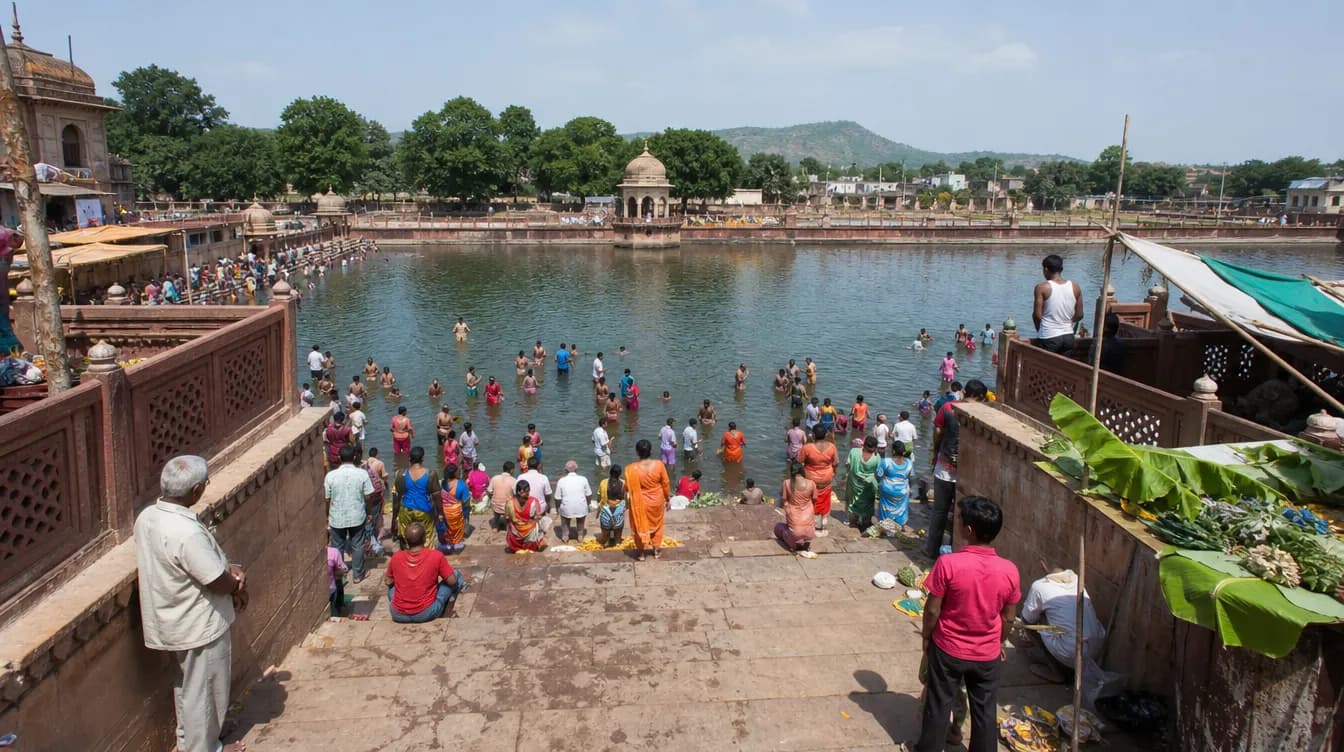
The waters of Vashishtha Kund are held to be of the greatest sanctity. The Skanda Purana promises that one who bathes here with purity and devotion, offering shraddha for the ancestors, gains excellent merit and is freed from sins; indeed it says, in a striking phrase, that one who takes a holy dip here becomes equal to Vashishtha himself. Devotees worship Sage Vashishtha, Sage Vamadeva and the lady Arundhati here, take the sacred bath, and give charity as they are able, and an annual festival is kept at the kund in the month of Bhadrapada. It is a quiet, deep, contemplative place, without crowds or spectacle, where the merit is inward and the peace profound.
The wellspring of Ayodhya, in my own words
By Rajeev Sharma, guide with Experience My India
Vashishtha Kund is a small, quiet place that most visitors walk past, and I always stop and tell them what it truly is, because it gives them a shiver. First, this is the ashram of Vashishtha, the great guru of Ram, where the young Lord and his brothers did their studies; I show them where the Master taught the boy who would be God. And then I tell them the wonderful secret: that this humble well is the source of the Saryu, the holy river of Ayodhya. I explain how King Ikshvaku had no sacred river, and how his guru Vashishtha, by his penance, made the Saryu spring from this very spot, which is why we also call the river Vashisti and Ishvaki.
People are always amazed. We stand at the ghats, we see the great aarti, we watch the river, and then I bring them here and say: and it all begins in this little well. The whole holy Saryu, from one quiet spring at the feet of the guru. It moves them deeply. It is a place of learning and of the river's birth, two of the most sacred things in Ayodhya, together in one humble ashram, and it is peaceful and uncrowded, so we can stand and feel it. I never let a thoughtful pilgrim miss the source of the river they have come so far to worship.
In more than forty years of guiding, this is the quiet well whose secret most astonishes the pilgrims I bring.
What to see and do
- Behold the sacred well, believed to be the very source of the holy Saryu river.
- Take darshan at the ashram of Guru Vashishtha, where Ram completed his studies, and worship Vashishtha, Vamadeva and Arundhati.
- Take a holy dip in the kund, believed to destroy sins and grant great merit.
- Come at sunrise or sunset for the quiet local prayers and the deep daan by the water.
- Pair it with the nearby Vidya Kund, the pond of Ram's early learning.
How to reach Vashishtha Kund
Vashishtha Kund is in the Sai Nagar and Gokul Bhawan area, near the Ram Janmabhoomi, just north of the Rukmini and Dhanayak kunds, at the heart of old Ayodhya. It is reached on foot or by e-rickshaw.
| From | Distance | Notes |
|---|---|---|
| Ram Janmabhoomi Mandir | Very near | A short walk in the core area. |
| Vidya Kund | Nearby | The pond of Ram's early learning; pair the two Vashishtha-and-learning sites. |
| The Saryu ghats and Ram ki Paidi | A short ride | See the source here, then the river at the ghats. |
| Ayodhya Dham Junction (railway) | About 2 km | By e-rickshaw, auto or taxi. |
| Maharishi Valmiki Airport, Ayodhya | About 10 km | The new airport; taxis and autos to the old city. |
It is a natural, meaningful add-on to the core temples and the Saryu, and pairs beautifully with Vidya Kund.
Best time to visit and how to plan it
| When | Why |
|---|---|
| Sunrise or sunset | The quiet local prayers and the deep daan by the kund; the most peaceful, beautiful hours. |
| The Bhadrapada festival (August or September) | The annual festival kept at the kund, especially auspicious. |
| With Vidya Kund | The two sites of Ram's learning and his guru, together. |
| Before or after the Saryu ghats | To see the source of the river here and the river itself at the ghats. |
- Pair it with Vidya Kund and the core temples, and with the Saryu ghats for the source-and-river.
- Allow 20 to 30 minutes for a gentle, contemplative visit.
For Ayodhya, or a combined Kashi and Ayodhya pilgrimage, planned end to end, see our tour packages.
Accessibility for elderly and mobility limited visitors
- The kund and ashram are at ground level, near the core temples, gentler than the hilltop sites, though there may be steps down to the water.
- It is quiet and uncrowded, ideal for a slow, restful, contemplative visit.
- The shrine and the source can be honoured without descending to the water.
- We arrange transport and plan a gentle visit within your Ayodhya day.
Our guided visits and Ayodhya tours
We are a Varanasi and Ayodhya based operator, a unit of Experience My India, with more than forty years of guiding pilgrims across Kashi, Ayodhya, and Prayagraj, and we have our own local guide and pandit in Ayodhya. It is a free, open site, so what we offer is the knowledge and the planning: a guide who tells the profound story of the source of the Saryu and the ashram of Ram's guru, a shraddha or a puja by a pandit if you wish, and the source, the learning-kunds and the river woven into a fuller day of Ayodhya.
| Service | Includes | Price |
|---|---|---|
| Guided Vashishtha and Vidya Kund visit | The source of the Saryu and the kunds of Ram's learning, with a guide. | Contact us for pricing |
| Shraddha or puja at Vashishtha Kund | A shraddha or puja by a pandit at the sacred kund, with the rite. | Contact us for pricing |
| Saryu source-and-river day | Vashishtha Kund, the source, with the Saryu ghats and the aarti. | Contact us for pricing |
| Full Ayodhya darshan tour | Vashishtha Kund within a wider Ayodhya pilgrimage, with a guide. | Contact us for pricing |
Inclusions and exclusions are stated up front, with any taxes and conditions, and no charge appears later that was not named. Darshan is free; our charge is only for guiding, the pandit and services. See all our tour packages for the full range.
Experience My India is a travel operator, not the ashram administration. Darshan is free; our charge is only for our guiding and services. Timings and rites are set by the ashram and can change.
Nearby sacred sites in Ayodhya
Vashishtha Kund is near the Ram Janmabhoomi, among the sacred kunds and the river.
| Site | What it is | Internal link |
|---|---|---|
| Vidya Kund | The pond of Ram's early learning, the companion Vashishtha-and-education site. | /temple/ayodhya/vidya-kund |
| Saryu Ghats and Ram ki Paidi | The sacred river that springs from here, with its evening aarti. | /temple/ayodhya/saryu-ghat-aarti |
| Guptar Ghat | Where Ram departed into the Saryu, the river's other pole. | /temple/ayodhya/guptar-ghat |
| Shri Ram Janmabhoomi Mandir | The grand temple of Lord Ram, very near. | /temple/ayodhya/ram-janmabhoomi-mandir |
| Surajkund | The Sun pond of Ram's Suryavanshi line, whose guru Vashishtha was. | /temple/ayodhya/surajkund |
For the Ram Mandir darshan and its free Sugam booking, see our Ram Janmabhoomi Mandir guide.