
Essential info at a glance
| Detail | At a glance |
|---|---|
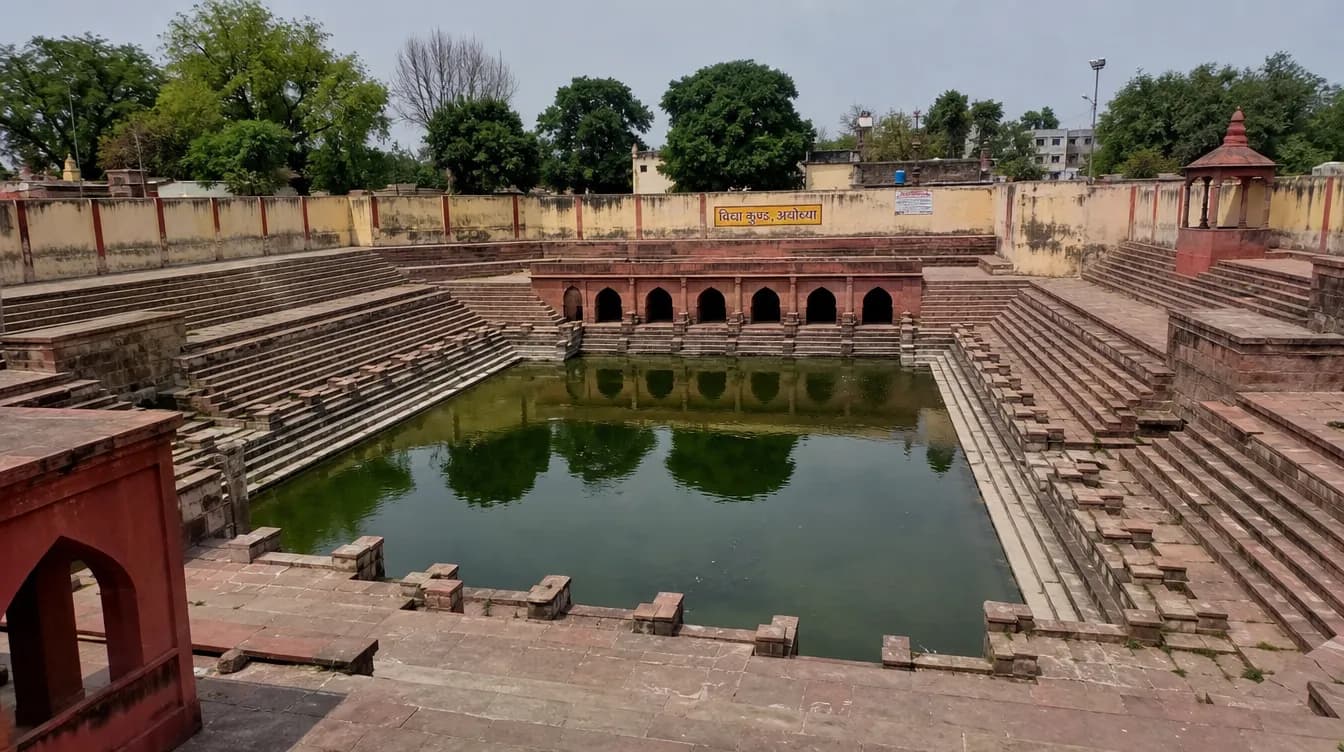
| What it is | A sacred, historic pond where Lord Ram and his brothers are believed to have received their early learning from Guru Vashishtha. |
| The meaning | Vidya means knowledge; this is the pond of learning, with a nearby Vidya Devi shrine. |
| Opening hours | Open through the day, typically 6:00 AM to 8:00 PM. |
| Entry fee | Free. It is a quiet heritage water body, with no VIP darshan or ticket. |
| Aarti | No formal aarti schedule; it is a serene, contemplative site. |
| Especially for | Those praying for knowledge, education and success in studies. |
| Nearby | The ancient mounds of Mani Parvat and Sugriv Parvat, in the same Kami Ganj area. |
| Location | Kami Ganj, about 2 km from the Ram Janmabhoomi. |
Vidya Kund timings
Vidya Kund is an open, sacred pond rather than a busy temple, so it has no formal aarti times or tickets; it is simply accessible through the day, typically from 6:00 AM to 8:00 PM, and entry is free. It is a quiet, gentle, uncrowded heritage site, at its most peaceful in the calm of the morning and the evening, and a lovely place for a few reflective minutes.
| Detail | When | Notes |
|---|---|---|
| Opening hours | About 6:00 AM to 8:00 PM | A quiet, open, sacred pond; free. |
| Entry fee | Free | No aarti schedule, ticket or VIP pass. |
| Best times | Morning and evening | Calm and peaceful for prayer and reflection. |
| Time needed | About 20 to 30 minutes | A short, gentle, contemplative visit. |
Vidya Kund: the pond of Ram's learning
Every great life has its school, and even Lord Ram, before he was king, before the exile and the war and the throne, was first a boy and a student; and Vidya Kund is the tender place that remembers those beginnings. Its very name tells its meaning, for Vidya means knowledge, learning, wisdom, and here, tradition holds, by the banks of this sacred pond at Kami Ganj, the young Lord Ram and his three brothers received their early education, their first teachings, from their revered guru, the great sage Vashishtha. This, then, is the schoolyard of Ram, the place where the ideal king first learned the scriptures and the wisdom that would shape his perfect rule; and there is something moving in standing at the quiet water where the divine child once sat at his lessons. It is a gentle, unhurried, deeply meaningful spot, cherished above all by those who value learning.
Guru Vashishtha and the education of Ram
To understand Vidya Kund is to honour the guru who taught here. Maharishi Vashishtha was one of the very greatest of the sages, one of the Saptarishi, the seven primordial seers, and he was appointed by Lord Brahma himself as the kula-guru, the family spiritual master, of the whole Suryavansha, the Solar Dynasty of Ayodhya; tradition tells that he took up that office because he knew that Lord Ram would one day be born in that line, and he wished to serve Him. He was also the wisest counsellor and chief minister of King Dasharatha, Ram's father. And it was under this greatest of gurus that Ram and his brothers, Lakshman, Bharat and Shatrughna, completed their studies, their Vedic learning and their training in dharma, before Ram went out into the world. In the ancient gurukul way, the prince sat as a humble student at the feet of his teacher; and that Ram, whom we worship as God, first bowed to a guru and learned as a boy is one of the most beautiful lessons of his life, the very model of the reverence a student owes a teacher.
The Vidya Devi shrine and the prayer for knowledge
Because this is the pond of learning, it has a special and lovely power for all who seek knowledge. Beside the kund stands a shrine of Vidya Devi, the Goddess of Learning, the Divine Mother in her form as the giver of knowledge and wisdom, akin to Saraswati; and devotees come to take a ritual dip in the holy waters and to pray before her for the blessing of learning. It has become especially dear to students and to families: young people come, or are brought by their parents, to pray for success in their studies and their examinations, and mothers and fathers come to seek the Goddess's grace upon their children's education. In a world that prizes learning, there are few more fitting places to offer such a prayer than the very pond where Lord Ram himself first learned, under the guidance of the Goddess of knowledge. If a child's studies weigh on your heart, this is a beautiful place to bring that prayer.
The quiet kunds of Kami Ganj
Vidya Kund lies in the Kami Ganj area, a little apart from the busy core, in a quarter rich with the ancient, quieter sacred places of Ayodhya. Close by rise the two old mounds, Mani Parvat, the hill of the Sanjeevani, and Sugriv Parvat, the hill of the monkey-king, and nearby lie other holy ponds, among them the Sita Kund. Together they make a peaceful, contemplative circuit of Ayodhya's ancient sacred geography, away from the crowds, and many lie on the parikrama route of the holy city. For the pilgrim who wishes to feel the older, gentler, greener Ayodhya, and to trace the childhood of Ram, this quiet quarter and its kunds are a quiet delight.
The schoolyard of the Lord, in my own words
By Rajeev Sharma, guide with Experience My India
Vidya Kund is a small, quiet place, and I love to bring thoughtful families here, especially those with children studying. I tell them: this is where Lord Ram went to school. Before He was the great king, He was a boy who sat at the feet of His guru Vashishtha, by this very pond, and learned His lessons. People are always touched by that thought, that even Ram had to learn, that even God bowed to a teacher. It teaches humility and respect for learning better than any sermon.
And I tell them about the Vidya Devi, the Goddess of Learning, by the water, and I say: if your child has exams, if you pray for knowledge, this is the place to ask. I have brought many students here to pray before their examinations, and many parents for their children, and it means a great deal to them. It is peaceful and green, near the old hills of Mani Parvat and Sugriv Parvat, away from the crowds, a gentle corner of the old Ayodhya. Most visitors never find it, but for anyone who values learning, or who loves the story of Ram's boyhood, I think it is one of the sweetest little places in the whole city.
In more than forty years of guiding, this is the quiet pond where I most often bring a student's prayer.
What to see and do
- Sit by the sacred Vidya Kund, the pond where Lord Ram received his early learning.
- Pray at the Vidya Devi shrine, the Goddess of Learning, for knowledge and success in studies.
- Take a ritual dip in the holy waters, as devotees do, with faith and respect.
- Reflect on the boyhood of Ram and his reverence for his guru, Vashishtha.
- Combine it with the nearby mounds of Mani Parvat and Sugriv Parvat and the quiet kunds of Kami Ganj.
How to reach Vidya Kund
Vidya Kund is at Kami Ganj, about 2 km from the Ram Janmabhoomi, in the same quarter as Mani Parvat and Sugriv Parvat, a little apart from the busy core. It is easily reached by road.
| From | Distance | Notes |
|---|---|---|
| Ram Janmabhoomi Mandir | About 2 km | By auto or e-rickshaw. |
| Mani Parvat and Sugriv Parvat | Nearby | In the same Kami Ganj area; pair the visit. |
| Ayodhya Dham Junction (railway) | About 3 km | By e-rickshaw, auto or taxi. |
| Maharishi Valmiki Airport, Ayodhya | About 12 km | The new airport; taxis and autos to the city. |
It is a natural add-on to the Kami Ganj mounds and a gentle, offbeat corner of Ayodhya.
Best time to visit and how to plan it
| When | Why |
|---|---|
| Morning or evening | The most peaceful, reflective time at the quiet pond. |
| Before examinations | Students and families come to pray for success in studies. |
| Basant Panchami | The festival of Saraswati, the Goddess of learning, especially auspicious for knowledge. |
| With the Kami Ganj mounds | Together with Mani Parvat and Sugriv Parvat for a quiet, ancient circuit. |
- Pair it with Mani Parvat and Sugriv Parvat and the quiet kunds of Kami Ganj.
- Allow 20 to 30 minutes for a gentle, reflective visit.
For Ayodhya, or a combined Kashi and Ayodhya pilgrimage, planned end to end, see our tour packages.
Accessibility for elderly and mobility limited visitors
- It is a pond at ground level, reachable by road, gentler than the hilltop temples, though there may be steps down to the water.
- It is quiet and uncrowded, ideal for a slow, restful, contemplative visit.
- The shrine and prayer can be enjoyed without descending to the water.
- We arrange transport and plan a gentle visit within your Ayodhya day.
Our guided visits and Ayodhya tours
We are a Varanasi and Ayodhya based operator, a unit of Experience My India, with more than forty years of guiding pilgrims across Kashi, Ayodhya, and Prayagraj, and we have our own local guide and pandit in Ayodhya. It is a free, open site, so what we offer is the knowledge and the planning: a guide who tells the tender story of Ram's learning and his guru Vashishtha, a prayer at the Vidya Devi for a student or a child, and the quiet kunds and mounds of Kami Ganj woven into a fuller day of Ayodhya.
| Service | Includes | Price |
|---|---|---|
| Guided Kami Ganj visit | Vidya Kund with Mani Parvat and Sugriv Parvat, the ancient quiet quarter, with a guide. | Contact us for pricing |
| Prayer for a student | A visit and prayer at the Vidya Devi for knowledge and success in studies, with a pandit. | Contact us for pricing |
| Full Ayodhya darshan day | Vidya Kund within a wider Ayodhya pilgrimage, with a guide. | Contact us for pricing |
| Kashi and Ayodhya pilgrimage | Varanasi and Ayodhya combined, with darshan, transfers and a guide. | Contact us for pricing |
Inclusions and exclusions are stated up front, with any taxes and conditions, and no charge appears later that was not named. Entry is free; our charge is only for guiding and services. See all our tour packages for the full range.
Experience My India is a travel operator, not the site administration. Entry is free; our charge is only for our guiding and services. Access can change.
Nearby sacred sites in Ayodhya
Vidya Kund is at Kami Ganj, among the ancient mounds and quiet kunds.
| Site | What it is | Internal link |
|---|---|---|
| Mani Parvat | The ancient mound of the Sanjeevani, in the same Kami Ganj area. | /temple/ayodhya/mani-parvat |
| Sugriv Parvat | The hill of the monkey-king Sugriv, near Hanuman Garhi. | /temple/ayodhya/sugriv-parvat |
| Shri Ram Janmabhoomi Mandir | The birthplace and grand temple of Lord Ram, about 2 km away. | /temple/ayodhya/ram-janmabhoomi-mandir |
| Dashrath Mahal | The palace of King Dashrath, Ram's childhood home. | /temple/ayodhya/dashrath-mahal |
| New Vishwanath Temple, BHU (Varanasi) | The temple at the great seat of learning, Banaras Hindu University, for the wider love of knowledge. | /temple/varanasi/new-vishwanath-temple-bhu |
For the Ram Mandir darshan and its free Sugam booking, see our Ram Janmabhoomi Mandir guide.