.webp&w=2048&q=75)
.webp&w=2048&q=75)
Essential info at a glance
| Detail | At a glance |
|---|---|
| What it is | One of the oldest and richest art and archaeology museums in India, on the Banaras Hindu University campus. |
| Regular timings | 10:30 AM to 4:30 PM, Monday to Saturday. |
| Closed | Sundays and national and university holidays. |
| Summer timings (May and June) | About 7:30 AM to 1:00 PM. |
| Entry fee | About ₹20 for Indian visitors (free for BHU students) and around ₹250 for foreign nationals. |
| Founded | 1920, by Rai Krishnadasa and Madan Mohan Malaviya, with Rabindranath Tagore as first chairman. |
| The collection | Over a lakh artefacts across 5,000 years: paintings, sculptures, coins, textiles and more, in 14 galleries. |
| Location | BHU campus, Semi Circle Road No. 3, in the south of the city. |
Bharat Kala Bhavan timings and entry
The museum keeps regular daytime hours and, importantly, is closed on Sundays, so plan your visit for a weekday. In the hot months of May and June it opens early and closes at midday. Allow a good couple of hours, as there is a great deal to see.
| Detail | Value | Notes |
|---|---|---|
| Regular hours | 10:30 AM to 4:30 PM | Monday to Saturday. |
| Closed | Sundays and holidays | National and university holidays too; check before you go. |
| Summer (May, June) | About 7:30 AM to 1:00 PM | Early hours in the heat; timings can vary by announcement. |
| Entry fee | About ₹20 Indian; about ₹250 foreign | Free for BHU students; confirm the current rate at the counter. |
Bharat Kala Bhavan: one of India's great museums
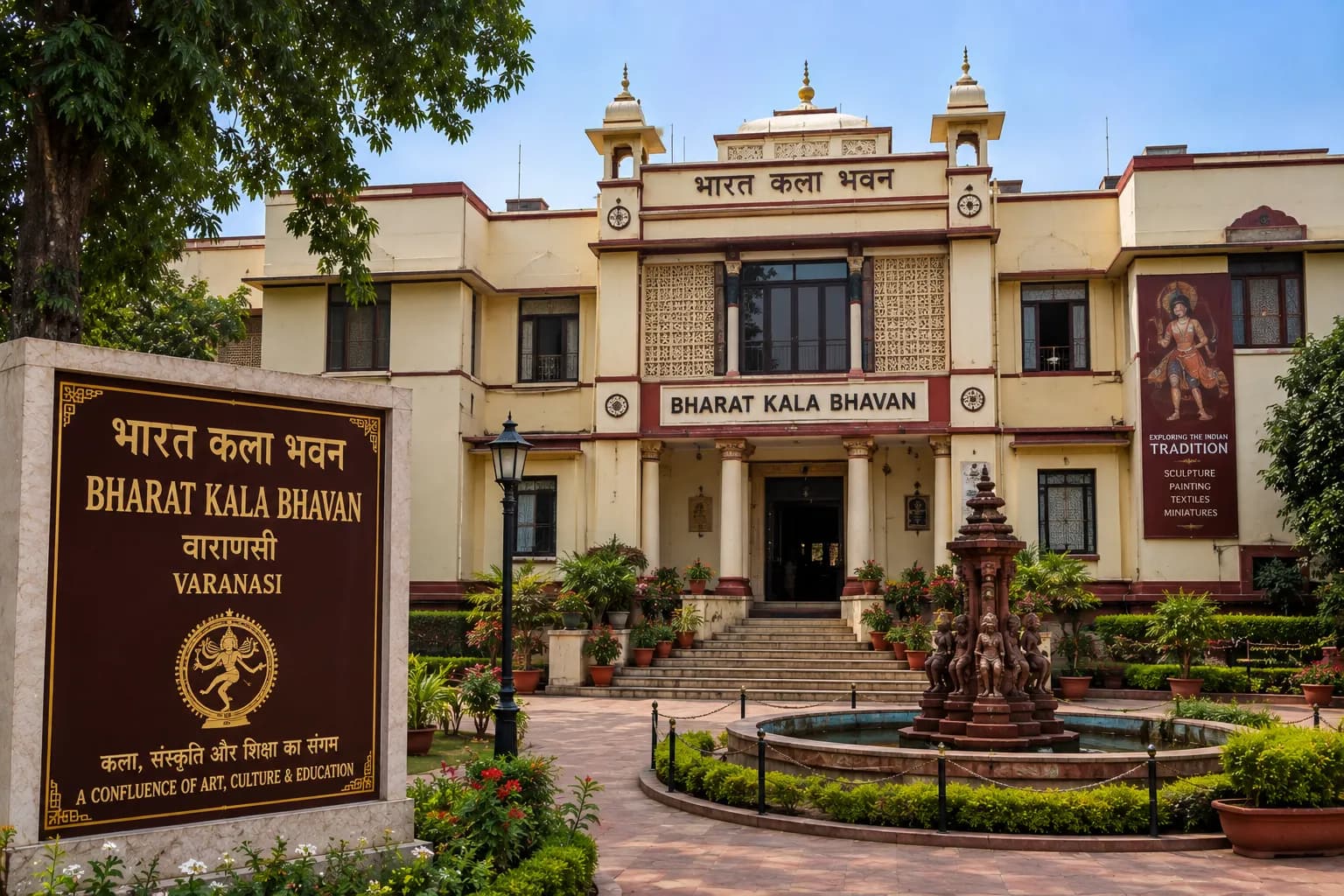
Varanasi is famous for its temples and ghats, but it is also, quietly, a city of memory and art, and nowhere holds that better than Bharat Kala Bhavan. Founded on the first day of 1920 by the great collector and Hindi literary figure Rai Krishnadasa, together with Mahamana Madan Mohan Malaviya, the founder of Banaras Hindu University, and guided in its early years by the Nobel laureate Rabindranath Tagore as its first chairman, it grew from a labour of love into one of the oldest and richest museums in all of India. The present building on the BHU campus was founded and later inaugurated by Jawaharlal Nehru, and Mahatma Gandhi himself, who visited more than once, praised the collection warmly.
Today it is a national treasure, holding over a hundred thousand artefacts that span some five thousand years of Indian civilisation, from the prehistoric age to modern times, arranged across fourteen galleries on two floors. For anyone who wants to understand the sheer depth and beauty of India's artistic heritage, this is one of the finest places in the country to do it, and a wonderful, contemplative counterpoint to the intensity of the ghats.
A treasure-house of Indian art
The collection is vast and varied, and even a short visit takes in some of the greatest works of Indian art. These are among the highlights.
| Gallery or treasure | What you will see |
|---|---|
| Miniature paintings | One of India's great collections, from the Mughal, Rajput, Pahari and Banaras schools, painted on paper, cloth, ivory and more. |
| Sculpture gallery | Stone and terracotta works from the Maurya, Gupta and medieval ages, Hindu, Buddhist and Jain, including the famous figure of Krishna lifting Mount Govardhan. |
| Coins | A superb numismatic collection, from the gold coins of the Guptas to a coin of the emperor Jahangir bearing his portrait and the zodiac. |
| Textiles and the Banaras gallery | Exquisite Banarasi brocades, costumes and embroideries, showcasing the city's legendary craft. |
| Nicholas Roerich gallery | Paintings of the Himalayas by the Russian artist Nicholas Roerich. |
| Archaeological gallery | Ancient finds including Harappan material and objects from the excavations of old Kashi at Rajghat. |
| Nidhi and decorative art | Treasures of ivory, jade, jewellery and fine decorative art. |
The single most famous exhibit is the great Gupta-era sculpture of Lord Krishna, standing on one leg with a hand on his hip, effortlessly lifting Mount Govardhan, a masterpiece of Indian art, and around it are images that show how deeply the worship of Krishna was rooted in Kashi centuries ago.
The devotion behind the collection
Behind every one of these treasures lies a remarkable story of devotion. Rai Krishnadasa, the museum's founder, was a scholar and writer who gave the greater part of his life to seeking out, saving and gathering the finest works of Indian art, at a time when many were being lost or sold abroad. Piece by piece, over decades, he built this collection not for profit but for the nation, and it was his lifelong labour that grew into the museum we see today. To walk these galleries is to walk through one man's love for the art of his country, carried on now by the university that keeps it. That spirit, of preserving and honouring India's heritage, is part of what makes a visit here quietly moving as well as beautiful.
Who it is for
Bharat Kala Bhavan is not a spectacle in the way the ghats and temples are; it is a place of quiet depth, and it rewards the curious. It is a joy for anyone who loves art, history and craft, for students and scholars, and for travellers who want to see beyond the ceremony of Kashi to the civilisation that produced it. Come here to slow down, to look closely, and to feel the long, deep continuity of Indian art, from a Harappan seal to a Mughal miniature to a Banarasi brocade, all under one roof, in the calm of a great university campus.
A quieter treasure of Kashi, in my own words
By Rajeev Sharma, Varanasi local
Bharat Kala Bhavan is the place I take the traveller who wants to understand Kashi with their mind as well as their heart. It is on the beautiful, green BHU campus, calm and unhurried after the crowds of the ghats, and I tell my guests that this is one of the oldest and greatest museums in all of India, built by a man, Rai Krishnadasa, who gave his whole life to gathering these treasures. That devotion moves people.
Inside, I love to show them the great sculpture of Krishna lifting the mountain, a masterpiece more than a thousand years old, and the room after room of exquisite miniature paintings, and the gold coins of ancient emperors, and the glorious Banarasi silks. I remind them that Gandhiji himself praised this collection. I usually bring them here on the same visit as the New Vishwanath Temple, which is on the same campus, so they get both the living faith and the deep art of India in one calm afternoon. For the thoughtful traveller, this is one of the most rewarding places in the whole city.
In more than forty years of guiding, this is where I have most often watched a traveller fall in love with the depth of Indian art.
[Photos where permitted; much of the museum does not allow photography.]
What to see and do
- Find the famous Gupta-era sculpture of Krishna lifting Mount Govardhan in the main hall.
- Spend time with the great collection of Mughal, Rajput, Pahari and Banaras miniature paintings.
- See the gold coins of the Guptas and the zodiac coin of Jahangir.
- Admire the Banarasi brocades and costumes, and the ivory and decorative arts.
- Visit the Nicholas Roerich gallery and the archaeological gallery of ancient Kashi.
How to reach Bharat Kala Bhavan
The museum is on the Banaras Hindu University campus, on Semi Circle Road No. 3, in the south of the city near Lanka. It is easy to reach by road, and it sits within the lovely green campus.
| From | Distance | Notes |
|---|---|---|
| Lanka and the BHU main gate | On the campus | The museum is a short way inside the BHU campus. |
| Assi Ghat | A short drive | The nearest ghat, just north of the university. |
| Godowlia and the old city | A short drive | By auto or cab to the BHU campus. |
| Varanasi Junction (Cantt) | About 7 km | By taxi or auto. |
| Airport | About 30 km | Lal Bahadur Shastri International Airport, roughly an hour or more by road. |
It is easy to combine with the New Vishwanath Temple on the same campus and the southern temples. We arrange the transport, the timing and a guide.
Best time to visit and how to plan it
| When | Why |
|---|---|
| A weekday, 10:30 AM to 4:30 PM | The regular hours; avoid Sundays and holidays, when it is closed. |
| Morning | Cooler and calmer, with time to see the galleries properly. |
| May and June | Note the early summer hours, about 7:30 AM to 1:00 PM. |
| Allow two hours or more | There is a great deal to see across the fourteen galleries. |
- Pair it with the New Vishwanath Temple on the BHU campus, and the southern temples.
- Check that it is open before you go, as it closes on Sundays and holidays.
For a cultural day and the southern sights planned together, see our Varanasi tour packages.
Accessibility for elderly and mobility limited visitors
- The museum is on two floors; check on lift access for the upper galleries if stairs are difficult.
- The BHU campus is green and drivable, easier to reach than the old city, with parking.
- It is calm and unhurried, which suits a slow, seated, contemplative visit.
- We arrange comfortable transport and a guide, and plan a gentle route through the highlights.
Practical tips
| Good to know | Detail |
|---|---|
| Closed on Sundays. | And on national and university holidays; always check before you go. |
| Mind the summer hours. | In May and June it opens early and closes by early afternoon. |
| Photography is restricted. | Much of the museum does not allow photography; respect the rules. |
| It is on the BHU campus. | Combine it with the New Vishwanath Temple and the beautiful university grounds. |
Nearby sites to combine with your visit
Bharat Kala Bhavan is on the BHU campus in the south of the city, among the southern temples.
| Site | What it is | Internal link |
|---|---|---|
| New Vishwanath Temple (BHU) | The marble Birla temple on the same campus, open to all. | /temple/varanasi/new-vishwanath-temple-bhu |
| Sankat Mochan Hanuman Temple | The beloved Hanuman temple founded by Tulsidas, nearby. | /temple/varanasi/sankat-mochan-hanuman-temple |
| Durga Kund (Durga Mandir) | The red Nagara temple to Durga, in the southern cluster. | /temple/varanasi/durga-kund |
| ISKCON Varanasi | The calm Hare Krishna temple by Durga Kund. | /temple/varanasi/iskcon-temple |
| Ramnagar Fort | The Maharaja's palace and museum across the river, for more heritage. | /temple/varanasi/ramnagar-fort |
For the grand evening aarti and a boat ride, see our Varanasi tour packages.
Our guided cultural and campus visits
We are a Varanasi based operator, a unit of Experience My India, with more than forty years of guiding travellers across Kashi, Ayodhya, and Prayagraj. What we arrange is a rewarding cultural visit: a guide who brings the story of the museum and its treasures to life, transport to and around the beautiful BHU campus, and a route that pairs the museum with the New Vishwanath Temple and the southern temples for a rich, calm day of art and devotion.
| Experience | Includes | Price |
|---|---|---|
| Guided museum visit | A guide through the highlights of Bharat Kala Bhavan, with transport. | Contact us for pricing |
| Art and campus day | The museum with the New Vishwanath Temple and the BHU campus, with a guide. | Contact us for pricing |
| Culture lover's Varanasi | The museum with Ramnagar Fort and the heritage sights, with a guide. | Contact us for pricing |
| City, temples and museum | The museum as part of a wider Varanasi day. | Contact us for pricing |
Inclusions and exclusions are stated up front, with any taxes and conditions, and no charge appears later that was not named. See all our Varanasi tour packages for the full range.
Experience My India is a travel operator, not the museum authority. The museum is owned and run by Banaras Hindu University; our guiding and transport are ours, and the entry ticket is paid separately at the counter. Timings and fees are set by the museum and can change.