.webp&w=2048&q=75)
.webp&w=2048&q=75)
Essential info at a glance
| Detail | At a glance |
|---|---|
| What it is | An ancient Buddhist stupa marking where the Buddha met his first five disciples, crowned by a Mughal octagonal tower. |
| Opening hours | 6:00 AM to 6:00 PM, all days of the week. |
| Entry fee | About ₹25 for Indian, SAARC and BIMSTEC visitors; higher for foreign nationals; children under 15 usually free. |
| Time needed | About 30 to 45 minutes. |
| Built | A terraced stupa of the Gupta period (4th to 6th century CE), the tower added in 1588. |
| The tower | An octagonal Mughal tower, built on Akbar's order to mark the visit of Emperor Humayun. |
| Significance | The spot where the Buddha reunited with his five ascetics before his first sermon nearby. |
| Location | Rishipattan Road, Sarnath, about 10 km from the city; the first monument you meet entering Sarnath. |
Chaukhandi Stupa timings and entry
The stupa is a ticketed, ASI-protected monument set in green, serene grounds, open through the day. It is a short visit, half an hour or so, and it is usually the first of the Sarnath monuments you reach coming from the city, so it makes a natural first stop.
| Detail | Value | Notes |
|---|---|---|
| Opening hours | 6:00 AM to 6:00 PM, daily | Open all week. |
| Entry fee | About ₹25 Indian, SAARC and BIMSTEC; higher for foreign nationals | Children under 15 usually free; buy tickets at the counter or online. |
| Time needed | About 30 to 45 minutes | For the stupa, the tower and the grounds. |
Chaukhandi Stupa: where the Buddha met his five disciples
This ancient mound marks one of the quiet, pivotal moments in the whole story of the Buddha. After he attained enlightenment beneath the Bodhi tree at Bodh Gaya, the Buddha set out for Sarnath, and it was here, at the spot the Chaukhandi Stupa now marks, that he was reunited with the five ascetics who had once practised austerities alongside him and had left him when he gave up the path of extreme self-denial. Seeing him again, transformed, they became his first listeners, and he led them on to the deer park close by, where he preached his very first sermon and set in motion the wheel of the Dharma. From this meeting, in a real sense, the whole tradition of Buddhism began to unfold.
So although it is less famous than the great Dhamek Stupa, Chaukhandi honours the reunion that made the first sermon possible, and for pilgrims it is a place of deep significance, the threshold of the teaching. Many walk a reverent circle, a parikrama, around it, as is the Buddhist way.
A monument of two ages: a Gupta stupa and a Mughal tower
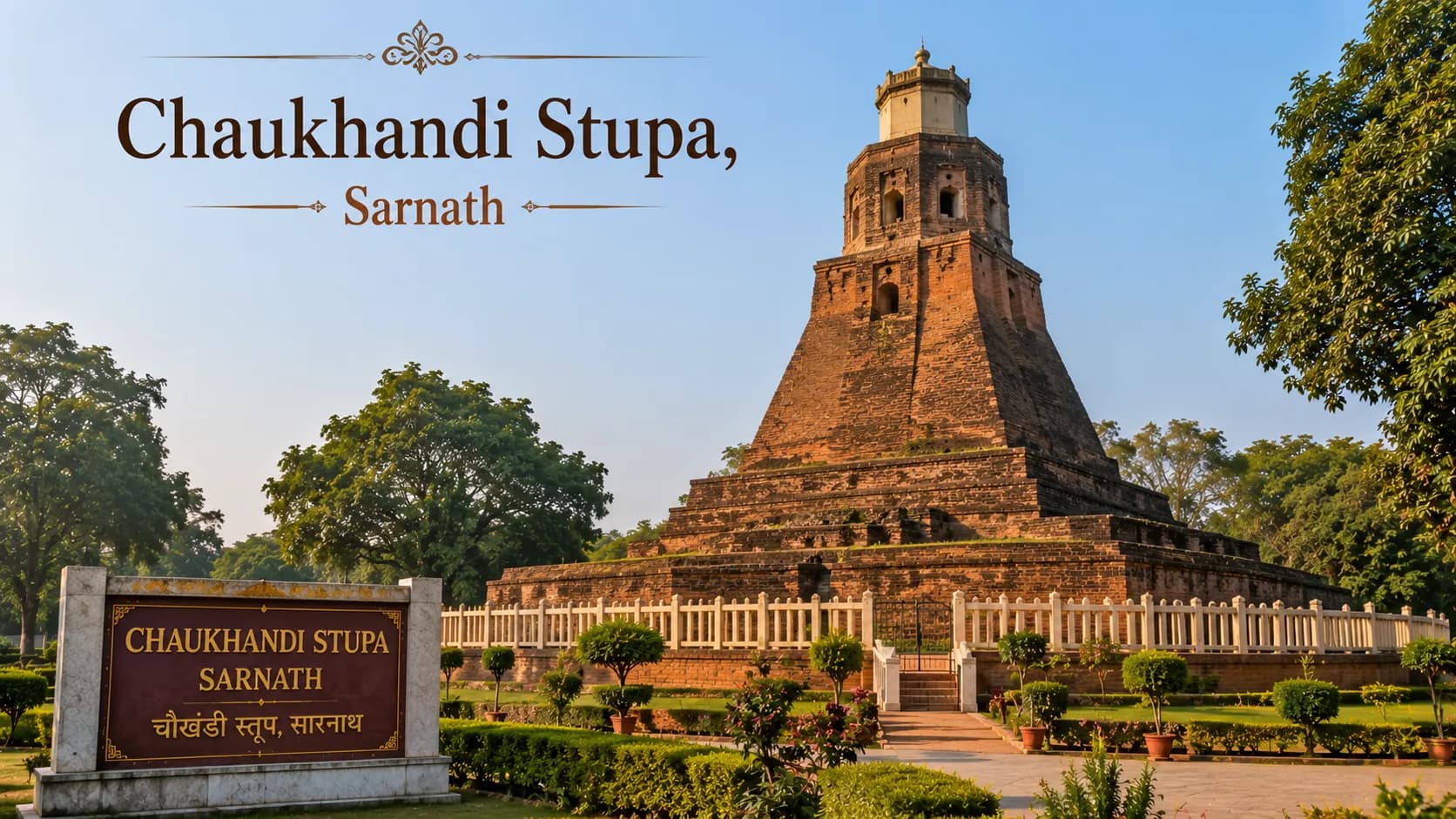
What makes Chaukhandi so unusual to look at is that it belongs to two very different worlds at once. The stupa itself is ancient, built as a terraced, temple-like structure during the Gupta period, between roughly the fourth and sixth centuries, a lofty mound of brick on a stepped, rectangular base, once adorned with images of the Buddha. But rising from its top is something entirely different: a graceful octagonal tower of the Mughal age.
That tower was raised in 1588 by Govardhan, the son of Raja Todar Mal, the famous finance minister of the emperor Akbar, on Akbar's own instructions, and it was built to commemorate a visit that Akbar's father, the Mughal emperor Humayun, had made to this spot. A Persian inscription over the doorway records the honour. The result is a rare and beautiful fusion, an ancient Buddhist stupa crowned by a Mughal tower, standing together as a single monument, a quiet testament to the many layers of India's history meeting in one place. It is this striking silhouette, the tiered brick mound and the octagonal spire, that makes Chaukhandi one of the most photographed sights of Sarnath.
The monument and its setting
Today the Chaukhandi Stupa stands as a high, terraced mound of brickwork on its rectangular plinth, topped by the octagonal tower, weathered and dignified, cared for by the Archaeological Survey of India. Around it lie green lawns and gardens, with the ruins of old monasteries not far off, and the whole place has a calm, contemplative air. Because it is the first monument on the road into Sarnath, it makes a fitting and evocative introduction to the sacred landscape where the Buddha first taught.
Its place in the Buddha's journey
To understand why so quiet a monument matters, it helps to picture the moment it marks. Having found enlightenment at Bodh Gaya, the Buddha faced a choice: to keep his realisation to himself, or to teach it to a suffering world. He chose to teach, and the first people he sought out were the five companions who had once shared his search and then, disappointed, left him. He walked many miles to find them, and it was here that they met again. At first, it is said, they resolved to ignore him, but such was the change in him that they could not, and they became his listeners. From that reconciliation flowed the first sermon, the first disciples, and the community, the Sangha, that carried the teaching across the world.
So Chaukhandi marks not a battle or a birth but a meeting, a coming-together that turned a private awakening into a message for all humanity. For the thoughtful visitor, of any faith, there is something quietly powerful in standing where that began, at the very threshold of one of the world's great spiritual traditions.
A meeting at the threshold, in my own words
By Rajeev Sharma, Varanasi local
Chaukhandi is where I like to begin a Sarnath visit, because it is the first monument you reach, and because its story is the beginning of the story. I stand my guests before it and tell them that this is the very spot where the Buddha, walking from Bodh Gaya, met again the five companions who had abandoned him, and that from this reunion he went on, just there, to give his first sermon. People are always moved to be standing at the threshold of it all.
And then I tell them to look up, because the surprise of Chaukhandi is that a Mughal tower sits on top of a Buddhist stupa. I explain how Akbar had it built to honour his father Humayun's visit, and my guests love that, this meeting of the Buddha, the Guptas and the Mughals in one strange, beautiful monument. It is quiet here, with the lawns and the old ruins around, and the silhouette against the sky is wonderful for photographs. It is a small stop, but it sets up the whole meaning of Sarnath, and I never skip it.
In more than forty years of guiding, this is the monument I use to open the story of the Buddha's teaching.
What to see and do
- Stand before the terraced brick stupa and take in its striking silhouette with the octagonal tower.
- Hear the story of the Buddha's reunion with his five disciples, the meeting that led to the first sermon.
- See the Mughal octagonal tower and the Persian inscription commemorating Humayun's visit.
- Walk a quiet circle, a parikrama, around the stupa, as pilgrims do.
- Enjoy the green, peaceful grounds and the nearby ruins.
How to reach the Chaukhandi Stupa
The stupa is on Rishipattan Road, on the approach into Sarnath, about 10 km from the city and roughly 2 km from Sarnath railway station, on the northern, airport side of Varanasi. It is the first monument you meet entering Sarnath, and it is easy to reach by road.
| From | Distance | Notes |
|---|---|---|
| Dhamek Stupa and the main site | About 1 to 2 km | The stupa is on the approach; see them on the same visit. |
| Varanasi city | About 10 km | By taxi or auto to Sarnath. |
| Varanasi Junction (Cantt) | About 8 to 9 km | By taxi or auto. |
| Airport | About 20 km | Sarnath is on the airport side; easy to pair with an arrival or departure. |
It is best seen as the opening stop of a Sarnath visit. See our guide to Sarnath. We arrange the transport, tickets, timing and a guide.
Best time to visit and how to plan it
| When | Why |
|---|---|
| Winter (October to March) | The most pleasant season for Sarnath and its open monuments. |
| Morning or late afternoon | The best light on the brick and the tower for photographs. |
| Sunset | The silhouette of the mound and the tower against the evening sky. |
| As the first stop of a Sarnath day | Begin here, then move on to the Dhamek Stupa, the ruins and the museum. |
- Pair it with the whole Sarnath site and the Mulagandha Kuti Vihar for a full Buddhist heritage visit.
- Allow 30 to 45 minutes; it is a short but meaningful stop.
For Sarnath planned as one route, see our Varanasi tour packages.
Accessibility for elderly and mobility limited visitors
- The grounds are green and largely level and reachable by road, easier than the old city.
- There are steps up the terraces of the stupa itself; the mound can be viewed and enjoyed from ground level without climbing.
- It is a short, calm visit, which suits a gentle pace.
- We arrange transport and plan the Sarnath visit so a senior guest is comfortable.
Nearby sites to combine with your visit
The Chaukhandi Stupa is the gateway to Sarnath, on the northern, airport side of the city.
| Site | What it is | Internal link |
|---|---|---|
| Sarnath (Dhamek Stupa and site) | The great Buddhist site where the Buddha gave his first sermon, just beyond. | /temple/varanasi/sarnath |
| Mulagandha Kuti Vihar | The beautiful modern Buddhist temple of Sarnath, with the frescoes and relics. | /temple/varanasi/mulagandha-kuti-vihar |
| Trilochan Mahadev Dham (Jaunpur) | A Shiva dham on the airport side, easily paired with Sarnath. | /temple/varanasi/trilochan-mahadev-dham |
| Adi Keshava Temple | The first Vishnu of Kashi, near Rajghat on the northern side. | /temple/varanasi/adi-keshava-temple |
| Namo Ghat | The striking new ghat near Rajghat, on the way from the city. | /temple/varanasi/namo-ghat |
For the grand evening Ganga aarti back in the city, see our Varanasi tour packages.
Our guided Sarnath and heritage visits
We are a Varanasi based operator, a unit of Experience My India, with more than forty years of guiding travellers across Kashi, Sarnath, Ayodhya, and Prayagraj. What we arrange is a rich, well-informed Sarnath visit: transport, the tickets, and a guide who opens the story of the Buddha at Chaukhandi and carries it through the whole sacred site, easily combined with an airport arrival or departure.
| Experience | Includes | Price |
|---|---|---|
| Sarnath half-day tour | Chaukhandi Stupa, the Dhamek Stupa, the ruins, the Mulagandha Kuti Vihar and the museum, with a guide. | Contact us for pricing |
| Airport-side Sarnath visit | Sarnath on your arrival or departure day, from Chaukhandi onward. | Contact us for pricing |
| Buddhist heritage day | Sarnath's Buddhist sites with a knowledgeable guide. | Contact us for pricing |
| Kashi and Sarnath day | The Buddhist Sarnath with the Hindu heart of Kashi. | Contact us for pricing |
Inclusions and exclusions are stated up front, with any taxes and conditions, and no charge appears later that was not named. See all our Varanasi tour packages for the full range.
Experience My India is a travel operator, not the monument authority. Our guiding and transport are ours; the stupa is maintained by the Archaeological Survey of India, and the entry ticket is paid separately. Timings and fees can change.